Compare commits
302 Commits
v3.0.0-bet
...
v3.0.0-bet
| Author | SHA1 | Date | |
|---|---|---|---|

|
0533e7f5db | ||
|
|
23c5ef428d | ||
|
|
f046a04510 | ||
|
|
4cda7d2363 | ||
|
|
ea48cfbfe9 | ||
|
|
1aeb912762 | ||
|
|
ce2cb35d71 | ||
|
|
d3ec68ac2f | ||
|
|
05bf52aac3 | ||
|
|
fed7f2fa5b | ||
|
|
686b0865b2 | ||
|
|
dfb4c8eb4c | ||
|
|
ad7a387e19 | ||
|
|
d05be016ce | ||
|
|
ec3bb71e7c | ||
|
|
825d8b83d1 | ||
|
|
83022f6d55 | ||
|
|
4bbc593dc5 | ||
|
|
03440f5eca | ||
|
|
0fa6611260 | ||
|
|
a2d68f84e1 | ||
|
|
49c0709fed | ||
|
|
350a4a0718 | ||
|
|
6349cd42e9 | ||
|
|
c2b2f10676 | ||
|
|
95ebead464 | ||
|
|
3eed8b11cb | ||
|
|
404008dc4e | ||
|
|
c7c6fca537 | ||
|
|
9de3ffdcfe | ||
|
|
1eefb12070 | ||
|
|
2d8b752ef2 | ||
|
|
3e5c31a024 | ||
|
|
631431e006 | ||
|
|
492d920133 | ||
|
|
f754edc375 | ||
|
|
d2571e10d6 | ||
|
|
a687cb9c5b | ||
|
|
cf6634111f | ||
|
|
1ee19d3016 | ||
|
|
9beaa281dc | ||
|
|
5174c7092f | ||
|
|
d894ac75f0 | ||
|
|
af0105ced5 | ||
|
|
93e81314df | ||
|
|
163d1c85da | ||
|
|
cb9b80aaf9 | ||
|
|
cad1906725 | ||
|
|
988c8848e9 | ||
|
|
95a8bb0d27 | ||
|
|
9c2ccbf61a | ||
|
|
3ee0e842a5 | ||
|
|
6ec982022e | ||
|
|
4f71df79fc | ||
|
|
227d2e0502 | ||
|
|
3a91deb0a4 | ||
|
|
9e6e8357b8 | ||
|
|
0dd17e6347 | ||
|
|
17312d9f90 | ||
|
|
0c36cbde73 | ||
|
|
ebd43c7763 | ||
|
|
adf2f31178 | ||
|
|
beadc0158e | ||
|
|
bb09da08c2 | ||
|
|
ab09f2aff5 | ||
|
|
2f3829083d | ||
|
|
a526c7becd | ||
|
|
2835e1d709 | ||
|
|
4808e31276 | ||
|
|
bd51fd1390 | ||
|
|
b3b1cd2c23 | ||
|
|
d67f674160 | ||
|
|
6eb4438dc8 | ||
|
|
2d6e7f8a37 | ||
|
|
3d37d74c6e | ||
|
|
de19822ed4 | ||
|
|
2b2bcb5264 | ||
|
|
e9b01e6d9f | ||
|
|
b0a760193e | ||
|
|
95569e44e4 | ||
|
|
11816080a6 | ||
|
|
3a86822f0a | ||
|
|
6f8604e18c | ||
|
|
aec3f5e308 | ||
|
|
e0a5de6730 | ||
|
|
5eee49da9a | ||
|
|
b7d01dec70 | ||
|
|
0618130fe3 | ||
|
|
cd245793fc | ||
|
|
3a6c75a1a3 | ||
|
|
5a683b6947 | ||
|
|
9b27f03e61 | ||
|
|
89746ebe09 | ||
|
|
eacf2030cd | ||
|
|
86428539f5 | ||
|
|
a7f519c53a | ||
|
|
49a2d70fbb | ||
|
|
cb7fa00a6f | ||
|
|
a212cdef3f | ||
|
|
4f323a3754 | ||
|
|
f5e7578b41 | ||
|
|
0bf27b117a | ||
|
|
806c22e6bd | ||
|
|
39d7b717a9 | ||
|
|
9d1997e6a0 | ||
|
|
c65f5027d6 | ||
|
|
dc496e4387 | ||
|
|
3d86bf1974 | ||
|
|
96e7c95ebc | ||
|
|
fca4ee995e | ||
|
|
352ed0ebef | ||
|
|
bcf9b17321 | ||
|
|
a19263245f | ||
|
|
78e55d61be | ||
|
|
cea272e189 | ||
|
|
8b13dc64d1 | ||
|
|
5fc9f76406 | ||
|
|
6c0f99082b | ||
|
|
90b7b20699 | ||
|
|
9cb84c48b9 | ||
|
|
390f88867f | ||
|
|
b33b5f43f4 | ||
|
|
56aded8507 | ||
|
|
78dd6a2d5b | ||
|
|
a063b81460 | ||
|
|
18d9314f22 | ||
|
|
8d120373a7 | ||
|
|
f88cef5470 | ||
|
|
5dfcffa281 | ||
|
|
fa3d250053 | ||
|
|
4b2a9f75d0 | ||
|
|
e225783d76 | ||
|
|
0d552fd523 | ||
|
|
69ada97df5 | ||
|
|
81e7355ee0 | ||
|
|
ce8b95f6bb | ||
|
|
c1b0d93c93 | ||
|
|
6227276d2c | ||
|
|
ee62ed6ebb | ||
|
|
0283039257 | ||
|
|
b546c7b655 | ||
|
|
a933eb7311 | ||
|
|
b5d65dd1ac | ||
|
|
c4ee623907 | ||
|
|
1cb1e5e8b3 | ||
|
|
e0699838e1 | ||
|
|
46f70d9df4 | ||
|
|
b7e2c59622 | ||
|
|
0cc7184023 | ||
|
|
e905675a05 | ||
|
|
4a20a63563 | ||
|
|
8d1fc6e8fb | ||
|
|
62744e79ac | ||
|
|
e8bed7b315 | ||
|
|
f2b8ddb299 | ||
|
|
ffd8ea516d | ||
|
|
3bf09703e9 | ||
|
|
c15d679b65 | ||
|
|
a422a0d568 | ||
|
|
edaeb1e29f | ||
|
|
6f35c356fe | ||
|
|
0b9397399a | ||
|
|
cdcc35ccdb | ||
|
|
442189ec48 | ||
|
|
5d1cc760c9 | ||
|
|
2f90683c7d | ||
|
|
3f5403a52a | ||
|
|
9bccdfd60a | ||
|
|
62666a9897 | ||
|
|
eb27b84854 | ||
|
|
c3480811d3 | ||
|
|
12ba820de4 | ||
|
|
95fcd13929 | ||
|
|
6141c5950b | ||
|
|
0040e1756c | ||
|
|
1ebd54b315 | ||
|
|
cdb2072a6d | ||
|
|
68553ff974 | ||
|
|
9a3bce1118 | ||
|
|
005befcbe2 | ||
|
|
e65b6478c9 | ||
|
|
a79e92a145 | ||
|
|
995f51d941 | ||
|
|
4d19e64961 | ||
|
|
31143599f6 | ||
|
|
f752804410 | ||
|
|
a18d4061ea | ||
|
|
449c16d28f | ||
|
|
d307d627ab | ||
|
|
075819964d | ||
|
|
1ec78a16f0 | ||
|
|
290ffd3287 | ||
|
|
3d89508ce3 | ||
|
|
b160686fff | ||
|
|
ba6ef6777f | ||
|
|
febd7f7073 | ||
|
|
695ef32d1e | ||
|
|
b5b2bb1907 | ||
|
|
6f5cf5d916 | ||
|
|
aaf3a39f7e | ||
|
|
5ef2951829 | ||
|
|
a943487fca | ||
|
|
3a941c7c8a | ||
|
|
354588898f | ||
|
|
ada9978a8c | ||
|
|
874279c530 | ||
|
|
7ed6634bc5 | ||
|
|
09a0ee3ab9 | ||
|
|
67acab2cd5 | ||
|
|
b3dc6cc811 | ||
|
|
5cd0c7ec7d | ||
|
|
cd592cb3a2 | ||
|
|
6d066c2ba4 | ||
|
|
1dc428823a | ||
|
|
c8da9b148c | ||
|
|
2021028d64 | ||
|
|
2ea56fe0f8 | ||
|
|
ea16119af7 | ||
|
|
97837f0708 | ||
|
|
e734d51760 | ||
|
|
5655266daa | ||
|
|
f9e5573c1e | ||
|
|
e823051a8e | ||
|
|
49df61d9ec | ||
|
|
4704c8db2a | ||
|
|
a64f37e014 | ||
|
|
55c6ce92b0 | ||
|
|
2ecbcee378 | ||
|
|
70f2e1698a | ||
|
|
8ba39aa5ca | ||
|
|
f8c79d2f84 | ||
|
|
128d72185d | ||
|
|
abc786d864 | ||
|
|
791fa68820 | ||
|
|
2796d2100f | ||
|
|
cbac62a36f | ||
|
|
b5afc62e14 | ||
|
|
0627272d6c | ||
|
|
51f1c8e7e8 | ||
|
|
09ad6e4280 | ||
|
|
c129c10f0f | ||
|
|
904ec0160e | ||
|
|
b2814eb67c | ||
|
|
c405e5958f | ||
|
|
a35979f74e | ||
|
|
863abc0e6b | ||
|
|
b9cf6c73a9 | ||
|
|
f2b3305cb0 | ||
|
|
b3e8ddf302 | ||
|
|
b6d4bc4d37 | ||
|
|
83ad453a89 | ||
|
|
4e6a7d489c | ||
|
|
a8d88b8238 | ||
|
|
5aa3283dc0 | ||
|
|
45844789f2 | ||
|
|
79975f48cf | ||
|
|
bba7cf37f8 | ||
|
|
1ae71a3d24 | ||
|
|
e83eb99436 | ||
|
|
f50e599684 | ||
|
|
7dab75d85e | ||
|
|
c45fbb9149 | ||
|
|
2c16c608ba | ||
|
|
c3f6c81dc6 | ||
|
|
a7b0f8ba36 | ||
|
|
014ee1a1b2 | ||
|
|
cf6da0186b | ||
|
|
18063bd256 | ||
|
|
76b3075369 | ||
|
|
3d63ce94bb | ||
|
|
f8a5103ed7 | ||
|
|
2bd53a06eb | ||
|
|
442518dbc9 | ||
|
|
d3131122db | ||
|
|
6d0dfeafc8 | ||
|
|
00771b1f2a | ||
|
|
448186f374 | ||
|
|
0ada3df220 | ||
|
|
478fb8d3fd | ||
|
|
700baf1899 | ||
|
|
7b3b02198c | ||
|
|
a3af3605f0 | ||
|
|
502548a581 | ||
|
|
1fe6761d43 | ||
|
|
f909f0663b | ||
|
|
edb501349f | ||
|
|
4ff8b20ddb | ||
|
|
fe23ca5b1a | ||
|
|
8fdd88bd66 | ||
|
|
676dfa3ecf | ||
|
|
1ea2e323bc | ||
|
|
8fb17c2752 | ||
|
|
2d96a1f0b6 | ||
|
|
2f0aa83a93 | ||
|
|
0371aea711 | ||
|
|
36ae125caf | ||
|
|
fa07b317b1 | ||
|
|
08f50bb441 | ||
|
|
2925c3bb90 | ||
|
|
c6da04a061 | ||
|
|
809ae41725 | ||
|
|
ee6ab214a5 |
21
.github/CODEOWNERS
vendored
21
.github/CODEOWNERS
vendored
@@ -1,24 +1,23 @@
|
||||
# Order matters. The last matching pattern takes precedence.
|
||||
# Approvals are not required currently but may be enabled in the future.
|
||||
|
||||
### Package Exports ###
|
||||
/**/exports/ @denolfe @jmikrut
|
||||
/**/exports/ @denolfe @jmikrut @DanRibbens
|
||||
|
||||
### Packages ###
|
||||
/packages/richtext-*/ @AlessioGr
|
||||
/packages/plugin-cloud*/ @denolfe
|
||||
/packages/email-*/ @denolfe
|
||||
/packages/storage-*/ @denolfe
|
||||
/packages/create-payload-app/ @denolfe
|
||||
/packages/eslint-*/ @denolfe
|
||||
/packages/plugin-cloud*/src/ @denolfe
|
||||
/packages/email-*/src/ @denolfe
|
||||
/packages/storage-*/src/ @denolfe
|
||||
/packages/create-payload-app/src/ @denolfe
|
||||
/packages/eslint-*/ @denolfe @AlessioGr
|
||||
|
||||
### Templates ###
|
||||
/templates/ @jacobsfletch @denolfe
|
||||
/templates/_data/ @denolfe
|
||||
/templates/_template/ @denolfe
|
||||
|
||||
### Build Files ###
|
||||
/**/package.json @denolfe
|
||||
/tsconfig.json @denolfe
|
||||
/**/tsconfig*.json @denolfe
|
||||
|
||||
/jest.config.js @denolfe
|
||||
/**/jest.config.js @denolfe
|
||||
|
||||
@@ -26,5 +25,5 @@
|
||||
/package.json @denolfe
|
||||
/scripts/ @denolfe
|
||||
/.husky/ @denolfe
|
||||
/.vscode/ @denolfe
|
||||
/.vscode/ @denolfe @AlessioGr
|
||||
/.github/ @denolfe
|
||||
|
||||
4
.github/actions/setup/action.yml
vendored
4
.github/actions/setup/action.yml
vendored
@@ -9,7 +9,7 @@ inputs:
|
||||
pnpm-version:
|
||||
description: 'The pnpm version to use'
|
||||
required: true
|
||||
default: 8.15.7
|
||||
default: 9.7.0
|
||||
|
||||
runs:
|
||||
using: composite
|
||||
@@ -25,7 +25,7 @@ runs:
|
||||
node-version: ${{ inputs.node-version }}
|
||||
|
||||
- name: Install pnpm
|
||||
uses: pnpm/action-setup@v3
|
||||
uses: pnpm/action-setup@v4
|
||||
with:
|
||||
version: ${{ inputs.pnpm-version }}
|
||||
run_install: false
|
||||
|
||||
54
.github/workflows/main.yml
vendored
54
.github/workflows/main.yml
vendored
@@ -18,7 +18,7 @@ concurrency:
|
||||
|
||||
env:
|
||||
NODE_VERSION: 18.20.2
|
||||
PNPM_VERSION: 8.15.7
|
||||
PNPM_VERSION: 9.7.1
|
||||
DO_NOT_TRACK: 1 # Disable Turbopack telemetry
|
||||
NEXT_TELEMETRY_DISABLED: 1 # Disable Next telemetry
|
||||
|
||||
@@ -74,7 +74,7 @@ jobs:
|
||||
node-version: ${{ env.NODE_VERSION }}
|
||||
|
||||
- name: Install pnpm
|
||||
uses: pnpm/action-setup@v3
|
||||
uses: pnpm/action-setup@v4
|
||||
with:
|
||||
version: ${{ env.PNPM_VERSION }}
|
||||
run_install: false
|
||||
@@ -120,7 +120,7 @@ jobs:
|
||||
node-version: ${{ env.NODE_VERSION }}
|
||||
|
||||
- name: Install pnpm
|
||||
uses: pnpm/action-setup@v3
|
||||
uses: pnpm/action-setup@v4
|
||||
with:
|
||||
version: ${{ env.PNPM_VERSION }}
|
||||
run_install: false
|
||||
@@ -167,7 +167,7 @@ jobs:
|
||||
node-version: ${{ env.NODE_VERSION }}
|
||||
|
||||
- name: Install pnpm
|
||||
uses: pnpm/action-setup@v3
|
||||
uses: pnpm/action-setup@v4
|
||||
with:
|
||||
version: ${{ env.PNPM_VERSION }}
|
||||
run_install: false
|
||||
@@ -196,6 +196,7 @@ jobs:
|
||||
- postgres-custom-schema
|
||||
- postgres-uuid
|
||||
- supabase
|
||||
- sqlite
|
||||
env:
|
||||
POSTGRES_USER: postgres
|
||||
POSTGRES_PASSWORD: postgres
|
||||
@@ -206,6 +207,9 @@ jobs:
|
||||
AWS_REGION: us-east-1
|
||||
|
||||
steps:
|
||||
- uses: actions/checkout@v4
|
||||
with:
|
||||
fetch-depth: 25
|
||||
# https://github.com/actions/virtual-environments/issues/1187
|
||||
- name: tune linux network
|
||||
run: sudo ethtool -K eth0 tx off rx off
|
||||
@@ -216,17 +220,12 @@ jobs:
|
||||
node-version: ${{ env.NODE_VERSION }}
|
||||
|
||||
- name: Install pnpm
|
||||
uses: pnpm/action-setup@v3
|
||||
uses: pnpm/action-setup@v4
|
||||
with:
|
||||
version: ${{ env.PNPM_VERSION }}
|
||||
run_install: false
|
||||
|
||||
- name: Restore build
|
||||
uses: actions/cache@v4
|
||||
timeout-minutes: 10
|
||||
with:
|
||||
path: ./*
|
||||
key: ${{ github.sha }}-${{ github.run_number }}
|
||||
- run: pnpm install
|
||||
|
||||
- name: Start LocalStack
|
||||
run: pnpm docker:start
|
||||
@@ -292,6 +291,7 @@ jobs:
|
||||
- access-control
|
||||
- admin__e2e__1
|
||||
- admin__e2e__2
|
||||
- admin-root
|
||||
- auth
|
||||
- field-error-states
|
||||
- fields-relationship
|
||||
@@ -330,7 +330,7 @@ jobs:
|
||||
node-version: ${{ env.NODE_VERSION }}
|
||||
|
||||
- name: Install pnpm
|
||||
uses: pnpm/action-setup@v3
|
||||
uses: pnpm/action-setup@v4
|
||||
with:
|
||||
version: ${{ env.PNPM_VERSION }}
|
||||
run_install: false
|
||||
@@ -369,7 +369,7 @@ jobs:
|
||||
run: pnpm exec playwright install-deps chromium
|
||||
|
||||
- name: E2E Tests
|
||||
run: PLAYWRIGHT_JSON_OUTPUT_NAME=results_${{ matrix.suite }}.json pnpm test:e2e ${{ matrix.suite }}
|
||||
run: PLAYWRIGHT_JSON_OUTPUT_NAME=results_${{ matrix.suite }}.json pnpm test:e2e:prod:ci ${{ matrix.suite }}
|
||||
env:
|
||||
PLAYWRIGHT_JSON_OUTPUT_NAME: results_${{ matrix.suite }}.json
|
||||
NEXT_TELEMETRY_DISABLED: 1
|
||||
@@ -390,6 +390,7 @@ jobs:
|
||||
# job-summary: true
|
||||
|
||||
app-build-with-packed:
|
||||
if: false # Disable until package resolution in tgzs can be figured out
|
||||
runs-on: ubuntu-latest
|
||||
needs: build
|
||||
|
||||
@@ -404,7 +405,7 @@ jobs:
|
||||
node-version: ${{ env.NODE_VERSION }}
|
||||
|
||||
- name: Install pnpm
|
||||
uses: pnpm/action-setup@v3
|
||||
uses: pnpm/action-setup@v4
|
||||
with:
|
||||
version: ${{ env.PNPM_VERSION }}
|
||||
run_install: false
|
||||
@@ -417,15 +418,15 @@ jobs:
|
||||
key: ${{ github.sha }}-${{ github.run_number }}
|
||||
|
||||
- name: Start MongoDB
|
||||
uses: supercharge/mongodb-github-action@1.10.0
|
||||
uses: supercharge/mongodb-github-action@1.11.0
|
||||
with:
|
||||
mongodb-version: 6.0
|
||||
|
||||
- name: Pack and build app
|
||||
run: |
|
||||
set -ex
|
||||
pnpm run script:pack --dest templates/blank-3.0
|
||||
cd templates/blank-3.0
|
||||
pnpm run script:pack --dest templates/blank
|
||||
cd templates/blank
|
||||
cp .env.example .env
|
||||
ls -la
|
||||
pnpm add ./*.tgz --ignore-workspace
|
||||
@@ -448,7 +449,7 @@ jobs:
|
||||
node-version: ${{ env.NODE_VERSION }}
|
||||
|
||||
- name: Install pnpm
|
||||
uses: pnpm/action-setup@v3
|
||||
uses: pnpm/action-setup@v4
|
||||
with:
|
||||
version: ${{ env.PNPM_VERSION }}
|
||||
run_install: false
|
||||
@@ -489,7 +490,7 @@ jobs:
|
||||
node-version: ${{ env.NODE_VERSION }}
|
||||
|
||||
- name: Start MongoDB
|
||||
uses: supercharge/mongodb-github-action@1.10.0
|
||||
uses: supercharge/mongodb-github-action@1.11.0
|
||||
with:
|
||||
mongodb-version: 6.0
|
||||
|
||||
@@ -517,7 +518,7 @@ jobs:
|
||||
node-version: ${{ env.NODE_VERSION }}
|
||||
|
||||
- name: Install pnpm
|
||||
uses: pnpm/action-setup@v3
|
||||
uses: pnpm/action-setup@v4
|
||||
with:
|
||||
version: ${{ env.PNPM_VERSION }}
|
||||
run_install: false
|
||||
@@ -546,3 +547,16 @@ jobs:
|
||||
steps:
|
||||
- if: ${{ always() && (contains(needs.*.result, 'failure') || contains(needs.*.result, 'cancelled')) }}
|
||||
run: exit 1
|
||||
|
||||
publish-canary:
|
||||
name: Publish Canary
|
||||
runs-on: ubuntu-latest
|
||||
needs:
|
||||
- all-green
|
||||
|
||||
steps:
|
||||
# debug github.ref output
|
||||
- run: |
|
||||
echo github.ref: ${{ github.ref }}
|
||||
echo isBeta: ${{ github.ref == 'refs/heads/beta' }}
|
||||
echo isMain: ${{ github.ref == 'refs/heads/main' }}
|
||||
|
||||
16
.github/workflows/pr-title.yml
vendored
16
.github/workflows/pr-title.yml
vendored
@@ -38,6 +38,7 @@ jobs:
|
||||
db-\*
|
||||
db-mongodb
|
||||
db-postgres
|
||||
db-sqlite
|
||||
email-nodemailer
|
||||
eslint
|
||||
graphql
|
||||
@@ -101,3 +102,18 @@ jobs:
|
||||
with:
|
||||
header: pr-title-lint-error
|
||||
delete: true
|
||||
|
||||
label-pr-on-open:
|
||||
name: label-pr-on-open
|
||||
runs-on: ubuntu-latest
|
||||
steps:
|
||||
- name: Tag with main branch with v2
|
||||
if: github.event.action == 'opened' && github.event.pull_request.base.ref == 'main'
|
||||
uses: actions-ecosystem/action-add-labels@v1
|
||||
with:
|
||||
labels: v2
|
||||
- name: Tag with beta branch with v3
|
||||
if: github.event.action == 'opened' && github.event.pull_request.base.ref == 'beta'
|
||||
uses: actions-ecosystem/action-add-labels@v1
|
||||
with:
|
||||
labels: v3
|
||||
|
||||
2
.github/workflows/release-canary.yml
vendored
2
.github/workflows/release-canary.yml
vendored
@@ -7,7 +7,7 @@ on:
|
||||
|
||||
env:
|
||||
NODE_VERSION: 18.20.2
|
||||
PNPM_VERSION: 8.15.7
|
||||
PNPM_VERSION: 9.7.1
|
||||
DO_NOT_TRACK: 1 # Disable Turbopack telemetry
|
||||
NEXT_TELEMETRY_DISABLED: 1 # Disable Next telemetry
|
||||
|
||||
|
||||
14
.gitignore
vendored
14
.gitignore
vendored
@@ -5,6 +5,7 @@ dist
|
||||
!/.idea/runConfigurations
|
||||
!/.idea/payload.iml
|
||||
|
||||
test/packed
|
||||
test-results
|
||||
.devcontainer
|
||||
.localstack
|
||||
@@ -22,6 +23,10 @@ meta_shared.json
|
||||
# Ignore test directory media folder/files
|
||||
/media
|
||||
test/media
|
||||
*payloadtests.db
|
||||
*payloadtests.db-journal
|
||||
*payloadtests.db-shm
|
||||
*payloadtests.db-wal
|
||||
/versions
|
||||
|
||||
# Created by https://www.toptal.com/developers/gitignore/api/node,macos,windows,webstorm,sublimetext,visualstudiocode
|
||||
@@ -149,6 +154,7 @@ out
|
||||
# Nuxt.js build / generate output
|
||||
.nuxt
|
||||
dist
|
||||
dist_optimized
|
||||
|
||||
# Gatsby files
|
||||
.cache/
|
||||
@@ -296,3 +302,11 @@ $RECYCLE.BIN/
|
||||
|
||||
/build
|
||||
.swc
|
||||
app/(payload)/admin/importMap.js
|
||||
test/live-preview/app/(payload)/admin/importMap.js
|
||||
/test/live-preview/app/(payload)/admin/importMap.js
|
||||
test/admin-root/app/(payload)/admin/importMap.js
|
||||
/test/admin-root/app/(payload)/admin/importMap.js
|
||||
test/app/(payload)/admin/importMap.js
|
||||
/test/app/(payload)/admin/importMap.js
|
||||
test/pnpm-lock.yaml
|
||||
|
||||
7
.idea/payload.iml
generated
7
.idea/payload.iml
generated
@@ -26,6 +26,7 @@
|
||||
<excludeFolder url="file://$MODULE_DIR$/packages/live-preview/dist" />
|
||||
<excludeFolder url="file://$MODULE_DIR$/packages/next/.swc" />
|
||||
<excludeFolder url="file://$MODULE_DIR$/packages/next/.turbo" />
|
||||
<excludeFolder url="file://$MODULE_DIR$/packages/next/dist" />
|
||||
<excludeFolder url="file://$MODULE_DIR$/packages/payload/fields" />
|
||||
<excludeFolder url="file://$MODULE_DIR$/packages/plugin-cloud-storage/.turbo" />
|
||||
<excludeFolder url="file://$MODULE_DIR$/packages/plugin-cloud-storage/dist" />
|
||||
@@ -75,8 +76,12 @@
|
||||
<excludeFolder url="file://$MODULE_DIR$/packages/ui/.swc" />
|
||||
<excludeFolder url="file://$MODULE_DIR$/packages/ui/.turbo" />
|
||||
<excludeFolder url="file://$MODULE_DIR$/packages/ui/dist" />
|
||||
<excludeFolder url="file://$MODULE_DIR$/packages/drizzle/.turbo" />
|
||||
<excludeFolder url="file://$MODULE_DIR$/packages/drizzle/dist" />
|
||||
<excludeFolder url="file://$MODULE_DIR$/packages/db-sqlite/.turbo" />
|
||||
<excludeFolder url="file://$MODULE_DIR$/packages/db-sqlite/dist" />
|
||||
</content>
|
||||
<orderEntry type="inheritedJdk" />
|
||||
<orderEntry type="sourceFolder" forTests="false" />
|
||||
</component>
|
||||
</module>
|
||||
</module>
|
||||
|
||||
13
.idea/runConfigurations/Run_Dev_Fields.xml
generated
13
.idea/runConfigurations/Run_Dev_Fields.xml
generated
@@ -1,8 +1,13 @@
|
||||
<component name="ProjectRunConfigurationManager">
|
||||
<configuration default="false" name="Run Dev Fields" type="NodeJSConfigurationType" application-parameters="--no-deprecation fields" path-to-js-file="test/dev.js" working-dir="$PROJECT_DIR$">
|
||||
<envs>
|
||||
<env name="NODE_OPTIONS" value="--no-deprecation" />
|
||||
</envs>
|
||||
<configuration default="false" name="Run Dev Fields" type="js.build_tools.npm">
|
||||
<package-json value="$PROJECT_DIR$/package.json" />
|
||||
<command value="run" />
|
||||
<scripts>
|
||||
<script value="dev" />
|
||||
</scripts>
|
||||
<arguments value="fields" />
|
||||
<node-interpreter value="project" />
|
||||
<envs />
|
||||
<method v="2" />
|
||||
</configuration>
|
||||
</component>
|
||||
13
.idea/runConfigurations/Run_Dev__community.xml
generated
13
.idea/runConfigurations/Run_Dev__community.xml
generated
@@ -1,8 +1,13 @@
|
||||
<component name="ProjectRunConfigurationManager">
|
||||
<configuration default="false" name="Run Dev _community" type="NodeJSConfigurationType" application-parameters="--no-deprecation _community" path-to-js-file="test/dev.js" working-dir="$PROJECT_DIR$">
|
||||
<envs>
|
||||
<env name="NODE_OPTIONS" value="--no-deprecation" />
|
||||
</envs>
|
||||
<configuration default="false" name="Run Dev _community" type="js.build_tools.npm">
|
||||
<package-json value="$PROJECT_DIR$/package.json" />
|
||||
<command value="run" />
|
||||
<scripts>
|
||||
<script value="dev" />
|
||||
</scripts>
|
||||
<arguments value="_community" />
|
||||
<node-interpreter value="project" />
|
||||
<envs />
|
||||
<method v="2" />
|
||||
</configuration>
|
||||
</component>
|
||||
13
.idea/runConfigurations/Run_Dev_admin.xml
generated
Normal file
13
.idea/runConfigurations/Run_Dev_admin.xml
generated
Normal file
@@ -0,0 +1,13 @@
|
||||
<component name="ProjectRunConfigurationManager">
|
||||
<configuration default="false" name="Run Dev admin" type="js.build_tools.npm">
|
||||
<package-json value="$PROJECT_DIR$/package.json" />
|
||||
<command value="run" />
|
||||
<scripts>
|
||||
<script value="dev" />
|
||||
</scripts>
|
||||
<arguments value="admin" />
|
||||
<node-interpreter value="project" />
|
||||
<envs />
|
||||
<method v="2" />
|
||||
</configuration>
|
||||
</component>
|
||||
@@ -1,7 +1,7 @@
|
||||
<component name="ProjectRunConfigurationManager">
|
||||
<configuration default="true" type="JavaScriptTestRunnerJest">
|
||||
<node-interpreter value="project" />
|
||||
<node-options value="--experimental-vm-modules --no-deprecation" />
|
||||
<node-options value="--no-deprecation" />
|
||||
<envs />
|
||||
<scope-kind value="ALL" />
|
||||
<method v="2" />
|
||||
|
||||
3
.npmrc
3
.npmrc
@@ -1,2 +1,3 @@
|
||||
symlink=true
|
||||
node-linker=isolated # due to a typescript bug, isolated mode requires @types/express-serve-static-core, terser and monaco-editor to be installed https://github.com/microsoft/TypeScript/issues/47663#issuecomment-1519138189 along with two other changes in the code which I've marked with (tsbugisolatedmode) in the code
|
||||
node-linker=isolated
|
||||
hoist-workspace-packages=false # the default in pnpm v9 is true, but that can break our runtime dependency checks
|
||||
|
||||
14
.vscode/launch.json
vendored
14
.vscode/launch.json
vendored
@@ -56,6 +56,20 @@
|
||||
"request": "launch",
|
||||
"type": "node-terminal"
|
||||
},
|
||||
{
|
||||
"command": "node --no-deprecation test/dev.js fields-relationship",
|
||||
"cwd": "${workspaceFolder}",
|
||||
"name": "Run Dev Fields-Relationship",
|
||||
"request": "launch",
|
||||
"type": "node-terminal"
|
||||
},
|
||||
{
|
||||
"command": "node --no-deprecation test/dev.js login-with-username",
|
||||
"cwd": "${workspaceFolder}",
|
||||
"name": "Run Dev Login-With-Username",
|
||||
"request": "launch",
|
||||
"type": "node-terminal"
|
||||
},
|
||||
{
|
||||
"command": "pnpm run dev plugin-cloud-storage",
|
||||
"cwd": "${workspaceFolder}",
|
||||
|
||||
4
.vscode/settings.json
vendored
4
.vscode/settings.json
vendored
@@ -42,8 +42,8 @@
|
||||
}
|
||||
},
|
||||
"files.insertFinalNewline": true,
|
||||
"jestrunner.jestCommand": "pnpm exec cross-env NODE_OPTIONS=\"--experimental-vm-modules --no-deprecation\" node 'node_modules/jest/bin/jest.js'",
|
||||
"jestrunner.jestCommand": "pnpm exec cross-env NODE_OPTIONS=\"--no-deprecation\" node 'node_modules/jest/bin/jest.js'",
|
||||
"jestrunner.debugOptions": {
|
||||
"runtimeArgs": ["--experimental-vm-modules", "--no-deprecation"]
|
||||
"runtimeArgs": ["--no-deprecation"]
|
||||
}
|
||||
}
|
||||
|
||||
@@ -63,7 +63,7 @@ Each test directory is split up in this way specifically to reduce friction when
|
||||
|
||||
The following command will start Payload with your config: `pnpm dev my-test-dir`. Example: `pnpm dev fields` for the test/`fields` test suite. This command will start up Payload using your config and refresh a test database on every restart. If you're using VS Code, the most common run configs are automatically added to your editor - you should be able to find them in your VS Code launch tab.
|
||||
|
||||
By default, payload will [automatically log you in](https://payloadcms.com/docs/authentication/config#admin-autologin) with the default credentials. To disable that, you can either pass in the --no-auto-login flag (example: `pnpm dev my-test-dir --no-auto-login`) or set the `PAYLOAD_PUBLIC_DISABLE_AUTO_LOGIN` environment variable to `false`.
|
||||
By default, payload will [automatically log you in](https://payloadcms.com/docs/authentication/overview#admin-autologin) with the default credentials. To disable that, you can either pass in the --no-auto-login flag (example: `pnpm dev my-test-dir --no-auto-login`) or set the `PAYLOAD_PUBLIC_DISABLE_AUTO_LOGIN` environment variable to `false`.
|
||||
|
||||
The default credentials are `dev@payloadcms.com` as E-Mail and `test` as password. These are used in the auto-login.
|
||||
|
||||
@@ -120,5 +120,5 @@ This is how you can preview changes you made locally to the docs:
|
||||
2. Run `yarn install`
|
||||
3. Duplicate the `.env.example` file and rename it to `.env`
|
||||
4. Add a `DOCS_DIR` environment variable to the `.env` file which points to the absolute path of your modified docs folder. For example `DOCS_DIR=/Users/yourname/Documents/GitHub/payload/docs`
|
||||
5. Run `yarn run fetchDocs:local`. If this was successful, you should see no error messages and the following output: *Docs successfully written to /.../website/src/app/docs.json*. There could be error messages if you have incorrect markdown in your local docs folder. In this case, it will tell you how you can fix it
|
||||
5. Run `yarn run fetchDocs:local`. If this was successful, you should see no error messages and the following output: _Docs successfully written to /.../website/src/app/docs.json_. There could be error messages if you have incorrect markdown in your local docs folder. In this case, it will tell you how you can fix it
|
||||
6. You're done! Now you can start the website locally using `yarn run dev` and preview the docs under [http://localhost:3000/docs/](http://localhost:3000/docs/)
|
||||
|
||||
14
app/(app)/layout.tsx
Normal file
14
app/(app)/layout.tsx
Normal file
@@ -0,0 +1,14 @@
|
||||
import React from 'react'
|
||||
|
||||
export const metadata = {
|
||||
description: 'Generated by Next.js',
|
||||
title: 'Next.js',
|
||||
}
|
||||
|
||||
export default function RootLayout({ children }: { children: React.ReactNode }) {
|
||||
return (
|
||||
<html lang="en">
|
||||
<body>{children}</body>
|
||||
</html>
|
||||
)
|
||||
}
|
||||
11
app/(app)/test/page.tsx
Normal file
11
app/(app)/test/page.tsx
Normal file
@@ -0,0 +1,11 @@
|
||||
import configPromise from '@payload-config'
|
||||
import { getPayloadHMR } from '@payloadcms/next/utilities'
|
||||
|
||||
export const Page = async ({ params, searchParams }) => {
|
||||
const payload = await getPayloadHMR({
|
||||
config: configPromise,
|
||||
})
|
||||
return <div>test ${payload?.config?.collections?.length}</div>
|
||||
}
|
||||
|
||||
export default Page
|
||||
@@ -5,6 +5,8 @@ import config from '@payload-config'
|
||||
/* DO NOT MODIFY IT BECAUSE IT COULD BE REWRITTEN AT ANY TIME. */
|
||||
import { NotFoundPage, generatePageMetadata } from '@payloadcms/next/views'
|
||||
|
||||
import { importMap } from '../importMap.js'
|
||||
|
||||
type Args = {
|
||||
params: {
|
||||
segments: string[]
|
||||
@@ -17,6 +19,7 @@ type Args = {
|
||||
export const generateMetadata = ({ params, searchParams }: Args): Promise<Metadata> =>
|
||||
generatePageMetadata({ config, params, searchParams })
|
||||
|
||||
const NotFound = ({ params, searchParams }: Args) => NotFoundPage({ config, params, searchParams })
|
||||
const NotFound = ({ params, searchParams }: Args) =>
|
||||
NotFoundPage({ config, importMap, params, searchParams })
|
||||
|
||||
export default NotFound
|
||||
|
||||
@@ -5,6 +5,8 @@ import config from '@payload-config'
|
||||
/* DO NOT MODIFY IT BECAUSE IT COULD BE REWRITTEN AT ANY TIME. */
|
||||
import { RootPage, generatePageMetadata } from '@payloadcms/next/views'
|
||||
|
||||
import { importMap } from '../importMap.js'
|
||||
|
||||
type Args = {
|
||||
params: {
|
||||
segments: string[]
|
||||
@@ -17,6 +19,7 @@ type Args = {
|
||||
export const generateMetadata = ({ params, searchParams }: Args): Promise<Metadata> =>
|
||||
generatePageMetadata({ config, params, searchParams })
|
||||
|
||||
const Page = ({ params, searchParams }: Args) => RootPage({ config, params, searchParams })
|
||||
const Page = ({ params, searchParams }: Args) =>
|
||||
RootPage({ config, importMap, params, searchParams })
|
||||
|
||||
export default Page
|
||||
|
||||
@@ -1,6 +1,9 @@
|
||||
/* THIS FILE WAS GENERATED AUTOMATICALLY BY PAYLOAD. */
|
||||
import configPromise from '@payload-config'
|
||||
import { RootLayout } from '@payloadcms/next/layouts'
|
||||
|
||||
import { importMap } from './admin/importMap.js'
|
||||
|
||||
// import '@payloadcms/ui/styles.css' // Uncomment this line if `@payloadcms/ui` in `tsconfig.json` points to `/ui/dist` instead of `/ui/src`
|
||||
/* DO NOT MODIFY IT BECAUSE IT COULD BE REWRITTEN AT ANY TIME. */
|
||||
import React from 'react'
|
||||
@@ -11,6 +14,10 @@ type Args = {
|
||||
children: React.ReactNode
|
||||
}
|
||||
|
||||
const Layout = ({ children }: Args) => <RootLayout config={configPromise}>{children}</RootLayout>
|
||||
const Layout = ({ children }: Args) => (
|
||||
<RootLayout config={configPromise} importMap={importMap}>
|
||||
{children}
|
||||
</RootLayout>
|
||||
)
|
||||
|
||||
export default Layout
|
||||
|
||||
@@ -44,7 +44,7 @@ export const CollectionWithAccessControl: CollectionConfig = {
|
||||
unlock: () => {...},
|
||||
|
||||
// Version-enabled Collections only
|
||||
readVersion: () => {...},
|
||||
readVersions: () => {...},
|
||||
},
|
||||
// highlight-end
|
||||
}
|
||||
@@ -286,7 +286,7 @@ The following arguments are provided to the `admin` function:
|
||||
|
||||
### Unlock
|
||||
|
||||
Determines which users can [unlock](/docs/authentication/operations#unlock) other users who may be blocked from authenticating successfully due to [failing too many login attempts](/docs/authentication/config#options).
|
||||
Determines which users can [unlock](/docs/authentication/operations#unlock) other users who may be blocked from authenticating successfully due to [failing too many login attempts](/docs/authentication/overview#options).
|
||||
|
||||
To add Unlock Access Control to a Collection, use the `unlock` property in the [Collection Config](../collections/overview):
|
||||
|
||||
|
||||
@@ -46,7 +46,7 @@ const defaultPayloadAccess = ({ req: { user } }) => {
|
||||
In the [Local API](../local-api/overview), all Access Control is _skipped_ by default. This allows your server to have full control over your application. To opt back in, you can set the `overrideAccess` option to `false` in your requests.
|
||||
</Banner>
|
||||
|
||||
## The Admin Panel
|
||||
## The Access Operation
|
||||
|
||||
The Admin Panel responds dynamically to your changes to Access Control. For example, if you restrict editing `ExampleCollection` to only users that feature an "admin" role, Payload will **hide** that Collection from the Admin Panel entirely. This is super powerful and allows you to control who can do what within your Admin Panel using the same functions that secure your APIs.
|
||||
|
||||
|
||||
173
docs/admin/collections.mdx
Normal file
173
docs/admin/collections.mdx
Normal file
@@ -0,0 +1,173 @@
|
||||
---
|
||||
title: Collection Admin Config
|
||||
label: Collections
|
||||
order: 20
|
||||
desc:
|
||||
keywords: admin, components, custom, documentation, Content Management System, cms, headless, javascript, node, react, nextjs
|
||||
---
|
||||
|
||||
The behavior of [Collections](../configuration/collections) within the [Admin Panel](./overview) can be fully customized to fit the needs of your application. This includes grouping or hiding their navigation links, adding [Custom Components](./components), selecting which fields to display in the List View, and more.
|
||||
|
||||
To configure Admin Options for Collections, use the `admin` property in your Collection Config:
|
||||
|
||||
```ts
|
||||
import { CollectionConfig } from 'payload'
|
||||
|
||||
export const MyCollection: CollectionConfig = {
|
||||
// ...
|
||||
admin: { // highlight-line
|
||||
// ...
|
||||
},
|
||||
}
|
||||
```
|
||||
|
||||
## Admin Options
|
||||
|
||||
The following options are available:
|
||||
|
||||
| Option | Description |
|
||||
| ---------------------------- | ----------------------------------------------------------------------------------------------------------------------------------------------------------------------------------------------------- |
|
||||
| **`group`** | Text used as a label for grouping Collection and Global links together in the navigation. |
|
||||
| **`hidden`** | Set to true or a function, called with the current user, returning true to exclude this Collection from navigation and admin routing. |
|
||||
| **`hooks`** | Admin-specific hooks for this Collection. [More details](../hooks/collections). |
|
||||
| **`useAsTitle`** | Specify a top-level field to use for a document title throughout the Admin Panel. If no field is defined, the ID of the document is used as the title. |
|
||||
| **`description`** | Text to display below the Collection label in the List View to give editors more information. Alternatively, you can use the `admin.components.Description` to render a React component. [More details](#components). |
|
||||
| **`defaultColumns`** | Array of field names that correspond to which columns to show by default in this Collection's List View. |
|
||||
| **`hideAPIURL`** | Hides the "API URL" meta field while editing documents within this Collection. |
|
||||
| **`enableRichTextLink`** | The [Rich Text](../fields/rich-text) field features a `Link` element which allows for users to automatically reference related documents within their rich text. Set to `true` by default. |
|
||||
| **`enableRichTextRelationship`** | The [Rich Text](../fields/rich-text) field features a `Relationship` element which allows for users to automatically reference related documents within their rich text. Set to `true` by default. |
|
||||
| **`meta`** | Page metadata overrides to apply to this Collection within the Admin Panel. [More details](./metadata). |
|
||||
| **`preview`** | Function to generate preview URLs within the Admin Panel that can point to your app. [More details](#preview). |
|
||||
| **`livePreview`** | Enable real-time editing for instant visual feedback of your front-end application. [More details](../live-preview/overview). |
|
||||
| **`components`** | Swap in your own React components to be used within this Collection. [More details](#components). |
|
||||
| **`listSearchableFields`** | Specify which fields should be searched in the List search view. [More details](#list-searchable-fields). |
|
||||
| **`pagination`** | Set pagination-specific options for this Collection. [More details](#pagination). |
|
||||
|
||||
### Components
|
||||
|
||||
Collections can set their own [Custom Components](./components) which only apply to [Collection](../configuration/collections)-specific UI within the [Admin Panel](./overview). This includes elements such as the Save Button, or entire layouts such as the Edit View.
|
||||
|
||||
To override Collection Components, use the `admin.components` property in your [Collection Config](../configuration/collections):
|
||||
|
||||
```ts
|
||||
import type { SanitizedCollectionConfig } from 'payload'
|
||||
|
||||
export const MyCollection: SanitizedCollectionConfig = {
|
||||
// ...
|
||||
admin: {
|
||||
components: { // highlight-line
|
||||
// ...
|
||||
},
|
||||
},
|
||||
}
|
||||
```
|
||||
|
||||
The following options are available:
|
||||
|
||||
| Path | Description |
|
||||
| -------------------------- | ---------------------------------------------------------------------------------------------------------------------- |
|
||||
| **`beforeList`** | An array of components to inject _before_ the built-in List View |
|
||||
| **`beforeListTable`** | An array of components to inject _before_ the built-in List View's table |
|
||||
| **`afterList`** | An array of components to inject _after_ the built-in List View |
|
||||
| **`afterListTable`** | An array of components to inject _after_ the built-in List View's table
|
||||
| **`Description`** | A component to render below the Collection label in the List View. An alternative to the `admin.description` property. |
|
||||
| **`edit.SaveButton`** | Replace the default Save Button with a Custom Component. [Drafts](../versions/drafts) must be disabled. |
|
||||
| **`edit.SaveDraftButton`** | Replace the default Save Draft Button with a Custom Component. [Drafts](../versions/drafts) must be enabled and autosave must be disabled. |
|
||||
| **`edit.PublishButton`** | Replace the default Publish Button with a Custom Component. [Drafts](../versions/drafts) must be enabled. |
|
||||
| **`edit.PreviewButton`** | Replace the default Preview Button with a Custom Component. [Preview](#preview) must be enabled. |
|
||||
| **`views`** | Override or create new views within the Admin Panel. [More details](./views). |
|
||||
|
||||
<Banner type="success">
|
||||
<strong>Note:</strong>
|
||||
For details on how to build Custom Components, see [Building Custom Components](./components#building-custom-components).
|
||||
</Banner>
|
||||
|
||||
### Preview
|
||||
|
||||
It is possible to display a Preview Button within the Edit View of the Admin Panel. This will allow editors to visit the frontend of your app the corresponds to the document they are actively editing. This way they can preview the latest, potentially unpublished changes.
|
||||
|
||||
To configure the Preview Button, set the `admin.preview` property to a function in your [Collection Config](../configuration/collections):
|
||||
|
||||
```ts
|
||||
import { CollectionConfig } from 'payload'
|
||||
|
||||
export const Posts: CollectionConfig = {
|
||||
// ...
|
||||
admin: {
|
||||
// highlight-start
|
||||
preview: (doc, { locale }) => {
|
||||
if (doc?.slug) {
|
||||
return `/${doc.slug}?locale=${locale}`
|
||||
}
|
||||
|
||||
return null
|
||||
},
|
||||
// highlight-end
|
||||
},
|
||||
}
|
||||
```
|
||||
|
||||
The preview function receives two arguments:
|
||||
|
||||
| Argument | Description |
|
||||
| --- | --- |
|
||||
| **`doc`** | The Document being edited. |
|
||||
| **`ctx`** | An object containing `locale` and `token` properties. The `token` is the currently logged-in user's JWT. |
|
||||
|
||||
<Banner type="success">
|
||||
<strong>Note:</strong>
|
||||
For fully working example of this, check of the official [Draft Preview Example](https://github.com/payloadcms/payload/tree/main/examples/draft-preview) in the [Examples Directory](https://github.com/payloadcms/payload/tree/main/examples).
|
||||
</Banner>
|
||||
|
||||
### Pagination
|
||||
|
||||
All Collections receive their own List View which displays a paginated list of documents that can be sorted and filtered. The pagination behavior of the List View can be customized on a per-Collection basis, and uses the same [Pagination](../queries/pagination) API that Payload provides.
|
||||
|
||||
To configure pagination options, use the `admin.pagination` property in your [Collection Config](../configuration/collections):
|
||||
|
||||
```ts
|
||||
import { CollectionConfig } from 'payload'
|
||||
|
||||
export const Posts: CollectionConfig = {
|
||||
// ...
|
||||
admin: {
|
||||
// highlight-start
|
||||
pagination: {
|
||||
defaultLimit: 10,
|
||||
limits: [10, 20, 50],
|
||||
},
|
||||
// highlight-end
|
||||
},
|
||||
}
|
||||
```
|
||||
|
||||
The following options are available:
|
||||
|
||||
| Option | Description |
|
||||
| -------------- | --------------------------------------------------------------------------------------------------- |
|
||||
| `defaultLimit` | Integer that specifies the default per-page limit that should be used. Defaults to 10. |
|
||||
| `limits` | Provide an array of integers to use as per-page options for admins to choose from in the List View. |
|
||||
|
||||
### List Searchable Fields
|
||||
|
||||
In the List View, there is a "search" box that allows you to quickly find a document through a simple text search. By default, it searches on the ID field. If defined, the `admin.useAsTitle` field is used. Or, you can explicitly define which fields to search based on the needs of your application.
|
||||
|
||||
To define which fields should be searched, use the `admin.listSearchableFields` property in your [Collection Config](../configuration/collections):
|
||||
|
||||
```ts
|
||||
import { CollectionConfig } from 'payload'
|
||||
|
||||
export const Posts: CollectionConfig = {
|
||||
// ...
|
||||
admin: {
|
||||
// highlight-start
|
||||
listSearchableFields: ['title', 'slug'],
|
||||
// highlight-end
|
||||
},
|
||||
}
|
||||
```
|
||||
|
||||
<Banner type="warning">
|
||||
<strong>Tip:</strong>
|
||||
If you are adding `listSearchableFields`, make sure you index each of these fields so your admin queries can remain performant.
|
||||
</Banner>
|
||||
@@ -1,7 +1,7 @@
|
||||
---
|
||||
title: Swap in your own React components
|
||||
label: Custom Components
|
||||
order: 20
|
||||
order: 40
|
||||
desc: Fully customize your Admin Panel by swapping in your own React components. Add fields, remove views, update routes and change functions to sculpt your perfect Dashboard.
|
||||
keywords: admin, components, custom, documentation, Content Management System, cms, headless, javascript, node, react, nextjs
|
||||
---
|
||||
@@ -18,12 +18,184 @@ All Custom Components in Payload are [React Server Components](https://react.dev
|
||||
There are four main types of Custom Components in Payload:
|
||||
|
||||
- [Root Components](#root-components)
|
||||
- [Collection Components](#collection-components)
|
||||
- [Global Components](#global-components)
|
||||
- [Collection Components](./collections#components)
|
||||
- [Global Components](./globals#components)
|
||||
- [Field Components](./fields)
|
||||
|
||||
To swap in your own Custom Component, consult the list of available components. Determine the scope that corresponds to what you are trying to accomplish, then [author your React component(s)](#building-custom-components) accordingly.
|
||||
|
||||
|
||||
## Defining Custom Components in the Payload Config
|
||||
|
||||
In the Payload Config, you can define custom React Components to enhance the admin interface. However, these components should not be imported directly into the server-only Payload Config to avoid including client-side code. Instead, you specify the path to the component. Here’s how you can do it:
|
||||
|
||||
|
||||
src/components/Logout.tsx
|
||||
```tsx
|
||||
'use client'
|
||||
import React from 'react'
|
||||
|
||||
export const MyComponent = () => {
|
||||
return (
|
||||
<button>Click me!</button>
|
||||
)
|
||||
}
|
||||
```
|
||||
|
||||
payload.config.ts:
|
||||
```ts
|
||||
import { buildConfig } from 'payload'
|
||||
|
||||
const config = buildConfig({
|
||||
// ...
|
||||
admin: { // highlight-line
|
||||
components: {
|
||||
logout: {
|
||||
Button: '/src/components/Logout#MyComponent'
|
||||
}
|
||||
}
|
||||
},
|
||||
})
|
||||
```
|
||||
|
||||
In the path `/src/components/Logout#MyComponent`, `/src/components/Logout` is the file path, and `MyComponent` is the named export. If the component is the default export, the export name can be omitted. Path and export name are separated by a `#`.
|
||||
|
||||
### Configuring the Base Directory
|
||||
|
||||
Component paths, by default, are relative to your working directory - this is usually where your Next.js config lies. To simplify component paths, you have the option to configure the *base directory* using the `admin.baseDir.baseDir` property:
|
||||
|
||||
```ts
|
||||
import { buildConfig } from 'payload'
|
||||
import { fileURLToPath } from 'node:url'
|
||||
import path from 'path'
|
||||
const filename = fileURLToPath(import.meta.url)
|
||||
const dirname = path.dirname(filename)
|
||||
|
||||
const config = buildConfig({
|
||||
// ...
|
||||
admin: { // highlight-line
|
||||
importMap: {
|
||||
baseDir: path.resolve(dirname, 'src'),
|
||||
},
|
||||
components: {
|
||||
logout: {
|
||||
Button: '/components/Logout#MyComponent'
|
||||
}
|
||||
}
|
||||
},
|
||||
})
|
||||
```
|
||||
|
||||
In this example, we set the base directory to the `src` directory - thus we can omit the `/src/` part of our component path string.
|
||||
|
||||
### Passing Props
|
||||
|
||||
Each React Component in the Payload Config is typed as `PayloadComponent`. This usually is a string, but can also be an object containing the following properties:
|
||||
|
||||
| Property | Description |
|
||||
|---------------|-------------------------------------------------------------------------------------------------------------------------------|
|
||||
| `clientProps` | Props to be passed to the React Component if it's a Client Component |
|
||||
| `exportName` | Instead of declaring named exports using `#` in the component path, you can also omit them from `path` and pass them in here. |
|
||||
| `path` | Path to the React Component. Named exports can be appended to the end of the path, separated by a `#` |
|
||||
| `serverProps` | Props to be passed to the React Component if it's a Server Component |
|
||||
|
||||
To pass in props from the config, you can use the `clientProps` and/or `serverProps` properties. This alleviates the need to use an HOC (Higher-Order-Component) to declare a React Component with props passed in.
|
||||
|
||||
Here is an example:
|
||||
|
||||
src/components/Logout.tsx
|
||||
```tsx
|
||||
'use client'
|
||||
import React from 'react'
|
||||
|
||||
export const MyComponent = ({ text }: { text: string }) => {
|
||||
return (
|
||||
<button>Click me! {text}</button>
|
||||
)
|
||||
}
|
||||
```
|
||||
|
||||
payload.config.ts:
|
||||
```ts
|
||||
import { buildConfig } from 'payload'
|
||||
|
||||
const config = buildConfig({
|
||||
// ...
|
||||
admin: { // highlight-line
|
||||
components: {
|
||||
logout: {
|
||||
Button: {
|
||||
path: '/src/components/Logout',
|
||||
clientProps: {
|
||||
text: 'Some Text.'
|
||||
},
|
||||
exportName: 'MyComponent'
|
||||
}
|
||||
}
|
||||
}
|
||||
},
|
||||
})
|
||||
```
|
||||
|
||||
### Import Maps
|
||||
|
||||
It's essential to understand how `PayloadComponent` paths function behind the scenes. Directly importing React Components into your Payload Config using import statements can introduce client-only modules like CSS into your server-only config. This could error when attempting to load the Payload Config in server-only environments and unnecessarily increase the size of the Payload Config, which should remain streamlined and efficient for server use.
|
||||
|
||||
Instead, we utilize component paths to reference React Components. This method enhances the Payload Config with actual React Component imports on the client side, without affecting server-side usage. A script is deployed to scan the Payload Config, collecting all component paths and creating an `importMap.js`. This file, located in app/(payload)/admin/importMap.js, must be statically imported by your Next.js root page and layout. The script imports all the React Components from the specified paths into a Map, associating them with their respective paths (the ones you defined).
|
||||
|
||||
When constructing the `ClientConfig`, Payload uses the component paths as keys to fetch the corresponding React Component imports from the Import Map. It then substitutes the `PayloadComponent` with a `MappedComponent`. A `MappedComponent` includes the React Component and additional metadata, such as whether it's a server or a client component and which props it should receive. These components are then rendered through the `<RenderComponent />` component within the Payload Admin Panel.
|
||||
|
||||
Import maps are regenerated whenever you modify any element related to component paths. This regeneration occurs at startup and whenever Hot Module Replacement (HMR) runs. If the import maps fail to regenerate during HMR, you can restart your application and execute the `payload generate:importmap` command to manually create a new import map. If you encounter any errors running this command, see the [Troubleshooting](/docs/beta/local-api/outside-nextjs#troubleshooting) section.
|
||||
|
||||
### Component paths in external packages
|
||||
|
||||
Component paths are resolved relative to your project's base directory, which is either your current working directory or the directory specified in `config.admin.baseDir`. When using custom components from external packages, you can't use relative paths. Instead, use an import path that's accessible as if you were writing an import statement in your project's base directory.
|
||||
|
||||
For example, to export a field with a custom component from an external package named `my-external-package`:
|
||||
|
||||
```ts
|
||||
import type { Field } from 'payload'
|
||||
export const MyCustomField: Field = {
|
||||
type: 'text',
|
||||
name: 'MyField',
|
||||
admin: {
|
||||
components: {
|
||||
Field: 'my-external-package/client#MyFieldComponent'
|
||||
}
|
||||
}
|
||||
}
|
||||
```
|
||||
|
||||
Despite `MyFieldComponent` living in `src/components/MyFieldComponent.tsx` in `my-external-package`, this will not be accessible from the consuming project. Instead, we recommend exporting all custom components from one file in the external package. For example, you can define a `src/client.ts file in `my-external-package`:
|
||||
|
||||
```ts
|
||||
'use client'
|
||||
export { MyFieldComponent } from './components/MyFieldComponent'
|
||||
```
|
||||
|
||||
Then, update the package.json of `my-external-package:
|
||||
|
||||
```json
|
||||
{
|
||||
...
|
||||
"exports": {
|
||||
"./client": {
|
||||
"import": "./dist/client.js",
|
||||
"types": "./dist/client.d.ts",
|
||||
"default": "./dist/client.js"
|
||||
}
|
||||
}
|
||||
}
|
||||
```
|
||||
|
||||
This setup allows you to specify the component path as `my-external-package/client#MyFieldComponent` as seen above. The import map will generate:
|
||||
|
||||
```ts
|
||||
import { MyFieldComponent } from 'my-external-package/client'
|
||||
```
|
||||
|
||||
which is a valid way to access MyFieldComponent that can be resolved by the consuming project.
|
||||
|
||||
## Root Components
|
||||
|
||||
Root Components are those that effect the [Admin Panel](./overview) generally, such as the logo or the main nav.
|
||||
@@ -33,16 +205,14 @@ To override Root Components, use the `admin.components` property in your [Payloa
|
||||
```ts
|
||||
import { buildConfig } from 'payload'
|
||||
|
||||
import { MyCustomLogo } from './MyCustomLogo'
|
||||
|
||||
export default buildConfig({
|
||||
// ...
|
||||
admin: {
|
||||
// highlight-start
|
||||
components: {
|
||||
graphics: {
|
||||
Logo: MyCustomLogo, // highlight-line
|
||||
},
|
||||
// ...
|
||||
},
|
||||
// highlight-end
|
||||
},
|
||||
})
|
||||
```
|
||||
@@ -63,30 +233,29 @@ The following options are available:
|
||||
| **`logout.Button`** | The button displayed in the sidebar that logs the user out. |
|
||||
| **`graphics.Icon`** | The simplified logo used in contexts like the the `Nav` component. |
|
||||
| **`graphics.Logo`** | The full logo used in contexts like the `Login` view. |
|
||||
| **`providers`** | Custom [React Context](https://react.dev/learn/scaling-up-with-reducer-and-context) providers that will wrap the entire [Admin Panel](./overview). [More details](#custom-providers). |
|
||||
| **`actions`** | An array of Custom Components to be rendered in the header of the [Admin Panel](./overview), providing additional interactivity and functionality. |
|
||||
| **`views`** | Override or create new views within the [Admin Panel](./overview). [More details](./views). |
|
||||
| **`providers`** | Custom [React Context](https://react.dev/learn/scaling-up-with-reducer-and-context) providers that will wrap the entire Admin Panel. [More details](#custom-providers). |
|
||||
| **`actions`** | An array of Custom Components to be rendered in the header of the Admin Panel, providing additional interactivity and functionality. |
|
||||
| **`views`** | Override or create new views within the Admin Panel. [More details](./views). |
|
||||
|
||||
<Banner type="success">
|
||||
<strong>Note:</strong> You can also use the `admin.components` property in your _[Collection](#collection-components) or [Global](#global-components)_.
|
||||
<strong>Note:</strong>
|
||||
You can also use set [Collection Components](./collections#components) and [Global Components](./globals#components) in their respective configs.
|
||||
</Banner>
|
||||
|
||||
### Custom Providers
|
||||
|
||||
As you add more and more Custom Components to your [Admin Panel](./overview), you may find it helpful to add additional [React Context](https://react.dev/learn/scaling-up-with-reducer-and-context)(s). Payload allows you to inject your own context providers in your app where you can export your own custom hooks, etc.
|
||||
As you add more and more Custom Components to your [Admin Panel](./overview), you may find it helpful to add additional [React Context](https://react.dev/learn/scaling-up-with-reducer-and-context)(s). Payload allows you to inject your own context providers in your app so you can export your own custom hooks, etc.
|
||||
|
||||
To add a Custom Provider, use the `admin.components.providers` property in your [Payload Config](../getting-started/overview):
|
||||
|
||||
```ts
|
||||
import { buildConfig } from 'payload'
|
||||
|
||||
import { MyProvider } from './MyProvider'
|
||||
|
||||
export default buildConfig({
|
||||
// ...
|
||||
admin: {
|
||||
components: {
|
||||
providers: [MyProvider], // highlight-line
|
||||
providers: ['/path/to/MyProvider'], // highlight-line
|
||||
},
|
||||
},
|
||||
})
|
||||
@@ -115,80 +284,6 @@ export const useMyCustomContext = () => useContext(MyCustomContext)
|
||||
<strong>Reminder:</strong> Custom Providers are by definition Client Components. This means they must include the `use client` directive at the top of their files and cannot use server-only code.
|
||||
</Banner>
|
||||
|
||||
## Collection Components
|
||||
|
||||
Collection Components are those that effect [Collection](../configuration/collections)-specific UI within the [Admin Panel](./overview), such as the save button or the List View.
|
||||
|
||||
To override Collection Components, use the `admin.components` property in your [Collection Config](../configuration/collections):
|
||||
|
||||
```ts
|
||||
import type { SanitizedCollectionConfig } from 'payload'
|
||||
import { CustomSaveButton } from './CustomSaveButton'
|
||||
|
||||
export const MyCollection: SanitizedCollectionConfig = {
|
||||
slug: 'my-collection',
|
||||
admin: {
|
||||
components: {
|
||||
edit: {
|
||||
SaveButton: CustomSaveButton, // highlight-line
|
||||
},
|
||||
},
|
||||
},
|
||||
// ...
|
||||
}
|
||||
```
|
||||
|
||||
_For details on how to build Custom Components, see [Building Custom Components](#building-custom-components)._
|
||||
|
||||
The following options are available:
|
||||
|
||||
| Path | Description |
|
||||
| -------------------------- | ---------------------------------------------------------------------------------------------------------------------- |
|
||||
| **`beforeList`** | An array of components to inject _before_ the built-in List View |
|
||||
| **`beforeListTable`** | An array of components to inject _before_ the built-in List View's table |
|
||||
| **`afterList`** | An array of components to inject _after_ the built-in List View |
|
||||
| **`afterListTable`** | An array of components to inject _after_ the built-in List View's table |
|
||||
| **`edit.SaveButton`** | Replace the default `Save` button with a Custom Component. Drafts must be disabled |
|
||||
| **`edit.SaveDraftButton`** | Replace the default `Save Draft` button with a Custom Component. Drafts must be enabled and autosave must be disabled. |
|
||||
| **`edit.PublishButton`** | Replace the default `Publish` button with a Custom Component. Drafts must be enabled. |
|
||||
| **`edit.PreviewButton`** | Replace the default `Preview` button with a Custom Component. |
|
||||
| **`views`** | Override or create new views within the [Admin Panel](./overview). [More details](./views). |
|
||||
|
||||
## Global Components
|
||||
|
||||
Global Components are those that effect [Global](../configuration/globals)-specific UI within the [Admin Panel](./overview), such as the save button or the Edit View.
|
||||
|
||||
To override Global Components, use the `admin.components` property in your [Global Config](../configuration/globals):
|
||||
|
||||
```ts
|
||||
import type { SanitizedGlobalConfig } from 'payload'
|
||||
import { CustomSaveButton } from './CustomSaveButton'
|
||||
|
||||
export const MyGlobal: SanitizedGlobalConfig = {
|
||||
slug: 'my-global',
|
||||
admin: {
|
||||
components: {
|
||||
elements: {
|
||||
SaveButton: CustomSaveButton, // highlight-line
|
||||
},
|
||||
},
|
||||
},
|
||||
// ...
|
||||
}
|
||||
```
|
||||
|
||||
_For details on how to build Custom Components, see [Building Custom Components](#building-custom-components)._
|
||||
|
||||
The following options are available:
|
||||
|
||||
| Path | Description |
|
||||
| ------------------------------ | ---------------------------------------------------------------------------------------------------------------------- |
|
||||
| **`elements.SaveButton`** | Replace the default `Save` button with a Custom Component. Drafts must be disabled. |
|
||||
| **`elements.SaveDraftButton`** | Replace the default `Save Draft` button with a Custom Component. Drafts must be enabled and autosave must be disabled. |
|
||||
| **`elements.PublishButton`** | Replace the default `Publish` button with a Custom Component. Drafts must be enabled. |
|
||||
| **`elements.PreviewButton`** | Replace the default `Preview` button with a Custom Component. |
|
||||
| **`views`** | Override or create new views within the [Admin Panel](./overview). [More details](./views). |
|
||||
|
||||
## Building Custom Components
|
||||
|
||||
All Custom Components in Payload are [React Server Components](https://react.dev/reference/rsc/server-components) by default, with the exception of [Custom Providers](#custom-providers). This enables the use of the [Local API](../local-api) directly on the front-end, among other things.
|
||||
@@ -280,7 +375,7 @@ import React from 'react'
|
||||
import { useConfig } from '@payloadcms/ui'
|
||||
|
||||
export const MyClientComponent: React.FC = () => {
|
||||
const { serverURL } = useConfig() // highlight-line
|
||||
const { config: { serverURL } } = useConfig() // highlight-line
|
||||
|
||||
return (
|
||||
<Link href={serverURL}>
|
||||
@@ -294,6 +389,22 @@ export const MyClientComponent: React.FC = () => {
|
||||
See [Using Hooks](#using-hooks) for more details.
|
||||
</Banner>
|
||||
|
||||
All [Field Components](./fields) automatically receive their respective Client Field Config through a common [`field`](./fields#the-field-prop) prop:
|
||||
|
||||
```tsx
|
||||
'use client'
|
||||
import React from 'react'
|
||||
import type { TextFieldProps } from 'payload'
|
||||
|
||||
export const MyClientFieldComponent: TextFieldProps = ({ field: { name } }) => {
|
||||
return (
|
||||
<p>
|
||||
{`This field's name is ${name}`}
|
||||
</p>
|
||||
)
|
||||
}
|
||||
```
|
||||
|
||||
### Using Hooks
|
||||
|
||||
To make it easier to [build your Custom Components](#building-custom-components), you can use [Payload's built-in React Hooks](./hooks) in any Client Component. For example, you might want to interact with one of Payload's many React Contexts:
|
||||
|
||||
@@ -1,7 +1,7 @@
|
||||
---
|
||||
title: Customizing CSS & SCSS
|
||||
label: Customizing CSS
|
||||
order: 60
|
||||
order: 80
|
||||
desc: Customize the Payload Admin Panel further by adding your own CSS or SCSS style sheet to the configuration, powerful theme and design options are waiting for you.
|
||||
keywords: admin, css, scss, documentation, Content Management System, cms, headless, javascript, node, react, nextjs
|
||||
---
|
||||
|
||||
@@ -1,7 +1,7 @@
|
||||
---
|
||||
title: Customizing Fields
|
||||
label: Customizing Fields
|
||||
order: 40
|
||||
order: 60
|
||||
desc:
|
||||
keywords:
|
||||
---
|
||||
@@ -18,7 +18,7 @@ For example, your app might need to render a specific interface that Payload doe
|
||||
|
||||
## Admin Options
|
||||
|
||||
You can customize the appearance and behavior of fields within the [Admin Panel](./overvieW) through the `admin` property of any [Field Config](../fields/overview):
|
||||
You can customize the appearance and behavior of fields within the [Admin Panel](./overview) through the `admin` property of any [Field Config](../fields/overview):
|
||||
|
||||
```ts
|
||||
import type { CollectionConfig } from 'payload'
|
||||
@@ -117,7 +117,7 @@ export const CollectionConfig: CollectionConfig = {
|
||||
// ...
|
||||
admin: {
|
||||
components: {
|
||||
Field: MyFieldComponent, // highlight-line
|
||||
Field: '/path/to/MyFieldComponent', // highlight-line
|
||||
},
|
||||
},
|
||||
}
|
||||
@@ -135,32 +135,12 @@ All Field Components receive the following props:
|
||||
|
||||
| Property | Description |
|
||||
| ---------------- | -------------------------------------------------------------------------------------------------------------------------------------------------------------------------------------------------------------------------------- |
|
||||
| **`AfterInput`** | The rendered result of the `admin.components.afterInput` property. [More details](#afterinput-and-beforeinput). |
|
||||
| **`BeforeInput`** | The rendered result of the `admin.components.beforeInput` property. [More details](#afterinput-and-beforeinput). |
|
||||
| **`CustomDescription`** | The rendered result of the `admin.components.Description` property. [More details](#the-description-component). |
|
||||
| **`CustomError`** | The rendered result of the `admin.components.Error` property. [More details](#the-error-component). |
|
||||
| **`CustomLabel`** | The rendered result of the `admin.components.Label` property. [More details](#the-label-component).
|
||||
| **`path`** | The static path of the field at render time. [More details](./hooks#usefieldprops). |
|
||||
| **`disabled`** | The `admin.disabled` property defined in the [Field Config](../fields/overview). |
|
||||
| **`required`** | The `admin.required` property defined in the [Field Config](../fields/overview). |
|
||||
| **`className`** | The `admin.className` property defined in the [Field Config](../fields/overview). |
|
||||
| **`style`** | The `admin.style` property defined in the [Field Config](../fields/overview). |
|
||||
| **`custom`** | The `admin.custom` property defined in the [Field Config](../fields/overview).
|
||||
| **`placeholder`** | The `admin.placeholder` property defined in the [Field Config](../fields/overview). |
|
||||
| **`descriptionProps`** | An object that contains the props for the `FieldDescription` component. |
|
||||
| **`labelProps`** | An object that contains the props needed for the `FieldLabel` component. |
|
||||
| **`errorProps`** | An object that contains the props for the `FieldError` component. |
|
||||
| **`docPreferences`** | An object that contains the preferences for the document. |
|
||||
| **`label`** | The label value provided in the field, it can be used with i18n. |
|
||||
| **`docPreferences`** | An object that contains the [Preferences](./preferences) for the document.
|
||||
| **`field`** | The sanitized, client-friendly version of the field's config. [More details](#the-field-prop) |
|
||||
| **`locale`** | The locale of the field. [More details](../configuration/localization). |
|
||||
| **`localized`** | A boolean value that represents if the field is localized or not. [More details](../fields/localized). |
|
||||
| **`readOnly`** | A boolean value that represents if the field is read-only or not. |
|
||||
| **`rtl`** | A boolean value that represents if the field should be rendered right-to-left or not. [More details](../configuration/i18n). |
|
||||
| **`user`** | The currently authenticated user. [More details](../authentication/overview). |
|
||||
| **`validate`** | A function that can be used to validate the field. |
|
||||
| **`hasMany`** | If a [`relationship`](../fields/relationship) field, the `hasMany` property defined in the [Field Config](../fields/overview). |
|
||||
| **`maxLength`** | If a [`text`](../fields/text) field, the `maxLength` property defined in the [Field Config](../fields/overview). |
|
||||
| **`minLength`** | If a [`text`](../fields/text) field, the `minLength` property defined in the [Field Config](../fields/overview). |
|
||||
|
||||
<Banner type="success">
|
||||
<strong>Reminder:</strong>
|
||||
@@ -193,6 +173,105 @@ export const CustomTextField: React.FC = () => {
|
||||
For a complete list of all available React hooks, see the [Payload React Hooks](./hooks) documentation. For additional help, see [Building Custom Components](./components#building-custom-components).
|
||||
</Banner>
|
||||
|
||||
#### TypeScript
|
||||
|
||||
When building Custom Field Components, you can import the component props to ensure type safety in your component. There is an explicit type for the Field Component, one for every [Field Type](../fields/overview). The convention is to append `Props` to the type of field, i.e. `TextFieldProps`.
|
||||
|
||||
```tsx
|
||||
import type {
|
||||
ArrayFieldProps,
|
||||
BlocksFieldProps,
|
||||
CheckboxFieldProps,
|
||||
CodeFieldProps,
|
||||
CollapsibleFieldProps,
|
||||
DateFieldProps,
|
||||
EmailFieldProps,
|
||||
GroupFieldProps,
|
||||
HiddenFieldProps,
|
||||
JSONFieldProps,
|
||||
NumberFieldProps,
|
||||
PointFieldProps,
|
||||
RadioFieldProps,
|
||||
RelationshipFieldProps,
|
||||
RichTextFieldProps,
|
||||
RowFieldProps,
|
||||
SelectFieldProps,
|
||||
TabsFieldProps,
|
||||
TextFieldProps,
|
||||
TextareaFieldProps,
|
||||
UploadFieldProps
|
||||
} from 'payload'
|
||||
```
|
||||
|
||||
### The `field` Prop
|
||||
|
||||
All Field Components are passed a client-friendly version of their Field Config through a common `field` prop. Since the raw Field Config is [non-serializable](https://react.dev/reference/rsc/use-client#serializable-types), Payload sanitized it into a [Client Config](./components#accessing-the-payload-config) that is safe to pass into Client Components.
|
||||
|
||||
The exact shape of this prop is unique to the specific [Field Type](../fields/overview) being rendered, minus all non-serializable properties. Any [Custom Components](../components) are also resolved into a "mapped component" that is safe to pass.
|
||||
|
||||
```tsx
|
||||
'use client'
|
||||
import React from 'react'
|
||||
import type { TextFieldProps } from 'payload'
|
||||
|
||||
export const MyClientFieldComponent: React.FC<TextFieldProps> = ({ field: { name } }) => {
|
||||
return (
|
||||
<p>
|
||||
{`This field's name is ${name}`}
|
||||
</p>
|
||||
)
|
||||
}
|
||||
```
|
||||
|
||||
The following additional properties are also provided to the `field` prop:
|
||||
|
||||
| Property | Description |
|
||||
| ---------------- | -------------------------------------------------------------------------------------------------------------------------------------------------------------------------------------------------------------------------------- |
|
||||
| **`_isPresentational`** | A boolean indicating that the field is purely visual and does not directly affect data or change data shape, i.e. the [UI Field](../fields/ui). |
|
||||
| **`_path`** | A string representing the direct, dynamic path to the field at runtime, i.e. `myGroup.myArray[0].myField`. |
|
||||
| **`_schemaPath`** | A string representing the direct, static path to the [Field Config](../fields/overview), i.e. `myGroup.myArray.myField` |
|
||||
|
||||
<Banner type="info">
|
||||
<strong>Note:</strong>
|
||||
These properties are underscored to denote that they are not part of the original Field Config, and instead are attached during client sanitization to make fields easier to work with on the front-end.
|
||||
</Banner>
|
||||
|
||||
#### TypeScript
|
||||
|
||||
When building Custom Field Components, you can import the client field props to ensure type safety in your component. There is an explicit type for the Field Component, one for every [Field Type](../fields/overview). The convention is to append `Client` to the type of field, i.e. `TextFieldClient`.
|
||||
|
||||
```tsx
|
||||
import type {
|
||||
ArrayFieldClient,
|
||||
BlocksFieldClient,
|
||||
CheckboxFieldClient,
|
||||
CodeFieldClient,
|
||||
CollapsibleFieldClient,
|
||||
DateFieldClient,
|
||||
EmailFieldClient,
|
||||
GroupFieldClient,
|
||||
HiddenFieldClient,
|
||||
JSONFieldClient,
|
||||
NumberFieldClient,
|
||||
PointFieldClient,
|
||||
RadioFieldClient,
|
||||
RelationshipFieldClient,
|
||||
RichTextFieldClient,
|
||||
RowFieldClient,
|
||||
SelectFieldClient,
|
||||
TabsFieldClient,
|
||||
TextFieldClient,
|
||||
TextareaFieldClient,
|
||||
UploadFieldClient
|
||||
} from 'payload'
|
||||
```
|
||||
|
||||
When working on the client, you will never have access to objects of type `Field`. This is reserved for the server-side. Instead, you can use `ClientField` which is a union type of all the client fields:
|
||||
|
||||
```tsx
|
||||
import type { ClientField } from 'payload'
|
||||
```
|
||||
|
||||
### The Cell Component
|
||||
|
||||
The Cell Component is rendered in the table of the List View. It represents the value of the field when displayed in a table cell.
|
||||
@@ -207,7 +286,7 @@ export const myField: Field = {
|
||||
type: 'text',
|
||||
admin: {
|
||||
components: {
|
||||
Cell: MyCustomCell, // highlight-line
|
||||
Cell: '/path/to/MyCustomCellComponent', // highlight-line
|
||||
},
|
||||
},
|
||||
}
|
||||
@@ -219,20 +298,9 @@ All Cell Components receive the following props:
|
||||
|
||||
| Property | Description |
|
||||
| ---------------- | ----------------------------------------------------------------- |
|
||||
| **`name`** | The name of the field. |
|
||||
| **`className`** | The `admin.className` property defined in the [Field Config](../fields/overview). |
|
||||
| **`fieldType`** | The `type` property defined in the [Field Config](../fields/overview). |
|
||||
| **`schemaPath`** | The path to the field in the schema. Similar to `path`, but without dynamic indices. |
|
||||
| **`isFieldAffectingData`** | A boolean value that represents if the field is affecting the data or not. |
|
||||
| **`label`** | The label value provided in the field, it can be used with i18n. |
|
||||
| **`labels`** | An object that contains the labels for the field. |
|
||||
| **`field`** | The sanitized, client-friendly version of the field's config. [More details](#the-field-prop) |
|
||||
| **`link`** | A boolean representing whether this cell should be wrapped in a link. |
|
||||
| **`onClick`** | A function that is called when the cell is clicked. |
|
||||
| **`dateDisplayFormat`** | If a [`date`](../fields/date) field, the `admin.dateDisplayFormat` property defined in the [Field Config](../fields/overview). |
|
||||
| **`options`** | If a [`select`](../fields/select) field, this is an array of options defined in the [Field Config](../fields/overview). [More details](../fields/select). |
|
||||
| **`relationTo`** | If a [`relationship`](../fields/relationship). or [`upload`](../fields/upload) field, this is the collection(s) the field is related to. |
|
||||
| **`richTextComponentMap`** | If a [`richText`](../fields/rich-text) field, this is an object that maps the rich text components. [More details](../fields/rich-text). |
|
||||
| **`blocks`** | If a [`blocks`](../fields/blocks) field, this is an array of labels and slugs representing the blocks defined in the [Field Config](../fields/overview). [More details](../fields/blocks). |
|
||||
|
||||
<Banner type="info">
|
||||
<strong>Tip:</strong>
|
||||
@@ -258,7 +326,7 @@ export const myField: Field = {
|
||||
type: 'text',
|
||||
admin: {
|
||||
components: {
|
||||
Label: MyCustomLabel, // highlight-line
|
||||
Label: '/path/to/MyCustomLabelComponent', // highlight-line
|
||||
},
|
||||
},
|
||||
}
|
||||
@@ -266,19 +334,29 @@ export const myField: Field = {
|
||||
|
||||
_For details on how to build Custom Components, see [Building Custom Components](./components#building-custom-components)._
|
||||
|
||||
All Label Components receive the following props:
|
||||
Custom Label Components receive all [Field Component](#the-field-component) props, plus the following props:
|
||||
|
||||
| Property | Description |
|
||||
| -------------- | ---------------------------------------------------------------- |
|
||||
| **`label`** | Label value provided in field, it can be used with i18n. |
|
||||
| **`required`** | The `admin.required` property defined in the [Field Config](../fields/overview). |
|
||||
| **`schemaPath`** | The path to the field in the schema. Similar to `path`, but without dynamic indices. |
|
||||
| **`field`** | The sanitized, client-friendly version of the field's config. [More details](#the-field-prop) |
|
||||
|
||||
<Banner type="success">
|
||||
<strong>Reminder:</strong>
|
||||
All [Custom Server Components](./components) receive the `payload` and `i18n` properties by default. See [Building Custom Components](./components#building-custom-components) for more details.
|
||||
</Banner>
|
||||
|
||||
#### TypeScript
|
||||
|
||||
When building Custom Label Components, you can import the component props to ensure type safety in your component. There is an explicit type for the Label Component, one for every [Field Type](../fields/overview) and server/client environment. The convention is to append `LabelServerComponent` or `LabelClientComponent` to the type of field, i.e. `TextFieldLabelClientComponent`.
|
||||
|
||||
```tsx
|
||||
import type {
|
||||
TextFieldLabelServerComponent,
|
||||
TextFieldLabelClientComponent,
|
||||
// And so on for each Field Type
|
||||
} from 'payload'
|
||||
```
|
||||
|
||||
### The Error Component
|
||||
|
||||
The Error Component is rendered when a field fails validation. It is typically displayed beneath the field input in a visually-compelling style.
|
||||
@@ -293,7 +371,7 @@ export const myField: Field = {
|
||||
type: 'text',
|
||||
admin: {
|
||||
components: {
|
||||
Error: MyCustomError, // highlight-line
|
||||
Error: '/path/to/MyCustomErrorComponent', // highlight-line
|
||||
},
|
||||
},
|
||||
}
|
||||
@@ -301,17 +379,29 @@ export const myField: Field = {
|
||||
|
||||
_For details on how to build Custom Components, see [Building Custom Components](./components#building-custom-components)._
|
||||
|
||||
All Error Components receive the following props:
|
||||
Custom Error Components receive all [Field Component](#the-field-component) props, plus the following props:
|
||||
|
||||
| Property | Description |
|
||||
| --------------- | ------------------------------------------------------------- |
|
||||
| **`path`*** | The static path of the field at render time. [More details](./hooks#usefieldprops). |
|
||||
| **`field`** | The sanitized, client-friendly version of the field's config. [More details](#the-field-prop) |
|
||||
|
||||
<Banner type="success">
|
||||
<strong>Reminder:</strong>
|
||||
All [Custom Server Components](./components) receive the `payload` and `i18n` properties by default. See [Building Custom Components](./components#building-custom-components) for more details.
|
||||
</Banner>
|
||||
|
||||
#### TypeScript
|
||||
|
||||
When building Custom Error Components, you can import the component props to ensure type safety in your component. There is an explicit type for the Error Component, one for every [Field Type](../fields/overview) and server/client environment. The convention is to append `ErrorServerComponent` or `ErrorClientComponent` to the type of field, i.e. `TextFieldErrorClientComponent`.
|
||||
|
||||
```tsx
|
||||
import type {
|
||||
TextFieldErrorServerComponent,
|
||||
TextFieldErrorClientComponent,
|
||||
// And so on for each Field Type
|
||||
} from 'payload'
|
||||
```
|
||||
|
||||
### The Description Property
|
||||
|
||||
Field Descriptions are used to provide additional information to the editor about a field, such as special instructions. Their placement varies from field to field, but typically are displayed with subtle style differences beneath the field inputs.
|
||||
@@ -385,7 +475,6 @@ To easily add a Description Component to a field, use the `admin.components.Desc
|
||||
|
||||
```ts
|
||||
import type { SanitizedCollectionConfig } from 'payload'
|
||||
import { MyCustomDescription } from './MyCustomDescription'
|
||||
|
||||
export const MyCollectionConfig: SanitizedCollectionConfig = {
|
||||
// ...
|
||||
@@ -396,7 +485,7 @@ export const MyCollectionConfig: SanitizedCollectionConfig = {
|
||||
type: 'text',
|
||||
admin: {
|
||||
components: {
|
||||
Description: MyCustomDescription, // highlight-line
|
||||
Description: '/path/to/MyCustomDescriptionComponent', // highlight-line
|
||||
}
|
||||
}
|
||||
}
|
||||
@@ -406,17 +495,29 @@ export const MyCollectionConfig: SanitizedCollectionConfig = {
|
||||
|
||||
_For details on how to build a Custom Description, see [Building Custom Components](./components#building-custom-components)._
|
||||
|
||||
All Description Components receive the following props:
|
||||
Custom Description Components receive all [Field Component](#the-field-component) props, plus the following props:
|
||||
|
||||
| Property | Description |
|
||||
| -------------- | ---------------------------------------------------------------- |
|
||||
| **`description`** | The `description` property defined in the [Field Config](../fields/overview). |
|
||||
| **`field`** | The sanitized, client-friendly version of the field's config. [More details](#the-field-prop) |
|
||||
|
||||
<Banner type="success">
|
||||
<strong>Reminder:</strong>
|
||||
All [Custom Server Components](./components) receive the `payload` and `i18n` properties by default. See [Building Custom Components](./components#building-custom-components) for more details.
|
||||
</Banner>
|
||||
|
||||
#### TypeScript
|
||||
|
||||
When building Custom Description Components, you can import the component props to ensure type safety in your component. There is an explicit type for the Description Component, one for every [Field Type](../fields/overview) and server/client environment. The convention is to append `DescriptionServerComponent` or `DescriptionClientComponent` to the type of field, i.e. `TextFieldDescriptionClientComponent`.
|
||||
|
||||
```tsx
|
||||
import type {
|
||||
TextFieldDescriptionServerComponent,
|
||||
TextFieldDescriptionClientComponent,
|
||||
// And so on for each Field Type
|
||||
} from 'payload'
|
||||
```
|
||||
|
||||
### afterInput and beforeInput
|
||||
|
||||
With these properties you can add multiple components _before_ and _after_ the input element, as their name suggests. This is useful when you need to render additional elements alongside the field without replacing the entire field component.
|
||||
@@ -436,8 +537,8 @@ export const MyCollectionConfig: SanitizedCollectionConfig = {
|
||||
admin: {
|
||||
components: {
|
||||
// highlight-start
|
||||
beforeInput: [MyCustomComponent],
|
||||
afterInput: [MyOtherCustomComponent],
|
||||
beforeInput: ['/path/to/MyCustomComponent'],
|
||||
afterInput: ['/path/to/MyOtherCustomComponent'],
|
||||
// highlight-end
|
||||
}
|
||||
}
|
||||
|
||||
107
docs/admin/globals.mdx
Normal file
107
docs/admin/globals.mdx
Normal file
@@ -0,0 +1,107 @@
|
||||
---
|
||||
title: Global Admin Config
|
||||
label: Globals
|
||||
order: 30
|
||||
desc:
|
||||
keywords: admin, components, custom, documentation, Content Management System, cms, headless, javascript, node, react, nextjs
|
||||
---
|
||||
|
||||
The behavior of [Globals](../configuration/globals) within the [Admin Panel](./overview) can be fully customized to fit the needs of your application. This includes grouping or hiding their navigation links, adding [Custom Components](./components), setting page metadata, and more.
|
||||
|
||||
To configure Admin Options for Globals, use the `admin` property in your Global Config:
|
||||
|
||||
```ts
|
||||
import { GlobalConfig } from 'payload'
|
||||
|
||||
export const MyGlobal: GlobalConfig = {
|
||||
// ...
|
||||
admin: { // highlight-line
|
||||
// ...
|
||||
},
|
||||
}
|
||||
```
|
||||
|
||||
## Admin Options
|
||||
|
||||
The following options are available:
|
||||
|
||||
| Option | Description |
|
||||
| ------------- | --------------------------------------------------------------------------------------------------------------------------------- |
|
||||
| **`group`** | Text used as a label for grouping Collection and Global links together in the navigation. |
|
||||
| **`hidden`** | Set to true or a function, called with the current user, returning true to exclude this Global from navigation and admin routing. |
|
||||
| **`components`** | Swap in your own React components to be used within this Global. [More details](#components). |
|
||||
| **`preview`** | Function to generate a preview URL within the Admin Panel for this Global that can point to your app. [More details](#preview). |
|
||||
| **`livePreview`** | Enable real-time editing for instant visual feedback of your front-end application. [More details](../live-preview/overview). |
|
||||
| **`hideAPIURL`** | Hides the "API URL" meta field while editing documents within this collection. |
|
||||
| **`meta`** | Page metadata overrides to apply to this Global within the Admin Panel. [More details](./metadata). |
|
||||
|
||||
### Components
|
||||
|
||||
Globals can set their own [Custom Components](./components) which only apply to [Global](../configuration/globals)-specific UI within the [Admin Panel](./overview). This includes elements such as the Save Button, or entire layouts such as the Edit View.
|
||||
|
||||
To override Global Components, use the `admin.components` property in your [Global Config](../configuration/globals):
|
||||
|
||||
```ts
|
||||
import type { SanitizedGlobalConfig } from 'payload'
|
||||
|
||||
export const MyGlobal: SanitizedGlobalConfig = {
|
||||
// ...
|
||||
admin: {
|
||||
components: { // highlight-line
|
||||
// ...
|
||||
},
|
||||
},
|
||||
}
|
||||
```
|
||||
|
||||
The following options are available:
|
||||
|
||||
| Path | Description |
|
||||
| ------------------------------ | ---------------------------------------------------------------------------------------------------------------------- |
|
||||
| **`elements.SaveButton`** | Replace the default Save Button with a Custom Component. [Drafts](../versions/drafts) must be disabled. |
|
||||
| **`elements.SaveDraftButton`** | Replace the default Save Draft Button with a Custom Component. [Drafts](../versions/drafts) must be enabled and autosave must be disabled. |
|
||||
| **`elements.PublishButton`** | Replace the default Publish Button with a Custom Component. [Drafts](../versions/drafts) must be enabled. |
|
||||
| **`elements.PreviewButton`** | Replace the default Preview Button with a Custom Component. [Preview](#preview) must be enabled. |
|
||||
| **`views`** | Override or create new views within the Admin Panel. [More details](./views). |
|
||||
|
||||
<Banner type="success">
|
||||
<strong>Note:</strong>
|
||||
For details on how to build Custom Components, see [Building Custom Components](./components#building-custom-components).
|
||||
</Banner>
|
||||
|
||||
### Preview
|
||||
|
||||
It is possible to display a Preview Button within the Edit View of the Admin Panel. This will allow editors to visit the frontend of your app the corresponds to the document they are actively editing. This way they can preview the latest, potentially unpublished changes.
|
||||
|
||||
To configure the Preview Button, set the `admin.preview` property to a function in your Global Config:
|
||||
|
||||
```ts
|
||||
import { GlobalConfig } from 'payload'
|
||||
|
||||
export const MainMenu: GlobalConfig = {
|
||||
// ...
|
||||
admin: {
|
||||
// highlight-start
|
||||
preview: (doc, { locale }) => {
|
||||
if (doc?.slug) {
|
||||
return `/${doc.slug}?locale=${locale}`
|
||||
}
|
||||
|
||||
return null
|
||||
},
|
||||
// highlight-end
|
||||
},
|
||||
}
|
||||
```
|
||||
|
||||
The preview function receives two arguments:
|
||||
|
||||
| Argument | Description |
|
||||
| --- | --- |
|
||||
| **`doc`** | The Document being edited. |
|
||||
| **`ctx`** | An object containing `locale` and `token` properties. The `token` is the currently logged-in user's JWT. |
|
||||
|
||||
<Banner type="success">
|
||||
<strong>Note:</strong>
|
||||
For fully working example of this, check of the official [Draft Preview Example](https://github.com/payloadcms/payload/tree/main/examples/draft-preview) in the [Examples Directory](https://github.com/payloadcms/payload/tree/main/examples).
|
||||
</Banner>
|
||||
@@ -1,7 +1,7 @@
|
||||
---
|
||||
title: React Hooks
|
||||
label: React Hooks
|
||||
order: 50
|
||||
order: 70
|
||||
desc: Make use of all of the powerful React hooks that Payload provides.
|
||||
keywords: admin, components, custom, documentation, Content Management System, cms, headless, javascript, node, react, nextjs
|
||||
---
|
||||
@@ -52,7 +52,7 @@ The `useField` hook accepts the following arguments:
|
||||
The `useField` hook returns the following object:
|
||||
|
||||
```ts
|
||||
type FieldResult<T> = {
|
||||
type FieldType<T> = {
|
||||
errorMessage?: string
|
||||
errorPaths?: string[]
|
||||
filterOptions?: FilterOptionsResult
|
||||
@@ -65,7 +65,7 @@ type FieldResult<T> = {
|
||||
readOnly?: boolean
|
||||
rows?: Row[]
|
||||
schemaPath: string
|
||||
setValue: (val: unknown, disableModifyingForm?: boolean) => voi
|
||||
setValue: (val: unknown, disableModifyingForm?: boolean) => void
|
||||
showError: boolean
|
||||
valid?: boolean
|
||||
value: T
|
||||
@@ -74,9 +74,9 @@ type FieldResult<T> = {
|
||||
|
||||
## useFieldProps
|
||||
|
||||
All [Custom Field Components](./fields#the-field-component) are rendered on the server, and as such, only have access to static props at render time. But, some fields can be dynamic, such as when nested in an [`array`](../fields/array) or [`blocks`](../fields/block) field. For example, items can be added, re-ordered, or deleted on-the-fly.
|
||||
[Custom Field Components](./fields#the-field-component) can be rendered on the server. When using a server component as a custom field component, you can access dynamic props from within any client component rendered by your custom server component. This is done using the `useFieldProps` hook. This is important because some fields can be dynamic, such as when nested in an [`array`](../fields/array) or [`blocks`](../fields/block) field. For example, items can be added, re-ordered, or deleted on-the-fly.
|
||||
|
||||
For this reason, dynamic props like `path` are managed in their own React context, which can be accessed using the `useFieldProps` hook:
|
||||
You can use the `useFieldProps` hooks to access dynamic props like `path`:
|
||||
|
||||
```tsx
|
||||
'use client'
|
||||
@@ -463,7 +463,7 @@ export const CustomArrayManager = () => {
|
||||
name: "customArrayManager",
|
||||
admin: {
|
||||
components: {
|
||||
Field: CustomArrayManager,
|
||||
Field: '/path/to/CustomArrayManagerField',
|
||||
},
|
||||
},
|
||||
},
|
||||
@@ -560,7 +560,7 @@ export const CustomArrayManager = () => {
|
||||
name: "customArrayManager",
|
||||
admin: {
|
||||
components: {
|
||||
Field: CustomArrayManager,
|
||||
Field: '/path/to/CustomArrayManagerField',
|
||||
},
|
||||
},
|
||||
},
|
||||
@@ -670,7 +670,7 @@ export const CustomArrayManager = () => {
|
||||
name: "customArrayManager",
|
||||
admin: {
|
||||
components: {
|
||||
Field: CustomArrayManager,
|
||||
Field: '/path/to/CustomArrayManagerField',
|
||||
},
|
||||
},
|
||||
},
|
||||
@@ -818,7 +818,7 @@ import { useConfig } from '@payloadcms/ui'
|
||||
|
||||
const MyComponent: React.FC = () => {
|
||||
// highlight-start
|
||||
const config = useConfig()
|
||||
const { config } = useConfig()
|
||||
// highlight-end
|
||||
|
||||
return <span>{config.serverURL}</span>
|
||||
|
||||
216
docs/admin/metadata.mdx
Normal file
216
docs/admin/metadata.mdx
Normal file
@@ -0,0 +1,216 @@
|
||||
---
|
||||
title: Page Metadata
|
||||
label: Metadata
|
||||
order: 70
|
||||
desc: Customize the metadata of your pages within the Admin Panel
|
||||
keywords: admin, components, custom, documentation, Content Management System, cms, headless, javascript, node, react, nextjs
|
||||
---
|
||||
|
||||
Every page within the Admin Panel automatically receives dynamic, auto-generated metadata derived from live document data, the user's current locale, and more, without any additional configuration. This includes the page title, description, og:image and everything in between. Metadata is fully configurable at the root level and cascades down to individual collections, documents, and custom views, allowing for the ability to control metadata on any page with high precision.
|
||||
|
||||
Within the Admin Panel, metadata can be customized at the following levels:
|
||||
|
||||
- [Root Metadata](#root-metadata)
|
||||
- [Collection Metadata](#collection-metadata)
|
||||
- [Global Metadata](#global-metadata)
|
||||
- [View Metadata](#view-metadata)
|
||||
|
||||
All of these types of metadata share a similar structure, with a few key differences on the Root level. To customize metadata, consult the list of available scopes. Determine the scope that corresponds to what you are trying to accomplish, then author your metadata within the Payload Config accordingly.
|
||||
|
||||
## Root Metadata
|
||||
|
||||
Root Metadata is the metadata that is applied to all pages within the Admin Panel. This is where you can control things like the suffix appended onto each page's title, the favicon displayed in the browser's tab, and the Open Graph data that is used when sharing the Admin Panel on social media.
|
||||
|
||||
To customize Root Metadata, use the `admin.meta` key in your Payload Config:
|
||||
|
||||
```ts
|
||||
{
|
||||
// ...
|
||||
admin: {
|
||||
// highlight-start
|
||||
meta: {
|
||||
// highlight-end
|
||||
title: 'My Admin Panel',
|
||||
description: 'The best admin panel in the world',
|
||||
icons: [
|
||||
{
|
||||
rel: 'icon',
|
||||
type: 'image/png',
|
||||
href: '/favicon.png',
|
||||
},
|
||||
],
|
||||
},
|
||||
},
|
||||
}
|
||||
```
|
||||
|
||||
The following options are available for Root Metadata:
|
||||
|
||||
| Key | Type | Description |
|
||||
| --- | --- | --- |
|
||||
| **`title`** | `string` | The title of the Admin Panel. |
|
||||
| **`description`** | `string` | The description of the Admin Panel. |
|
||||
| **`defaultOGImageType`** | `dynamic` (default), `static`, or `off` | The type of default OG image to use. If set to `dynamic`, Payload will use Next.js image generation to create an image with the title of the page. If set to `static`, Payload will use the `defaultOGImage` URL. If set to `off`, Payload will not generate an OG image. |
|
||||
| **`icons`** | `IconConfig[]` | An array of icon objects. [More details](#icons) |
|
||||
| **`keywords`** | `string` | A comma-separated list of keywords to include in the metadata of the Admin Panel. |
|
||||
| **`openGraph`** | `OpenGraphConfig` | An object containing Open Graph metadata. [More details](#open-graph) |
|
||||
| **`titleSuffix`** | `string` | A suffix to append to the end of the title of every page. Defaults to "- Payload". |
|
||||
|
||||
<Banner type="success">
|
||||
<strong>Reminder:</strong>
|
||||
These are the _root-level_ options for the Admin Panel. You can also customize [Collection Metadata](./collections), [Global Metadata](./globals), and [Document Metadata](./documents) in their respective configs.
|
||||
</Banner>
|
||||
|
||||
### Icons
|
||||
|
||||
The Icons Config corresponds to the `<link>` tags that are used to specify icons for the Admin Panel. The `icons` key is an array of objects, each of which represents an individual icon. Icons are differentiated from one another by their `rel` attribute, which specifies the relationship between the document and the icon.
|
||||
|
||||
The most common icon type is the favicon, which is displayed in the browser tab. This is specified by the `rel` attribute `icon`. Other common icon types include `apple-touch-icon`, which is used by Apple devices when the Admin Panel is saved to the home screen, and `mask-icon`, which is used by Safari to mask the Admin Panel icon.
|
||||
|
||||
To customize icons, use the `icons` key within the `admin.meta` object in your Payload Config:
|
||||
|
||||
```ts
|
||||
{
|
||||
// ...
|
||||
admin: {
|
||||
meta: {
|
||||
// highlight-start
|
||||
icons: [
|
||||
// highlight-end
|
||||
{
|
||||
rel: 'icon',
|
||||
type: 'image/png',
|
||||
href: '/favicon.png',
|
||||
},
|
||||
{
|
||||
rel: 'apple-touch-icon',
|
||||
type: 'image/png',
|
||||
href: '/apple-touch-icon.png',
|
||||
},
|
||||
],
|
||||
},
|
||||
},
|
||||
}
|
||||
```
|
||||
|
||||
The following options are available for Icons:
|
||||
|
||||
| Key | Type | Description |
|
||||
| --- | --- | --- |
|
||||
| **`rel`** | `string` | The HTML `rel` attribute of the icon. |
|
||||
| **`type`** | `string` | The MIME type of the icon. |
|
||||
| **`color`** | `string` | The color of the icon. |
|
||||
| **`fetchPriority`** | `string` | The [fetch priority](https://developer.mozilla.org/en-US/docs/Web/API/HTMLImageElement/fetchPriority) of the icon. |
|
||||
| **`media`** | `string` | The [media query](https://developer.mozilla.org/en-US/docs/Web/CSS/CSS_media_queries/Using_media_queries) of the icon. |
|
||||
| **`sizes`** | `string` | The [sizes](https://developer.mozilla.org/en-US/docs/Web/API/HTMLImageElement/sizes) of the icon. |
|
||||
| **`url`** | `string` | The URL pointing the resource of the icon. |
|
||||
|
||||
### Open Graph
|
||||
|
||||
Open Graph metadata is a set of tags that are used to control how URLs are displayed when shared on social media platforms. Open Graph metadata is automatically generated by Payload, but can be customized at the Root level.
|
||||
|
||||
To customize Open Graph metadata, use the `openGraph` key within the `admin.meta` object in your Payload Config:
|
||||
|
||||
```ts
|
||||
{
|
||||
// ...
|
||||
admin: {
|
||||
meta: {
|
||||
// highlight-start
|
||||
openGraph: {
|
||||
// highlight-end
|
||||
description: 'The best admin panel in the world',
|
||||
images: [
|
||||
{
|
||||
url: 'https://example.com/image.jpg',
|
||||
width: 800,
|
||||
height: 600,
|
||||
},
|
||||
],
|
||||
siteName: 'Payload',
|
||||
title: 'My Admin Panel',
|
||||
},
|
||||
},
|
||||
},
|
||||
}
|
||||
```
|
||||
|
||||
The following options are available for Open Graph Metadata:
|
||||
|
||||
| Key | Type | Description |
|
||||
| --- | --- | --- |
|
||||
| **`description`** | `string` | The description of the Admin Panel. |
|
||||
| **`images`** | `OGImageConfig | OGImageConfig[]` | An array of image objects. |
|
||||
| **`siteName`** | `string` | The name of the site. |
|
||||
| **`title`** | `string` | The title of the Admin Panel. |
|
||||
|
||||
## Collection Metadata
|
||||
|
||||
Collection Metadata is the metadata that is applied to all pages within any given Collection within the Admin Panel. This metadata is used to customize the title and description of all views within any given Collection, unless overridden by the view itself.
|
||||
|
||||
To customize Collection Metadata, use the `admin.meta` key within your Collection Config:
|
||||
|
||||
```ts
|
||||
import { CollectionConfig } from 'payload'
|
||||
|
||||
export const MyCollection: CollectionConfig = {
|
||||
// ...
|
||||
admin: {
|
||||
// highlight-start
|
||||
meta: {
|
||||
// highlight-end
|
||||
title: 'My Collection',
|
||||
description: 'The best collection in the world',
|
||||
},
|
||||
},
|
||||
}
|
||||
```
|
||||
|
||||
The Collection Meta config has the same options as the [Root Metadata](#root-metadata) config.
|
||||
|
||||
## Global Metadata
|
||||
|
||||
Global Metadata is the metadata that is applied to all pages within any given Global within the Admin Panel. This metadata is used to customize the title and description of all views within any given Global, unless overridden by the view itself.
|
||||
|
||||
To customize Global Metadata, use the `admin.meta` key within your Global Config:
|
||||
|
||||
```ts
|
||||
import { GlobalConfig } from 'payload'
|
||||
|
||||
export const MyGlobal: GlobalConfig = {
|
||||
// ...
|
||||
admin: {
|
||||
// highlight-start
|
||||
meta: {
|
||||
// highlight-end
|
||||
title: 'My Global',
|
||||
description: 'The best
|
||||
},
|
||||
},
|
||||
}
|
||||
```
|
||||
|
||||
The Global Meta config has the same options as the [Root Metadata](#root-metadata) config.
|
||||
|
||||
## View Metadata
|
||||
|
||||
View Metadata is the metadata that is applied to specific [Views](./views) within the Admin Panel. This metadata is used to customize the title and description of a specific view, overriding any metadata set at the [Root](#root-metadata), [Collection](#collection-metadata), or [Global](#global-metadata) level.
|
||||
|
||||
To customize View Metadata, use the `meta` key within your View Config:
|
||||
|
||||
```ts
|
||||
{
|
||||
// ...
|
||||
admin: {
|
||||
views: {
|
||||
dashboard: {
|
||||
// highlight-start
|
||||
meta: {
|
||||
// highlight-end
|
||||
title: 'My Dashboard',
|
||||
description: 'The best dashboard in the world',
|
||||
}
|
||||
},
|
||||
},
|
||||
},
|
||||
}
|
||||
@@ -55,6 +55,11 @@ As shown above, all Payload routes are nested within the `(payload)` route group
|
||||
|
||||
The `admin` directory contains all the _pages_ related to the interface itself, whereas the `api` and `graphql` directories contains all the _routes_ related to the [REST API](../rest-api/overview) and [GraphQL API](../graphql/overview). All admin routes are [easily configurable](#customizing-routes) to meet your application's exact requirements.
|
||||
|
||||
<Banner type="warning">
|
||||
<strong>Note:</strong>
|
||||
If you don't use the [REST API](../rest/overview) or [GraphQL API](../graphql/overview), you can delete the [Next.js files corresponding to those routes](../admin/overview#project-structure), however, the overhead of this API is completely constrained to these endpoints, and will not slow down or affect Payload outside of the endpoints.
|
||||
</Banner>
|
||||
|
||||
Finally, the `custom.scss` file is where you can add or override globally-oriented styles in the Admin Panel, such as modify the color palette. Customizing the look and feel through CSS alone is a powerful feature of the Admin Panel, [more on that here](./customizing-css).
|
||||
|
||||
All auto-generated files will contain the following comments at the top of each file:
|
||||
@@ -81,23 +86,23 @@ const config = buildConfig({
|
||||
|
||||
The following options are available:
|
||||
|
||||
| Option | Description |
|
||||
| ----------------- | --------------------------------------------------------------------------------------------------------------------------------------------------------------------------------------------------------------------------------------------------------------------------- |
|
||||
| `user` | The `slug` of the Collection that you want to allow to login to the Admin Panel. [More details](#the-admin-user-collection). |
|
||||
| `buildPath` | Specify an absolute path for where to store the built Admin bundle used in production. Defaults to `path.resolve(process.cwd(), 'build')`. |
|
||||
| `meta` | Base metadata to use for the Admin Panel. Included properties are `titleSuffix`, `icons`, and `openGraph`. Can be overridden on a per Collection or per Global basis. |
|
||||
| `disable` | If set to `true`, the entire Admin Panel will be disabled. |
|
||||
| `dateFormat` | The date format that will be used for all dates within the Admin Panel. Any valid [date-fns](https://date-fns.org/) format pattern can be used. |
|
||||
| `avatar` | Set account profile picture. Options: `gravatar`, `default` or a custom React component. |
|
||||
| `autoLogin` | Used to automate admin log-in for dev and demonstration convenience. [More details](../authentication/config). |
|
||||
| `livePreview` | Enable real-time editing for instant visual feedback of your front-end application. [More details](../live-preview/overview). |
|
||||
| `components` | Component overrides that affect the entirety of the Admin Panel. [More details](./components). |
|
||||
| `routes` | Replace built-in Admin Panel routes with your own custom routes. [More details](#customizing-routes). |
|
||||
| `custom` | Any custom properties you wish to pass to the Admin Panel. |
|
||||
| Option | Description |
|
||||
|---------------|-----------------------------------------------------------------------------------------------------------------------------------------------------------------------|
|
||||
| **`avatar`** | Set account profile picture. Options: `gravatar`, `default` or a custom React component. |
|
||||
| **`autoLogin`** | Used to automate log-in for dev and demonstration convenience. [More details](../authentication/overview). |
|
||||
| **`buildPath`** | Specify an absolute path for where to store the built Admin bundle used in production. Defaults to `path.resolve(process.cwd(), 'build')`. |
|
||||
| **`components`** | Component overrides that affect the entirety of the Admin Panel. [More details](./components). |
|
||||
| **`custom`** | Any custom properties you wish to pass to the Admin Panel. |
|
||||
| **`dateFormat`** | The date format that will be used for all dates within the Admin Panel. Any valid [date-fns](https://date-fns.org/) format pattern can be used. |
|
||||
| **`disable`** | If set to `true`, the entire Admin Panel will be disabled. |
|
||||
| **`livePreview`** | Enable real-time editing for instant visual feedback of your front-end application. [More details](../live-preview/overview). |
|
||||
| **`meta`** | Base metadata to use for the Admin Panel. [More details](./metadata). |
|
||||
| **`routes`** | Replace built-in Admin Panel routes with your own custom routes. [More details](#customizing-routes). |
|
||||
| **`user`** | The `slug` of the Collection that you want to allow to login to the Admin Panel. [More details](#the-admin-user-collection). |
|
||||
|
||||
<Banner type="success">
|
||||
<strong>Reminder:</strong>
|
||||
These are the _root-level_ options for the Admin Panel. You can also customize the admin options for _Collections and Globals_ through their respective `admin` keys.
|
||||
These are the _root-level_ options for the Admin Panel. You can also customize [Collection Admin Options](./collections) and [Global Admin Options](./globals) through their respective `admin` keys.
|
||||
</Banner>
|
||||
|
||||
### The Admin User Collection
|
||||
@@ -162,21 +167,34 @@ const config = buildConfig({
|
||||
|
||||
The following options are available:
|
||||
|
||||
| Option | Default route | Description |
|
||||
| ------------------ | ----------------------- | ------------------------------------- |
|
||||
| `admin` | `/admin` | The Admin Panel itself. |
|
||||
| `api` | `/api` | The [REST API](../rest-api/overview) base path. |
|
||||
| `graphQL` | `/graphql` | The [GraphQL API](../graphql/overview) base path. |
|
||||
| `graphQLPlayground`| `/graphql-playground` | The GraphQL Playground. |
|
||||
|
||||
<Banner type="warning">
|
||||
<strong>Warning:</strong>
|
||||
Changing Root-level Routes _after_ your project was generated will also require you to manually update the corresponding directories in your project. For example, changing `routes.admin` will require you to rename the `(payload)/admin` directory in your project to match the new route. [More details](#project-structure).
|
||||
</Banner>
|
||||
| Option | Default route | Description |
|
||||
|---------------------|-----------------------|---------------------------------------------------|
|
||||
| `admin` | `/admin` | The Admin Panel itself. |
|
||||
| `api` | `/api` | The [REST API](../rest-api/overview) base path. |
|
||||
| `graphQL` | `/graphql` | The [GraphQL API](../graphql/overview) base path. |
|
||||
| `graphQLPlayground` | `/graphql-playground` | The GraphQL Playground. |
|
||||
|
||||
<Banner type="success">
|
||||
<strong>Tip:</strong>
|
||||
You can easily add _new_ routes to the Admin Panel through the `endpoints` property of the Payload Config. See [Custom Endpoints](../rest-api/overview#custom-endpoints) for more information.
|
||||
You can easily add _new_ routes to the Admin Panel through [Custom Endpoints](../rest-api/overview#custom-endpoints) and [Custom Views](./views).
|
||||
</Banner>
|
||||
|
||||
#### Customizing Root-level Routes
|
||||
|
||||
You can change the Root-level Routes as needed, such as to mount the Admin Panel at the root of your application.
|
||||
|
||||
Changing Root-level Routes also requires a change to [Project Structure](#project-structure) to match the new route. For example, if you set `routes.admin` to `/`, you would need to completely remove the `admin` directory from the project structure:
|
||||
|
||||
```plaintext
|
||||
app/
|
||||
├─ (payload)/
|
||||
├── [[...segments]]/
|
||||
├──── ...
|
||||
```
|
||||
|
||||
<Banner type="warning">
|
||||
<strong>Note:</strong>
|
||||
If you set Root-level Routes _before_ auto-generating the Admin Panel, your [Project Structure](#project-structure) will already be set up correctly.
|
||||
</Banner>
|
||||
|
||||
### Admin-level Routes
|
||||
|
||||
@@ -1,7 +1,7 @@
|
||||
---
|
||||
title: Managing User Preferences
|
||||
label: Preferences
|
||||
order: 50
|
||||
order: 70
|
||||
desc: Store the preferences of your users as they interact with the Admin Panel.
|
||||
keywords: admin, preferences, custom, customize, documentation, Content Management System, cms, headless, javascript, node, react, nextjs
|
||||
---
|
||||
@@ -22,7 +22,7 @@ Out of the box, Payload handles the persistence of your users' preferences in a
|
||||
that is reading or setting a preference via all provided authentication methods.
|
||||
</Banner>
|
||||
|
||||
## Use cases
|
||||
## Use Cases
|
||||
|
||||
This API is used significantly for internal operations of the Admin Panel, as mentioned above. But, if you're building your own React components for use in the Admin Panel, you can allow users to set their own preferences in correspondence to their usage of your components. For example:
|
||||
|
||||
|
||||
@@ -1,7 +1,7 @@
|
||||
---
|
||||
title: Customizing Views
|
||||
label: Customizing Views
|
||||
order: 30
|
||||
order: 50
|
||||
desc:
|
||||
keywords:
|
||||
---
|
||||
@@ -31,7 +31,9 @@ const config = buildConfig({
|
||||
admin: {
|
||||
components: {
|
||||
views: {
|
||||
Dashboard: MyCustomDashboardView, // highlight-line
|
||||
dashboard: {
|
||||
Component: '/path/to/MyCustomDashboardView#MyCustomDashboardViewComponent', // highlight-line
|
||||
}
|
||||
},
|
||||
},
|
||||
},
|
||||
@@ -44,18 +46,19 @@ The following options are available:
|
||||
|
||||
| Property | Description |
|
||||
| --------------- | ----------------------------------------------------------------------------- |
|
||||
| **`Account`** | The Account view is used to show the currently logged in user's Account page. |
|
||||
| **`Dashboard`** | The main landing page of the [Admin Panel](./overview). |
|
||||
| **`account`** | The Account view is used to show the currently logged in user's Account page. |
|
||||
| **`dashboard`** | The main landing page of the [Admin Panel](./overview). |
|
||||
|
||||
For more granular control, pass a configuration object instead. Payload exposes the following properties for each view:
|
||||
|
||||
| Property | Description |
|
||||
| ------------------ | ------------------------------------------------------------------------------------------------------------------------------------------------------------------------------------------ |
|
||||
| **`Component`** \* | Pass in the component that should be rendered when a user navigates to this route. |
|
||||
| **`Component`** \* | Pass in the component path that should be rendered when a user navigates to this route. |
|
||||
| **`path`** \* | Any valid URL path or array of paths that [`path-to-regexp`](https://www.npmjs.com/package/path-to-regex) understands. |
|
||||
| **`exact`** | Boolean. When true, will only match if the path matches the `usePathname()` exactly. |
|
||||
| **`strict`** | When true, a path that has a trailing slash will only match a `location.pathname` with a trailing slash. This has no effect when there are additional URL segments in the pathname. |
|
||||
| **`sensitive`** | When true, will match if the path is case sensitive. |
|
||||
| **`sensitive`** | When true, will match if the path is case sensitive.
|
||||
| **`meta`** | Page metadata overrides to apply to this view within the Admin Panel. [More details](./metadata). |
|
||||
|
||||
_\* An asterisk denotes that a property is required._
|
||||
|
||||
@@ -72,9 +75,9 @@ const config = buildConfig({
|
||||
components: {
|
||||
views: {
|
||||
// highlight-start
|
||||
MyCustomView: {
|
||||
myCustomView: {
|
||||
// highlight-end
|
||||
Component: MyCustomView,
|
||||
Component: '/path/to/MyCustomView#MyCustomViewComponent',
|
||||
path: '/my-custom-view',
|
||||
},
|
||||
},
|
||||
@@ -108,7 +111,22 @@ export const MyCollectionConfig: SanitizedCollectionConfig = {
|
||||
admin: {
|
||||
components: {
|
||||
views: {
|
||||
Edit: MyCustomEditView, // highlight-line
|
||||
edit: {
|
||||
root: {
|
||||
Component: '/path/to/MyCustomEditView', // highlight-line
|
||||
}
|
||||
// other options include:
|
||||
// default
|
||||
// versions
|
||||
// version
|
||||
// api
|
||||
// livePreview
|
||||
// [key: string]
|
||||
// See "Document Views" for more details
|
||||
},
|
||||
list: {
|
||||
Component: '/path/to/MyCustomListView',
|
||||
}
|
||||
},
|
||||
},
|
||||
},
|
||||
@@ -119,15 +137,15 @@ _For details on how to build Custom Views, see [Building Custom Views](#building
|
||||
|
||||
<Banner type="warning">
|
||||
<strong>Note:</strong>
|
||||
The `Edit` property will replace the _entire_ Edit View, including the title, tabs, etc., _as well as all nested [Document Views](#document-views)_, such as the API, Live Preview, and Version views. To replace only the Edit View precisely, use the `Edit.Default` key instead.
|
||||
The `root` property will replace the _entire_ Edit View, including the title, tabs, etc., _as well as all nested [Document Views](#document-views)_, such as the API, Live Preview, and Version views. To replace only the Edit View precisely, use the `edit.default` key instead.
|
||||
</Banner>
|
||||
|
||||
The following options are available:
|
||||
|
||||
| Property | Description |
|
||||
| ---------- | ----------------------------------------------------------------------------------------------------------------- |
|
||||
| **`Edit`** | The Edit View is used to edit a single document for any given Collection. [More details](#document-views). |
|
||||
| **`List`** | The List View is used to show a list of documents for any given Collection. |
|
||||
| **`edit`** | The Edit View is used to edit a single document for any given Collection. [More details](#document-views). |
|
||||
| **`list`** | The List View is used to show a list of documents for any given Collection. |
|
||||
|
||||
<Banner type="success">
|
||||
<strong>Note:</strong>
|
||||
@@ -148,25 +166,36 @@ export const MyGlobalConfig: SanitizedGlobalConfig = {
|
||||
admin: {
|
||||
components: {
|
||||
views: {
|
||||
Edit: MyCustomEditView, // highlight-line
|
||||
edit: {
|
||||
root: {
|
||||
Component: '/path/to/MyCustomEditView', // highlight-line
|
||||
}
|
||||
// other options include:
|
||||
// default
|
||||
// versions
|
||||
// version
|
||||
// api
|
||||
// livePreview
|
||||
// [key: string]
|
||||
},
|
||||
},
|
||||
},
|
||||
},
|
||||
})
|
||||
}
|
||||
```
|
||||
|
||||
_For details on how to build Custom Views, see [Building Custom Views](#building-custom-views)._
|
||||
|
||||
<Banner type="warning">
|
||||
<strong>Note:</strong>
|
||||
The `Edit` property will replace the _entire_ Edit View, including the title, tabs, etc., _as well as all nested [Document Views](#document-views)_, such as the API, Live Preview, and Version views. To replace only the Edit View precisely, use the `Edit.Default` key instead.
|
||||
The `root` property will replace the _entire_ Edit View, including the title, tabs, etc., _as well as all nested [Document Views](#document-views)_, such as the API, Live Preview, and Version views. To replace only the Edit View precisely, use the `edit.default` key instead.
|
||||
</Banner>
|
||||
|
||||
The following options are available:
|
||||
|
||||
| Property | Description |
|
||||
| ---------- | ------------------------------------------------------------------- |
|
||||
| **`Edit`** | The Edit View is used to edit a single document for any given Global. [More details](#document-views). |
|
||||
| **`edit`** | The Edit View is used to edit a single document for any given Global. [More details](#document-views). |
|
||||
|
||||
<Banner type="success">
|
||||
<strong>Note:</strong>
|
||||
@@ -187,37 +216,38 @@ export const MyCollectionOrGlobalConfig: SanitizedCollectionConfig = {
|
||||
admin: {
|
||||
components: {
|
||||
views: {
|
||||
Edit: {
|
||||
API: {
|
||||
Component: MyCustomAPIView, // highlight-line
|
||||
edit: {
|
||||
api: {
|
||||
Component: '/path/to/MyCustomAPIViewComponent', // highlight-line
|
||||
},
|
||||
},
|
||||
},
|
||||
},
|
||||
},
|
||||
})
|
||||
}
|
||||
```
|
||||
|
||||
_For details on how to build Custom Views, see [Building Custom Views](#building-custom-views)._
|
||||
|
||||
<Banner type="warning">
|
||||
<strong>Note:</strong>
|
||||
If you need to replace the _entire_ Edit View, including _all_ nested Document Views, use the `Edit` key itself. See [Custom Collection Views](#collection-views) or [Custom Global Views](#global-views) for more information.
|
||||
If you need to replace the _entire_ Edit View, including _all_ nested Document Views, use the `root` key. See [Custom Collection Views](#collection-views) or [Custom Global Views](#global-views) for more information.
|
||||
</Banner>
|
||||
|
||||
The following options are available:
|
||||
|
||||
| Property | Description |
|
||||
| ----------------- | --------------------------------------------------------------------------------------------------------------------------- |
|
||||
| **`Default`** | The Default view is the primary view in which your document is edited. |
|
||||
| **`Versions`** | The Versions view is used to view the version history of a single document. [More details](../versions). |
|
||||
| **`Version`** | The Version view is used to view a single version of a single document for a given collection. [More details](../versions). |
|
||||
| **`API`** | The API view is used to display the REST API JSON response for a given document. |
|
||||
| **`LivePreview`** | The LivePreview view is used to display the Live Preview interface. [More details](../live-preview). |
|
||||
| **`root`** | The Root View overrides all other nested views and routes. No document controls or tabs are rendered when this key is set. |
|
||||
| **`default`** | The Default View is the primary view in which your document is edited. It is rendered within the "Edit" tab. |
|
||||
| **`versions`** | The Versions View is used to navigate the version history of a single document. It is rendered within the "Versions" tab. [More details](../versions). |
|
||||
| **`version`** | The Version View is used to edit a single version of a document. It is rendered within the "Version" tab. [More details](../versions). |
|
||||
| **`api`** | The API View is used to display the REST API JSON response for a given document. It is rendered within the "API" tab. |
|
||||
| **`livePreview`** | The LivePreview view is used to display the Live Preview interface. It is rendered within the "Live Preview" tab. [More details](../live-preview). |
|
||||
|
||||
### Document Tabs
|
||||
|
||||
Each Document View can be given a new tab in the Edit View, if desired. Tabs are highly configurable, from as simple as changing the label to swapping out the entire component, they can be modified in any way. To add or customize tabs in the Edit View, use the `Component.Tab` key:
|
||||
Each Document View can be given a new tab in the Edit View, if desired. Tabs are highly configurable, from as simple as changing the label to swapping out the entire component, they can be modified in any way. To add or customize tabs in the Edit View, use the `tab` key:
|
||||
|
||||
```ts
|
||||
import type { SanitizedCollectionConfig } from 'payload'
|
||||
@@ -227,17 +257,19 @@ export const MyCollection: SanitizedCollectionConfig = {
|
||||
admin: {
|
||||
components: {
|
||||
views: {
|
||||
Edit: {
|
||||
MyCustomTab: {
|
||||
Component: MyCustomTab,
|
||||
edit: {
|
||||
myCustomTab: {
|
||||
Component: '/path/to/MyCustomTab',
|
||||
path: '/my-custom-tab',
|
||||
Tab: MyCustomTab // highlight-line
|
||||
tab: {
|
||||
Component: '/path/to/MyCustomTabComponent' // highlight-line
|
||||
}
|
||||
},
|
||||
AnotherCustomView: {
|
||||
Component: AnotherCustomView,
|
||||
anotherCustomTab: {
|
||||
Component: '/path/to/AnotherCustomView',
|
||||
path: '/another-custom-view',
|
||||
// highlight-start
|
||||
Tab: {
|
||||
tab: {
|
||||
label: 'Another Custom View',
|
||||
href: '/another-custom-view',
|
||||
}
|
||||
@@ -261,14 +293,15 @@ Custom Views are just [Custom Components](./components) rendered at the page-lev
|
||||
|
||||
```ts
|
||||
import type { SanitizedCollectionConfig } from 'payload'
|
||||
import { MyCustomView } from './MyCustomView'
|
||||
|
||||
export const MyCollectionConfig: SanitizedCollectionConfig = {
|
||||
// ...
|
||||
admin: {
|
||||
components: {
|
||||
views: {
|
||||
Edit: MyCustomView, // highlight-line
|
||||
edit: {
|
||||
Component: '/path/to/MyCustomView' // highlight-line
|
||||
}
|
||||
},
|
||||
},
|
||||
},
|
||||
@@ -278,7 +311,7 @@ export const MyCollectionConfig: SanitizedCollectionConfig = {
|
||||
Your Custom Views will be provided with the following props:
|
||||
|
||||
| Prop | Description |
|
||||
| ------------------------- | -------------------------------------------------------------------------------------------------------------------------------------- | |
|
||||
| ------------------------- | -------------------------------------------------------------------------------------------------------------------------------------- |
|
||||
| **`user`** | The currently logged in user. |
|
||||
| **`locale`** | The current [Locale](../configuration/localization) of the [Admin Panel](./overview). |
|
||||
| **`navGroups`** | The grouped navigation items according to `admin.group` in your [Collection Config](../collections/overview) or [Global Config](../globals/overview). |
|
||||
|
||||
@@ -1,206 +0,0 @@
|
||||
---
|
||||
title: Authentication Config
|
||||
label: Config
|
||||
order: 20
|
||||
desc: Enable and customize options in the Authentication config for features including Forgot Password, Login Attempts, API key usage and more.
|
||||
keywords: authentication, config, configuration, documentation, Content Management System, cms, headless, javascript, node, react, nextjs
|
||||
---
|
||||
|
||||
Payload's Authentication is extremely powerful and gives you everything you need when you go to build a new app or site in a secure and responsible manner.
|
||||
|
||||
To enable Authentication on a collection, define an `auth` property and set it to either `true` or to an object containing the options below.
|
||||
|
||||
## Options
|
||||
|
||||
| Option | Description |
|
||||
|----------------------------|-------------------------------------------------------------------------------------------------------------------------------------------------------------------------------------------------------------------------------------|
|
||||
| **`useAPIKey`** | Payload Authentication provides for API keys to be set on each user within an Authentication-enabled Collection. [More](/docs/authentication/config#api-keys) |
|
||||
| **`tokenExpiration`** | How long (in seconds) to keep the user logged in. JWTs and HTTP-only cookies will both expire at the same time. |
|
||||
| **`maxLoginAttempts`** | Only allow a user to attempt logging in X amount of times. Automatically locks out a user from authenticating if this limit is passed. Set to `0` to disable. |
|
||||
| **`lockTime`** | Set the time (in milliseconds) that a user should be locked out if they fail authentication more times than `maxLoginAttempts` allows for. |
|
||||
| **`depth`** | How many levels deep a `user` document should be populated when creating the JWT and binding the `user` to the `req`. Defaults to `0` and should only be modified if absolutely necessary, as this will affect performance. |
|
||||
| **`cookies`** | Set cookie options, including `secure`, `sameSite`, and `domain`. For advanced users. |
|
||||
| **`forgotPassword`** | Customize the way that the `forgotPassword` operation functions. [More](/docs/authentication/config#forgot-password) |
|
||||
| **`verify`** | Set to `true` or pass an object with verification options to require users to verify by email before they are allowed to log into your app. [More](/docs/authentication/config#email-verification) |
|
||||
| **`disableLocalStrategy`** | Advanced - disable Payload's built-in local auth strategy. Only use this property if you have replaced Payload's auth mechanisms with your own. |
|
||||
| **`strategies`** | Advanced - an array of custom authentification strategies to extend this collection's authentication with. [More](/docs/authentication/custom-strategies) |
|
||||
|
||||
### Forgot Password
|
||||
|
||||
You can customize how the Forgot Password workflow operates with the following options on the `auth.forgotPassword` property:
|
||||
|
||||
**`generateEmailHTML`**
|
||||
|
||||
Function that accepts one argument, containing `{ req, token, user }`, that allows for overriding the HTML within emails that are sent to users attempting to reset their password. The function should return a string that supports HTML, which can be a full HTML email.
|
||||
|
||||
<Banner type="success">
|
||||
<strong>Tip:</strong>
|
||||
<br />
|
||||
HTML templating can be used to create custom email templates, inline CSS automatically, and more.
|
||||
You can make a reusable function that standardizes all email sent from Payload, which makes
|
||||
sending custom emails more DRY. Payload doesn't ship with an HTML templating engine, so you are
|
||||
free to choose your own.
|
||||
</Banner>
|
||||
|
||||
Example:
|
||||
|
||||
```ts
|
||||
import { CollectionConfig } from 'payload'
|
||||
|
||||
export const Customers: CollectionConfig = {
|
||||
slug: 'customers',
|
||||
auth: {
|
||||
forgotPassword: {
|
||||
// highlight-start
|
||||
generateEmailHTML: ({ req, token, user }) => {
|
||||
// Use the token provided to allow your user to reset their password
|
||||
const resetPasswordURL = `https://yourfrontend.com/reset-password?token=${token}`
|
||||
|
||||
return `
|
||||
<!doctype html>
|
||||
<html>
|
||||
<body>
|
||||
<h1>Here is my custom email template!</h1>
|
||||
<p>Hello, ${user.email}!</p>
|
||||
<p>Click below to reset your password.</p>
|
||||
<p>
|
||||
<a href="${resetPasswordURL}">${resetPasswordURL}</a>
|
||||
</p>
|
||||
</body>
|
||||
</html>
|
||||
`
|
||||
},
|
||||
// highlight-end
|
||||
},
|
||||
},
|
||||
}
|
||||
```
|
||||
|
||||
<Banner type="warning">
|
||||
<strong>Important:</strong>
|
||||
<br />
|
||||
If you specify a different URL to send your users to for resetting their password, such as a page
|
||||
on the frontend of your app or similar, you need to handle making the call to the Payload REST or
|
||||
GraphQL reset-password operation yourself on your frontend, using the token that was provided for
|
||||
you. Above, it was passed via query parameter.
|
||||
</Banner>
|
||||
|
||||
**`generateEmailSubject`**
|
||||
|
||||
Similarly to the above `generateEmailHTML`, you can also customize the subject of the email. The function argument are the same but you can only return a string - not HTML.
|
||||
|
||||
Example:
|
||||
|
||||
```ts
|
||||
{
|
||||
slug: 'customers',
|
||||
auth: {
|
||||
forgotPassword: {
|
||||
// highlight-start
|
||||
generateEmailSubject: ({ req, user }) => {
|
||||
return `Hey ${user.email}, reset your password!`;
|
||||
}
|
||||
// highlight-end
|
||||
}
|
||||
}
|
||||
}
|
||||
```
|
||||
|
||||
### Email Verification
|
||||
|
||||
If you'd like to require email verification before a user can successfully log in, you can enable it by passing `true` or an `options` object to `auth.verify`. The following options are available:
|
||||
|
||||
**`generateEmailHTML`**
|
||||
|
||||
Function that accepts one argument, containing `{ req, token, user }`, that allows for overriding the HTML within emails that are sent to users indicating how to validate their account. The function should return a string that supports HTML, which can optionally be a full HTML email.
|
||||
|
||||
Example:
|
||||
|
||||
```ts
|
||||
import { CollectionConfig } from 'payload'
|
||||
|
||||
export const Customers: CollectionConfig = {
|
||||
slug: 'customers',
|
||||
auth: {
|
||||
verify: {
|
||||
// highlight-start
|
||||
generateEmailHTML: ({ req, token, user }) => {
|
||||
// Use the token provided to allow your user to verify their account
|
||||
const url = `https://yourfrontend.com/verify?token=${token}`
|
||||
|
||||
return `Hey ${user.email}, verify your email by clicking here: ${url}`
|
||||
},
|
||||
// highlight-end
|
||||
},
|
||||
},
|
||||
}
|
||||
```
|
||||
|
||||
<Banner type="warning">
|
||||
<strong>Important:</strong>
|
||||
<br />
|
||||
If you specify a different URL to send your users to for email verification, such as a page on the
|
||||
frontend of your app or similar, you need to handle making the call to the Payload REST or GraphQL
|
||||
verification operation yourself on your frontend, using the token that was provided for you.
|
||||
Above, it was passed via query parameter.
|
||||
</Banner>
|
||||
|
||||
**`generateEmailSubject`**
|
||||
|
||||
Similarly to the above `generateEmailHTML`, you can also customize the subject of the email. The function argument are the same but you can only return a string - not HTML.
|
||||
|
||||
Example:
|
||||
|
||||
```ts
|
||||
{
|
||||
slug: 'customers',
|
||||
auth: {
|
||||
forgotPassword: {
|
||||
// highlight-start
|
||||
generateEmailSubject: ({ req, user }) => {
|
||||
return `Hey ${user.email}, reset your password!`;
|
||||
}
|
||||
// highlight-end
|
||||
}
|
||||
}
|
||||
}
|
||||
```
|
||||
|
||||
### Admin autologin
|
||||
|
||||
For testing and demo purposes you may want to skip forcing the admin user to login in order to access the panel.
|
||||
The `admin.autologin` property is used to configure the how visitors are handled when accessing the Admin Panel.
|
||||
The default is that all users will have to login and this should not be enabled for environments where data needs to protected.
|
||||
|
||||
#### autoLogin Options
|
||||
|
||||
| Option | Description |
|
||||
| ----------------- | --------------------------------------------------------------------------------------------------------------- |
|
||||
| **`email`** | The email address of the user to login as |
|
||||
| **`password`** | The password of the user to login as |
|
||||
| **`prefillOnly`** | If set to true, the login credentials will be prefilled but the user will still need to click the login button. |
|
||||
|
||||
The recommended way to use this feature is behind an environment variable to ensure it is disabled when in production.
|
||||
|
||||
**Example:**
|
||||
|
||||
```ts
|
||||
export default buildConfig({
|
||||
admin: {
|
||||
user: 'users',
|
||||
// highlight-start
|
||||
autoLogin:
|
||||
process.env.PAYLOAD_PUBLIC_ENABLE_AUTOLOGIN === 'true'
|
||||
? {
|
||||
email: 'test@example.com',
|
||||
password: 'test',
|
||||
prefillOnly: true,
|
||||
}
|
||||
: false,
|
||||
// highlight-end
|
||||
},
|
||||
collections: [
|
||||
/** */
|
||||
],
|
||||
})
|
||||
```
|
||||
@@ -1,19 +1,16 @@
|
||||
---
|
||||
title: Cookie Strategy
|
||||
label: Cookie Strategy
|
||||
order: 30
|
||||
order: 40
|
||||
desc: Enable HTTP Cookie based authentication to interface with Payload.
|
||||
keywords: authentication, config, configuration, documentation, Content Management System, cms, headless, javascript, node, react, nextjs
|
||||
---
|
||||
|
||||
Payload `login`, `logout`, and `refresh` operations make use of HTTP-only cookies for authentication purposes.
|
||||
Payload offers the ability to [Authenticate](./overview) via HTTP-only cookies. These can be read from the responses of `login`, `logout`, `refresh`, and `me` auth operations.
|
||||
|
||||
<Banner type="success">
|
||||
<strong>Tip:</strong>
|
||||
<br />
|
||||
You can access the logged-in user from [Access Control](../access-control/overview) functions and hooks from the `req.user` property.
|
||||
<br />
|
||||
[Learn more about token data](/docs/authentication/token-data).
|
||||
You can access the logged-in user from within [Access Control](../access-control/overview) and [Hooks](../hooks/overview) through the `req.user` argument. [More details](./token-data).
|
||||
</Banner>
|
||||
|
||||
### Automatic browser inclusion
|
||||
@@ -38,7 +35,6 @@ For more about including cookies in requests from your app to your Payload API,
|
||||
|
||||
<Banner type="success">
|
||||
<strong>Tip:</strong>
|
||||
<br />
|
||||
To make sure you have a Payload cookie set properly in your browser after logging in, you can use
|
||||
the browsers Developer Tools > Application > Cookies > [your-domain-here]. The Developer tools
|
||||
will still show HTTP-only cookies.
|
||||
@@ -13,7 +13,7 @@ keywords: authentication, config, configuration, overview, documentation, Conten
|
||||
|
||||
### Creating a strategy
|
||||
|
||||
At the core, a strategy is a way to authenticate a user making a request. As of `3.0` we moved away from passportJS in favor of pulling back the curtain and putting you in full control.
|
||||
At the core, a strategy is a way to authenticate a user making a request. As of `3.0` we moved away from [Passport](https://www.passportjs.org) in favor of pulling back the curtain and putting you in full control.
|
||||
|
||||
A strategy is made up of the following:
|
||||
|
||||
|
||||
203
docs/authentication/email.mdx
Normal file
203
docs/authentication/email.mdx
Normal file
@@ -0,0 +1,203 @@
|
||||
---
|
||||
title: Authentication Emails
|
||||
label: Email Verification
|
||||
order: 30
|
||||
desc: Email Verification allows users to verify their email address before they're account is fully activated. Email Verification ties directly into the Email functionality that Payload provides.
|
||||
keywords: authentication, email, config, configuration, documentation, Content Management System, cms, headless, javascript, node, react, nextjs
|
||||
---
|
||||
|
||||
[Authentication](./overview) ties directly into the [Email](../email) functionality that Payload provides. This allows you to send emails to users for verification, password resets, and more. While Payload provides default email templates for these actions, you can customize them to fit your brand.
|
||||
|
||||
## Email Verification
|
||||
|
||||
Email Verification forces users to prove they have access to the email address they can authenticate. This will help to reduce spam accounts and ensure that users are who they say they are.
|
||||
|
||||
To enable Email Verification, use the `auth.verify` property on your [Collection Config](../configuration/collections):
|
||||
|
||||
```ts
|
||||
import { CollectionConfig } from 'payload'
|
||||
|
||||
export const Customers: CollectionConfig = {
|
||||
// ...
|
||||
auth: {
|
||||
verify: true // highlight-line
|
||||
},
|
||||
}
|
||||
```
|
||||
|
||||
<Banner type="info">
|
||||
<strong>Tip:</strong>
|
||||
Verification emails are fully customizable. [More details](#generateEmailHTML).
|
||||
</Banner>
|
||||
|
||||
The following options are available:
|
||||
|
||||
| Option | Description |
|
||||
|----------------------|-------------------------------------------------------------------------------------------------------------------------------------------------------------------------------------------------------------------------------------|
|
||||
| **`generateEmailHTML`** | Allows for overriding the HTML within emails that are sent to users indicating how to validate their account. [More details](#generateEmailHTML). |
|
||||
| **`generateEmailSubject`** | Allows for overriding the subject of the email that is sent to users indicating how to validate their account. [More details](#generateEmailSubject). |
|
||||
|
||||
#### generateEmailHTML
|
||||
|
||||
Function that accepts one argument, containing `{ req, token, user }`, that allows for overriding the HTML within emails that are sent to users indicating how to validate their account. The function should return a string that supports HTML, which can optionally be a full HTML email.
|
||||
|
||||
```ts
|
||||
import { CollectionConfig } from 'payload'
|
||||
|
||||
export const Customers: CollectionConfig = {
|
||||
// ...
|
||||
auth: {
|
||||
verify: {
|
||||
// highlight-start
|
||||
generateEmailHTML: ({ req, token, user }) => {
|
||||
// Use the token provided to allow your user to verify their account
|
||||
const url = `https://yourfrontend.com/verify?token=${token}`
|
||||
|
||||
return `Hey ${user.email}, verify your email by clicking here: ${url}`
|
||||
},
|
||||
// highlight-end
|
||||
},
|
||||
},
|
||||
}
|
||||
```
|
||||
|
||||
<Banner type="warning">
|
||||
<strong>Important:</strong>
|
||||
If you specify a different URL to send your users to for email verification, such as a page on the
|
||||
frontend of your app or similar, you need to handle making the call to the Payload REST or GraphQL
|
||||
verification operation yourself on your frontend, using the token that was provided for you.
|
||||
Above, it was passed via query parameter.
|
||||
</Banner>
|
||||
|
||||
#### generateEmailSubject
|
||||
|
||||
Similarly to the above `generateEmailHTML`, you can also customize the subject of the email. The function argument are the same but you can only return a string - not HTML.
|
||||
|
||||
```ts
|
||||
import { CollectionConfig } from 'payload'
|
||||
|
||||
export const Customers: CollectionConfig = {
|
||||
// ...
|
||||
auth: {
|
||||
verify: {
|
||||
// highlight-start
|
||||
generateEmailSubject: ({ req, user }) => {
|
||||
return `Hey ${user.email}, reset your password!`;
|
||||
}
|
||||
// highlight-end
|
||||
}
|
||||
}
|
||||
}
|
||||
```
|
||||
|
||||
## Forgot Password
|
||||
|
||||
You can customize how the Forgot Password workflow operates with the following options on the `auth.forgotPassword` property:
|
||||
|
||||
```ts
|
||||
import { CollectionConfig } from 'payload'
|
||||
|
||||
export const Customers: CollectionConfig = {
|
||||
// ...
|
||||
auth: {
|
||||
forgotPassword: { // highlight-line
|
||||
// ...
|
||||
},
|
||||
},
|
||||
}
|
||||
```
|
||||
|
||||
The following options are available:
|
||||
|
||||
| Option | Description |
|
||||
|----------------------|-------------------------------------------------------------------------------------------------------------------------------------------------------------------------------------------------------------------------------------|
|
||||
| **`generateEmailHTML`** | Allows for overriding the HTML within emails that are sent to users attempting to reset their password. [More details](#generateEmailHTML). |
|
||||
| **`generateEmailSubject`** | Allows for overriding the subject of the email that is sent to users attempting to reset their password. [More details](#generateEmailSubject). |
|
||||
|
||||
#### generateEmailHTML
|
||||
|
||||
This function allows for overriding the HTML within emails that are sent to users attempting to reset their password. The function should return a string that supports HTML, which can be a full HTML email.
|
||||
|
||||
```ts
|
||||
import { CollectionConfig } from 'payload'
|
||||
|
||||
export const Customers: CollectionConfig = {
|
||||
// ...
|
||||
auth: {
|
||||
forgotPassword: {
|
||||
// highlight-start
|
||||
generateEmailHTML: ({ req, token, user }) => {
|
||||
// Use the token provided to allow your user to reset their password
|
||||
const resetPasswordURL = `https://yourfrontend.com/reset-password?token=${token}`
|
||||
|
||||
return `
|
||||
<!doctype html>
|
||||
<html>
|
||||
<body>
|
||||
<h1>Here is my custom email template!</h1>
|
||||
<p>Hello, ${user.email}!</p>
|
||||
<p>Click below to reset your password.</p>
|
||||
<p>
|
||||
<a href="${resetPasswordURL}">${resetPasswordURL}</a>
|
||||
</p>
|
||||
</body>
|
||||
</html>
|
||||
`
|
||||
},
|
||||
// highlight-end
|
||||
},
|
||||
},
|
||||
}
|
||||
```
|
||||
|
||||
<Banner type="warning">
|
||||
<strong>Important:</strong>
|
||||
If you specify a different URL to send your users to for resetting their password, such as a page
|
||||
on the frontend of your app or similar, you need to handle making the call to the Payload REST or
|
||||
GraphQL reset-password operation yourself on your frontend, using the token that was provided for
|
||||
you. Above, it was passed via query parameter.
|
||||
</Banner>
|
||||
|
||||
<Banner type="success">
|
||||
<strong>Tip:</strong>
|
||||
HTML templating can be used to create custom email templates, inline CSS automatically, and more.
|
||||
You can make a reusable function that standardizes all email sent from Payload, which makes
|
||||
sending custom emails more DRY. Payload doesn't ship with an HTML templating engine, so you are
|
||||
free to choose your own.
|
||||
</Banner>
|
||||
|
||||
The following arguments are passed to the `generateEmailHTML` function:
|
||||
|
||||
| Argument | Description |
|
||||
|----------|-----------------------------------------------------------------------------------------------|
|
||||
| `req` | The request object. |
|
||||
| `token` | The token that is generated for the user to reset their password. |
|
||||
| `user` | The user document that is attempting to reset their password. |
|
||||
|
||||
#### generateEmailSubject
|
||||
|
||||
Similarly to the above `generateEmailHTML`, you can also customize the subject of the email. The function argument are the same but you can only return a string - not HTML.
|
||||
|
||||
```ts
|
||||
import { CollectionConfig } from 'payload'
|
||||
|
||||
export const Customers: CollectionConfig = {
|
||||
// ...
|
||||
auth: {
|
||||
forgotPassword: {
|
||||
// highlight-start
|
||||
generateEmailSubject: ({ req, user }) => {
|
||||
return `Hey ${user.email}, reset your password!`;
|
||||
}
|
||||
// highlight-end
|
||||
}
|
||||
}
|
||||
}
|
||||
```
|
||||
|
||||
The following arguments are passed to the `generateEmailSubject` function:
|
||||
|
||||
| Argument | Description |
|
||||
|----------|-----------------------------------------------------------------------------------------------|
|
||||
| `req` | The request object. |
|
||||
| `user` | The user document that is attempting to reset their password. |
|
||||
@@ -6,14 +6,11 @@ desc: Enable JSON Web Token based authentication to interface with Payload.
|
||||
keywords: authentication, config, configuration, documentation, Content Management System, cms, headless, javascript, node, react, nextjs
|
||||
---
|
||||
|
||||
Payload offers the ability to authenticate via `JWT` (JSON web token). These can be read from the responses of `login`, `refresh`, and `me` auth operations.
|
||||
Payload offers the ability to [Authenticate](./overview) via JSON Web Tokens (JWT). These can be read from the responses of `login`, `logout`, `refresh`, and `me` auth operations.
|
||||
|
||||
<Banner type="success">
|
||||
<strong>Tip:</strong>
|
||||
<br />
|
||||
You can access the logged-in user from [Access Control](../access-control/overview) functions and hooks from the `req.user` property.
|
||||
<br />
|
||||
[Learn more about token data](/docs/authentication/token-data).
|
||||
You can access the logged-in user from within [Access Control](../access-control/overview) and [Hooks](../hooks/overview) through the `req.user` argument. [More details](./token-data).
|
||||
</Banner>
|
||||
|
||||
### Identifying Users Via The Authorization Header
|
||||
|
||||
@@ -1,12 +1,12 @@
|
||||
---
|
||||
title: Authentication Operations
|
||||
label: Operations
|
||||
order: 80
|
||||
order: 20
|
||||
desc: Enabling Authentication automatically makes key operations available such as Login, Logout, Verify, Unlock, Reset Password and more.
|
||||
keywords: authentication, config, configuration, documentation, Content Management System, cms, headless, javascript, node, react, nextjs
|
||||
---
|
||||
|
||||
Enabling Authentication on a Collection automatically exposes additional auth-based operations in the Local, REST, and GraphQL APIs.
|
||||
Enabling [Authentication](./overview) on a [Collection](../configuration/collections) automatically exposes additional auth-based operations in the [Local API](../local-api/overview), [REST API](../rest-api/overview), and [GraphQL API](../graphql/overview).
|
||||
|
||||
## Access
|
||||
|
||||
@@ -308,7 +308,7 @@ Payload comes with built-in forgot password functionality. Submitting an email a
|
||||
|
||||
The link to reset the user's password contains a token which is what allows the user to securely reset their password.
|
||||
|
||||
By default, the Forgot Password operations send users to the [Admin Panel](../admin/overview) to reset their password, but you can customize the generated email to send users to the frontend of your app instead by [overriding the email HTML](/docs/authentication/config#forgot-password).
|
||||
By default, the Forgot Password operations send users to the [Admin Panel](../admin/overview) to reset their password, but you can customize the generated email to send users to the frontend of your app instead by [overriding the email HTML](/docs/authentication/overview#forgot-password).
|
||||
|
||||
**Example REST API Forgot Password**:
|
||||
|
||||
|
||||
@@ -11,38 +11,47 @@ keywords: authentication, config, configuration, overview, documentation, Conten
|
||||
title="Simplified Authentication for Headless CMS: Unlocking Reusability in One Line"
|
||||
/>
|
||||
|
||||
<Banner>
|
||||
Payload provides for highly secure and customizable user Authentication out of the box, which
|
||||
allows for users to identify themselves to Payload.
|
||||
</Banner>
|
||||
Authentication is a critical part of any application. Payload provides a secure, portable way to manage user accounts out of the box. Payload Authentication is designed to be used in both the [Admin Panel](../admin/overview), all well as your own external applications, completely eliminating the need for paid, third-party platforms and services.
|
||||
|
||||
Authentication is used within the [Admin Panel](../admin/overview) itself as well as throughout your app(s) themselves however you determine necessary.
|
||||
Here are some common use cases of Authentication in your own applications:
|
||||
|
||||
- Customer accounts for an e-commerce app
|
||||
- User accounts for a SaaS product
|
||||
- P2P apps or social sites where users need to log in and manage their profiles
|
||||
- Online games where players need to track their progress over time
|
||||
|
||||
When Authentication is enabled on a [Collection](../configuration/collections), Payload injects all necessary functionality to support the entire user flow. This includes all [auth-related operations](./operations) like account creation, logging in and out, and resetting passwords, all [auth-related emails](./email) like email verification and password reset, as well as any necessary UI to manage users from the Admin Panel.
|
||||
|
||||
To enable Authentication on a Collection, use the `auth` property in the [Collection Config](../configuration/collection#auth):
|
||||
|
||||
```ts
|
||||
import { CollectionConfig } from 'payload'
|
||||
|
||||
export const Users: CollectionConfig = {
|
||||
// ...
|
||||
auth: true, // highlight-line
|
||||
}
|
||||
```
|
||||
|
||||
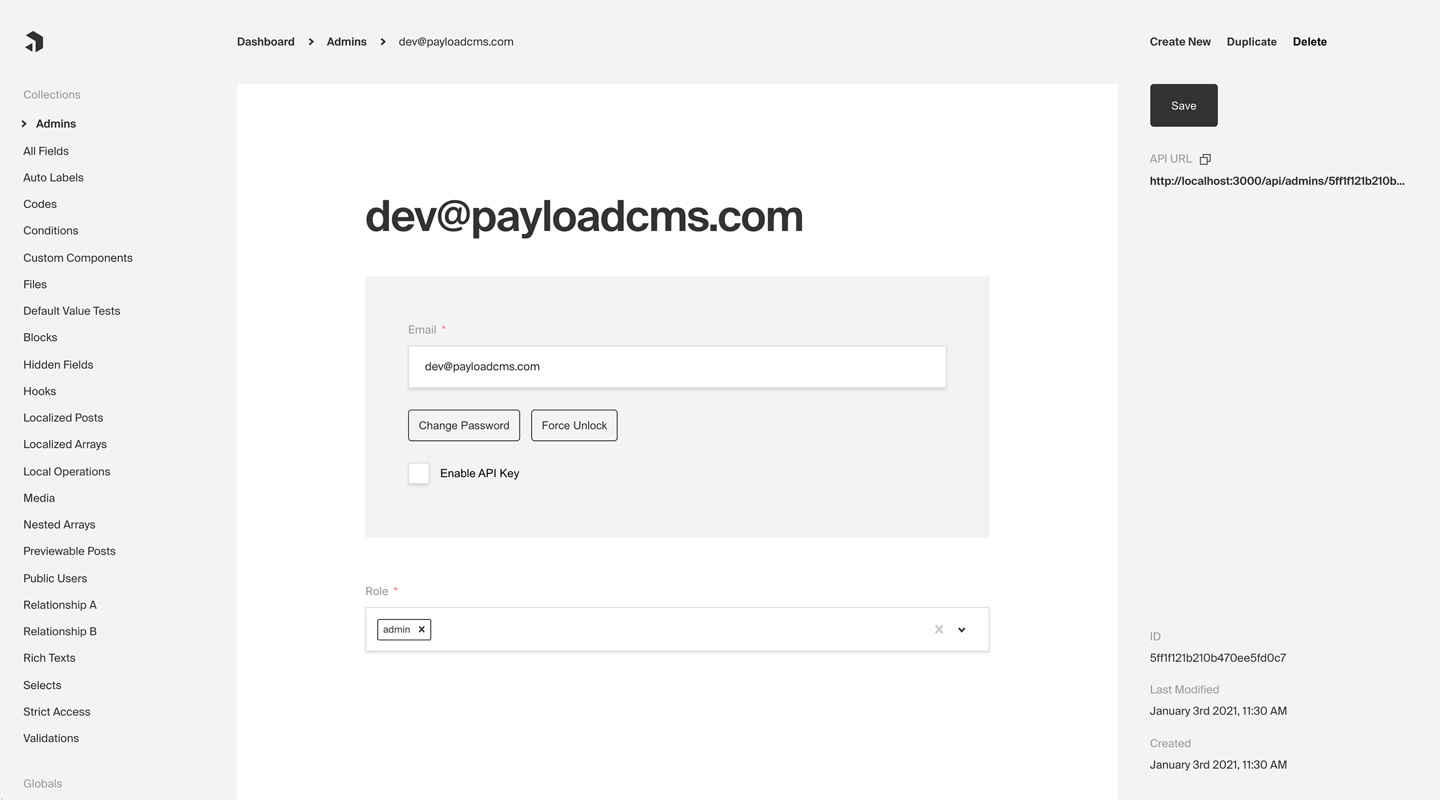
|
||||
_Admin Panel screenshot depicting an Admins Collection with Auth enabled_
|
||||
|
||||
**Here are some common use cases of Authentication outside of Payload's dashboard itself:**
|
||||
## Config Options
|
||||
|
||||
- Customer accounts for an ecommerce app
|
||||
- Customer accounts for a SaaS product
|
||||
- P2P app or social site where users need to log in and manage their profiles
|
||||
- Online game where players need to track their progress over time
|
||||
Any [Collection](../configuration/collections) can opt-in to supporting Authentication. Once enabled, each Document that is created within the Collection can be thought of as a "user". This enables a complete authentication workflow on your Collection, such as logging in and out, resetting their password, and more.
|
||||
|
||||
By default, Payload provides you with a `User` collection that supports Authentication, which is used to access the [Admin Panel](../admin/overview). But, you can add support to one or many Collections of your own. For more information on how to customize, override, or remove the default `User` collection, [click here](/docs/admin/overview#the-admin-user-collection).
|
||||
<Banner type="warning">
|
||||
<strong>Note:</strong>
|
||||
By default, Payload provides an auth-enabled `User` Collection which is used to access the Admin Panel. [More details](../admin/overview#the-admin-user-collection).
|
||||
</Banner>
|
||||
|
||||
## Enabling Auth on a collection
|
||||
|
||||
Every Payload Collection can opt-in to supporting Authentication by specifying the `auth` property on the Collection's config to either `true` or to an object containing `auth` options.
|
||||
|
||||
**For a full list of all `auth` options, [click here](/docs/authentication/config).**
|
||||
|
||||
Simple example collection:
|
||||
To enable Authentication on a Collection, use the `auth` property in the [Collection Config](../configuration/collections):
|
||||
|
||||
```ts
|
||||
import { CollectionConfig } from 'payload'
|
||||
|
||||
export const Admins: CollectionConfig = {
|
||||
slug: 'admins',
|
||||
// ...
|
||||
// highlight-start
|
||||
auth: {
|
||||
tokenExpiration: 7200, // How many seconds to keep the user logged in
|
||||
@@ -52,53 +61,136 @@ export const Admins: CollectionConfig = {
|
||||
// More options are available
|
||||
},
|
||||
// highlight-end
|
||||
fields: [
|
||||
{
|
||||
name: 'role',
|
||||
type: 'select',
|
||||
required: true,
|
||||
options: ['user', 'admin', 'editor', 'developer'],
|
||||
},
|
||||
],
|
||||
}
|
||||
```
|
||||
|
||||
**By enabling Authentication on a config, the following modifications will automatically be made to your Collection:**
|
||||
<Banner type="info">
|
||||
<strong>Tip:</strong>
|
||||
For default auth behavior, set `auth: true`. This is a good starting point for most applications.
|
||||
</Banner>
|
||||
|
||||
1. `email` as well as password `salt` & `hash` fields will be added to your Collection's schema
|
||||
1. The [Admin Panel](../admin/overview) will feature a new set of corresponding UI to allow for changing password and editing email
|
||||
1. [A new set of `operations`](/docs/authentication/operations) will be exposed via Payload's REST, Local, and GraphQL APIs
|
||||
<Banner type="warning">
|
||||
<strong>Note:</strong>
|
||||
Auth-enabled Collections with be automatically injected with the `hash`, `salt`, and `email` fields. [More details](../fields/overview#field-names).
|
||||
</Banner>
|
||||
|
||||
Once enabled, each document that is created within the Collection can be thought of as a `user` - who can make use of commonly required authentication functions such as logging in / out, resetting their password, and more.
|
||||
The following options are available:
|
||||
|
||||
## Authentication Strategies
|
||||
| Option | Description |
|
||||
|----------------------------|-------------------------------------------------------------------------------------------------------------------------------------------------------------------------------------------------------------------------------------|
|
||||
| **`cookies`** | Set cookie options, including `secure`, `sameSite`, and `domain`. For advanced users. |
|
||||
| **`depth`** | How many levels deep a `user` document should be populated when creating the JWT and binding the `user` to the `req`. Defaults to `0` and should only be modified if absolutely necessary, as this will affect performance. |
|
||||
| **`disableLocalStrategy`** | Advanced - disable Payload's built-in local auth strategy. Only use this property if you have replaced Payload's auth mechanisms with your own. |
|
||||
| **`forgotPassword`** | Customize the way that the `forgotPassword` operation functions. [More details](./email#forgot-password). |
|
||||
| **`lockTime`** | Set the time (in milliseconds) that a user should be locked out if they fail authentication more times than `maxLoginAttempts` allows for. |
|
||||
| **`loginWithUsername`** | Ability to allow users to login with username/password. [More](/docs/authentication/overview#login-with-username) |
|
||||
| **`maxLoginAttempts`** | Only allow a user to attempt logging in X amount of times. Automatically locks out a user from authenticating if this limit is passed. Set to `0` to disable. |
|
||||
| **`strategies`** | Advanced - an array of custom authentification strategies to extend this collection's authentication with. [More details](./custom-strategies). |
|
||||
| **`tokenExpiration`** | How long (in seconds) to keep the user logged in. JWTs and HTTP-only cookies will both expire at the same time. |
|
||||
| **`useAPIKey`** | Payload Authentication provides for API keys to be set on each user within an Authentication-enabled Collection. [More details](./api-keys). |
|
||||
| **`verify`** | Set to `true` or pass an object with verification options to require users to verify by email before they are allowed to log into your app. [More details](./email#email-verification). |
|
||||
|
||||
Out of the box Payload ships with a few powerful authentication strategies. HTTP-Only Cookies, JWT's and API-Keys, they can work together or individually. You can also have multiple collections that have auth enabled, but only 1 of them can be used to log into the Admin Panel.
|
||||
### Login With Username
|
||||
|
||||
You can allow users to login with their username instead of their email address by setting the `loginWithUsername` property to `true`.
|
||||
|
||||
Example:
|
||||
|
||||
```ts
|
||||
{
|
||||
slug: 'customers',
|
||||
auth: {
|
||||
loginWithUsername: true,
|
||||
},
|
||||
}
|
||||
```
|
||||
|
||||
Or, you can pass an object with additional options:
|
||||
|
||||
```ts
|
||||
{
|
||||
slug: 'customers',
|
||||
auth: {
|
||||
loginWithUsername: {
|
||||
allowEmailLogin: true, // default: false
|
||||
requireEmail: false, // default: false
|
||||
},
|
||||
},
|
||||
}
|
||||
```
|
||||
|
||||
**`allowEmailLogin`**
|
||||
|
||||
If set to `true`, users can log in with either their username or email address. If set to `false`, users can only log in with their username.
|
||||
|
||||
**`requireEmail`**
|
||||
|
||||
If set to `true`, an email address is required when creating a new user. If set to `false`, email is not required upon creation.
|
||||
|
||||
## Auto-Login
|
||||
|
||||
For testing and demo purposes you may want to skip forcing the user to login in order to access your application. Typically, all users should be required to login, however, you can speed up local development time by enabling auto-login.
|
||||
|
||||
To enable auto-login, set the `autoLogin` property in the [Admin Config](../configuration/admin):
|
||||
|
||||
```ts
|
||||
import { buildConfig } from 'payload'
|
||||
|
||||
export default buildConfig({
|
||||
// ...
|
||||
// highlight-start
|
||||
autoLogin:
|
||||
process.env.NEXT_PUBLIC_ENABLE_AUTOLOGIN === 'true'
|
||||
? {
|
||||
email: 'test@example.com',
|
||||
password: 'test',
|
||||
prefillOnly: true,
|
||||
}
|
||||
: false,
|
||||
// highlight-end
|
||||
})
|
||||
```
|
||||
|
||||
<Banner type="warning">
|
||||
<strong>Warning:</strong>
|
||||
The recommended way to use this feature is behind an [Environment Variable](../configuration/environment-vars). This will ensure it is _disabled_ in production.
|
||||
</Banner>
|
||||
|
||||
The following options are available:
|
||||
|
||||
| Option | Description |
|
||||
|-------------------|-----------------------------------------------------------------------------------------------------------------|
|
||||
| **`username`** | The username of the user to login as |
|
||||
| **`email`** | The email address of the user to login as |
|
||||
| **`password`** | The password of the user to login as. This is only needed if `prefillOnly` is set to true |
|
||||
| **`prefillOnly`** | If set to true, the login credentials will be prefilled but the user will still need to click the login button. |
|
||||
|
||||
## Operations
|
||||
|
||||
All auth-related operations are available via Payload's REST, Local, and GraphQL APIs. These operations are automatically added to your Collection when you enable Authentication. [More details](./operations).
|
||||
|
||||
## Strategies
|
||||
|
||||
Out of the box Payload ships with a three powerful Authentication strategies:
|
||||
|
||||
- [HTTP-Only Cookies](./cookies)
|
||||
- [JSON Web Tokens (JWT)](./jwt)
|
||||
- [API-Keys](./api-keys)
|
||||
|
||||
Each of these strategies can work together or independently. You can also create your own custom strategies to fit your specific needs. [More details](./custom-strategies).
|
||||
|
||||
### HTTP-Only Cookies
|
||||
|
||||
HTTP-only cookies are a highly secure method of storing identifiable data on a user's device so that Payload can automatically recognize a returning user until their cookie expires. They are totally protected from common XSS attacks and <strong>cannot be read by JavaScript in the browser</strong>, unlike JWT's.
|
||||
|
||||
You can learn more about this strategy from the [HTTP-Only Cookies](/docs/authentication/http-only-cookies) docs.
|
||||
[HTTP-only cookies](https://developer.mozilla.org/en-US/docs/Web/HTTP/Cookies) are a highly secure method of storing identifiable data on a user's device so that Payload can automatically recognize a returning user until their cookie expires. They are totally protected from common XSS attacks and <strong>cannot be read by JavaScript in the browser</strong>, unlike JWT's. [More details](./cookies).
|
||||
|
||||
### JSON Web Tokens
|
||||
|
||||
JWT (JSON Web Tokens) can also be utilized to perform authentication. Tokens are generated on `login`, `refresh` and `me` operations and can be attached to future requests to authenticate users.
|
||||
|
||||
You can learn more about this strategy from the [JWT](/docs/authentication/jwt) docs.
|
||||
JWT (JSON Web Tokens) can also be utilized to perform authentication. Tokens are generated on `login`, `refresh` and `me` operations and can be attached to future requests to authenticate users. [More details](./jwt).
|
||||
|
||||
### API Keys
|
||||
|
||||
API Keys can be enabled on auth collections. These are particularly useful when you want to authenticate against Payload from a third party service.
|
||||
|
||||
You can learn more about this strategy from the [API Keys](/docs/authentication/api-keys) docs.
|
||||
API Keys can be enabled on auth collections. These are particularly useful when you want to authenticate against Payload from a third party service. [More details](./api-keys).
|
||||
|
||||
### Custom Strategies
|
||||
|
||||
There are cases where these may not be enough for your application. Payload is extendable by design so you can wire up your own strategy when you need to.
|
||||
|
||||
You can learn more about custom strategies from the [Custom Strategies](/docs/authentication/custom-strategies) docs.
|
||||
|
||||
## Logging in / out, resetting password, etc.
|
||||
|
||||
[Click here](/docs/authentication/operations) for a list of all automatically-enabled Auth operations, including `login`, `logout`, `refresh`, and others.
|
||||
There are cases where these may not be enough for your application. Payload is extendable by design so you can wire up your own strategy when you need to. [More details](./custom-strategies).
|
||||
|
||||
@@ -59,9 +59,7 @@ You can update settings from your Project’s Settings tab. Changes to your buil
|
||||
From the Environment Variables page of the Settings tab, you can add, update and delete variables for use in your project. Like build settings, these changes will trigger a redeployment of your project.
|
||||
|
||||
<Banner>
|
||||
Note: For security reasons, any variables you wish to provide to the [Admin Panel](../admin/overview) must be prefixed
|
||||
with `PAYLOAD_PUBLIC_`. Learn more
|
||||
[here](../configuration/environment-vars).
|
||||
Note: For security reasons, any variables you wish to provide to the [Admin Panel](../admin/overview) must be prefixed with `NEXT_PUBLIC_`. [More details](../configuration/environment-vars).
|
||||
</Banner>
|
||||
|
||||
## Custom Domains
|
||||
|
||||
@@ -6,9 +6,9 @@ desc: Structure your Collections for your needs by defining fields, adding slugs
|
||||
keywords: collections, config, configuration, documentation, Content Management System, cms, headless, javascript, node, react, nextjs
|
||||
---
|
||||
|
||||
A Collection is a group of records, called Documents, that all share a common schema. You can define as many Collections as your application needs. Each Collection saves to the [Database](../database/overview) based on the [Fields](../fields/overview) that you define, and automatically generates the [Local API](../local-api/overview), [REST API](../rest-api/overview), and [GraphQL API](../graphql/overview) to manage your Documents.
|
||||
A Collection is a group of records, called Documents, that all share a common schema. You can define as many Collections as your application needs. Each Document in a Collection is stored in the [Database](../database/overview) based on the [Fields](../fields/overview) that you define, and automatically generates a [Local API](../local-api/overview), [REST API](../rest-api/overview), and [GraphQL API](../graphql/overview) used to manage your Documents.
|
||||
|
||||
Collections are also the primary way to achieve [Authentication](../authentication/overview) in Payload. By defining a Collection with `auth` options, that Collection receives additional operations to support user authentication.
|
||||
Collections are also used to achieve [Authentication](../authentication/overview) in Payload. By defining a Collection with `auth` options, that Collection receives additional operations to support user authentication.
|
||||
|
||||
Collections are the primary way to structure recurring data in your application, such as users, products, pages, posts, and other types of content that you might want to manage. Each Collection can have its own unique [Access Control](../access-control/overview), [Hooks](../hooks/overview), [Admin Options](#admin-options), and more.
|
||||
|
||||
@@ -59,15 +59,15 @@ The following options are available:
|
||||
|
||||
| Option | Description |
|
||||
|------------------------|--------------------------------------------------------------------------------------------------------------------------------------------------------------------------------------------------------------------------|
|
||||
| **`admin`** | The configuration options for the Admin Panel. [More details](#admin-options). |
|
||||
| **`admin`** | The configuration options for the Admin Panel. [More details](../admin/collections). |
|
||||
| **`access`** | Provide Access Control functions to define exactly who should be able to do what with Documents in this Collection. [More details](../access-control/collections). |
|
||||
| **`auth`** | Specify options if you would like this Collection to feature authentication. For more, consult the [Authentication](../authentication/config) documentation. |
|
||||
| **`auth`** | Specify options if you would like this Collection to feature authentication. [More details](../authentication/overview). |
|
||||
| **`custom`** | Extension point for adding custom data (e.g. for plugins) |
|
||||
| **`disableDuplicate`** | When true, do not show the "Duplicate" button while editing documents within this Collection and prevent `duplicate` from all APIs. |
|
||||
| **`defaultSort`** | Pass a top-level field to sort by default in the Collection List View. Prefix the name of the field with a minus symbol ("-") to sort in descending order. |
|
||||
| **`dbName`** | Custom table or Collection name depending on the Database Adapter. Auto-generated from slug if not defined. |
|
||||
| **`endpoints`** | Add custom routes to the REST API. Set to `false` to disable routes. [More details](../rest-api/overview#custom-endpoints). |
|
||||
| **`fields`** \* | Array of field types that will determine the structure and functionality of the data stored within this Collection. [Click here](../fields/overview) for a full list of field types as well as how to configure them. |
|
||||
| **`fields`** \* | Array of field types that will determine the structure and functionality of the data stored within this Collection. [More details](../fields/overview). |
|
||||
| **`graphQL`** | An object with `singularName` and `pluralName` strings used in schema generation. Auto-generated from slug if not defined. Set to `false` to disable GraphQL. |
|
||||
| **`hooks`** | Entry point for Hooks. [More details](../hooks/overview#collection-hooks). |
|
||||
| **`labels`** | Singular and plural labels for use in identifying this Collection throughout Payload. Auto-generated from slug if not defined. |
|
||||
@@ -93,145 +93,14 @@ Fields define the schema of the Documents within a Collection. To learn more, go
|
||||
|
||||
### Admin Options
|
||||
|
||||
You can customize the way that the [Admin Panel](../admin/overview) behaves on a Collection-by-Collection basis.
|
||||
|
||||
To configure Admin Options for Collections, use the `admin` property in your Collection Config:
|
||||
|
||||
```ts
|
||||
import { CollectionConfig } from 'payload'
|
||||
|
||||
export const Posts: CollectionConfig = {
|
||||
// ...
|
||||
admin: { // highlight-line
|
||||
// ...
|
||||
},
|
||||
}
|
||||
```
|
||||
|
||||
The following options are available:
|
||||
|
||||
| Option | Description |
|
||||
| ---------------------------- | ----------------------------------------------------------------------------------------------------------------------------------------------------------------------------------------------------- |
|
||||
| **`group`** | Text used as a label for grouping Collection and Global links together in the navigation. |
|
||||
| **`hidden`** | Set to true or a function, called with the current user, returning true to exclude this Collection from navigation and admin routing. |
|
||||
| **`hooks`** | Admin-specific hooks for this Collection. [More details](#admin-hooks). |
|
||||
| **`useAsTitle`** | Specify a top-level field to use for a document title throughout the [Admin Panel](../admin/overview). If no field is defined, the ID of the document is used as the title. |
|
||||
| **`description`** | Text or React component to display below the Collection label in the List View to give editors more information. |
|
||||
| **`defaultColumns`** | Array of field names that correspond to which columns to show by default in this Collection's List View. |
|
||||
| **`hideAPIURL`** | Hides the "API URL" meta field while editing documents within this Collection. |
|
||||
| **`enableRichTextLink`** | The [Rich Text](../fields/rich-text) field features a `Link` element which allows for users to automatically reference related documents within their rich text. Set to `true` by default. |
|
||||
| **`enableRichTextRelationship`** | The [Rich Text](../fields/rich-text) field features a `Relationship` element which allows for users to automatically reference related documents within their rich text. Set to `true` by default. |
|
||||
| **`meta`** | Metadata overrides to apply to the [Admin Panel](../admin/overview). Included properties are `description` and `openGraph`. |
|
||||
| **`preview`** | Function to generate preview URLs within the [Admin Panel](../admin/overview) that can point to your app. [More details](#preview). |
|
||||
| **`livePreview`** | Enable real-time editing for instant visual feedback of your front-end application. [More details](../live-preview/overview). |
|
||||
| **`components`** | Swap in your own React components to be used within this Collection. [More details](../admin/components#collections). |
|
||||
| **`listSearchableFields`** | Specify which fields should be searched in the List search view. [More details](#list-searchable-fields). |
|
||||
| **`pagination`** | Set pagination-specific options for this Collection. [More details](#pagination). |
|
||||
|
||||
#### Preview
|
||||
|
||||
It is possible to display a Preview Button in the Admin Panel within the Edit View. This will allow editors to visit the frontend of your app the corresponds to the document they are actively editing. This way they can preview the latest, potentially unpublished changes.
|
||||
|
||||
To configure the Preview Button, set the `admin.preview` property to a function in your Collection Config:
|
||||
|
||||
```ts
|
||||
import { CollectionConfig } from 'payload'
|
||||
|
||||
export const Posts: CollectionConfig = {
|
||||
// ...
|
||||
admin: {
|
||||
// highlight-start
|
||||
preview: (doc, { locale }) => {
|
||||
if (doc?.slug) {
|
||||
return `/${doc.slug}?locale=${locale}`
|
||||
}
|
||||
|
||||
return null
|
||||
},
|
||||
// highlight-end
|
||||
},
|
||||
}
|
||||
```
|
||||
|
||||
The preview function receives two arguments:
|
||||
|
||||
| Argument | Description |
|
||||
| --- | --- |
|
||||
| **`doc`** | The document being edited |
|
||||
| **`ctx`** | An object containing `locale` and `token` properties. The `token` is the currently logged-in user's JWT. |
|
||||
|
||||
<Banner type="success">
|
||||
<strong>Reminder:</strong>
|
||||
For fully working example of this, check of the official [Draft Preview Example](https://github.com/payloadcms/payload/tree/main/examples/draft-preview) in the [Examples Directory](https://github.com/payloadcms/payload/tree/main/examples).
|
||||
</Banner>
|
||||
|
||||
#### Pagination
|
||||
|
||||
All Collections receive their own List View which displays a paginated list of documents that can be sorted and filtered. The pagination behavior of the List View can be customized on a per-Collection basis.
|
||||
|
||||
To configure pagination options, use the `admin.pagination` property in your Collection Config:
|
||||
|
||||
```ts
|
||||
import { CollectionConfig } from 'payload'
|
||||
|
||||
export const Posts: CollectionConfig = {
|
||||
// ...
|
||||
admin: {
|
||||
// highlight-start
|
||||
pagination: {
|
||||
defaultLimit: 10,
|
||||
limits: [10, 20, 50],
|
||||
},
|
||||
// highlight-end
|
||||
},
|
||||
}
|
||||
```
|
||||
|
||||
The following options are available:
|
||||
|
||||
| Option | Description |
|
||||
| -------------- | --------------------------------------------------------------------------------------------------- |
|
||||
| `defaultLimit` | Integer that specifies the default per-page limit that should be used. Defaults to 10. |
|
||||
| `limits` | Provide an array of integers to use as per-page options for admins to choose from in the List View. |
|
||||
|
||||
#### List Searchable Fields
|
||||
|
||||
In the List View, there is a "search" box that allows you to quickly find a document through a simple text search. By default, it searches on the ID field. If defined, the `admin.useAsTitle` field is used. Or, you can explicitly define which fields to search based on the needs of your application.
|
||||
|
||||
To define which fields should be searched, use the `admin.listSearchableFields` property in your Collection Config:
|
||||
|
||||
```ts
|
||||
import { CollectionConfig } from 'payload'
|
||||
|
||||
export const Posts: CollectionConfig = {
|
||||
// ...
|
||||
admin: {
|
||||
// highlight-start
|
||||
listSearchableFields: ['title', 'slug'],
|
||||
// highlight-end
|
||||
},
|
||||
}
|
||||
```
|
||||
|
||||
<Banner type="warning">
|
||||
<strong>Tip:</strong>
|
||||
If you are adding `listSearchableFields`, make sure you index each of these fields so your admin queries can remain performant.
|
||||
</Banner>
|
||||
You can customize the way that the [Admin Panel](../admin/overview) behaves on a Collection-by-Collection basis. To learn more, go to the [Collection Admin Options](../admin/collections) documentation.
|
||||
|
||||
## TypeScript
|
||||
|
||||
You can import Collection types as follows:
|
||||
You can import types from Payload to help make writing your Collection configs easier and type-safe. There are two main types that represent the Collection Config, `CollectionConfig` and `SanitizeCollectionConfig`.
|
||||
|
||||
The `CollectionConfig` type represents a raw Collection Config in its full form, where only the bare minimum properties are marked as required. The `SanitizedCollectionConfig` type represents a Collection Config after it has been fully sanitized. Generally, this is only used internally by Payload.
|
||||
|
||||
```ts
|
||||
import { CollectionConfig } from 'payload'
|
||||
|
||||
// This is the type used for incoming Collection configs.
|
||||
// Only the bare minimum properties are marked as required.
|
||||
```
|
||||
|
||||
```ts
|
||||
import { SanitizedCollectionConfig } from 'payload'
|
||||
|
||||
// This is the type used after an incoming Collection config is fully sanitized.
|
||||
// Generally, this is only used internally by Payload.
|
||||
import type { CollectionConfig, SanitizedCollectionConfig } from 'payload'
|
||||
```
|
||||
|
||||
@@ -6,7 +6,7 @@ desc: Set up your Global config for your needs by defining fields, adding slugs
|
||||
keywords: globals, config, configuration, documentation, Content Management System, cms, headless, javascript, node, react, nextjs
|
||||
---
|
||||
|
||||
Globals are in many ways similar to [Collections](../configuration/collections), except they correspond to only a single Document. You can define as many Globals as your application needs. Each Global saves to the [Database](../database/overview) based on the [Fields](../fields/overview) that you define, and automatically generates the [Local API](../local-api/overview), [REST API](../rest-api/overview), and [GraphQL API](../graphql/overview) to manage your Documents.
|
||||
Globals are in many ways similar to [Collections](../configuration/collections), except they correspond to only a single Document. You can define as many Globals as your application needs. Each Global Document is stored in the [Database](../database/overview) based on the [Fields](../fields/overview) that you define, and automatically generates a [Local API](../local-api/overview), [REST API](../rest-api/overview), and [GraphQL API](../graphql/overview) used to manage your Documents.
|
||||
|
||||
Globals are the primary way to structure singletons in Payload, such as a header navigation, site-wide banner alerts, or app-wide localized strings. Each Global can have its own unique [Access Control](../access-control/overview), [Hooks](../hooks/overview), [Admin Options](#admin-options), and more.
|
||||
|
||||
@@ -68,12 +68,12 @@ The following options are available:
|
||||
| Option | Description |
|
||||
| ------------------ | -------------------------------------------------------------------------------------------------------------------------------------------------------------------------------------------------------------------- |
|
||||
| **`access`** | Provide Access Control functions to define exactly who should be able to do what with this Global. [More details](../access-control/globals). |
|
||||
| **`admin`** | The configuration options for the Admin Panel. [More details](#admin-options). |
|
||||
| **`admin`** | The configuration options for the Admin Panel. [More details](../admin/globals). |
|
||||
| **`custom`** | Extension point for adding custom data (e.g. for plugins) |
|
||||
| **`dbName`** | Custom table or collection name for this Global depending on the Database Adapter. Auto-generated from slug if not defined. |
|
||||
| **`description`** | Text or React component to display below the Global header to give editors more information. |
|
||||
| **`endpoints`** | Add custom routes to the REST API. [More details](../rest-api/overview#custom-endpoints). |
|
||||
| **`fields`** \* | Array of field types that will determine the structure and functionality of the data stored within this Global. [Click here](../fields/overview) for a full list of field types as well as how to configure them. |
|
||||
| **`fields`** \* | Array of field types that will determine the structure and functionality of the data stored within this Global. [More details](../fields/overview). |
|
||||
| **`graphQL.name`** | Text used in schema generation. Auto-generated from slug if not defined. |
|
||||
| **`hooks`** | Entry point for Hooks. [More details](../hooks/overview#global-hooks). |
|
||||
| **`label`** | Text for the name in the Admin Panel or an object with keys for each language. Auto-generated from slug if not defined. |
|
||||
@@ -97,84 +97,14 @@ Fields define the schema of the Global. To learn more, go to the [Fields](../fie
|
||||
|
||||
### Admin Options
|
||||
|
||||
You can customize the way that the [Admin Panel](../admin/overview) behaves on a Global-by-Global basis.
|
||||
|
||||
To configure Admin Options for Globals, use the `admin` property in your Global Config:
|
||||
|
||||
```ts
|
||||
import { GlobalConfig } from 'payload'
|
||||
|
||||
const MyGlobal: GlobalConfig = {
|
||||
// ...
|
||||
admin: { // highlight-line
|
||||
// ...
|
||||
},
|
||||
}
|
||||
```
|
||||
|
||||
The following options are available:
|
||||
|
||||
| Option | Description |
|
||||
| ------------- | --------------------------------------------------------------------------------------------------------------------------------- |
|
||||
| **`group`** | Text used as a label for grouping Collection and Global links together in the navigation. |
|
||||
| **`hidden`** | Set to true or a function, called with the current user, returning true to exclude this Global from navigation and admin routing. |
|
||||
| **`components`** | Swap in your own React components to be used within this Global. [More details](../admin/components#globals). |
|
||||
| **`preview`** | Function to generate a preview URL within the [Admin Panel](../admin/overview) for this Global that can point to your app. [More details](#preview). |
|
||||
| **`livePreview`** | Enable real-time editing for instant visual feedback of your front-end application. [More details](../live-preview/overview). |
|
||||
| **`hideAPIURL`** | Hides the "API URL" meta field while editing documents within this collection. |
|
||||
| **`meta`** | Metadata overrides to apply to the [Admin Panel](../admin/overview). Included properties are `description` and `openGraph`. |
|
||||
|
||||
#### Preview
|
||||
|
||||
It is possible to display a Preview Button in the Admin Panel within the Edit View. This will allow editors to visit the frontend of your app the corresponds to the document they are actively editing. This way they can preview the latest, potentially unpublished changes.
|
||||
|
||||
To configure the Preview Button, set the `admin.preview` property to a function in your Global Config:
|
||||
|
||||
```ts
|
||||
import { GlobalConfig } from 'payload'
|
||||
|
||||
export const MainMenu: GlobalConfig = {
|
||||
// ...
|
||||
admin: {
|
||||
// highlight-start
|
||||
preview: (doc, { locale }) => {
|
||||
if (doc?.slug) {
|
||||
return `/${doc.slug}?locale=${locale}`
|
||||
}
|
||||
|
||||
return null
|
||||
},
|
||||
// highlight-end
|
||||
},
|
||||
}
|
||||
```
|
||||
|
||||
The preview function receives two arguments:
|
||||
|
||||
| Argument | Description |
|
||||
| --- | --- |
|
||||
| **`doc`** | The document being edited |
|
||||
| **`ctx`** | An object containing `locale` and `token` properties. The `token` is the currently logged-in user's JWT. |
|
||||
|
||||
<Banner type="success">
|
||||
<strong>Reminder:</strong>
|
||||
For fully working example of this, check of the official [Draft Preview Example](https://github.com/payloadcms/payload/tree/main/examples/draft-preview) in the [Examples Directory](https://github.com/payloadcms/payload/tree/main/examples).
|
||||
</Banner>
|
||||
You can customize the way that the [Admin Panel](../admin/overview) behaves on a Global-by-Global basis. To learn more, go to the [Global Admin Options](../admin/globals) documentation.
|
||||
|
||||
## TypeScript
|
||||
|
||||
You can import Global types as follows:
|
||||
You can import types from Payload to help make writing your Global configs easier and type-safe. There are two main types that represent the Global Config, `GlobalConfig` and `SanitizeGlobalConfig`.
|
||||
|
||||
The `GlobalConfig` type represents a raw Global Config in its full form, where only the bare minimum properties are marked as required. The `SanitizedGlobalConfig` type represents a Global Config after it has been fully sanitized. Generally, this is only used internally by Payload.
|
||||
|
||||
```ts
|
||||
import { GlobalConfig } from 'payload'
|
||||
|
||||
// This is the type used for incoming Global configs.
|
||||
// Only the bare minimum properties are marked as required.
|
||||
```
|
||||
|
||||
```ts
|
||||
import { SanitizedGlobalConfig } from 'payload'
|
||||
|
||||
// This is the type used after an incoming Global config is fully sanitized.
|
||||
// Generally, this is only used internally by Payload.
|
||||
import type { GlobalConfig, SanitizedGlobalConfig } from 'payload'
|
||||
```
|
||||
|
||||
@@ -36,7 +36,6 @@ Here is one of the simplest possible Payload configs:
|
||||
```ts
|
||||
import { buildConfig } from 'payload'
|
||||
import { mongooseAdapter } from '@payloadcms/db-mongodb'
|
||||
// import { postgresAdapter } from '@payloadcms/db-postgres'
|
||||
|
||||
export default buildConfig({
|
||||
secret: process.env.PAYLOAD_SECRET,
|
||||
@@ -58,56 +57,56 @@ export default buildConfig({
|
||||
```
|
||||
|
||||
<Banner type="success">
|
||||
<strong>Reminder:</strong>
|
||||
<strong>Note:</strong>
|
||||
For a more complex example, see the [Public Demo](https://github.com/payloadcms/public-demo) source code on GitHub, or the [Templates](https://github.com/payloadcms/payload/tree/main/templates) and [Examples](https://github.com/payloadcms/payload/tree/main/examples) directories in the Payload repository.
|
||||
</Banner>
|
||||
|
||||
The following options are available:
|
||||
|
||||
| Option | Description |
|
||||
| ---------------------- | ---------------------------------------------------------------------------------------------------------------------------------------------------------------------------------- |
|
||||
| **`admin`** | The configuration options for the Admin Panel, including Custom Components, Live Preview, etc. [More details](../admin/overview#admin-options). |
|
||||
| **`bin`** | Register custom bin scripts with the `payload` bin function. |
|
||||
| **`editor`** | The Rich Text Editor which will be used by `richText` fields. [More details](../rich-text/overview). |
|
||||
| **`db`** \* | The Database Adapter which will be used by Payload. [More details](../database/overview). |
|
||||
| **`serverURL`** | A string used to define the absolute URL of your app including the protocol, for example `https://example.com`. No paths allowed, only protocol, domain and (optionally) port |
|
||||
| **`collections`** | An array of Collections for Payload to manage. [More details](./collections). |
|
||||
| **`globals`** | An array of Globals for Payload to manage. [More details](./globals). |
|
||||
| **`cors`** | Cross-origin resource sharing (CORS) is a mechanism that accept incoming requests from given domains. You can also customize the `Access-Control-Allow-Headers` header. [More](#cors) |
|
||||
| **`localization`** | Opt-in and control how Payload handles the translation of your content into multiple locales. [More details](./localization). |
|
||||
| **`graphQL`** | Manage GraphQL-specific functionality, including custom queries and mutations, query complexity limits, etc. [More details](../graphql/overview#graphql-options). |
|
||||
| **`cookiePrefix`** | A string that will be prefixed to all cookies that Payload sets. |
|
||||
| **`csrf`** | A whitelist array of URLs to allow Payload cookies to be accepted from as a form of CSRF protection. [More details](../authentication/overview#csrf-protection). |
|
||||
| **`defaultDepth`** | If a user does not specify `depth` while requesting a resource, this depth will be used. [More details](../queries/depth). |
|
||||
| **`defaultMaxTextLength`** | The maximum allowed string length to be permitted application-wide. Helps to prevent malicious public document creation. |
|
||||
| **`maxDepth`** | The maximum allowed depth to be permitted application-wide. This setting helps prevent against malicious queries. Defaults to `10`. |
|
||||
| **`indexSortableFields`** | Automatically index all sortable top-level fields in the database to improve sort performance and add database compatibility for Azure Cosmos and similar. |
|
||||
| **`upload`** | Base Payload upload configuration. [More details](../upload/overview#payload-wide-upload-options). |
|
||||
| **`routes`** | Control the routing structure that Payload binds itself to. Specify `admin`, `api`, `graphQL`, and `graphQLPlayground`. [More details](../admin/overview#root-level-routes). |
|
||||
| **`email`** | Configure the Email Adapter for Payload to use. [More details](../email/overview). |
|
||||
| **`debug`** | Enable to expose more detailed error information. |
|
||||
| **`telemetry`** | Disable Payload telemetry by passing `false`. [More details](#telemetry). |
|
||||
| **`rateLimit`** | Control IP-based rate limiting for all Payload resources. Used to prevent DDoS attacks, etc. [More details](../production/preventing-abuse#rate-limiting-requests). |
|
||||
| **`hooks`** | Tap into Payload-wide hooks. [More details](../hooks/overview). |
|
||||
| **`plugins`** | An array of Payload plugins. [More details](../plugins/overview). |
|
||||
| **`endpoints`** | An array of custom API endpoints added to the Payload router. [More details](../rest-api/overview#custom-endpoints). |
|
||||
| **`custom`** | Extension point for adding custom data (e.g. for plugins). |
|
||||
| **`i18n`** | Internationalization configuration. Pass all i18n languages you'd like the admin UI to support. Defaults to English-only. [More details](./i18n). |
|
||||
| **`secret`** \* | A secure, unguessable string that Payload will use for any encryption workflows - for example, password salt / hashing. |
|
||||
| **`sharp`** | If you would like Payload to offer cropping, focal point selection, and automatic media resizing, install and pass the Sharp module to the config here. |
|
||||
| **`typescript`** | Configure TypeScript settings here. [More details](#typescript). |
|
||||
| Option | Description |
|
||||
|----------------------------|------------------------------------------------------------------------------------------------------------------------------------------------------------------------------------------------|
|
||||
| **`admin`** | The configuration options for the Admin Panel, including Custom Components, Live Preview, etc. [More details](../admin/overview#admin-options). |
|
||||
| **`bin`** | Register custom bin scripts for Payload to execute. |
|
||||
| **`editor`** | The Rich Text Editor which will be used by `richText` fields. [More details](../rich-text/overview). |
|
||||
| **`db`** \* | The Database Adapter which will be used by Payload. [More details](../database/overview). |
|
||||
| **`serverURL`** | A string used to define the absolute URL of your app. This includes the protocol, for example `https://example.com`. No paths allowed, only protocol, domain and (optionally) port. |
|
||||
| **`collections`** | An array of Collections for Payload to manage. [More details](./collections). |
|
||||
| **`globals`** | An array of Globals for Payload to manage. [More details](./globals). |
|
||||
| **`cors`** | Cross-origin resource sharing (CORS) is a mechanism that accept incoming requests from given domains. You can also customize the `Access-Control-Allow-Headers` header. [More details](#cors). |
|
||||
| **`localization`** | Opt-in to translate your content into multiple locales. [More details](./localization). |
|
||||
| **`graphQL`** | Manage GraphQL-specific functionality, including custom queries and mutations, query complexity limits, etc. [More details](../graphql/overview#graphql-options). |
|
||||
| **`cookiePrefix`** | A string that will be prefixed to all cookies that Payload sets. |
|
||||
| **`csrf`** | A whitelist array of URLs to allow Payload to accept cookies from. [More details](../authentication/overview#csrf-protection). |
|
||||
| **`defaultDepth`** | If a user does not specify `depth` while requesting a resource, this depth will be used. [More details](../queries/depth). |
|
||||
| **`defaultMaxTextLength`** | The maximum allowed string length to be permitted application-wide. Helps to prevent malicious public document creation. |
|
||||
| **`maxDepth`** | The maximum allowed depth to be permitted application-wide. This setting helps prevent against malicious queries. Defaults to `10`. [More details](../queries/depth). |
|
||||
| **`indexSortableFields`** | Automatically index all sortable top-level fields in the database to improve sort performance and add database compatibility for Azure Cosmos and similar. |
|
||||
| **`upload`** | Base Payload upload configuration. [More details](../upload/overview#payload-wide-upload-options). |
|
||||
| **`routes`** | Control the routing structure that Payload binds itself to. [More details](../admin/overview#root-level-routes). |
|
||||
| **`email`** | Configure the Email Adapter for Payload to use. [More details](../email/overview). |
|
||||
| **`debug`** | Enable to expose more detailed error information. |
|
||||
| **`telemetry`** | Disable Payload telemetry by passing `false`. [More details](#telemetry). |
|
||||
| **`rateLimit`** | Control IP-based rate limiting for all Payload resources. Used to prevent DDoS attacks, etc. [More details](../production/preventing-abuse#rate-limiting-requests). |
|
||||
| **`hooks`** | An array of Root Hooks. [More details](../hooks/overview). |
|
||||
| **`plugins`** | An array of Plugins. [More details](../plugins/overview). |
|
||||
| **`endpoints`** | An array of Custom Endpoints added to the Payload router. [More details](../rest-api/overview#custom-endpoints). |
|
||||
| **`custom`** | Extension point for adding custom data (e.g. for plugins). |
|
||||
| **`i18n`** | Internationalization configuration. Pass all i18n languages you'd like the admin UI to support. Defaults to English-only. [More details](./i18n). |
|
||||
| **`secret`** \* | A secure, unguessable string that Payload will use for any encryption workflows - for example, password salt / hashing. |
|
||||
| **`sharp`** | If you would like Payload to offer cropping, focal point selection, and automatic media resizing, install and pass the Sharp module to the config here. |
|
||||
| **`typescript`** | Configure TypeScript settings here. [More details](#typescript). |
|
||||
|
||||
_\* An asterisk denotes that a property is required._
|
||||
|
||||
<Banner type="warning">
|
||||
<strong>Reminder:</strong>
|
||||
<strong>Note:</strong>
|
||||
Some properties are removed from the client-side bundle. [More details](../admin/components#accessing-the-payload-config).
|
||||
</Banner>
|
||||
|
||||
|
||||
### TypeScript
|
||||
### Typescript Config
|
||||
|
||||
Payload exposes a variety of TypeScript settings that you can leverage. These settings are used to auto-generate TypeScript interfaces for your Collections and Globals, and to ensure that Payload uses your [Generated Types](../typescript/overview) for all Local API methods.
|
||||
Payload exposes a variety of TypeScript settings that you can leverage. These settings are used to auto-generate TypeScript interfaces for your [Collections](../configuration/collections) and [Globals](../configuration/globals), and to ensure that Payload uses your [Generated Types](../typescript/overview) for all [Local API](../local-api/overview) methods.
|
||||
|
||||
To customize the TypeScript settings, use the `typescript` property in your Payload Config:
|
||||
|
||||
@@ -130,39 +129,59 @@ The following options are available:
|
||||
| **`declare`** | By default, Payload adds a `declare` block to your generated types, which makes sure that Payload uses your generated types for all Local API methods. Opt out by setting `typescript.declare: false`. |
|
||||
| **`outputFile`** | Control the output path and filename of Payload's auto-generated types by defining the `typescript.outputFile` property to a full, absolute path. |
|
||||
|
||||
#### Importing Payload Config types
|
||||
|
||||
You can import config types as follows:
|
||||
|
||||
```ts
|
||||
import { Config } from 'payload'
|
||||
|
||||
// This is the type used for an incoming Payload Config.
|
||||
// Only the bare minimum properties are marked as required.
|
||||
```
|
||||
|
||||
```ts
|
||||
import { SanitizedConfig } from 'payload'
|
||||
|
||||
// This is the type used after an incoming Payload Config is fully sanitized.
|
||||
// Generally, this is only used internally by Payload.
|
||||
```
|
||||
|
||||
## Config Location
|
||||
|
||||
For Payload command-line scripts, we need to be able to locate your Payload Config. We'll check a variety of locations for the presence of `payload.config.ts` by default, including the root current working directory, your `tsconfig`'s `rootDir`, and your `tsconfig`'s `outDir`.
|
||||
For Payload command-line scripts, we need to be able to locate your Payload Config. We'll check a variety of locations for the presence of `payload.config.ts` by default, including:
|
||||
|
||||
In development mode, if the configuration file is not found at the root, Payload will attempt to read your `tsconfig.json`, and search in the directory specified in `compilerOptions.rootDir` (typically "src").
|
||||
1. The root current working directory
|
||||
1. The `compilerOptions` in your `tsconfig`*
|
||||
1. The `dist` directory*
|
||||
|
||||
In production mode, Payload will first attempt to find the config file in the output directory specified in `compilerOptions.outDir` of your `tsconfig.json`, then fallback to the source directory (`compilerOptions.rootDir`), and finally will check the 'dist' directory.
|
||||
_\* Config location detection is different between development and production environments. See below for more details._
|
||||
|
||||
Please ensure your `tsconfig.json` is properly configured if you want Payload to accurately auto-detect your configuration file location. If `tsconfig.json` does not exist or doesn't specify `rootDir` or `outDir`, Payload will default to the current working directory.
|
||||
<Banner type="warning">
|
||||
<strong>Important:</strong>
|
||||
Ensure your `tsconfig.json` is properly configured for Payload to auto-detect your config location. If if does not exist, or does not specify the proper `compilerOptions`, Payload will default to the current working directory.
|
||||
</Banner>
|
||||
|
||||
**Development Mode**
|
||||
|
||||
In development mode, if the configuration file is not found at the root, Payload will attempt to read your `tsconfig.json`, and attempt to find the config file specified in the `rootDir`:
|
||||
|
||||
```json
|
||||
{
|
||||
// ...
|
||||
// highlight-start
|
||||
"compilerOptions": {
|
||||
"rootDir": "src"
|
||||
}
|
||||
// highlight-end
|
||||
}
|
||||
```
|
||||
|
||||
**Production Mode**
|
||||
|
||||
In production mode, Payload will first attempt to find the config file in the `outDir` of your `tsconfig.json`, and if not found, will fallback to the `rootDor` directory:
|
||||
|
||||
```json
|
||||
{
|
||||
// ...
|
||||
// highlight-start
|
||||
"compilerOptions": {
|
||||
"outDir": "dist",
|
||||
"rootDir": "src"
|
||||
}
|
||||
// highlight-end
|
||||
}
|
||||
```
|
||||
|
||||
If none was in either location, Payload will finally check the `dist` directory.
|
||||
|
||||
### Customizing the Config Location
|
||||
|
||||
In addition to the above automated detection, you can specify your own location for the Payload Config. This is done by using the environment variable `PAYLOAD_CONFIG_PATH`. The path you provide via this environment variable can either be absolute or relative to your current working directory. This can be useful in situations where your Payload Config is not in a standard location, or you wish to switch between multiple configurations.
|
||||
In addition to the above automated detection, you can specify your own location for the Payload Config. This can be useful in situations where your config is not in a standard location, or you wish to switch between multiple configurations. To do this, Payload exposes an [Environment Variable](..environment-variables) to bypass all automatic config detection.
|
||||
|
||||
**Example in package.json:**
|
||||
To use a custom config location, set the `PAYLOAD_CONFIG_PATH` environment variable:
|
||||
|
||||
```json
|
||||
{
|
||||
@@ -172,7 +191,10 @@ In addition to the above automated detection, you can specify your own location
|
||||
}
|
||||
```
|
||||
|
||||
When `PAYLOAD_CONFIG_PATH` is set, Payload will use this path to load the configuration, bypassing all automated detection.
|
||||
<Banner type="info">
|
||||
<strong>Tip:</strong>
|
||||
`PAYLOAD_CONFIG_PATH` can be either an absolute path, or path relative to your current working directory.
|
||||
</Banner>
|
||||
|
||||
## Telemetry
|
||||
|
||||
@@ -186,8 +208,8 @@ Cross-origin resource sharing (CORS) can be configured with either a whitelist a
|
||||
|
||||
| Option | Description |
|
||||
| --------- | --------------------------------------------------------------------------------------------------------------------------------------- |
|
||||
| `origins` | Either a whitelist array of URLS to allow CORS requests from, or a wildcard string (`'*'`) to accept incoming requests from any domain. |
|
||||
| `headers | A list of allowed headers that will be appended in `Access-Control-Allow-Headers`. |
|
||||
| **`origins`** | Either a whitelist array of URLS to allow CORS requests from, or a wildcard string (`'*'`) to accept incoming requests from any domain. |
|
||||
| **`headers`** | A list of allowed headers that will be appended in `Access-Control-Allow-Headers`. |
|
||||
|
||||
Here's an example showing how to allow incoming requests from any domain:
|
||||
|
||||
@@ -196,7 +218,7 @@ import { buildConfig } from 'payload/config'
|
||||
|
||||
export default buildConfig({
|
||||
// ...
|
||||
cors: '*'
|
||||
cors: '*' // highlight-line
|
||||
})
|
||||
```
|
||||
|
||||
@@ -207,9 +229,27 @@ import { buildConfig } from 'payload/config'
|
||||
|
||||
export default buildConfig({
|
||||
// ...
|
||||
// highlight-start
|
||||
cors: {
|
||||
origins: ['http://localhost:3000']
|
||||
headers: ['x-custom-header']
|
||||
}
|
||||
// highlight-end
|
||||
})
|
||||
```
|
||||
|
||||
## TypeScript
|
||||
|
||||
You can import types from Payload to help make writing your config easier and type-safe. There are two main types that represent the Payload Config, `Config` and `SanitizedConfig`.
|
||||
|
||||
The `Config` type represents a raw Payload Config in its full form. Only the bare minimum properties are marked as required. The `SanitizedConfig` type represents a Payload Config after it has been fully sanitized. Generally, this is only used internally by Payload.
|
||||
|
||||
```ts
|
||||
import type { Config, SanitizedConfig } from 'payload'
|
||||
```
|
||||
|
||||
## Server vs. Client
|
||||
|
||||
The Payload Config only lives on the server and is not allowed to contain any client-side code. That way, you can load up the Payload Config in any server environment or standalone script, without having to use Bundlers or Node.js loaders to handle importing client-only modules (e.g. scss files or React Components) without any errors.
|
||||
|
||||
Behind the curtains, the Next.js-based Admin Panel generates a ClientConfig, which strips away any server-only code and enriches the config with React Components.
|
||||
|
||||
@@ -211,3 +211,32 @@ In the example above, we've specified a `ci` script which we can use as our "bui
|
||||
This will require that your build pipeline can connect to your database, and it will simply run the `payload migrate` command prior to starting the build process. By calling `payload migrate`, Payload will automatically execute any migrations in your `/migrations` folder that have not yet been executed against your production database, in the order that they were created.
|
||||
|
||||
If it fails, the deployment will be rejected. But now, with your build script set up to run your migrations, you will be all set! Next time you deploy, your CI will execute the required migrations for you, and your database will be caught up with the shape that your Payload Config requires.
|
||||
|
||||
## Running migrations in production
|
||||
|
||||
In certain cases, you might want to run migrations at runtime when the server starts. Running them during build time may be impossible due to not having access to your database connection while building or similar reasoning.
|
||||
|
||||
If you're using a long-running server or container where your Node server starts up one time and then stays initialized, you might prefer to run migrations on server startup instead of within your CI.
|
||||
|
||||
In order to run migrations at runtime, on initialization, you can pass your migrations to your database adapter under the `prodMigrations` key as follows:
|
||||
|
||||
```ts
|
||||
// Import your migrations from the `index.ts` file
|
||||
// that Payload generates for you
|
||||
import { migrations } from './migrations'
|
||||
import { buildConfig } from 'payload'
|
||||
|
||||
export default buildConfig({
|
||||
// your config here
|
||||
db: postgresAdapter({
|
||||
// your adapter config here
|
||||
prodMigrations: migrations
|
||||
})
|
||||
})
|
||||
```
|
||||
|
||||
Passing your migrations as shown above will tell Payload, in production only, to execute any migrations that need to be run prior to completing the initialization of Payload. This is ideal for long-running services where Payload will only be initialized at startup.
|
||||
|
||||
<Banner type="warning">
|
||||
Warning - if Payload is instructed to run migrations in production, this may slow down serverless cold starts on platforms such as Vercel. Generally, this option should only be used for long-running servers / containers.
|
||||
</Banner>
|
||||
|
||||
@@ -37,6 +37,7 @@ export default buildConfig({
|
||||
| `disableIndexHints` | Set to true to disable hinting to MongoDB to use 'id' as index. This is currently done when counting documents for pagination, as it increases the speed of the count function used in that query. Disabling this optimization might fix some problems with AWS DocumentDB. Defaults to false |
|
||||
| `migrationDir` | Customize the directory that migrations are stored. |
|
||||
| `transactionOptions` | An object with configuration properties used in [transactions](https://www.mongodb.com/docs/manual/core/transactions/) or `false` which will disable the use of transactions. |
|
||||
| `collation` | Enable language-specific string comparison with customizable options. Available on MongoDB 3.4+. Defaults locale to "en". Example: `{ strength: 3 }`. For a full list of collation options and their definitions, see the [MongoDB documentation](https://www.mongodb.com/docs/manual/reference/collation/). |
|
||||
|
||||
## Access to Mongoose models
|
||||
|
||||
|
||||
@@ -12,7 +12,7 @@ Currently, Payload officially supports the following Database Adapters:
|
||||
|
||||
- [MongoDB](/docs/database/mongodb) with [Mongoose](https://mongoosejs.com/)
|
||||
- [Postgres](/docs/database/postgres) with [Drizzle](https://drizzle.team/)
|
||||
- Coming soon: SQLite and MySQL using Drizzle.
|
||||
- [SQLite](/docs/database/sqlite) with [Drizzle](https://drizzle.team/)
|
||||
|
||||
To configure a Database Adapter, use the `db` property in your [Payload Config](../configuration/overview):
|
||||
|
||||
@@ -59,7 +59,7 @@ You should prefer MongoDB if:
|
||||
|
||||
Many projects might call for more rigid database architecture where the shape of your data is strongly enforced at the database level. For example, if you know the shape of your data and it's relatively "flat", and you don't anticipate it to change often, your workload might suit relational databases like Postgres very well.
|
||||
|
||||
You should prefer a relational DB like Postgres if:
|
||||
You should prefer a relational DB like Postgres or SQLite if:
|
||||
|
||||
- You are comfortable with [Migrations](./migrations)
|
||||
- You require enforced data consistency at the database level
|
||||
|
||||
@@ -8,18 +8,20 @@ keywords: Postgres, documentation, typescript, Content Management System, cms, h
|
||||
|
||||
To use Payload with Postgres, install the package `@payloadcms/db-postgres`. It leverages Drizzle ORM and `node-postgres` to interact with a Postgres database that you provide.
|
||||
|
||||
Alternatively, the `@payloadcms/db-vercel-postgres` package is also available and is optimized for use with Vercel.
|
||||
|
||||
It automatically manages changes to your database for you in development mode, and exposes a full suite of migration controls for you to leverage in order to keep other database environments in sync with your schema. DDL transformations are automatically generated.
|
||||
|
||||
To configure Payload to use Postgres, pass the `postgresAdapter` to your Payload Config as follows:
|
||||
|
||||
### Usage
|
||||
|
||||
`@payloadcms/db-postgres`:
|
||||
|
||||
```ts
|
||||
import { postgresAdapter } from '@payloadcms/db-postgres'
|
||||
|
||||
export default buildConfig({
|
||||
// Your config goes here
|
||||
collections: [
|
||||
// Collections go here
|
||||
],
|
||||
// Configure the Postgres adapter here
|
||||
db: postgresAdapter({
|
||||
// Postgres-specific arguments go here.
|
||||
@@ -31,20 +33,37 @@ export default buildConfig({
|
||||
})
|
||||
```
|
||||
|
||||
`@payloadcms/db-vercel-postgres`:
|
||||
|
||||
```ts
|
||||
import { vercelPostgresAdapter } from '@payloadcms/db-vercel-postgres'
|
||||
|
||||
export default buildConfig({
|
||||
// Automatically uses proces.env.POSTGRES_URL if no options are provided.
|
||||
db: vercelPostgresAdapter(),
|
||||
// Optionally, can accept the same options as the @vercel/postgres package.
|
||||
db: vercelPostgresAdapter({
|
||||
pool: {
|
||||
connectionString: process.env.DATABASE_URL
|
||||
},
|
||||
}),
|
||||
})
|
||||
```
|
||||
|
||||
## Options
|
||||
|
||||
| Option | Description |
|
||||
|-----------------------|-------------------------------------------------------------------------------------------------------------------------------------------------------------------------------------------------------|
|
||||
| `pool` \* | [Pool connection options](https://orm.drizzle.team/docs/quick-postgresql/node-postgres) that will be passed to Drizzle and `node-postgres`. |
|
||||
| `push` | Disable Drizzle's [`db push`](https://orm.drizzle.team/kit-docs/overview#prototyping-with-db-push) in development mode. By default, `push` is enabled for development mode only. |
|
||||
| `migrationDir` | Customize the directory that migrations are stored. |
|
||||
| `logger` | The instance of the logger to be passed to drizzle. By default Payload's will be used. |
|
||||
| `schemaName` | A string for the postgres schema to use, defaults to 'public'. |
|
||||
| `localesSuffix` | A string appended to the end of table names for storing localized fields. Default is '_locales'. |
|
||||
| `relationshipsSuffix` | A string appended to the end of table names for storing relationships. Default is '_rels'. |
|
||||
| `versionsSuffix` | A string appended to the end of table names for storing versions. Defaults to '_v'. |
|
||||
|
||||
|
||||
| Option | Description |
|
||||
| --------------------------- | -------------------------------------------------------------------------------------------------------------------------------------------------------------------------------- |
|
||||
| `pool` \* | [Pool connection options](https://orm.drizzle.team/docs/quick-postgresql/node-postgres) that will be passed to Drizzle and `node-postgres` or to `@vercel/postgres` |
|
||||
| `push` | Disable Drizzle's [`db push`](https://orm.drizzle.team/kit-docs/overview#prototyping-with-db-push) in development mode. By default, `push` is enabled for development mode only. |
|
||||
| `migrationDir` | Customize the directory that migrations are stored. |
|
||||
| `logger` | The instance of the logger to be passed to drizzle. By default Payload's will be used. |
|
||||
| `schemaName` (experimental) | A string for the postgres schema to use, defaults to 'public'. |
|
||||
| `idType` | A string of 'serial', or 'uuid' that is used for the data type given to id columns. |
|
||||
| `transactionOptions` | A PgTransactionConfig object for transactions, or set to `false` to disable using transactions. [More details](https://orm.drizzle.team/docs/transactions) |
|
||||
| `localesSuffix` | A string appended to the end of table names for storing localized fields. Default is '_locales'. |
|
||||
| `relationshipsSuffix` | A string appended to the end of table names for storing relationships. Default is '_rels'. |
|
||||
| `versionsSuffix` | A string appended to the end of table names for storing versions. Defaults to '_v'. |
|
||||
|
||||
## Access to Drizzle
|
||||
|
||||
|
||||
81
docs/database/sqlite.mdx
Normal file
81
docs/database/sqlite.mdx
Normal file
@@ -0,0 +1,81 @@
|
||||
---
|
||||
title: SQLite
|
||||
label: SQLite
|
||||
order: 60
|
||||
desc: Payload supports SQLite through an officially supported Drizzle Database Adapter.
|
||||
keywords: SQLite, documentation, typescript, Content Management System, cms, headless, javascript, node, react, nextjs
|
||||
---
|
||||
|
||||
To use Payload with SQLite, install the package `@payloadcms/db-sqlite`. It leverages Drizzle ORM and `libSQL` to interact with a SQLite database that you provide.
|
||||
|
||||
It automatically manages changes to your database for you in development mode, and exposes a full suite of migration controls for you to leverage in order to keep other database environments in sync with your schema. DDL transformations are automatically generated.
|
||||
|
||||
To configure Payload to use SQLite, pass the `sqliteAdapter` to your Payload Config as follows:
|
||||
|
||||
```ts
|
||||
import { sqliteAdapter } from '@payloadcms/db-sqlite'
|
||||
|
||||
export default buildConfig({
|
||||
// Your config goes here
|
||||
collections: [
|
||||
// Collections go here
|
||||
],
|
||||
// Configure the SQLite adapter here
|
||||
db: sqliteAdapter({
|
||||
// SQLite-specific arguments go here.
|
||||
// `client.url` is required.
|
||||
client: {
|
||||
url: process.env.DATABASE_URL,
|
||||
authToken: process.env.DATABASE_AUTH_TOKEN,
|
||||
}
|
||||
}),
|
||||
})
|
||||
```
|
||||
|
||||
## Options
|
||||
|
||||
| Option | Description |
|
||||
|-----------------------|----------------------------------------------------------------------------------------------------------------------------------------------------------------------------------|
|
||||
| `client` \* | [Client connection options](https://orm.drizzle.team/docs/get-started-sqlite#turso) that will be passed to `createClient` from `@libsql/client`. |
|
||||
| `push` | Disable Drizzle's [`db push`](https://orm.drizzle.team/kit-docs/overview#prototyping-with-db-push) in development mode. By default, `push` is enabled for development mode only. |
|
||||
| `migrationDir` | Customize the directory that migrations are stored. |
|
||||
| `logger` | The instance of the logger to be passed to drizzle. By default Payload's will be used. |
|
||||
| `transactionOptions` | A SQLiteTransactionConfig object for transactions, or set to `false` to disable using transactions. [More details](https://orm.drizzle.team/docs/transactions) |
|
||||
| `localesSuffix` | A string appended to the end of table names for storing localized fields. Default is '_locales'. |
|
||||
| `relationshipsSuffix` | A string appended to the end of table names for storing relationships. Default is '_rels'. |
|
||||
| `versionsSuffix` | A string appended to the end of table names for storing versions. Defaults to '_v'. |
|
||||
|
||||
|
||||
|
||||
## Access to Drizzle
|
||||
|
||||
After Payload is initialized, this adapter will expose the full power of Drizzle to you for use if you need it.
|
||||
|
||||
You can access Drizzle as follows:
|
||||
|
||||
```text
|
||||
payload.db.drizzle
|
||||
```
|
||||
|
||||
## Tables and relations
|
||||
|
||||
In addition to exposing Drizzle directly, all of the tables and Drizzle relations are exposed for you via the `payload.db` property as well.
|
||||
|
||||
- Tables - `payload.db.tables`
|
||||
- Relations - `payload.db.relations`
|
||||
|
||||
## Prototyping in development mode
|
||||
|
||||
Drizzle exposes two ways to work locally in development mode.
|
||||
|
||||
The first is [`db push`](https://orm.drizzle.team/kit-docs/overview#prototyping-with-db-push), which automatically pushes changes you make to your Payload Config (and therefore, Drizzle schema) to your database so you don't have to manually migrate every time you change your Payload Config. This only works in development mode, and should not be mixed with manually running [`migrate`](/docs/database/migrations) commands.
|
||||
|
||||
You will be warned if any changes that you make will entail data loss while in development mode. Push is enabled by default, but you can opt out if you'd like.
|
||||
|
||||
Alternatively, you can disable `push` and rely solely on migrations to keep your local database in sync with your Payload Config.
|
||||
|
||||
## Migration workflows
|
||||
|
||||
In SQLite, migrations are a fundamental aspect of working with Payload and you should become familiar with how they work.
|
||||
|
||||
For more information about migrations, [click here](/docs/beta/database/migrations#when-to-run-migrations).
|
||||
@@ -68,3 +68,7 @@ The following functions can be used for managing transactions:
|
||||
`payload.db.beginTransaction` - Starts a new session and returns a transaction ID for use in other Payload Local API calls.
|
||||
`payload.db.commitTransaction` - Takes the identifier for the transaction, finalizes any changes.
|
||||
`payload.db.rollbackTransaction` - Takes the identifier for the transaction, discards any changes.
|
||||
|
||||
## Disabling Transactions
|
||||
|
||||
If you wish to disable transactions entirely, you can do so by passing `false` as the `transactionOptions` in your database adapter configuration. All the official Payload database adapters support this option.
|
||||
|
||||
@@ -10,7 +10,7 @@ keywords: email, overview, config, configuration, documentation, Content Managem
|
||||
|
||||
Payload has a few email adapters that can be imported to enable email functionality. The [@payloadcms/email-nodemailer](https://www.npmjs.com/package/@payloadcms/email-nodemailer) package will be the package most will want to install. This package provides an easy way to use [Nodemailer](https://nodemailer.com) for email and won't get in your way for those already familiar.
|
||||
|
||||
The email adapter should be passed into the `email` property of the Payload Config. This will allow Payload to send emails for things like password resets, new user verification, and any other email sending needs you may have.
|
||||
The email adapter should be passed into the `email` property of the Payload Config. This will allow Payload to send [auth-related emails](../authentication/email) for things like password resets, new user verification, and any other email sending needs you may have.
|
||||
|
||||
## Configuration
|
||||
|
||||
|
||||
@@ -2,14 +2,17 @@
|
||||
title: Array Field
|
||||
label: Array
|
||||
order: 20
|
||||
desc: Array fields are intended for sets of repeating fields, that you define. Learn how to use array fields, see examples and options.
|
||||
desc: Array Fields are intended for sets of repeating fields, that you define. Learn how to use Array Fields, see examples and options.
|
||||
keywords: array, fields, config, configuration, documentation, Content Management System, cms, headless, javascript, node, react, nextjs
|
||||
---
|
||||
|
||||
<Banner>
|
||||
The Array field type is used when you need to have a set of "repeating" fields. It stores an array
|
||||
of objects containing the fields that you define. Its uses can be simple or highly complex.
|
||||
</Banner>
|
||||
The Array Field is used when you need to have a set of "repeating" [Fields](./overview). It stores an array of objects containing fields that you define. These fields can be of any type, including other arrays to achieve infinitely nested structures.
|
||||
|
||||
Arrays are useful for many different types of content from simple to complex, such as:
|
||||
|
||||
- A "slider" with an image ([upload field](/docs/fields/upload)) and a caption ([text field](/docs/fields/text))
|
||||
- Navigational structures where editors can specify nav items containing pages ([relationship field](/docs/fields/relationship)), an "open in new tab" [checkbox field](/docs/fields/checkbox)
|
||||
- Event agenda "timeslots" where you need to specify start & end time ([date field](/docs/fields/date)), label ([text field](/docs/fields/text)), and Learn More page [relationship](/docs/fields/relationship)
|
||||
|
||||
<LightDarkImage
|
||||
srcLight="https://payloadcms.com/images/docs/fields/array.png"
|
||||
@@ -18,13 +21,23 @@ keywords: array, fields, config, configuration, documentation, Content Managemen
|
||||
caption="Admin Panel screenshot of an Array field with two Rows"
|
||||
/>
|
||||
|
||||
**Example uses:**
|
||||
To create an Array Field, set the `type` to `array` in your [Field Config](./overview):
|
||||
|
||||
- A "slider" with an image ([upload field](/docs/fields/upload)) and a caption ([text field](/docs/fields/text))
|
||||
- Navigational structures where editors can specify nav items containing pages ([relationship field](/docs/fields/relationship)), an "open in new tab" [checkbox field](/docs/fields/checkbox)
|
||||
- Event agenda "timeslots" where you need to specify start & end time ([date field](/docs/fields/date)), label ([text field](/docs/fields/text)), and Learn More page [relationship](/docs/fields/relationship)
|
||||
```ts
|
||||
import type { Field } from 'payload/types'
|
||||
|
||||
## Config
|
||||
export const MyArrayField: Field = {
|
||||
// ...
|
||||
// highlight-start
|
||||
type: 'array',
|
||||
fields: [
|
||||
// ...
|
||||
],
|
||||
// highlight-end
|
||||
}
|
||||
```
|
||||
|
||||
## Config Options
|
||||
|
||||
| Option | Description |
|
||||
| ---------------------- | ---------------------------------------------------------------------------------------------------------------------------------------------------------------------------------------------------------------------------------------------------------------------------------- |
|
||||
@@ -34,7 +47,7 @@ keywords: array, fields, config, configuration, documentation, Content Managemen
|
||||
| **`validate`** | Provide a custom validation function that will be executed on both the [Admin Panel](../admin/overview) and the backend. [More](/docs/fields/overview#validation) |
|
||||
| **`minRows`** | A number for the fewest allowed items during validation when a value is present. |
|
||||
| **`maxRows`** | A number for the most allowed items during validation when a value is present. |
|
||||
| **`saveToJWT`** | If this field is top-level and nested in a config supporting [Authentication](/docs/authentication/config), include its data in the user JWT. |
|
||||
| **`saveToJWT`** | If this field is top-level and nested in a config supporting [Authentication](/docs/authentication/overview), include its data in the user JWT. |
|
||||
| **`hooks`** | Provide Field Hooks to control logic for this field. [More details](../hooks/fields). |
|
||||
| **`access`** | Provide Field Access Control to denote what users can see and do with this field's data. [More details](../access-control/fields). |
|
||||
| **`hidden`** | Restrict this field's visibility from all APIs entirely. Will still be saved to the database, but will not appear in any API or the Admin Panel. |
|
||||
@@ -42,7 +55,7 @@ keywords: array, fields, config, configuration, documentation, Content Managemen
|
||||
| **`localized`** | Enable localization for this field. Requires [localization to be enabled](/docs/configuration/localization) in the Base config. If enabled, a separate, localized set of all data within this Array will be kept, so there is no need to specify each nested field as `localized`. |
|
||||
| **`required`** | Require this field to have a value. |
|
||||
| **`labels`** | Customize the row labels appearing in the Admin dashboard. |
|
||||
| **`admin`** | Admin-specific configuration. See below for [more detail](#admin-config). |
|
||||
| **`admin`** | Admin-specific configuration. [More details](#admin-options). |
|
||||
| **`custom`** | Extension point for adding custom data (e.g. for plugins) |
|
||||
| **`interfaceName`** | Create a top level, reusable [Typescript interface](/docs/typescript/generating-types#custom-field-interfaces) & [GraphQL type](/docs/graphql/graphql-schema#custom-field-schemas). |
|
||||
| **`dbName`** | Custom table name for the field when using SQL Database Adapter ([Postgres](/docs/database/postgres)). Auto-generated from name if not defined. |
|
||||
@@ -50,9 +63,22 @@ keywords: array, fields, config, configuration, documentation, Content Managemen
|
||||
|
||||
_\* An asterisk denotes that a property is required._
|
||||
|
||||
## Admin Config
|
||||
## Admin Options
|
||||
|
||||
In addition to the default [field admin config](/docs/fields/overview#admin-config), you can adjust the following properties:
|
||||
The customize the appearance and behavior of the Array Field in the [Admin Panel](../admin/overview), you can use the `admin` option:
|
||||
|
||||
```ts
|
||||
import type { Field } from 'payload/types'
|
||||
|
||||
export const MyArrayField: Field = {
|
||||
// ...
|
||||
admin: { // highlight-line
|
||||
// ...
|
||||
},
|
||||
}
|
||||
```
|
||||
|
||||
The Array Field inherits all of the default options from the base [Field Admin Config](../admin/fields#admin-options), plus the following additional options:
|
||||
|
||||
| Option | Description |
|
||||
| ------------------------- | -------------------------------------------------------------------------------------------------------------------- |
|
||||
@@ -62,7 +88,7 @@ In addition to the default [field admin config](/docs/fields/overview#admin-conf
|
||||
|
||||
## Example
|
||||
|
||||
`collections/ExampleCollection.ts`
|
||||
In this example, we have an Array Field called `slider` that contains a set of fields for a simple image slider. Each row in the array has a `title`, `image`, and `caption`. We also customize the row label to display the title if it exists, or a default label if it doesn't.
|
||||
|
||||
```ts
|
||||
import { CollectionConfig } from 'payload'
|
||||
|
||||
@@ -2,16 +2,17 @@
|
||||
title: Blocks Field
|
||||
label: Blocks
|
||||
order: 30
|
||||
desc: The Blocks field type is a great layout build and can be used to construct any flexible content model. Learn how to use Block fields, see examples and options.
|
||||
desc: The Blocks Field is a great layout build and can be used to construct any flexible content model. Learn how to use Block Fields, see examples and options.
|
||||
keywords: blocks, fields, config, configuration, documentation, Content Management System, cms, headless, javascript, node, react, nextjs
|
||||
---
|
||||
|
||||
<Banner>
|
||||
The Blocks field type is <strong>incredibly powerful</strong> and can be used as a{' '}
|
||||
<em>layout builder</em> as well as to define any other flexible content model you can think of. It
|
||||
stores an array of objects, where each object must match the shape of one of your provided block
|
||||
configs.
|
||||
</Banner>
|
||||
The Blocks Field is <strong>incredibly powerful</strong>, storing an array of objects based on the fields that your define, where each item in the array is a "block" with its own unique schema.
|
||||
|
||||
Blocks are a great way to create a flexible content model that can be used to build a wide variety of content types, including:
|
||||
|
||||
- A layout builder tool that grants editors to design highly customizable page or post layouts. Blocks could include configs such as `Quote`, `CallToAction`, `Slider`, `Content`, `Gallery`, or others.
|
||||
- A form builder tool where available block configs might be `Text`, `Select`, or `Checkbox`.
|
||||
- Virtual event agenda "timeslots" where a timeslot could either be a `Break`, a `Presentation`, or a `BreakoutSession`.
|
||||
|
||||
<LightDarkImage
|
||||
srcLight="https://payloadcms.com/images/docs/fields/blocks.png"
|
||||
@@ -20,13 +21,23 @@ keywords: blocks, fields, config, configuration, documentation, Content Manageme
|
||||
caption="Admin Panel screenshot of add Blocks drawer view"
|
||||
/>
|
||||
|
||||
**Example uses:**
|
||||
To add a Blocks Field, set the `type` to `blocks` in your [Field Config](./overview):
|
||||
|
||||
- A layout builder tool that grants editors to design highly customizable page or post layouts. Blocks could include configs such as `Quote`, `CallToAction`, `Slider`, `Content`, `Gallery`, or others.
|
||||
- A form builder tool where available block configs might be `Text`, `Select`, or `Checkbox`.
|
||||
- Virtual event agenda "timeslots" where a timeslot could either be a `Break`, a `Presentation`, or a `BreakoutSession`.
|
||||
```ts
|
||||
import type { Field } from 'payload/types'
|
||||
|
||||
## Field config
|
||||
export const MyBlocksField: Field = {
|
||||
// ...
|
||||
// highlight-start
|
||||
type: 'blocks',
|
||||
blocks: [
|
||||
// ...
|
||||
],
|
||||
// highlight-end
|
||||
}
|
||||
```
|
||||
|
||||
## Config Options
|
||||
|
||||
| Option | Description |
|
||||
| ---------------------- | ---------------------------------------------------------------------------------------------------------------------------------------------------------------------------------------------------------------------------------------------------------------------------------- |
|
||||
@@ -36,7 +47,7 @@ keywords: blocks, fields, config, configuration, documentation, Content Manageme
|
||||
| **`validate`** | Provide a custom validation function that will be executed on both the Admin Panel and the backend. [More](/docs/fields/overview#validation) |
|
||||
| **`minRows`** | A number for the fewest allowed items during validation when a value is present. |
|
||||
| **`maxRows`** | A number for the most allowed items during validation when a value is present. |
|
||||
| **`saveToJWT`** | If this field is top-level and nested in a config supporting [Authentication](/docs/authentication/config), include its data in the user JWT. |
|
||||
| **`saveToJWT`** | If this field is top-level and nested in a config supporting [Authentication](/docs/authentication/overview), include its data in the user JWT. |
|
||||
| **`hooks`** | Provide Field Hooks to control logic for this field. [More details](../hooks/fields). |
|
||||
| **`access`** | Provide Field Access Control to denote what users can see and do with this field's data. [More details](../access-control/fields). |
|
||||
| **`hidden`** | Restrict this field's visibility from all APIs entirely. Will still be saved to the database, but will not appear in any API response or the Admin Panel. |
|
||||
@@ -44,22 +55,35 @@ keywords: blocks, fields, config, configuration, documentation, Content Manageme
|
||||
| **`localized`** | Enable localization for this field. Requires [localization to be enabled](/docs/configuration/localization) in the Base config. If enabled, a separate, localized set of all data within this field will be kept, so there is no need to specify each nested field as `localized`. |
|
||||
| **`unique`** | Enforce that each entry in the Collection has a unique value for this field. |
|
||||
| **`labels`** | Customize the block row labels appearing in the Admin dashboard. |
|
||||
| **`admin`** | Admin-specific configuration. See below for [more detail](#admin-config). |
|
||||
| **`admin`** | Admin-specific configuration. [More details](#admin-options). |
|
||||
| **`custom`** | Extension point for adding custom data (e.g. for plugins) |
|
||||
| **`typescriptSchema`** | Override field type generation with providing a JSON schema |
|
||||
|
||||
_\* An asterisk denotes that a property is required._
|
||||
|
||||
## Admin Config
|
||||
## Admin Options
|
||||
|
||||
In addition to the default [field admin config](/docs/fields/overview#admin-config), you can adjust the following properties:
|
||||
The customize the appearance and behavior of the Blocks Field in the [Admin Panel](../admin/overview), you can use the `admin` option:
|
||||
|
||||
```ts
|
||||
import type { Field } from 'payload/types'
|
||||
|
||||
export const MyBlocksField: Field = {
|
||||
// ...
|
||||
admin: { // highlight-line
|
||||
// ...
|
||||
},
|
||||
}
|
||||
```
|
||||
|
||||
The Blocks Field inherits all of the default options from the base [Field Admin Config](../admin/fields#admin-options), plus the following additional options:
|
||||
|
||||
| Option | Description |
|
||||
| ------------------- | ---------------------------------- |
|
||||
| **`initCollapsed`** | Set the initial collapsed state |
|
||||
| **`isSortable`** | Disable order sorting by setting this value to `false` |
|
||||
|
||||
## Block configs
|
||||
## Block Configs
|
||||
|
||||
Blocks are defined as separate configs of their own.
|
||||
|
||||
|
||||
@@ -6,7 +6,7 @@ desc: Checkbox field types allow the developer to save a boolean value in the da
|
||||
keywords: checkbox, fields, config, configuration, documentation, Content Management System, cms, headless, javascript, node, react, nextjs
|
||||
---
|
||||
|
||||
<Banner>The Checkbox field type saves a boolean in the database.</Banner>
|
||||
The Checkbox Field saves a boolean in the database.
|
||||
|
||||
<LightDarkImage
|
||||
srcLight="https://payloadcms.com/images/docs/fields/checkbox.png"
|
||||
@@ -15,7 +15,18 @@ keywords: checkbox, fields, config, configuration, documentation, Content Manage
|
||||
caption="Admin Panel screenshot of Checkbox field with Text field below"
|
||||
/>
|
||||
|
||||
## Config
|
||||
To add a Checkbox Field, set the `type` to `checkbox` in your [Field Config](./overview):
|
||||
|
||||
```ts
|
||||
import type { Field } from 'payload/types'
|
||||
|
||||
export const MyCheckboxField: Field = {
|
||||
// ...
|
||||
type: 'checkbox', // highlight-line
|
||||
}
|
||||
```
|
||||
|
||||
## Config Options
|
||||
|
||||
| Option | Description |
|
||||
| ---------------------- | --------------------------------------------------------------------------------------------------------------------------------------------------------------------------- |
|
||||
@@ -23,14 +34,14 @@ keywords: checkbox, fields, config, configuration, documentation, Content Manage
|
||||
| **`label`** | Text used as a field label in the Admin Panel or an object with keys for each language. |
|
||||
| **`validate`** | Provide a custom validation function that will be executed on both the Admin Panel and the backend. [More](/docs/fields/overview#validation) |
|
||||
| **`index`** | Build an [index](/docs/database/overview) for this field to produce faster queries. Set this field to `true` if your users will perform queries on this field's data often. |
|
||||
| **`saveToJWT`** | If this field is top-level and nested in a config supporting [Authentication](/docs/authentication/config), include its data in the user JWT. |
|
||||
| **`saveToJWT`** | If this field is top-level and nested in a config supporting [Authentication](/docs/authentication/overview), include its data in the user JWT. |
|
||||
| **`hooks`** | Provide Field Hooks to control logic for this field. [More details](../hooks/fields). |
|
||||
| **`access`** | Provide Field Access Control to denote what users can see and do with this field's data. [More details](../access-control/fields). |
|
||||
| **`hidden`** | Restrict this field's visibility from all APIs entirely. Will still be saved to the database, but will not appear in any API or the Admin Panel. |
|
||||
| **`defaultValue`** | Provide data to be used for this field's default value, will default to false if field is also `required`. [More](/docs/fields/overview#default-values) |
|
||||
| **`localized`** | Enable localization for this field. Requires [localization to be enabled](/docs/configuration/localization) in the Base config. |
|
||||
| **`required`** | Require this field to have a value. |
|
||||
| **`admin`** | Admin-specific configuration. See the [default field admin config](/docs/fields/overview#admin-config) for more details. |
|
||||
| **`admin`** | Admin-specific configuration. [More details](../admin/fields#admin-options). |
|
||||
| **`custom`** | Extension point for adding custom data (e.g. for plugins) |
|
||||
| **`typescriptSchema`** | Override field type generation with providing a JSON schema |
|
||||
|
||||
@@ -38,7 +49,7 @@ _\* An asterisk denotes that a property is required._
|
||||
|
||||
## Example
|
||||
|
||||
`collections/ExampleCollection.ts`
|
||||
Here is an example of a Checkbox Field in a Collection:
|
||||
|
||||
```ts
|
||||
import { CollectionConfig } from 'payload'
|
||||
|
||||
@@ -7,21 +7,27 @@ desc: The Code field type will store any string in the Database. Learn how to us
|
||||
keywords: code, fields, config, configuration, documentation, Content Management System, cms, headless, javascript, node, react, nextjs
|
||||
---
|
||||
|
||||
<Banner>
|
||||
The Code field type saves a string in the database, but provides the Admin Panel with a code
|
||||
editor styled interface.
|
||||
</Banner>
|
||||
The Code Field saves a string in the database, but provides the [Admin Panel](../admin/overview) with a code editor styled interface.
|
||||
|
||||
<LightDarkImage
|
||||
srcLight="https://payloadcms.com/images/docs/fields/code.png"
|
||||
srcDark="https://payloadcms.com/images/docs/fields/code-dark.png"
|
||||
alt="Shows a Code field in the Payload Admin Panel"
|
||||
caption="Admin Panel screenshot of a Code field"
|
||||
caption="This field is using the `monaco-react` editor syntax highlighting."
|
||||
/>
|
||||
|
||||
This field uses the `monaco-react` editor syntax highlighting.
|
||||
To add a Code Field, set the `type` to `code` in your [Field Config](./overview):
|
||||
|
||||
## Config
|
||||
```ts
|
||||
import type { Field } from 'payload/types'
|
||||
|
||||
export const MyBlocksField: Field = {
|
||||
// ...
|
||||
type: 'code', // highlight-line
|
||||
}
|
||||
```
|
||||
|
||||
## Config Options
|
||||
|
||||
| Option | Description |
|
||||
| ---------------------- | --------------------------------------------------------------------------------------------------------------------------------------------------------------------------- |
|
||||
@@ -32,22 +38,35 @@ This field uses the `monaco-react` editor syntax highlighting.
|
||||
| **`minLength`** | Used by the default validation function to ensure values are of a minimum character length. |
|
||||
| **`maxLength`** | Used by the default validation function to ensure values are of a maximum character length. |
|
||||
| **`validate`** | Provide a custom validation function that will be executed on both the Admin Panel and the backend. [More](/docs/fields/overview#validation) |
|
||||
| **`saveToJWT`** | If this field is top-level and nested in a config supporting [Authentication](/docs/authentication/config), include its data in the user JWT. |
|
||||
| **`saveToJWT`** | If this field is top-level and nested in a config supporting [Authentication](/docs/authentication/overview), include its data in the user JWT. |
|
||||
| **`hooks`** | Provide Field Hooks to control logic for this field. [More details](../hooks/fields). |
|
||||
| **`access`** | Provide Field Access Control to denote what users can see and do with this field's data. [More details](../access-control/fields). |
|
||||
| **`hidden`** | Restrict this field's visibility from all APIs entirely. Will still be saved to the database, but will not appear in any API or the Admin Panel. |
|
||||
| **`defaultValue`** | Provide data to be used for this field's default value. [More](/docs/fields/overview#default-values) |
|
||||
| **`localized`** | Enable localization for this field. Requires [localization to be enabled](/docs/configuration/localization) in the Base config. |
|
||||
| **`required`** | Require this field to have a value. |
|
||||
| **`admin`** | Admin-specific configuration. See below for [more detail](#admin-config). |
|
||||
| **`admin`** | Admin-specific configuration. See below for [more detail](#admin-options). |
|
||||
| **`custom`** | Extension point for adding custom data (e.g. for plugins) |
|
||||
| **`typescriptSchema`** | Override field type generation with providing a JSON schema |
|
||||
|
||||
_\* An asterisk denotes that a property is required._
|
||||
|
||||
## Admin Config
|
||||
## Admin Options
|
||||
|
||||
In addition to the default [field admin config](/docs/fields/overview#admin-config), you can adjust the following properties:
|
||||
The customize the appearance and behavior of the Code Field in the [Admin Panel](../admin/overview), you can use the `admin` option:
|
||||
|
||||
```ts
|
||||
import type { Field } from 'payload/types'
|
||||
|
||||
export const MyCodeField: Field = {
|
||||
// ...
|
||||
admin: { // highlight-line
|
||||
// ...
|
||||
},
|
||||
}
|
||||
```
|
||||
|
||||
The Code Field inherits all of the default options from the base [Field Admin Config](../admin/fields#admin-options), plus the following additional options:
|
||||
|
||||
| Option | Description |
|
||||
| ------------------- | ------------------------------------------------------------------------------------------------------------------------------------------------------------------------------- |
|
||||
|
||||
@@ -6,10 +6,7 @@ desc: With the Collapsible field, you can place fields within a collapsible layo
|
||||
keywords: row, fields, config, configuration, documentation, Content Management System, cms, headless, javascript, node, react, nextjs
|
||||
---
|
||||
|
||||
<Banner>
|
||||
The Collapsible field is presentational-only and only affects the Admin Panel. By using it, you
|
||||
can place fields within a nice layout component that can be collapsed / expanded.
|
||||
</Banner>
|
||||
The Collapsible Field is presentational-only and only affects the Admin Panel. By using it, you can place fields within a nice layout component that can be collapsed / expanded.
|
||||
|
||||
<LightDarkImage
|
||||
srcLight="https://payloadcms.com/images/docs/fields/collapsible.png"
|
||||
@@ -18,20 +15,49 @@ keywords: row, fields, config, configuration, documentation, Content Management
|
||||
caption="Admin Panel screenshot of a Collapsible field"
|
||||
/>
|
||||
|
||||
## Config
|
||||
To add a Collapsible Field, set the `type` to `collapsible` in your [Field Config](./overview):
|
||||
|
||||
```ts
|
||||
import type { Field } from 'payload/types'
|
||||
|
||||
export const MyCollapsibleField: Field = {
|
||||
// ...
|
||||
// highlight-start
|
||||
type: 'collapsible',
|
||||
fields: [
|
||||
// ...
|
||||
],
|
||||
// highlight-end
|
||||
}
|
||||
```
|
||||
|
||||
## Config Options
|
||||
|
||||
| Option | Description |
|
||||
| --------------- | ---------------------------------------------------------------------------------------------------------------------------------------------------------------------------- |
|
||||
| **`label`** \* | A label to render within the header of the collapsible component. This can be a string, function or react component. Function/components receive `({ data, path })` as args. |
|
||||
| **`fields`** \* | Array of field types to nest within this Collapsible. |
|
||||
| **`admin`** | Admin-specific configuration. See below for [more detail](#admin-config). |
|
||||
| **`admin`** | Admin-specific configuration. [More details](#admin-options). |
|
||||
| **`custom`** | Extension point for adding custom data (e.g. for plugins) |
|
||||
|
||||
_\* An asterisk denotes that a property is required._
|
||||
|
||||
## Admin Config
|
||||
## Admin Options
|
||||
|
||||
In addition to the default [field admin config](/docs/fields/overview#admin-config), you can adjust the following properties:
|
||||
The customize the appearance and behavior of the Collapsible Field in the [Admin Panel](../admin/overview), you can use the `admin` option:
|
||||
|
||||
```ts
|
||||
import type { Field } from 'payload/types'
|
||||
|
||||
export const MyCollapsibleField: Field = {
|
||||
// ...
|
||||
admin: { // highlight-line
|
||||
// ...
|
||||
},
|
||||
}
|
||||
```
|
||||
|
||||
The Collapsible Field inherits all of the default options from the base [Field Admin Config](../admin/fields#admin-options), plus the following additional options:
|
||||
|
||||
| Option | Description |
|
||||
| ------------------- | ------------------------------- |
|
||||
|
||||
@@ -6,21 +6,27 @@ desc: The Date field type stores a Date in the database. Learn how to use and cu
|
||||
keywords: date, fields, config, configuration, documentation, Content Management System, cms, headless, javascript, node, react, nextjs
|
||||
---
|
||||
|
||||
<Banner>
|
||||
The Date field type saves a Date in the database and provides the Admin Panel with a customizable
|
||||
time picker interface.
|
||||
</Banner>
|
||||
The Date Field saves a Date in the database and provides the [Admin Panel](../admin/overview) with a customizable time picker interface.
|
||||
|
||||
<LightDarkImage
|
||||
srcLight="https://payloadcms.com/images/docs/fields/date.png"
|
||||
srcDark="https://payloadcms.com/images/docs/fields/date-dark.png"
|
||||
alt="Shows a Date field in the Payload Admin Panel"
|
||||
caption="Admin Panel screenshot of a Date field"
|
||||
caption="This field is using the `react-datepicker` component for UI."
|
||||
/>
|
||||
|
||||
This field uses [`react-datepicker`](https://www.npmjs.com/package/react-datepicker) for the Admin Panel component.
|
||||
To add a Date Field, set the `type` to `date` in your [Field Config](./overview):
|
||||
|
||||
## Config
|
||||
```ts
|
||||
import type { Field } from 'payload/types'
|
||||
|
||||
export const MyDateField: Field = {
|
||||
// ...
|
||||
type: 'date', // highlight-line
|
||||
}
|
||||
```
|
||||
|
||||
## Config Options
|
||||
|
||||
| Option | Description |
|
||||
| ---------------------- | --------------------------------------------------------------------------------------------------------------------------------------------------------------------------- |
|
||||
@@ -28,22 +34,35 @@ This field uses [`react-datepicker`](https://www.npmjs.com/package/react-datepic
|
||||
| **`label`** | Text used as a field label in the Admin Panel or an object with keys for each language. |
|
||||
| **`index`** | Build an [index](/docs/database/overview) for this field to produce faster queries. Set this field to `true` if your users will perform queries on this field's data often. |
|
||||
| **`validate`** | Provide a custom validation function that will be executed on both the Admin Panel and the backend. [More](/docs/fields/overview#validation) |
|
||||
| **`saveToJWT`** | If this field is top-level and nested in a config supporting [Authentication](/docs/authentication/config), include its data in the user JWT. |
|
||||
| **`saveToJWT`** | If this field is top-level and nested in a config supporting [Authentication](/docs/authentication/overview), include its data in the user JWT. |
|
||||
| **`hooks`** | Provide Field Hooks to control logic for this field. [More details](../hooks/fields). |
|
||||
| **`access`** | Provide Field Access Control to denote what users can see and do with this field's data. [More details](../access-control/fields). |
|
||||
| **`hidden`** | Restrict this field's visibility from all APIs entirely. Will still be saved to the database, but will not appear in any API or the Admin Panel. |
|
||||
| **`defaultValue`** | Provide data to be used for this field's default value. [More](/docs/fields/overview#default-values) |
|
||||
| **`localized`** | Enable localization for this field. Requires [localization to be enabled](/docs/configuration/localization) in the Base config. |
|
||||
| **`required`** | Require this field to have a value. |
|
||||
| **`admin`** | Admin-specific configuration. See below for [more detail](#admin-config). |
|
||||
| **`admin`** | Admin-specific configuration. [More details](#admin-options). |
|
||||
| **`custom`** | Extension point for adding custom data (e.g. for plugins) |
|
||||
| **`typescriptSchema`** | Override field type generation with providing a JSON schema |
|
||||
|
||||
_\* An asterisk denotes that a property is required._
|
||||
|
||||
## Admin Config
|
||||
## Admin Options
|
||||
|
||||
In addition to the default [field admin config](/docs/fields/overview#admin-config), you can customize the following fields that will adjust how the component displays in the Admin Panel via the `date` property.
|
||||
The customize the appearance and behavior of the Date Field in the [Admin Panel](../admin/overview), you can use the `admin` option:
|
||||
|
||||
```ts
|
||||
import type { Field } from 'payload/types'
|
||||
|
||||
export const MyDateField: Field = {
|
||||
// ...
|
||||
admin: { // highlight-line
|
||||
// ...
|
||||
},
|
||||
}
|
||||
```
|
||||
|
||||
The Date Field inherits all of the default options from the base [Field Admin Config](../admin/fields#admin-options), plus the following additional options:
|
||||
|
||||
| Property | Description |
|
||||
| ------------------------------ | -------------------------------------------------------------------------------------------------------------------------------------- |
|
||||
|
||||
@@ -6,7 +6,7 @@ desc: The Email field enforces that the value provided is a valid email address.
|
||||
keywords: email, fields, config, configuration, documentation, Content Management System, cms, headless, javascript, node, react, nextjs
|
||||
---
|
||||
|
||||
<Banner>The Email field enforces that the value provided is a valid email address.</Banner>
|
||||
The Email Field enforces that the value provided is a valid email address.
|
||||
|
||||
<LightDarkImage
|
||||
srcLight="https://payloadcms.com/images/docs/fields/email.png"
|
||||
@@ -15,7 +15,18 @@ keywords: email, fields, config, configuration, documentation, Content Managemen
|
||||
caption="Admin Panel screenshot of an Email field"
|
||||
/>
|
||||
|
||||
## Config
|
||||
To create an Email Field, set the `type` to `email` in your [Field Config](./overview):
|
||||
|
||||
```ts
|
||||
import type { Field } from 'payload/types'
|
||||
|
||||
export const MyEmailField: Field = {
|
||||
// ...
|
||||
type: 'email', // highlight-line
|
||||
}
|
||||
```
|
||||
|
||||
## Config Options
|
||||
|
||||
| Option | Description |
|
||||
| ---------------------- | --------------------------------------------------------------------------------------------------------------------------------------------------------------------------- |
|
||||
@@ -24,30 +35,40 @@ keywords: email, fields, config, configuration, documentation, Content Managemen
|
||||
| **`unique`** | Enforce that each entry in the Collection has a unique value for this field. |
|
||||
| **`index`** | Build an [index](/docs/database/overview) for this field to produce faster queries. Set this field to `true` if your users will perform queries on this field's data often. |
|
||||
| **`validate`** | Provide a custom validation function that will be executed on both the Admin Panel and the backend. [More](/docs/fields/overview#validation) |
|
||||
| **`saveToJWT`** | If this field is top-level and nested in a config supporting [Authentication](/docs/authentication/config), include its data in the user JWT. |
|
||||
| **`saveToJWT`** | If this field is top-level and nested in a config supporting [Authentication](/docs/authentication/overview), include its data in the user JWT. |
|
||||
| **`hooks`** | Provide Field Hooks to control logic for this field. [More details](../hooks/fields). |
|
||||
| **`access`** | Provide Field Access Control to denote what users can see and do with this field's data. [More details](../access-control/fields). |
|
||||
| **`hidden`** | Restrict this field's visibility from all APIs entirely. Will still be saved to the database, but will not appear in any API or the Admin Panel. |
|
||||
| **`defaultValue`** | Provide data to be used for this field's default value. [More](/docs/fields/overview#default-values) |
|
||||
| **`localized`** | Enable localization for this field. Requires [localization to be enabled](/docs/configuration/localization) in the Base config. |
|
||||
| **`required`** | Require this field to have a value. |
|
||||
| **`admin`** | Admin-specific configuration. See below for [more detail](#admin-config). |
|
||||
| **`admin`** | Admin-specific configuration. [More details](#admin-options). |
|
||||
| **`custom`** | Extension point for adding custom data (e.g. for plugins) |
|
||||
| **`typescriptSchema`** | Override field type generation with providing a JSON schema |
|
||||
|
||||
_\* An asterisk denotes that a property is required._
|
||||
|
||||
## Admin config
|
||||
## Admin Options
|
||||
|
||||
In addition to the default [field admin config](/docs/fields/overview#admin-config), this field type allows for the following `admin` properties:
|
||||
The customize the appearance and behavior of the Email Field in the [Admin Panel](../admin/overview), you can use the `admin` option:
|
||||
|
||||
**`placeholder`**
|
||||
```ts
|
||||
import type { Field } from 'payload/types'
|
||||
|
||||
Set this property to define a placeholder string for the field.
|
||||
export const MyEmailField: Field = {
|
||||
// ...
|
||||
admin: { // highlight-line
|
||||
// ...
|
||||
},
|
||||
}
|
||||
```
|
||||
|
||||
**`autoComplete`**
|
||||
The Email Field inherits all of the default options from the base [Field Admin Config](../admin/fields#admin-options), plus the following additional options:
|
||||
|
||||
Set this property to a string that will be used for browser autocomplete.
|
||||
| Property | Description |
|
||||
| ------------------------------ | -------------------------------------------------------------------------------------------------------------------------------------- |
|
||||
| **`placeholder`** | Set this property to define a placeholder string for the field. |
|
||||
| **`autoComplete`** | Set this property to a string that will be used for browser autocomplete. |
|
||||
|
||||
## Example
|
||||
|
||||
|
||||
@@ -6,10 +6,7 @@ desc: The Group field allows other fields to be nested under a common property.
|
||||
keywords: group, fields, config, configuration, documentation, Content Management System, cms, headless, javascript, node, react, nextjs
|
||||
---
|
||||
|
||||
<Banner>
|
||||
The Group field allows fields to be nested under a common property name. It also groups fields
|
||||
together visually in the Admin Panel.
|
||||
</Banner>
|
||||
The Group Field allows [Fields](./overview) to be nested under a common property name. It also groups fields together visually in the [Admin Panel](../admin/overview).
|
||||
|
||||
<LightDarkImage
|
||||
srcLight="https://payloadcms.com/images/docs/fields/group.png"
|
||||
@@ -18,7 +15,23 @@ keywords: group, fields, config, configuration, documentation, Content Managemen
|
||||
caption="Admin Panel screenshot of a Group field"
|
||||
/>
|
||||
|
||||
## Config
|
||||
To add a Group Field, set the `type` to `group` in your [Field Config](./overview):
|
||||
|
||||
```ts
|
||||
import type { Field } from 'payload/types'
|
||||
|
||||
export const MyGroupField: Field = {
|
||||
// ...
|
||||
// highlight-start
|
||||
type: 'group',
|
||||
fields: [
|
||||
// ...
|
||||
],
|
||||
// highlight-end
|
||||
}
|
||||
```
|
||||
|
||||
## Config Options
|
||||
|
||||
| Option | Description |
|
||||
| ---------------------- | ---------------------------------------------------------------------------------------------------------------------------------------------------------------------------------------------------------------------------------------------------------------------------------- |
|
||||
@@ -26,26 +39,39 @@ keywords: group, fields, config, configuration, documentation, Content Managemen
|
||||
| **`fields`** \* | Array of field types to nest within this Group. |
|
||||
| **`label`** | Used as a heading in the Admin Panel and to name the generated GraphQL type. |
|
||||
| **`validate`** | Provide a custom validation function that will be executed on both the Admin Panel and the backend. [More](/docs/fields/overview#validation) |
|
||||
| **`saveToJWT`** | If this field is top-level and nested in a config supporting [Authentication](/docs/authentication/config), include its data in the user JWT. |
|
||||
| **`saveToJWT`** | If this field is top-level and nested in a config supporting [Authentication](/docs/authentication/overview), include its data in the user JWT. |
|
||||
| **`hooks`** | Provide Field Hooks to control logic for this field. [More details](../hooks/fields). |
|
||||
| **`access`** | Provide Field Access Control to denote what users can see and do with this field's data. [More details](../access-control/fields). |
|
||||
| **`hidden`** | Restrict this field's visibility from all APIs entirely. Will still be saved to the database, but will not appear in any API or the Admin Panel. |
|
||||
| **`defaultValue`** | Provide an object of data to be used for this field's default value. [More](/docs/fields/overview#default-values) |
|
||||
| **`localized`** | Enable localization for this field. Requires [localization to be enabled](/docs/configuration/localization) in the Base config. If enabled, a separate, localized set of all data within this Group will be kept, so there is no need to specify each nested field as `localized`. |
|
||||
| **`admin`** | Admin-specific configuration. See below for [more detail](#admin-config). |
|
||||
| **`admin`** | Admin-specific configuration. [More details](#admin-options). |
|
||||
| **`custom`** | Extension point for adding custom data (e.g. for plugins) |
|
||||
| **`interfaceName`** | Create a top level, reusable [Typescript interface](/docs/typescript/generating-types#custom-field-interfaces) & [GraphQL type](/docs/graphql/graphql-schema#custom-field-schemas). |
|
||||
| **`typescriptSchema`** | Override field type generation with providing a JSON schema |
|
||||
|
||||
_\* An asterisk denotes that a property is required._
|
||||
|
||||
## Admin config
|
||||
## Admin Options
|
||||
|
||||
In addition to the default [field admin config](/docs/fields/overview#admin-config), the Group allows for the following admin property:
|
||||
The customize the appearance and behavior of the Group Field in the [Admin Panel](../admin/overview), you can use the `admin` option:
|
||||
|
||||
**`hideGutter`**
|
||||
```ts
|
||||
import type { Field } from 'payload/types'
|
||||
|
||||
Set this property to `true` to hide this field's gutter within the Admin Panel. The field gutter is rendered as a vertical line and padding, but often if this field is nested within a Group, Block, or Array, you may want to hide the gutter.
|
||||
export const MyGroupField: Field = {
|
||||
// ...
|
||||
admin: { // highlight-line
|
||||
// ...
|
||||
},
|
||||
}
|
||||
```
|
||||
|
||||
The Group Field inherits all of the default options from the base [Field Admin Config](../admin/fields#admin-options), plus the following additional options:
|
||||
|
||||
| Option | Description |
|
||||
| ------------------- | ----------------------------------------------------------------------------------------------------------------------------------------------------------------------------------------------------------------------------- |
|
||||
| **`hideGutter`** | Set this property to `true` to hide this field's gutter within the Admin Panel. The field gutter is rendered as a vertical line and padding, but often if this field is nested within a Group, Block, or Array, you may want to hide the gutter. |
|
||||
|
||||
## Example
|
||||
|
||||
|
||||
@@ -7,21 +7,27 @@ desc: The JSON field type will store any string in the Database. Learn how to us
|
||||
keywords: json, jsonSchema, schema, validation, fields, config, configuration, documentation, Content Management System, cms, headless, javascript, node, react, nextjs
|
||||
---
|
||||
|
||||
<Banner>
|
||||
The JSON field type saves actual JSON in the database, which differs from the Code field that
|
||||
saves the value as a string in the database.
|
||||
</Banner>
|
||||
The JSON Field saves actual JSON in the database, which differs from the Code field that saves the value as a string in the database.
|
||||
|
||||
<LightDarkImage
|
||||
srcLight="https://payloadcms.com/images/docs/fields/json.png"
|
||||
srcDark="https://payloadcms.com/images/docs/fields/json-dark.png"
|
||||
alt="Shows a JSON field in the Payload Admin Panel"
|
||||
caption="Admin Panel screenshot of a JSON field"
|
||||
caption="This field is using the `monaco-react` editor syntax highlighting."
|
||||
/>
|
||||
|
||||
This field uses the `monaco-react` editor syntax highlighting.
|
||||
To add a JSON Field, set the `type` to `json` in your [Field Config](./overview):
|
||||
|
||||
## Config
|
||||
```ts
|
||||
import type { Field } from 'payload/types'
|
||||
|
||||
export const MyJSONField: Field = {
|
||||
// ...
|
||||
type: 'json', // highlight-line
|
||||
}
|
||||
```
|
||||
|
||||
## Config Options
|
||||
|
||||
| Option | Description |
|
||||
| ---------------------- | --------------------------------------------------------------------------------------------------------------------------------------------------------------------------- |
|
||||
@@ -31,22 +37,35 @@ This field uses the `monaco-react` editor syntax highlighting.
|
||||
| **`index`** | Build an [index](/docs/database/overview) for this field to produce faster queries. Set this field to `true` if your users will perform queries on this field's data often. |
|
||||
| **`validate`** | Provide a custom validation function that will be executed on both the Admin Panel and the backend. [More](/docs/fields/overview#validation) |
|
||||
| **`jsonSchema`** | Provide a JSON schema that will be used for validation. [JSON schemas](https://json-schema.org/learn/getting-started-step-by-step) |
|
||||
| **`saveToJWT`** | If this field is top-level and nested in a config supporting [Authentication](/docs/authentication/config), include its data in the user JWT. |
|
||||
| **`saveToJWT`** | If this field is top-level and nested in a config supporting [Authentication](/docs/authentication/overview), include its data in the user JWT. |
|
||||
| **`hooks`** | Provide Field Hooks to control logic for this field. [More details](../hooks/fields). |
|
||||
| **`access`** | Provide Field Access Control to denote what users can see and do with this field's data. [More details](../access-control/fields). |
|
||||
| **`hidden`** | Restrict this field's visibility from all APIs entirely. Will still be saved to the database, but will not appear in any API or the Admin Panel. |
|
||||
| **`defaultValue`** | Provide data to be used for this field's default value. [More](/docs/fields/overview#default-values) |
|
||||
| **`localized`** | Enable localization for this field. Requires [localization to be enabled](/docs/configuration/localization) in the Base config. |
|
||||
| **`required`** | Require this field to have a value. |
|
||||
| **`admin`** | Admin-specific configuration. See below for [more detail](#admin-config). |
|
||||
| **`admin`** | Admin-specific configuration. [More details](#admin-options). |
|
||||
| **`custom`** | Extension point for adding custom data (e.g. for plugins) |
|
||||
| **`typescriptSchema`** | Override field type generation with providing a JSON schema |
|
||||
|
||||
_\* An asterisk denotes that a property is required._
|
||||
|
||||
## Admin Config
|
||||
## Admin Options
|
||||
|
||||
In addition to the default [field admin config](/docs/fields/overview#admin-config), you can adjust the following properties:
|
||||
The customize the appearance and behavior of the JSON Field in the [Admin Panel](../admin/overview), you can use the `admin` option:
|
||||
|
||||
```ts
|
||||
import type { Field } from 'payload/types'
|
||||
|
||||
export const MyJSONField: Field = {
|
||||
// ...
|
||||
admin: { // highlight-line
|
||||
// ...
|
||||
},
|
||||
}
|
||||
```
|
||||
|
||||
The JSON Field inherits all of the default options from the base [Field Admin Config](../admin/fields#admin-options), plus the following additional options:
|
||||
|
||||
| Option | Description |
|
||||
| ------------------- | ------------------------------------------------------------------------------------------------------------------------------------------------------------- |
|
||||
|
||||
@@ -6,10 +6,7 @@ desc: Number fields store and validate numeric data. Learn how to use and format
|
||||
keywords: number, fields, config, configuration, documentation, Content Management System, cms, headless, javascript, node, react, nextjs
|
||||
---
|
||||
|
||||
<Banner>
|
||||
The Number field stores and validates numeric entry and supports additional numerical validation
|
||||
and formatting features.
|
||||
</Banner>
|
||||
The Number Field stores and validates numeric entry and supports additional numerical validation and formatting features.
|
||||
|
||||
<LightDarkImage
|
||||
srcLight="https://payloadcms.com/images/docs/fields/number.png"
|
||||
@@ -18,7 +15,18 @@ keywords: number, fields, config, configuration, documentation, Content Manageme
|
||||
caption="Admin Panel screenshot of a Number field"
|
||||
/>
|
||||
|
||||
## Config
|
||||
To add a Number Field, set the `type` to `number` in your [Field Config](./overview):
|
||||
|
||||
```ts
|
||||
import type { Field } from 'payload/types'
|
||||
|
||||
export const MyNumberField: Field = {
|
||||
// ...
|
||||
type: 'number', // highlight-line
|
||||
}
|
||||
```
|
||||
|
||||
## Config Options
|
||||
|
||||
| Option | Description |
|
||||
| ---------------------- | --------------------------------------------------------------------------------------------------------------------------------------------------------------------------- |
|
||||
@@ -32,34 +40,41 @@ keywords: number, fields, config, configuration, documentation, Content Manageme
|
||||
| **`unique`** | Enforce that each entry in the Collection has a unique value for this field. |
|
||||
| **`index`** | Build an [index](/docs/database/overview) for this field to produce faster queries. Set this field to `true` if your users will perform queries on this field's data often. |
|
||||
| **`validate`** | Provide a custom validation function that will be executed on both the Admin Panel and the backend. [More](/docs/fields/overview#validation) |
|
||||
| **`saveToJWT`** | If this field is top-level and nested in a config supporting [Authentication](/docs/authentication/config), include its data in the user JWT. |
|
||||
| **`saveToJWT`** | If this field is top-level and nested in a config supporting [Authentication](/docs/authentication/overview), include its data in the user JWT. |
|
||||
| **`hooks`** | Provide Field Hooks to control logic for this field. [More details](../hooks/fields). |
|
||||
| **`access`** | Provide Field Access Control to denote what users can see and do with this field's data. [More details](../access-control/fields). |
|
||||
| **`hidden`** | Restrict this field's visibility from all APIs entirely. Will still be saved to the database, but will not appear in any API or the Admin Panel. |
|
||||
| **`defaultValue`** | Provide data to be used for this field's default value. [More](/docs/fields/overview#default-values) |
|
||||
| **`localized`** | Enable localization for this field. Requires [localization to be enabled](/docs/configuration/localization) in the Base config. |
|
||||
| **`required`** | Require this field to have a value. |
|
||||
| **`admin`** | Admin-specific configuration. See below for [more detail](#admin-config). |
|
||||
| **`admin`** | Admin-specific configuration. [More details](#admin-options). |
|
||||
| **`custom`** | Extension point for adding custom data (e.g. for plugins) |
|
||||
| **`typescriptSchema`** | Override field type generation with providing a JSON schema |
|
||||
|
||||
_\* An asterisk denotes that a property is required._
|
||||
|
||||
## Admin config
|
||||
## Admin Options
|
||||
|
||||
In addition to the default [field admin config](/docs/fields/overview#admin-config), this field type allows for the following `admin` properties:
|
||||
The customize the appearance and behavior of the Number Field in the [Admin Panel](../admin/overview), you can use the `admin` option:
|
||||
|
||||
**`step`**
|
||||
```ts
|
||||
import type { Field } from 'payload/types'
|
||||
|
||||
Set a value for the number field to increment / decrement using browser controls.
|
||||
export const MyNumberField: Field = {
|
||||
// ...
|
||||
admin: { // highlight-line
|
||||
// ...
|
||||
},
|
||||
}
|
||||
```
|
||||
|
||||
**`placeholder`**
|
||||
The Number Field inherits all of the default options from the base [Field Admin Config](../admin/fields#admin-options), plus the following additional options:
|
||||
|
||||
Set this property to define a placeholder string for the field.
|
||||
|
||||
**`autoComplete`**
|
||||
|
||||
Set this property to a string that will be used for browser autocomplete.
|
||||
| Property | Description |
|
||||
| ------------------------------ | -------------------------------------------------------------------------------------------------------------------------------------- |
|
||||
| **`step`** | Set a value for the number field to increment / decrement using browser controls. |
|
||||
| **`placeholder`** | Set this property to define a placeholder string for the field. |
|
||||
| **`autoComplete`** | Set this property to a string that will be used for browser autocomplete. |
|
||||
|
||||
## Example
|
||||
|
||||
|
||||
@@ -205,7 +205,9 @@ export const MyField: Field = {
|
||||
}
|
||||
```
|
||||
|
||||
Default values can be defined as a static string or a function that returns a string. Functions are called with the following arguments:
|
||||
Default values can be defined as a static value or a function that returns a value. When a `defaultValue` is defined statically, Payload's DB adapters will apply it to the database schema or models.
|
||||
|
||||
Functions can be written to make use of the following argument properties:
|
||||
|
||||
- `user` - the authenticated user object
|
||||
- `locale` - the currently selected locale string
|
||||
@@ -294,7 +296,7 @@ When using custom validation functions, Payload will use yours in place of the d
|
||||
To reuse default field validations, call them from within your custom validation function:
|
||||
|
||||
```ts
|
||||
import { text } from 'payload/fields/validations'
|
||||
import { text } from 'payload/shared'
|
||||
|
||||
const field: Field = {
|
||||
name: 'notBad',
|
||||
@@ -375,6 +377,8 @@ export const MyCollection: CollectionConfig = {
|
||||
<Banner type="warning">
|
||||
<strong>Reminder:</strong>
|
||||
The Custom ID Fields can only be of type [`Number`](./number) or [`Text`](./text).
|
||||
|
||||
Custom ID fields with type `text` must not contain `/` or `.` characters.
|
||||
</Banner>
|
||||
|
||||
## TypeScript
|
||||
|
||||
@@ -3,18 +3,10 @@ title: Point Field
|
||||
label: Point
|
||||
order: 110
|
||||
desc: The Point field type stores coordinates in the database. Learn how to use Point field for geolocation and geometry.
|
||||
|
||||
keywords: point, geolocation, geospatial, geojson, 2dsphere, config, configuration, documentation, Content Management System, cms, headless, javascript, node, react, nextjs
|
||||
---
|
||||
|
||||
<Banner>
|
||||
The Point field type saves a pair of coordinates in the database and assigns an index for location
|
||||
related queries.
|
||||
</Banner>
|
||||
|
||||
<Banner type="warning">
|
||||
<strong>Note:</strong> The Point field type is currently only supported in MongoDB.
|
||||
</Banner>
|
||||
The Point Field saves a pair of coordinates in the database and assigns an index for location related queries. The data structure in the database matches the GeoJSON structure to represent point. The Payload APIs simplifies the object data to only the [longitude, latitude] location.
|
||||
|
||||
<LightDarkImage
|
||||
srcLight="https://payloadcms.com/images/docs/fields/point.png"
|
||||
@@ -23,7 +15,21 @@ keywords: point, geolocation, geospatial, geojson, 2dsphere, config, configurati
|
||||
caption="Admin Panel screenshot of a Point field"
|
||||
/>
|
||||
|
||||
The data structure in the database matches the GeoJSON structure to represent point. The Payload APIs simplifies the object data to only the [longitude, latitude] location.
|
||||
To add a Point Field, set the `type` to `point` in your [Field Config](./overview):
|
||||
|
||||
```ts
|
||||
import type { Field } from 'payload/types'
|
||||
|
||||
export const MyPointField: Field = {
|
||||
// ...
|
||||
type: 'point', // highlight-line
|
||||
}
|
||||
```
|
||||
|
||||
<Banner type="warning">
|
||||
<strong>Important:</strong>
|
||||
The Point Field is currently only supported in MongoDB.
|
||||
</Banner>
|
||||
|
||||
## Config
|
||||
|
||||
@@ -34,23 +40,19 @@ The data structure in the database matches the GeoJSON structure to represent po
|
||||
| **`unique`** | Enforce that each entry in the Collection has a unique value for this field. |
|
||||
| **`index`** | Build an [index](/docs/database/overview) for this field to produce faster queries. To support location queries, point index defaults to `2dsphere`, to disable the index set to `false`. |
|
||||
| **`validate`** | Provide a custom validation function that will be executed on both the Admin Panel and the backend. [More](/docs/fields/overview#validation) |
|
||||
| **`saveToJWT`** | If this field is top-level and nested in a config supporting [Authentication](/docs/authentication/config), include its data in the user JWT. |
|
||||
| **`saveToJWT`** | If this field is top-level and nested in a config supporting [Authentication](/docs/authentication/overview), include its data in the user JWT. |
|
||||
| **`hooks`** | Provide Field Hooks to control logic for this field. [More details](../hooks/fields). |
|
||||
| **`access`** | Provide Field Access Control to denote what users can see and do with this field's data. [More details](../access-control/fields). |
|
||||
| **`hidden`** | Restrict this field's visibility from all APIs entirely. Will still be saved to the database, but will not appear in any API or the Admin Panel. |
|
||||
| **`defaultValue`** | Provide data to be used for this field's default value. [More](/docs/fields/overview#default-values) |
|
||||
| **`localized`** | Enable localization for this field. Requires [localization to be enabled](/docs/configuration/localization) in the Base config. |
|
||||
| **`required`** | Require this field to have a value. |
|
||||
| **`admin`** | Admin-specific configuration. See below for [more detail](#admin-config). |
|
||||
| **`admin`** | Admin-specific configuration. [More details](../admin/fields#admin-options). |
|
||||
| **`custom`** | Extension point for adding custom data (e.g. for plugins) |
|
||||
| **`typescriptSchema`** | Override field type generation with providing a JSON schema |
|
||||
|
||||
_\* An asterisk denotes that a property is required._
|
||||
|
||||
<Banner type="warning">
|
||||
<strong>Note:</strong> The Point field type is currently only supported in MongoDB.
|
||||
</Banner>
|
||||
|
||||
## Example
|
||||
|
||||
`collections/ExampleCollection.ts`
|
||||
|
||||
@@ -6,10 +6,7 @@ desc: The Radio field type allows for the selection of one value from a predefin
|
||||
keywords: radio, fields, config, configuration, documentation, Content Management System, cms, headless, javascript, node, react, nextjs
|
||||
---
|
||||
|
||||
<Banner>
|
||||
The Radio Group field type allows for the selection of one value from a predefined set of possible
|
||||
values and presents a radio group-style set of inputs to the Admin Panel.
|
||||
</Banner>
|
||||
The Radio Field allows for the selection of one value from a predefined set of possible values and presents a radio group-style set of inputs to the [Admin Panel](../admin/overview).
|
||||
|
||||
<LightDarkImage
|
||||
srcLight="https://payloadcms.com/images/docs/fields/radio.png"
|
||||
@@ -18,7 +15,23 @@ keywords: radio, fields, config, configuration, documentation, Content Managemen
|
||||
caption="Admin Panel screenshot of a Radio field"
|
||||
/>
|
||||
|
||||
## Config
|
||||
To add a Radio Field, set the `type` to `radio` in your [Field Config](./overview):
|
||||
|
||||
```ts
|
||||
import type { Field } from 'payload/types'
|
||||
|
||||
export const MyRadioField: Field = {
|
||||
// ...
|
||||
// highlight-start
|
||||
type: 'radio',
|
||||
options: [
|
||||
// ...
|
||||
]
|
||||
// highlight-end
|
||||
}
|
||||
```
|
||||
|
||||
## Config Options
|
||||
|
||||
| Option | Description |
|
||||
| ---------------------- | --------------------------------------------------------------------------------------------------------------------------------------------------------------------------- |
|
||||
@@ -27,14 +40,14 @@ keywords: radio, fields, config, configuration, documentation, Content Managemen
|
||||
| **`label`** | Text used as a field label in the Admin Panel or an object with keys for each language. |
|
||||
| **`validate`** | Provide a custom validation function that will be executed on both the Admin Panel and the backend. [More](/docs/fields/overview#validation) |
|
||||
| **`index`** | Build an [index](/docs/database/overview) for this field to produce faster queries. Set this field to `true` if your users will perform queries on this field's data often. |
|
||||
| **`saveToJWT`** | If this field is top-level and nested in a config supporting [Authentication](/docs/authentication/config), include its data in the user JWT. |
|
||||
| **`saveToJWT`** | If this field is top-level and nested in a config supporting [Authentication](/docs/authentication/overview), include its data in the user JWT. |
|
||||
| **`hooks`** | Provide Field Hooks to control logic for this field. [More details](../hooks/fields). |
|
||||
| **`access`** | Provide Field Access Control to denote what users can see and do with this field's data. [More details](../access-control/fields). |
|
||||
| **`hidden`** | Restrict this field's visibility from all APIs entirely. Will still be saved to the database, but will not appear in any API or the Admin Panel. |
|
||||
| **`defaultValue`** | Provide data to be used for this field's default value. The default value must exist within provided values in `options`. [More](/docs/fields/overview#default-values) |
|
||||
| **`localized`** | Enable localization for this field. Requires [localization to be enabled](/docs/configuration/localization) in the Base config. |
|
||||
| **`required`** | Require this field to have a value. |
|
||||
| **`admin`** | Admin-specific configuration. See below for [more detail](#admin-config). |
|
||||
| **`admin`** | Admin-specific configuration. [More details](#admin-options). |
|
||||
| **`custom`** | Extension point for adding custom data (e.g. for plugins) |
|
||||
| **`enumName`** | Custom enum name for this field when using SQL Database Adapter ([Postgres](/docs/database/postgres)). Auto-generated from name if not defined. |
|
||||
| **`typescriptSchema`** | Override field type generation with providing a JSON schema |
|
||||
@@ -50,13 +63,26 @@ _\* An asterisk denotes that a property is required._
|
||||
being used as a GraphQL enum.
|
||||
</Banner>
|
||||
|
||||
## Admin config
|
||||
## Admin Options
|
||||
|
||||
In addition to the default [field admin config](/docs/fields/overview#admin-config), the Radio Group field type allows for the specification of the following `admin` properties:
|
||||
The customize the appearance and behavior of the Radio Field in the [Admin Panel](../admin/overview), you can use the `admin` option:
|
||||
|
||||
**`layout`**
|
||||
```ts
|
||||
import type { Field } from 'payload/types'
|
||||
|
||||
The `layout` property allows for the radio group to be styled as a horizonally or vertically distributed list. The default value is `horizontal`.
|
||||
export const MyRadioField: Field = {
|
||||
// ...
|
||||
admin: { // highlight-line
|
||||
// ...
|
||||
},
|
||||
}
|
||||
```
|
||||
|
||||
The Radio Field inherits all of the default options from the base [Field Admin Config](../admin/fields#admin-options), plus the following additional options:
|
||||
|
||||
| Property | Description |
|
||||
| ------------------------------ | -------------------------------------------------------------------------------------------------------------------------------------- |
|
||||
| **`layout`** | Allows for the radio group to be styled as a horizonally or vertically distributed list. The default value is `horizontal`. |
|
||||
|
||||
## Example
|
||||
|
||||
|
||||
@@ -6,10 +6,7 @@ desc: The Relationship field provides the ability to relate documents together.
|
||||
keywords: relationship, fields, config, configuration, documentation, Content Management System, cms, headless, javascript, node, react, nextjs
|
||||
---
|
||||
|
||||
<Banner>
|
||||
The Relationship field is one of the most powerful fields Payload features. It provides for the
|
||||
ability to easily relate documents together.
|
||||
</Banner>
|
||||
The Relationship Field is one of the most powerful fields Payload features. It provides for the ability to easily relate documents together.
|
||||
|
||||
<LightDarkImage
|
||||
srcLight="https://payloadcms.com/images/docs/fields/relationship.png"
|
||||
@@ -18,13 +15,27 @@ keywords: relationship, fields, config, configuration, documentation, Content Ma
|
||||
caption="Admin Panel screenshot of a Relationship field"
|
||||
/>
|
||||
|
||||
**Example uses:**
|
||||
The Relationship field is used in a variety of ways, including:
|
||||
|
||||
- To add `Product` documents to an `Order` document
|
||||
- To allow for an `Order` to feature a `placedBy` relationship to either an `Organization` or `User` collection
|
||||
- To assign `Category` documents to `Post` documents
|
||||
|
||||
## Config
|
||||
To add a Relationship Field, set the `type` to `relationship` in your [Field Config](./overview):
|
||||
|
||||
```ts
|
||||
import type { Field } from 'payload/types'
|
||||
|
||||
export const MyRelationshipField: Field = {
|
||||
// ...
|
||||
// highlight-start
|
||||
type: 'relationship',
|
||||
relationTo: 'products',
|
||||
// highlight-end
|
||||
}
|
||||
```
|
||||
|
||||
## Config Options
|
||||
|
||||
| Option | Description |
|
||||
| ---------------------- | ------------------------------------------------------------------------------------------------------------------------------------------------------------------------------- |
|
||||
@@ -39,14 +50,14 @@ keywords: relationship, fields, config, configuration, documentation, Content Ma
|
||||
| **`unique`** | Enforce that each entry in the Collection has a unique value for this field. |
|
||||
| **`validate`** | Provide a custom validation function that will be executed on both the Admin Panel and the backend. [More](/docs/fields/overview#validation) |
|
||||
| **`index`** | Build an [index](/docs/database/overview) for this field to produce faster queries. Set this field to `true` if your users will perform queries on this field's data often. |
|
||||
| **`saveToJWT`** | If this field is top-level and nested in a config supporting [Authentication](/docs/authentication/config), include its data in the user JWT. |
|
||||
| **`saveToJWT`** | If this field is top-level and nested in a config supporting [Authentication](/docs/authentication/overview), include its data in the user JWT. |
|
||||
| **`hooks`** | Provide Field Hooks to control logic for this field. [More details](../hooks/fields). |
|
||||
| **`access`** | Provide Field Access Control to denote what users can see and do with this field's data. [More details](../access-control/fields). |
|
||||
| **`hidden`** | Restrict this field's visibility from all APIs entirely. Will still be saved to the database, but will not appear in any API or the Admin Panel. |
|
||||
| **`defaultValue`** | Provide data to be used for this field's default value. [More](/docs/fields/overview#default-values) |
|
||||
| **`localized`** | Enable localization for this field. Requires [localization to be enabled](/docs/configuration/localization) in the Base config. |
|
||||
| **`required`** | Require this field to have a value. |
|
||||
| **`admin`** | Admin-specific configuration. See the [default field admin config](/docs/fields/overview#admin-config) for more details. |
|
||||
| **`admin`** | Admin-specific configuration. [More details](#admin-options). |
|
||||
| **`custom`** | Extension point for adding custom data (e.g. for plugins) |
|
||||
| **`typescriptSchema`** | Override field type generation with providing a JSON schema |
|
||||
|
||||
@@ -54,30 +65,33 @@ _\* An asterisk denotes that a property is required._
|
||||
|
||||
<Banner type="success">
|
||||
<strong>Tip:</strong>
|
||||
<br />
|
||||
The [Depth](../queries/depth) parameter can be used to automatically populate
|
||||
related documents that are returned by the API.
|
||||
The [Depth](../queries/depth) parameter can be used to automatically populate related documents that are returned by the API.
|
||||
</Banner>
|
||||
|
||||
## Admin config
|
||||
## Admin Options
|
||||
|
||||
In addition to the default [field admin config](/docs/fields/overview#admin-config), the Relationship field type also
|
||||
allows for the following admin-specific properties:
|
||||
The customize the appearance and behavior of the Relationship Field in the [Admin Panel](../admin/overview), you can use the `admin` option:
|
||||
|
||||
**`isSortable`**
|
||||
```ts
|
||||
import type { Field } from 'payload/types'
|
||||
|
||||
Set to `true` if you'd like this field to be sortable within the Admin UI using drag and drop (only works when `hasMany`
|
||||
is set to `true`).
|
||||
export const MyRelationshipField: Field = {
|
||||
// ...
|
||||
admin: { // highlight-line
|
||||
// ...
|
||||
},
|
||||
}
|
||||
```
|
||||
|
||||
**`allowCreate`**
|
||||
The Relationship Field inherits all of the default options from the base [Field Admin Config](../admin/fields#admin-options), plus the following additional options:
|
||||
|
||||
Set to `false` if you'd like to disable the ability to create new documents from within the relationship field (hides
|
||||
the "Add new" button in the admin UI).
|
||||
| Property | Description |
|
||||
| ------------------------------ | ---------------------------------------------------------------------------------------------------------------------------------------- |
|
||||
| **`isSortable`** | Set to `true` if you'd like this field to be sortable within the Admin UI using drag and drop (only works when `hasMany` is set to `true`). |
|
||||
| **`allowCreate`** | Set to `false` if you'd like to disable the ability to create new documents from within the relationship field. |
|
||||
| **`sortOptions`** | Define a default sorting order for the options within a Relationship field's dropdown. [More](#sortOptions) |
|
||||
|
||||
**`sortOptions`**
|
||||
|
||||
The `sortOptions` property allows you to define a default sorting order for the options within a Relationship field's
|
||||
dropdown. This can be particularly useful for ensuring that the most relevant options are presented first to the user.
|
||||
### Sort Options
|
||||
|
||||
You can specify `sortOptions` in two ways:
|
||||
|
||||
@@ -179,7 +193,7 @@ You can learn more about writing queries [here](/docs/queries/overview).
|
||||
When a relationship field has both <strong>filterOptions</strong> and a custom{' '}
|
||||
<strong>validate</strong> function, the api will not validate <strong>filterOptions</strong>{' '}
|
||||
unless you call the default relationship field validation function imported from{' '}
|
||||
<strong>payload/fields/validations</strong> in your validate function.
|
||||
<strong>payload/shared</strong> in your validate function.
|
||||
</Banner>
|
||||
|
||||
## How the data is saved
|
||||
|
||||
@@ -6,10 +6,7 @@ desc: The Rich Text field allows dynamic content to be written through the Admin
|
||||
keywords: rich text, fields, config, configuration, documentation, Content Management System, cms, headless, javascript, node, react, nextjs
|
||||
---
|
||||
|
||||
<Banner>
|
||||
The Rich Text field is a powerful way to allow editors to write dynamic content. The content is
|
||||
saved as JSON in the database and can be converted into any format, including HTML, that you need.
|
||||
</Banner>
|
||||
The Rich Text Field is a powerful way to allow editors to write dynamic content. The content is saved as JSON in the database and can be converted into any format, including HTML, that you need.
|
||||
|
||||
<LightDarkImage
|
||||
srcLight="https://payloadcms.com/images/docs/fields/richtext.png"
|
||||
@@ -39,43 +36,50 @@ Right now, Payload is officially supporting two rich text editors:
|
||||
will allow you to apply your learnings elsewhere as well.
|
||||
</Banner>
|
||||
|
||||
## Config
|
||||
## Config Options
|
||||
|
||||
| Option | Description |
|
||||
| ---------------------- | ------------------------------------------------------------------------------------------------------------------------------------------------------- |
|
||||
| **`name`** \* | To be used as the property name when stored and retrieved from the database. [More](/docs/fields/overview#field-names) |
|
||||
| **`label`** | Text used as a field label in the Admin Panel or an object with keys for each language. |
|
||||
| **`validate`** | Provide a custom validation function that will be executed on both the Admin Panel and the backend. [More](/docs/fields/overview#validation) |
|
||||
| **`saveToJWT`** | If this field is top-level and nested in a config supporting [Authentication](/docs/authentication/config), include its data in the user JWT. |
|
||||
| **`saveToJWT`** | If this field is top-level and nested in a config supporting [Authentication](/docs/authentication/overview), include its data in the user JWT. |
|
||||
| **`hooks`** | Provide Field Hooks to control logic for this field. [More details](../hooks/fields). |
|
||||
| **`access`** | Provide Field Access Control to denote what users can see and do with this field's data. [More details](../access-control/fields). |
|
||||
| **`hidden`** | Restrict this field's visibility from all APIs entirely. Will still be saved to the database, but will not appear in any API or the Admin Panel. |
|
||||
| **`defaultValue`** | Provide data to be used for this field's default value. [More](/docs/fields/overview#default-values) |
|
||||
| **`localized`** | Enable localization for this field. Requires [localization to be enabled](/docs/configuration/localization) in the Base config. |
|
||||
| **`required`** | Require this field to have a value. |
|
||||
| **`admin`** | Admin-specific configuration. See below for [more detail](#admin-config). |
|
||||
| **`admin`** | Admin-specific configuration. [More details](#admin-options). |
|
||||
| **`editor`** | Override the rich text editor specified in your base configuration for this field. |
|
||||
| **`custom`** | Extension point for adding custom data (e.g. for plugins) |
|
||||
| **`typescriptSchema`** | Override field type generation with providing a JSON schema |
|
||||
|
||||
_\* An asterisk denotes that a property is required._
|
||||
|
||||
## Admin config
|
||||
## Admin Options
|
||||
|
||||
In addition to the default [field admin config](/docs/fields/overview#admin-config), the Rich Text editor allows for the following admin properties:
|
||||
The customize the appearance and behavior of the Rich Text Field in the [Admin Panel](../admin/overview), you can use the `admin` option:
|
||||
|
||||
**`placeholder`**
|
||||
```ts
|
||||
import type { Field } from 'payload/types'
|
||||
|
||||
Set this property to define a placeholder string in the text input.
|
||||
export const MyRichTextField: Field = {
|
||||
// ...
|
||||
admin: { // highlight-line
|
||||
// ...
|
||||
},
|
||||
}
|
||||
```
|
||||
|
||||
**`hideGutter`**
|
||||
The Rich Text Field inherits all of the default options from the base [Field Admin Config](../admin/fields#admin-options), plus the following additional options:
|
||||
|
||||
Set this property to `true` to hide this field's gutter within the Admin Panel. The field gutter is rendered as a vertical line and padding, but often if this field is nested within a Group, Block, or Array, you may want to hide the gutter.
|
||||
| Property | Description |
|
||||
| ------------------------------ | -------------------------------------------------------------------------------------------------------------------------------------- |
|
||||
| **`placeholder`** | Set this property to define a placeholder string for the field. |
|
||||
| **`hideGutter`** | Set this property to `true` to hide this field's gutter within the Admin Panel. |
|
||||
| **`rtl`** | Override the default text direction of the Admin Panel for this field. Set to `true` to force right-to-left text direction. |
|
||||
|
||||
**`rtl`**
|
||||
|
||||
Override the default text direction of the Admin Panel for this field. Set to `true` to force right-to-left text direction.
|
||||
|
||||
## Editor-specific options
|
||||
## Editor-specific Options
|
||||
|
||||
For a ton more editor-specific options, including how to build custom rich text elements directly into your editor, take a look at either the [Slate docs](/docs/rich-text/slate) or the [Lexical docs](/docs/rich-text/lexical) depending on which editor you're using.
|
||||
|
||||
@@ -6,10 +6,7 @@ desc: With the Row field you can arrange fields next to each other in the Admin
|
||||
keywords: row, fields, config, configuration, documentation, Content Management System, cms, headless, javascript, node, react, nextjs
|
||||
---
|
||||
|
||||
<Banner>
|
||||
The Row field is presentational-only and only affects the Admin Panel. By using it, you can
|
||||
arrange fields next to each other horizontally.
|
||||
</Banner>
|
||||
The Row Field is presentational-only and only affects the [Admin Panel](../admin/overview). By using it, you can arrange [Fields](./overview) next to each other horizontally.
|
||||
|
||||
<LightDarkImage
|
||||
srcLight="https://payloadcms.com/images/docs/fields/row.png"
|
||||
@@ -18,12 +15,28 @@ keywords: row, fields, config, configuration, documentation, Content Management
|
||||
caption="Admin Panel screenshot of a Row field"
|
||||
/>
|
||||
|
||||
## Config
|
||||
To add a Row Field, set the `type` to `row` in your [Field Config](./overview):
|
||||
|
||||
```ts
|
||||
import type { Field } from 'payload/types'
|
||||
|
||||
export const MyRowField: Field = {
|
||||
// ...
|
||||
// highlight-start
|
||||
type: 'row',
|
||||
fields: [
|
||||
// ...
|
||||
]
|
||||
// highlight-end
|
||||
}
|
||||
```
|
||||
|
||||
## Config Options
|
||||
|
||||
| Option | Description |
|
||||
| --------------- | -------------------------------------------------------------------------------------------------------------------------------------------------------------------------- |
|
||||
| **`fields`** \* | Array of field types to nest within this Row. |
|
||||
| **`admin`** | Admin-specific configuration excluding `description`, `readOnly`, and `hidden`. See the [default field admin config](/docs/fields/overview#admin-config) for more details. |
|
||||
| **`admin`** | Admin-specific configuration excluding `description`, `readOnly`, and `hidden`. [More details](../admin/fields#admin-options). |
|
||||
| **`custom`** | Extension point for adding custom data (e.g. for plugins) |
|
||||
|
||||
_\* An asterisk denotes that a property is required._
|
||||
|
||||
@@ -6,10 +6,7 @@ desc: The Select field provides a dropdown-style interface for choosing options
|
||||
keywords: select, multi-select, fields, config, configuration, documentation, Content Management System, cms, headless, javascript, node, react, nextjs
|
||||
---
|
||||
|
||||
<Banner>
|
||||
The Select field provides a dropdown-style interface for choosing options from a predefined list
|
||||
as an enumeration.
|
||||
</Banner>
|
||||
The Select Field provides a dropdown-style interface for choosing options from a predefined list as an enumeration.
|
||||
|
||||
<LightDarkImage
|
||||
srcLight="https://payloadcms.com/images/docs/fields/select.png"
|
||||
@@ -18,7 +15,23 @@ keywords: select, multi-select, fields, config, configuration, documentation, Co
|
||||
caption="Admin Panel screenshot of a Select field"
|
||||
/>
|
||||
|
||||
## Config
|
||||
To add a Select Field, set the `type` to `select` in your [Field Config](./overview):
|
||||
|
||||
```ts
|
||||
import type { Field } from 'payload/types'
|
||||
|
||||
export const MySelectField: Field = {
|
||||
// ...
|
||||
// highlight-start
|
||||
type: 'select',
|
||||
options: [
|
||||
// ...
|
||||
]
|
||||
// highlight-end
|
||||
}
|
||||
```
|
||||
|
||||
## Config Options
|
||||
|
||||
| Option | Description |
|
||||
| ---------------------- | ----------------------------------------------------------------------------------------------------------------------------------------------------------------------------- |
|
||||
@@ -29,14 +42,14 @@ keywords: select, multi-select, fields, config, configuration, documentation, Co
|
||||
| **`unique`** | Enforce that each entry in the Collection has a unique value for this field. |
|
||||
| **`validate`** | Provide a custom validation function that will be executed on both the Admin Panel and the backend. [More](/docs/fields/overview#validation) |
|
||||
| **`index`** | Build an [index](/docs/database/overview) for this field to produce faster queries. Set this field to `true` if your users will perform queries on this field's data often. |
|
||||
| **`saveToJWT`** | If this field is top-level and nested in a config supporting [Authentication](/docs/authentication/config), include its data in the user JWT. |
|
||||
| **`saveToJWT`** | If this field is top-level and nested in a config supporting [Authentication](/docs/authentication/overview), include its data in the user JWT. |
|
||||
| **`hooks`** | Provide Field Hooks to control logic for this field. [More details](../hooks/fields). |
|
||||
| **`access`** | Provide Field Access Control to denote what users can see and do with this field's data. [More details](../access-control/fields). |
|
||||
| **`hidden`** | Restrict this field's visibility from all APIs entirely. Will still be saved to the database, but will not appear in any API or the Admin Panel. |
|
||||
| **`defaultValue`** | Provide data to be used for this field's default value. [More](/docs/fields/overview#default-values) |
|
||||
| **`localized`** | Enable localization for this field. Requires [localization to be enabled](/docs/configuration/localization) in the Base config. |
|
||||
| **`required`** | Require this field to have a value. |
|
||||
| **`admin`** | Admin-specific configuration. See the [default field admin config](/docs/fields/overview#admin-config) for more details. |
|
||||
| **`admin`** | Admin-specific configuration. See the [default field admin config](/docs/fields/overview#admin-options) for more details. |
|
||||
| **`custom`** | Extension point for adding custom data (e.g. for plugins) |
|
||||
| **`enumName`** | Custom enum name for this field when using SQL Database Adapter ([Postgres](/docs/database/postgres)). Auto-generated from name if not defined. |
|
||||
| **`dbName`** | Custom table name (if `hasMany` set to `true`) for this field when using SQL Database Adapter ([Postgres](/docs/database/postgres)). Auto-generated from name if not defined. |
|
||||
@@ -46,24 +59,33 @@ _\* An asterisk denotes that a property is required._
|
||||
|
||||
<Banner type="warning">
|
||||
<strong>Important:</strong>
|
||||
<br />
|
||||
Option values should be strings that do not contain hyphens or special characters due to GraphQL
|
||||
enumeration naming constraints. Underscores are allowed. If you determine you need your option
|
||||
values to be non-strings or contain special characters, they will be formatted accordingly before
|
||||
being used as a GraphQL enum.
|
||||
</Banner>
|
||||
|
||||
## Admin config
|
||||
## Admin Options
|
||||
|
||||
In addition to the default [field admin config](/docs/fields/overview#admin-config), the Select field type also allows for the following admin-specific properties:
|
||||
The customize the appearance and behavior of the Select Field in the [Admin Panel](../admin/overview), you can use the `admin` option:
|
||||
|
||||
**`isClearable`**
|
||||
```ts
|
||||
import type { Field } from 'payload/types'
|
||||
|
||||
Set to `true` if you'd like this field to be clearable within the Admin UI.
|
||||
export const MySelectField: Field = {
|
||||
// ...
|
||||
admin: { // highlight-line
|
||||
// ...
|
||||
},
|
||||
}
|
||||
```
|
||||
|
||||
**`isSortable`**
|
||||
The Select Field inherits all of the default options from the base [Field Admin Config](../admin/fields#admin-options), plus the following additional options:
|
||||
|
||||
Set to `true` if you'd like this field to be sortable within the Admin UI using drag and drop. (Only works when `hasMany` is set to `true`)
|
||||
| Property | Description |
|
||||
| ------------------------------ | ---------------------------------------------------------------------------------------------------------------------------------------- |
|
||||
| **`isClearable`** | Set to `true` if you'd like this field to be clearable within the Admin UI. |
|
||||
| **`isSortable`** | Set to `true` if you'd like this field to be sortable within the Admin UI using drag and drop. (Only works when `hasMany` is set to `true`) |
|
||||
|
||||
## Example
|
||||
|
||||
|
||||
@@ -6,11 +6,7 @@ desc: The Tabs field is a great way to organize complex editing experiences into
|
||||
keywords: tabs, fields, config, configuration, documentation, Content Management System, cms, headless, javascript, node, react, nextjs
|
||||
---
|
||||
|
||||
<Banner>
|
||||
The Tabs field is presentational-only and only affects the Admin Panel (unless a tab is named). By
|
||||
using it, you can place fields within a nice layout component that separates certain sub-fields by
|
||||
a tabbed interface.
|
||||
</Banner>
|
||||
The Tabs Field is presentational-only and only affects the [Admin Panel](../admin/overview) (unless a tab is named). By using it, you can place fields within a nice layout component that separates certain sub-fields by a tabbed interface.
|
||||
|
||||
<LightDarkImage
|
||||
srcLight="https://payloadcms.com/images/docs/fields/tabs.png"
|
||||
@@ -19,12 +15,28 @@ keywords: tabs, fields, config, configuration, documentation, Content Management
|
||||
caption="Tabs field type used to separate Hero fields from Page Layout"
|
||||
/>
|
||||
|
||||
## Config
|
||||
To add a Tabs Field, set the `type` to `tabs` in your [Field Config](./overview):
|
||||
|
||||
```ts
|
||||
import type { Field } from 'payload/types'
|
||||
|
||||
export const MyTabsField: Field = {
|
||||
// ...
|
||||
// highlight-start
|
||||
type: 'tabs',
|
||||
tabs: [
|
||||
// ...
|
||||
]
|
||||
// highlight-end
|
||||
}
|
||||
```
|
||||
|
||||
## Config Options
|
||||
|
||||
| Option | Description |
|
||||
| ------------- | ------------------------------------------------------------------------------------------------------------------------ |
|
||||
| **`tabs`** \* | Array of tabs to render within this Tabs field. |
|
||||
| **`admin`** | Admin-specific configuration. See the [default field admin config](/docs/fields/overview#admin-config) for more details. |
|
||||
| **`admin`** | Admin-specific configuration. [More details](../admin/fields#admin-options). |
|
||||
| **`custom`** | Extension point for adding custom data (e.g. for plugins) |
|
||||
|
||||
### Tab-specific Config
|
||||
|
||||
@@ -6,10 +6,7 @@ desc: Text field types simply save a string to the database and provide the Admi
|
||||
keywords: text, fields, config, configuration, documentation, Content Management System, cms, headless, javascript, node, react, nextjs
|
||||
---
|
||||
|
||||
<Banner>
|
||||
The Text field type is one of the most commonly used fields. It saves a string to the database and
|
||||
provides the Admin Panel with a simple text input.
|
||||
</Banner>
|
||||
The Text Field is one of the most commonly used fields. It saves a string to the database and provides the [Admin Panel](../admin/overview) with a simple text input.
|
||||
|
||||
<LightDarkImage
|
||||
srcLight="https://payloadcms.com/images/docs/fields/text.png"
|
||||
@@ -18,7 +15,18 @@ keywords: text, fields, config, configuration, documentation, Content Management
|
||||
caption="Admin Panel screenshot of a Text field and read-only Text field"
|
||||
/>
|
||||
|
||||
## Config
|
||||
To add a Text Field, set the `type` to `text` in your [Field Config](./overview):
|
||||
|
||||
```ts
|
||||
import type { Field } from 'payload/types'
|
||||
|
||||
export const MyTextField: Field = {
|
||||
// ...
|
||||
type: 'text', // highlight-line
|
||||
}
|
||||
```
|
||||
|
||||
## Config Options
|
||||
|
||||
| Option | Description |
|
||||
| ---------------------- | --------------------------------------------------------------------------------------------------------------------------------------------------------------------------- |
|
||||
@@ -29,14 +37,14 @@ keywords: text, fields, config, configuration, documentation, Content Management
|
||||
| **`maxLength`** | Used by the default validation function to ensure values are of a maximum character length. |
|
||||
| **`validate`** | Provide a custom validation function that will be executed on both the Admin Panel and the backend. [More](/docs/fields/overview#validation) |
|
||||
| **`index`** | Build an [index](/docs/database/overview) for this field to produce faster queries. Set this field to `true` if your users will perform queries on this field's data often. |
|
||||
| **`saveToJWT`** | If this field is top-level and nested in a config supporting [Authentication](/docs/authentication/config), include its data in the user JWT. |
|
||||
| **`saveToJWT`** | If this field is top-level and nested in a config supporting [Authentication](/docs/authentication/overview), include its data in the user JWT. |
|
||||
| **`hooks`** | Provide Field Hooks to control logic for this field. [More details](../hooks/fields). |
|
||||
| **`access`** | Provide Field Access Control to denote what users can see and do with this field's data. [More details](../access-control/fields). |
|
||||
| **`hidden`** | Restrict this field's visibility from all APIs entirely. Will still be saved to the database, but will not appear in any API or the Admin Panel. |
|
||||
| **`defaultValue`** | Provide data to be used for this field's default value. [More](/docs/fields/overview#default-values) |
|
||||
| **`localized`** | Enable localization for this field. Requires [localization to be enabled](/docs/configuration/localization) in the Base config. |
|
||||
| **`required`** | Require this field to have a value. |
|
||||
| **`admin`** | Admin-specific configuration. See below for [more detail](#admin-config). |
|
||||
| **`admin`** | Admin-specific configuration. [More details](#admin-options). |
|
||||
| **`custom`** | Extension point for adding custom data (e.g. for plugins) |
|
||||
| **`hasMany`** | Makes this field an ordered array of text instead of just a single text. |
|
||||
| **`minRows`** | Minimum number of texts in the array, if `hasMany` is set to true. |
|
||||
@@ -45,21 +53,28 @@ keywords: text, fields, config, configuration, documentation, Content Management
|
||||
|
||||
_\* An asterisk denotes that a property is required._
|
||||
|
||||
## Admin config
|
||||
## Admin Options
|
||||
|
||||
In addition to the default [field admin config](/docs/fields/overview#admin-config), the Text field type allows for the following `admin` properties:
|
||||
The customize the appearance and behavior of the Text Field in the [Admin Panel](../admin/overview), you can use the `admin` option:
|
||||
|
||||
**`placeholder`**
|
||||
```ts
|
||||
import type { Field } from 'payload/types'
|
||||
|
||||
Set this property to define a placeholder string in the text input.
|
||||
export const MyTextField: Field = {
|
||||
// ...
|
||||
admin: { // highlight-line
|
||||
// ...
|
||||
},
|
||||
}
|
||||
```
|
||||
|
||||
**`autoComplete`**
|
||||
The Text Field inherits all of the default options from the base [Field Admin Config](../admin/fields#admin-options), plus the following additional options:
|
||||
|
||||
Set this property to a string that will be used for browser autocomplete.
|
||||
|
||||
**`rtl`**
|
||||
|
||||
Override the default text direction of the Admin Panel for this field. Set to `true` to force right-to-left text direction.
|
||||
| Option | Description |
|
||||
| -------------- | ---------------------------------------------------------------------------------------------------------------- |
|
||||
| **`placeholder`** | Set this property to define a placeholder string in the text input. |
|
||||
| **`autoComplete`** | Set this property to a string that will be used for browser autocomplete. |
|
||||
| **`rtl`** | Override the default text direction of the Admin Panel for this field. Set to `true` to force right-to-left text direction. |
|
||||
|
||||
## Example
|
||||
|
||||
|
||||
@@ -6,10 +6,7 @@ desc: Textarea field types save a string to the database, similar to the Text fi
|
||||
keywords: textarea, fields, config, configuration, documentation, Content Management System, cms, headless, javascript, node, react, nextjs
|
||||
---
|
||||
|
||||
<Banner>
|
||||
The Textarea field is almost identical to the Text field but it features a slightly larger input
|
||||
that is better suited to edit longer text.
|
||||
</Banner>
|
||||
The Textarea Field is nearly identical to the [Text Field](./text) but it features a slightly larger input that is better suited to edit longer text.
|
||||
|
||||
<LightDarkImage
|
||||
srcLight="https://payloadcms.com/images/docs/fields/textarea.png"
|
||||
@@ -18,7 +15,18 @@ keywords: textarea, fields, config, configuration, documentation, Content Manage
|
||||
caption="Admin Panel screenshot of a Textarea field and read-only Textarea field"
|
||||
/>
|
||||
|
||||
## Config
|
||||
To add a Textarea Field, set the `type` to `textarea` in your [Field Config](./overview):
|
||||
|
||||
```ts
|
||||
import type { Field } from 'payload/types'
|
||||
|
||||
export const MyTextareaField: Field = {
|
||||
// ...
|
||||
type: 'textarea', // highlight-line
|
||||
}
|
||||
```
|
||||
|
||||
## Config Options
|
||||
|
||||
| Option | Description |
|
||||
| ---------------------- | --------------------------------------------------------------------------------------------------------------------------------------------------------------------------- |
|
||||
@@ -29,34 +37,41 @@ keywords: textarea, fields, config, configuration, documentation, Content Manage
|
||||
| **`maxLength`** | Used by the default validation function to ensure values are of a maximum character length. |
|
||||
| **`validate`** | Provide a custom validation function that will be executed on both the Admin Panel and the backend. [More](/docs/fields/overview#validation) |
|
||||
| **`index`** | Build an [index](/docs/database/overview) for this field to produce faster queries. Set this field to `true` if your users will perform queries on this field's data often. |
|
||||
| **`saveToJWT`** | If this field is top-level and nested in a config supporting [Authentication](/docs/authentication/config), include its data in the user JWT. |
|
||||
| **`saveToJWT`** | If this field is top-level and nested in a config supporting [Authentication](/docs/authentication/overview), include its data in the user JWT. |
|
||||
| **`hooks`** | Provide Field Hooks to control logic for this field. [More details](../hooks/fields). |
|
||||
| **`access`** | Provide Field Access Control to denote what users can see and do with this field's data. [More details](../access-control/fields). |
|
||||
| **`hidden`** | Restrict this field's visibility from all APIs entirely. Will still be saved to the database, but will not appear in any API or the Admin Panel. |
|
||||
| **`defaultValue`** | Provide data to be used for this field's default value. [More](/docs/fields/overview#default-values) |
|
||||
| **`localized`** | Enable localization for this field. Requires [localization to be enabled](/docs/configuration/localization) in the Base config. |
|
||||
| **`required`** | Require this field to have a value. |
|
||||
| **`admin`** | Admin-specific configuration. See below for [more detail](#admin-config). |
|
||||
| **`admin`** | Admin-specific configuration. [More details](#admin-options). |
|
||||
| **`custom`** | Extension point for adding custom data (e.g. for plugins) |
|
||||
| **`typescriptSchema`** | Override field type generation with providing a JSON schema |
|
||||
|
||||
_\* An asterisk denotes that a property is required._
|
||||
|
||||
## Admin config
|
||||
## Admin Options
|
||||
|
||||
In addition to the default [field admin config](/docs/fields/overview#admin-config), the Textarea field type allows for the following `admin` properties:
|
||||
The customize the appearance and behavior of the Textarea Field in the [Admin Panel](../admin/overview), you can use the `admin` option:
|
||||
|
||||
**`placeholder`**
|
||||
```ts
|
||||
import type { Field } from 'payload/types'
|
||||
|
||||
Set this property to define a placeholder string in the textarea.
|
||||
export const MyTextareaField: Field = {
|
||||
// ...
|
||||
admin: { // highlight-line
|
||||
// ...
|
||||
},
|
||||
}
|
||||
```
|
||||
|
||||
**`autoComplete`**
|
||||
The Textarea Field inherits all of the default options from the base [Field Admin Config](../admin/fields#admin-options), plus the following additional options:
|
||||
|
||||
Set this property to a string that will be used for browser autocomplete.
|
||||
|
||||
**`rtl`**
|
||||
|
||||
Override the default text direction of the Admin Panel for this field. Set to `true` to force right-to-left text direction.
|
||||
| Option | Description |
|
||||
| -------------- | ---------------------------------------------------------------------------------------------------------------- |
|
||||
| **`placeholder`** | Set this property to define a placeholder string in the textarea. |
|
||||
| **`autoComplete`** | Set this property to a string that will be used for browser autocomplete. |
|
||||
| **`rtl`** | Override the default text direction of the Admin Panel for this field. Set to `true` to force right-to-left text direction. |
|
||||
|
||||
## Example
|
||||
|
||||
|
||||
@@ -6,31 +6,34 @@ desc: UI fields are purely presentational and allow developers to customize the
|
||||
keywords: custom field, react component, fields, config, configuration, documentation, Content Management System, cms, headless, javascript, node, react, nextjs
|
||||
---
|
||||
|
||||
<Banner>
|
||||
The UI (user interface) field gives you a ton of power to add your own React components directly
|
||||
into the Admin Panel, nested directly within your other fields. It has absolutely no effect on the
|
||||
data of your documents. It is presentational-only.
|
||||
</Banner>
|
||||
The UI (user interface) Field gives you a ton of power to add your own React components directly into the [Admin Panel](../admin/overview), nested directly within your other fields. It has absolutely no effect on the data of your documents. It is presentational-only. Think of it as a way for you to "plug in" your own React components directly within your other fields, so you can provide your editors with new controls exactly where you want them to go.
|
||||
|
||||
This field is helpful if you need to build in custom functionality via React components within the Admin Panel. Think of it as a way for you to "plug in" your own React components directly within your other fields, so you can provide your editors with new controls exactly where you want them to go.
|
||||
|
||||
With this field, you can also inject custom `Cell` components that appear as additional columns within collections' List views.
|
||||
|
||||
**Example uses:**
|
||||
With the UI Field, you can:
|
||||
|
||||
- Add a custom message or block of text within the body of an Edit View to describe the purpose of surrounding fields
|
||||
- Add a "Refund" button to an Order's Edit View sidebar, which might make a fetch call to a custom `refund` endpoint
|
||||
- Add a "view page" button into a Pages List View to give editors a shortcut to view a page on the frontend of the site
|
||||
- Build a "clear cache" button or similar mechanism to manually clear caches of specific documents
|
||||
|
||||
## Config
|
||||
To add a UI Field, set the `type` to `ui` in your [Field Config](./overview):
|
||||
|
||||
```ts
|
||||
import type { Field } from 'payload/types'
|
||||
|
||||
export const MyUIField: Field = {
|
||||
// ...
|
||||
type: 'ui', // highlight-line
|
||||
}
|
||||
```
|
||||
|
||||
## Config Options
|
||||
|
||||
| Option | Description |
|
||||
| ------------------------------- | ---------------------------------------------------------------------------------------------------------------------- |
|
||||
| **`name`** \* | A unique identifier for this field. |
|
||||
| **`label`** | Human-readable label for this UI field. |
|
||||
| **`admin.components.Field`** \* | React component to be rendered for this field within the Edit View. [More](/docs/admin/components/#field-component) |
|
||||
| **`admin.components.Cell`** | React component to be rendered as a Cell within collection List views. [More](/docs/admin/components/#field-component) |
|
||||
| **`admin.components.Field`** \* | React component to be rendered for this field within the Edit View. [More](../admin/components/#field-component) |
|
||||
| **`admin.components.Cell`** | React component to be rendered as a Cell within collection List views. [More](../admin/components/#field-component) |
|
||||
| **`admin.disableListColumn`** | Set `disableListColumn` to `true` to prevent the UI field from appearing in the list view column selector. |
|
||||
| **`custom`** | Extension point for adding custom data (e.g. for plugins) |
|
||||
|
||||
@@ -51,8 +54,8 @@ export const ExampleCollection: CollectionConfig = {
|
||||
type: 'ui', // required
|
||||
admin: {
|
||||
components: {
|
||||
Field: MyCustomUIField,
|
||||
Cell: MyCustomUICell,
|
||||
Field: '/path/to/MyCustomUIField',
|
||||
Cell: '/path/to/MyCustomUICell',
|
||||
},
|
||||
},
|
||||
},
|
||||
|
||||
@@ -6,18 +6,13 @@ desc: Upload fields will allow a file to be uploaded, only from a collection sup
|
||||
keywords: upload, images media, fields, config, configuration, documentation, Content Management System, cms, headless, javascript, node, react, nextjs
|
||||
---
|
||||
|
||||
<Banner>
|
||||
The Upload field allows for the selection of a Document from a collection supporting Uploads, and
|
||||
formats the selection as a thumbnail in the Admin Panel.
|
||||
</Banner>
|
||||
The Upload Field allows for the selection of a Document from a Collection supporting [Uploads](../upload/overview), and formats the selection as a thumbnail in the Admin Panel.
|
||||
|
||||
<Banner type="warning">
|
||||
<strong>Important:</strong>
|
||||
<br />
|
||||
To use this field, you need to have a Collection configured to allow Uploads. For more
|
||||
information, [click here](/docs/upload/overview) to read about how to enable Uploads on a
|
||||
collection by collection basis.
|
||||
</Banner>
|
||||
Upload fields are useful for a variety of use cases, such as:
|
||||
|
||||
- To provide a `Page` with a featured image
|
||||
- To allow for a `Product` to deliver a downloadable asset like PDF or MP3
|
||||
- To give a layout building block the ability to feature a background image
|
||||
|
||||
<LightDarkImage
|
||||
srcLight="https://payloadcms.com/images/docs/fields/upload.png"
|
||||
@@ -26,13 +21,26 @@ keywords: upload, images media, fields, config, configuration, documentation, Co
|
||||
caption="Admin Panel screenshot of an Upload field"
|
||||
/>
|
||||
|
||||
**Example uses:**
|
||||
To create an Upload Field, set the `type` to `upload` in your [Field Config](./overview):
|
||||
|
||||
- To provide a `Page` with a featured image
|
||||
- To allow for a `Product` to deliver a downloadable asset like PDF or MP3
|
||||
- To give a layout building block the ability to feature a background image
|
||||
```ts
|
||||
import type { Field } from 'payload/types'
|
||||
|
||||
## Config
|
||||
export const MyUploadField: Field = {
|
||||
// ...
|
||||
// highlight-start
|
||||
type: 'upload',
|
||||
relationTo: 'media',
|
||||
// highlight-end
|
||||
}
|
||||
```
|
||||
|
||||
<Banner type="warning">
|
||||
<strong>Important:</strong>
|
||||
To use the Upload Field, you must have a [Collection](../configuration/collections) configured to allow [Uploads](../upload/overview).
|
||||
</Banner>
|
||||
|
||||
## Config Options
|
||||
|
||||
| Option | Description |
|
||||
| ---------------------- | --------------------------------------------------------------------------------------------------------------------------------------------------------------------------- |
|
||||
@@ -44,14 +52,15 @@ keywords: upload, images media, fields, config, configuration, documentation, Co
|
||||
| **`unique`** | Enforce that each entry in the Collection has a unique value for this field. |
|
||||
| **`validate`** | Provide a custom validation function that will be executed on both the Admin Panel and the backend. [More](/docs/fields/overview#validation) |
|
||||
| **`index`** | Build an [index](/docs/database/overview) for this field to produce faster queries. Set this field to `true` if your users will perform queries on this field's data often. |
|
||||
| **`saveToJWT`** | If this field is top-level and nested in a config supporting [Authentication](/docs/authentication/config), include its data in the user JWT. |
|
||||
| **`saveToJWT`** | If this field is top-level and nested in a config supporting [Authentication](/docs/authentication/overview), include its data in the user JWT. |
|
||||
| **`hooks`** | Provide Field Hooks to control logic for this field. [More details](../hooks/fields). |
|
||||
| **`access`** | Provide Field Access Control to denote what users can see and do with this field's data. [More details](../access-control/fields). |
|
||||
| **`hidden`** | Restrict this field's visibility from all APIs entirely. Will still be saved to the database, but will not appear in any API or the Admin Panel. |
|
||||
| **`defaultValue`** | Provide data to be used for this field's default value. [More](/docs/fields/overview#default-values) |
|
||||
| **`displayPreview`** | Enable displaying preview of the uploaded file. Overrides related Collection's `displayPreview` option. [More](/docs/upload/overview#collection-upload-options). |
|
||||
| **`localized`** | Enable localization for this field. Requires [localization to be enabled](/docs/configuration/localization) in the Base config. |
|
||||
| **`required`** | Require this field to have a value. |
|
||||
| **`admin`** | Admin-specific configuration. See the [default field admin config](/docs/fields/overview#admin-config) for more details. |
|
||||
| **`admin`** | Admin-specific configuration. [Admin Options](../admin/fields#admin-options). |
|
||||
| **`custom`** | Extension point for adding custom data (e.g. for plugins) |
|
||||
| **`typescriptSchema`** | Override field type generation with providing a JSON schema |
|
||||
|
||||
@@ -115,5 +124,5 @@ You can learn more about writing queries [here](/docs/queries/overview).
|
||||
When an upload field has both <strong>filterOptions</strong> and a custom{' '}
|
||||
<strong>validate</strong> function, the api will not validate <strong>filterOptions</strong>{' '}
|
||||
unless you call the default upload field validation function imported from{' '}
|
||||
<strong>payload/fields/validations</strong> in your validate function.
|
||||
<strong>payload/shared</strong> in your validate function.
|
||||
</Banner>
|
||||
|
||||
@@ -18,11 +18,11 @@ Payload is database agnostic, meaning you can use any type of database behind Pa
|
||||
|
||||
## Collections
|
||||
|
||||
A Collection is a group of records, called Documents, that all share a common schema. Each Collection saves to the [Database](../database/overview) based on the [Fields](../fields/overview) that you define. [More details](../configuration/collections).
|
||||
A Collection is a group of records, called Documents, that all share a common schema. Each Collection is stored in the [Database](../database/overview) based on the [Fields](../fields/overview) that you define. [More details](../configuration/collections).
|
||||
|
||||
## Globals
|
||||
|
||||
Globals are in many ways similar to [Collections](../configuration/collections), except they correspond to only a single Document. Each Global saves to the [Database](../database/overview) based on the [Fields](../fields/overview) that you define. [More details](../configuration/globals).
|
||||
Globals are in many ways similar to [Collections](../configuration/collections), except they correspond to only a single Document. Each Global is stored in the [Database](../database/overview) based on the [Fields](../fields/overview) that you define. [More details](../configuration/globals).
|
||||
|
||||
## Fields
|
||||
|
||||
@@ -30,23 +30,23 @@ Fields are the building blocks of Payload. They define the schema of the Documen
|
||||
|
||||
## Hooks
|
||||
|
||||
Hooks allow you to execute your own logic during specific events of the Document lifecycle, such as read or update. [More details](../hooks/overview).
|
||||
Hooks allow you to execute your own side effects during specific events of the Document lifecycle, such as before read, after create, etc. [More details](../hooks/overview).
|
||||
|
||||
## Authentication
|
||||
|
||||
Payload provides a secure, portable way to manage user accounts out of the box. Payload Authentication is designed to be used in both the Admin Panel, all well as your own external applications. [More details](../authentication/overview).
|
||||
|
||||
## Access Control
|
||||
|
||||
Access Control determines what a user can and cannot do with any given Document. [More details](../access-control/overview).
|
||||
Access Control determines what a user can and cannot do with any given Document, such as read, update, etc., as well as what they can and cannot see within the Admin Panel. [More details](../access-control/overview).
|
||||
|
||||
## Admin Panel
|
||||
|
||||
Payload dynamically generates a beautiful, fully type-safe interface to manage your users and data. The Admin Panel is a React application built using the Next.js App Router. [More details](../admin/overview).
|
||||
|
||||
## Plugins
|
||||
|
||||
Plugins allow for developers to easily inject custom—sometimes complex—functionality into Payload apps from a very small touch-point. [More details](../plugins/overview).
|
||||
|
||||
## Retrieving Data
|
||||
|
||||
Everything Payload does (create, read, update, delete, login, logout, etc) is exposed to you via three APIs:
|
||||
Everything Payload does (create, read, update, delete, login, logout, etc.) is exposed to you via three APIs:
|
||||
|
||||
- [Local API](#local-api) - Extremely fast, direct-to-database access
|
||||
- [REST API](#rest-api) - Standard HTTP endpoints for querying and mutating data
|
||||
@@ -59,11 +59,11 @@ Everything Payload does (create, read, update, delete, login, logout, etc) is ex
|
||||
|
||||
### Local API
|
||||
|
||||
By far one of the most powerful aspects of Payload is the fact that it gives you direct-to-database access to your data through the [Local API](../local-api/overview). It's _extremely_ fast and does not incur any typical REST API / GraphQL / HTTP overhead—you query your database directly in Node.js.
|
||||
By far one of the most powerful aspects of Payload is the fact that it gives you direct-to-database access to your data through the [Local API](../local-api/overview). It's _extremely_ fast and does not incur any typical HTTP overhead—you query your database directly in Node.js.
|
||||
|
||||
The Local API is written in TypeScript, and so it is strongly typed and extremely nice to use. It works anywhere on the server, including custom Next.js Routes, Payload Hooks, Payload Access Control, and React Server Components.
|
||||
|
||||
Here's a quick example of a React Server Component fetching page data with Payload's Local API:
|
||||
Here's a quick example of a React Server Component fetching data using the Local API:
|
||||
|
||||
```tsx
|
||||
import React from 'react'
|
||||
@@ -100,9 +100,9 @@ const MyServerComponent: React.FC = () => {
|
||||
|
||||
### REST API
|
||||
|
||||
By default, the Payload [REST API](../rest-api/overview) will be mounted automatically for you at the `/api` path of your app.
|
||||
By default, the Payload [REST API](../rest-api/overview) is mounted automatically for you at the `/api` path of your app.
|
||||
|
||||
For example, if you have a [Collection](../configuration/collections) called `pages`:
|
||||
For example, if you have a Collection called `pages`:
|
||||
|
||||
```ts
|
||||
fetch('https://localhost:3000/api/pages') // highlight-line
|
||||
@@ -116,27 +116,17 @@ fetch('https://localhost:3000/api/pages') // highlight-line
|
||||
|
||||
### GraphQL API
|
||||
|
||||
Payload automatically exposes GraphQL queries and mutations for everything it does through a dedicated [GraphQL API](../graphql/overview).
|
||||
|
||||
By default, you'll find the GraphQL route handler in your `/app/(payload)/api/graphql` folder, which makes the GraphQL endpoint available by default at `http://localhost:3000/api/graphql`.
|
||||
|
||||
You'll also find a full GraphQL Playground which can be accessible via `http://localhost:3000/api/graphql-playground`.
|
||||
Payload automatically exposes GraphQL queries and mutations through a dedicated [GraphQL API](../graphql/overview). By default, the GraphQL route handler is mounted at the `/api/graphql` path of your app. You'll also find a full GraphQL Playground which can be accessible at the `/api/graphql-playground` path of your app.
|
||||
|
||||
You can use any GraphQL client with Payload's GraphQL endpoint. Here are a few packages:
|
||||
|
||||
- [`graphql-request`](https://www.npmjs.com/package/graphql-request) - a very lightweight GraphQL client
|
||||
- [`@apollo/client`](https://www.apollographql.com/docs/react/api/core/ApolloClient/) - an industry-standard GraphQL client with lots of nice features
|
||||
|
||||
If you don't use GraphQL, you can delete those files! But if you do, you'll find that GraphQL is a first-class API in Payload. Either way, the overhead of GraphQL is completely constrained to these endpoints, and will not slow down / affect Payload outside of those endpoints themselves.
|
||||
|
||||
<Banner type="info">
|
||||
For more information about the GraphQL API, [click here](../graphql/overview).
|
||||
</Banner>
|
||||
|
||||
### Depth
|
||||
|
||||
Documents can be related to other Documents through a concept called "relationships". When you query a Document, you can specify these relationships are populated. [More details](../queries/depth).
|
||||
|
||||
## Package Structure
|
||||
|
||||
Payload is abstracted into a set of dedicated packages to keep the core `payload` package as lightweight as possible. This allows you to only install the parts of Payload based on your unique project requirements.
|
||||
@@ -172,7 +162,7 @@ All of Payload's GraphQL functionality is abstracted into a separate package. Pa
|
||||
|
||||
This is the UI library that Payload's Admin Panel uses. All components are exported from this package and can be re-used as you build extensions to the Payload admin UI, or want to use Payload components in your own React apps. Some exports are server components and some are client components.
|
||||
|
||||
`@payloadcms/db-postgres`, `@payloadcms/db-mongodb`
|
||||
`@payloadcms/db-postgres`, `@payloadcms/db-vercel-postgres`, `@payloadcms/db-mongodb`
|
||||
|
||||
You can choose which Database Adapter you'd like to use for your project, and no matter which you choose, the entire data layer for Payload is contained within these packages. You can only use one at a time for any given project.
|
||||
|
||||
@@ -180,4 +170,7 @@ You can choose which Database Adapter you'd like to use for your project, and no
|
||||
|
||||
Payload's Rich Text functionality is abstracted into separate packages and if you want to enable Rich Text in your project, you'll need to install one of these packages. We recommend Lexical for all new projects, and this is where Payload will focus its efforts on from this point, but Slate is still supported if you have already built with it.
|
||||
|
||||
Rich Text is entirely optional and you may not need it for your project.
|
||||
<Banner type="info">
|
||||
<strong>Note:</strong>
|
||||
Rich Text is entirely optional and you may not need it for your project.
|
||||
</Banner>
|
||||
|
||||
@@ -63,23 +63,13 @@ To install a Database Adapter, you can run **one** of the following commands:
|
||||
```
|
||||
|
||||
<Banner type="success">
|
||||
<strong>Reminder:</strong>
|
||||
<strong>Note:</strong>
|
||||
New [Database Adapters](/docs/database/overview) are becoming available every day. Check the docs for the most up-to-date list of what's available.
|
||||
</Banner>
|
||||
|
||||
#### 2. Copy Payload files into your Next.js app folder
|
||||
|
||||
Payload installs directly in your Next.js `/app` folder, and you'll need to place some files into that folder for Payload to run.
|
||||
|
||||
The files that Payload needs to have in your `/app` folder do not regenerate, and will never change. Once you slot them in, you never have to revisit them. They are not meant to be edited and simply import Payload dependencies from `@payloadcms/next` for the REST / GraphQL API and Admin Panel UI.
|
||||
|
||||
You can copy the Payload `/app` folder files from the Payload blank template on GitHub:
|
||||
|
||||
```
|
||||
https://github.com/payloadcms/payload/tree/beta/templates/blank-3.0/src/app/(payload)
|
||||
```
|
||||
|
||||
Once you have the required Payload files in place in your `/app` folder, you should have something like this:
|
||||
Payload installs directly in your Next.js `/app` folder, and you'll need to place some files into that folder for Payload to run. You can copy these files from the [Blank Template](https://github.com/payloadcms/payload/tree/beta/templates/blank/src/app/(payload)) on GitHub. Once you have the required Payload files in place in your `/app` folder, you should have something like this:
|
||||
|
||||
```plaintext
|
||||
app/
|
||||
@@ -89,10 +79,14 @@ app/
|
||||
├── // Your app files
|
||||
```
|
||||
|
||||
_For an exact reference of the `(payload)` directory, see [Project Structure](../admin/overview#project-structure)._
|
||||
|
||||
<Banner type="warning">
|
||||
You may need to copy all of your existing frontend files, including your existing root layout, into its own newly created [Route Group](https://nextjs.org/docs/app/building-your-application/routing/route-groups), i.e. `(my-app)`.
|
||||
</Banner>
|
||||
|
||||
The files that Payload needs to have in your `/app` folder do not regenerate, and will never change. Once you slot them in, you never have to revisit them. They are not meant to be edited and simply import Payload dependencies from `@payloadcms/next` for the REST / GraphQL API and Admin Panel.
|
||||
|
||||
You can name the `(my-app)` folder anything you want. The name does not matter and will just be used to clarify your directory structure for yourself. Common names might be `(frontend)`, `(app)`, or similar. [More details](../admin/overview).
|
||||
|
||||
#### 3. Add the Payload Plugin to your Next.js config
|
||||
|
||||
@@ -15,7 +15,7 @@ keywords: documentation, getting started, guide, Content Management System, cms,
|
||||
|
||||
- A full Admin Panel using React server / client components, matching the shape of your data and completely extensible with your own React components
|
||||
- Automatic database schema, including direct DB access and ownership, with migrations, transactions, proper indexing, and more
|
||||
- Instant REST, GraphQL, and straight-to-DB Node APIs
|
||||
- Instant REST, GraphQL, and straight-to-DB Node.js APIs
|
||||
- Authentication which can be used in your own apps
|
||||
- A deeply customizable access control pattern
|
||||
- File storage and image management tools like cropping / focal point selection
|
||||
@@ -28,14 +28,16 @@ No matter what you're building, Payload will give you backend superpowers. It ca
|
||||
|
||||
### Open source - deploy anywhere, including Vercel
|
||||
|
||||
It's fully open source with an MIT license and you can self-host anywhere that you can run a Node app. You can also deploy serverless to hosts like Vercel, right inside your existing Next.js app folder.
|
||||
It's fully open source with an MIT license and you can self-host anywhere that you can run a Node.js app. You can also deploy serverless to hosts like Vercel, right inside your existing Next.js application.
|
||||
|
||||
### Code-first and version controlled
|
||||
|
||||
In Payload, there are no "click ops" - as in clicking around in an Admin Panel to define your schema. In Payload, everything is done the right way—code-first and version controlled like a proper backend. But once developers define how Payload should work, non-technical users can independently make use of its Admin Panel to manage whatever they need to without having to know code whatsoever.
|
||||
|
||||
### Fully extensible
|
||||
|
||||
Even in spite of how much you get out of the box, you still have full control over every aspect of your app - be it database, admin UI, or anything else. Every part of Payload has been designed to be extensible and customizable with modern TypeScript / React. And you'll fully understand the code that you write.
|
||||
|
||||
In Payload, there are no "click ops" - as in clicking around in an Admin Panel to define your schema. In Payload, everything is done the right way—code-first and version controlled like a proper backend. But once developers define how Payload should work, non-technical users can independently make use of its Admin Panel to manage whatever they need to without having to know code whatsoever.
|
||||
|
||||
## Use Cases
|
||||
|
||||
Payload started as a headless Content Management System (CMS), but since, we've seen our community leverage Payload in ways far outside of simply managing pages and blog posts. It's grown into a full-stack TypeScript app framework.
|
||||
|
||||
@@ -21,28 +21,10 @@ export const CollectionWithHooks: CollectionConfig = {
|
||||
}
|
||||
```
|
||||
|
||||
The following Collection Hooks are available:
|
||||
|
||||
- [`beforeOperation`](#beforeoperation)
|
||||
- [`beforeValidate`](#beforevalidate)
|
||||
- [`beforeChange`](#beforechange)
|
||||
- [`afterChange`](#afterchange)
|
||||
- [`beforeRead`](#beforeread)
|
||||
- [`afterRead`](#afterread)
|
||||
- [`beforeDelete`](#beforedelete)
|
||||
- [`afterDelete`](#afterdelete)
|
||||
- [`afterOperation`](#afteroperation)
|
||||
|
||||
Additionally, all [Auth-enabled Collections](../authentication/overview) feature the following auth-related Hooks:
|
||||
|
||||
- [`beforeLogin`](#beforelogin)
|
||||
- [`afterLogin`](#afterlogin)
|
||||
- [`afterLogout`](#afterlogout)
|
||||
- [`afterRefresh`](#afterrefresh)
|
||||
- [`afterMe`](#afterme)
|
||||
- [`afterForgotPassword`](#afterforgotpassword)
|
||||
- [`refresh`](#refresh)
|
||||
- [`me`](#me)
|
||||
<Banner type="info">
|
||||
<strong>Tip:</strong>
|
||||
You can also set hooks on the field-level to isolate hook logic to specific fields. [More details](./fields).
|
||||
</Banner>
|
||||
|
||||
## Config Options
|
||||
|
||||
@@ -89,9 +71,9 @@ Available Collection operations include `create`, `read`, `update`, `delete`, `l
|
||||
import type { CollectionBeforeOperationHook } from 'payload'
|
||||
|
||||
const beforeOperationHook: CollectionBeforeOperationHook = async ({
|
||||
args, // original arguments passed into the operation
|
||||
operation, // name of the operation
|
||||
req, // full Request object
|
||||
args,
|
||||
operation,
|
||||
req,
|
||||
}) => {
|
||||
return args // return modified operation arguments as necessary
|
||||
}
|
||||
|
||||
@@ -8,7 +8,7 @@ keywords: hooks, context, payload context, payloadcontext, data, extra data, sha
|
||||
|
||||
The `context` object is used to share data across different Hooks. This persists throughout the entire lifecycle of a request and is available within every Hook. By setting properties to `req.context`, you can effectively logic across multiple Hooks.
|
||||
|
||||
## When to use Context
|
||||
## When To Use Context
|
||||
|
||||
Context gives you a way forward on otherwise difficult problems such as:
|
||||
|
||||
@@ -17,11 +17,11 @@ Context gives you a way forward on otherwise difficult problems such as:
|
||||
3. **Passing data to local API**: Setting values on the `req.context` and pass it to `payload.create()` you can provide additional data to hooks without adding extraneous fields.
|
||||
4. **Passing data between hooks and middleware or custom endpoints**: Hooks could set context across multiple collections and then be used in a final `postMiddleware`.
|
||||
|
||||
## How to Use Context
|
||||
## How To Use Context
|
||||
|
||||
Let's see examples on how context can be used in the first two scenarios mentioned above:
|
||||
|
||||
### Passing data between hooks
|
||||
### Passing Data Between Hooks
|
||||
|
||||
To pass data between hooks, you can assign values to context in an earlier hook in the lifecycle of a request and expect it the context in a later hook.
|
||||
|
||||
@@ -58,7 +58,7 @@ const Customer: CollectionConfig = {
|
||||
}
|
||||
```
|
||||
|
||||
### Preventing infinite loops
|
||||
### Preventing Infinite Loops
|
||||
|
||||
Let's say you have an `afterChange` hook, and you want to do a calculation inside the hook (as the document ID needed for the calculation is available in the `afterChange` hook, but not in the `beforeChange` hook). Once that's done, you want to update the document with the result of the calculation.
|
||||
|
||||
|
||||
@@ -21,14 +21,6 @@ export const FieldWithHooks: Field = {
|
||||
}
|
||||
```
|
||||
|
||||
The following Field Hooks are available:
|
||||
|
||||
- [`beforeValidate`](#beforevalidate)
|
||||
- [`beforeChange`](#beforechange)
|
||||
- [`beforeDuplicate`](#beforeduplicate)
|
||||
- [`afterChange`](#afterchange)
|
||||
- [`afterRead`](#afterread)
|
||||
|
||||
## Config Options
|
||||
|
||||
All Field Hooks accept an array of synchronous or asynchronous functions. These functions can optionally modify the return value of the field before the operation continues. All Field Hooks are formatted to accept the same arguments, although some arguments may be `undefined` based the specific hook type.
|
||||
|
||||
@@ -21,13 +21,10 @@ export const GlobalWithHooks: GlobalConfig = {
|
||||
}
|
||||
```
|
||||
|
||||
The following Global Hooks are available:
|
||||
|
||||
- [`beforeValidate`](#beforevalidate)
|
||||
- [`beforeChange`](#beforechange)
|
||||
- [`afterChange`](#afterchange)
|
||||
- [`beforeRead`](#beforeread)
|
||||
- [`afterRead`](#afterread)
|
||||
<Banner type="info">
|
||||
<strong>Tip:</strong>
|
||||
You can also set hooks on the field-level to isolate hook logic to specific fields. [More details](./fields).
|
||||
</Banner>
|
||||
|
||||
## Config Options
|
||||
|
||||
@@ -58,11 +55,11 @@ Runs before the `update` operation. This hook allows you to add or format data b
|
||||
import type { GlobalBeforeValidateHook } from 'payload'
|
||||
|
||||
const beforeValidateHook: GlobalBeforeValidateHook = async ({
|
||||
data, // incoming data to update or create with
|
||||
req, // full Request object
|
||||
originalDoc, // original document
|
||||
data,
|
||||
req,
|
||||
originalDoc,
|
||||
}) => {
|
||||
return data // Return data to update the document with
|
||||
return data
|
||||
}
|
||||
```
|
||||
|
||||
@@ -84,11 +81,11 @@ Immediately following validation, `beforeChange` hooks will run within the `upda
|
||||
import type { GlobalBeforeChangeHook } from 'payload'
|
||||
|
||||
const beforeChangeHook: GlobalBeforeChangeHook = async ({
|
||||
data, // incoming data to update or create with
|
||||
req, // full Request object
|
||||
originalDoc, // original document
|
||||
data,
|
||||
req,
|
||||
originalDoc,
|
||||
}) => {
|
||||
return data // Return data to update the document with
|
||||
return data
|
||||
}
|
||||
```
|
||||
|
||||
@@ -110,9 +107,9 @@ After a global is updated, the `afterChange` hook runs. Use this hook to purge c
|
||||
import type { GlobalAfterChangeHook } from 'payload'
|
||||
|
||||
const afterChangeHook: GlobalAfterChangeHook = async ({
|
||||
doc, // full document data
|
||||
previousDoc, // document data before updating the collection
|
||||
req, // full Request object
|
||||
doc,
|
||||
previousDoc,
|
||||
req,
|
||||
}) => {
|
||||
return data
|
||||
}
|
||||
@@ -136,8 +133,8 @@ Runs before `findOne` global operation is transformed for output by `afterRead`.
|
||||
import type { GlobalBeforeReadHook } from 'payload'
|
||||
|
||||
const beforeReadHook: GlobalBeforeReadHook = async ({
|
||||
doc, // full document data
|
||||
req, // full Request object
|
||||
doc,
|
||||
req,
|
||||
}) => {...}
|
||||
```
|
||||
|
||||
@@ -158,9 +155,9 @@ Runs as the last step before a global is returned. Flattens locales, hides prote
|
||||
import type { GlobalAfterReadHook } from 'payload'
|
||||
|
||||
const afterReadHook: GlobalAfterReadHook = async ({
|
||||
doc, // full document data
|
||||
req, // full Request object
|
||||
findMany, // boolean to denote if this hook is running against finding one, or finding many (useful in versions)
|
||||
doc,
|
||||
req,
|
||||
findMany,
|
||||
}) => {...}
|
||||
```
|
||||
|
||||
|
||||
@@ -2,13 +2,13 @@
|
||||
title: Hooks Overview
|
||||
label: Overview
|
||||
order: 10
|
||||
desc: Hooks allow you to add your own logic to Payload, including integrating with third-party APIs, adding auto-generated data, or modifing Payload's base functionality.
|
||||
desc: Hooks allow you to add your own logic to Payload, including integrating with third-party APIs, adding auto-generated data, or modifying Payload's base functionality.
|
||||
keywords: hooks, overview, config, configuration, documentation, Content Management System, cms, headless, javascript, node, react, nextjs
|
||||
---
|
||||
|
||||
Hooks allow you to execute your own side effects during specific events of the Document lifecycle. With Hooks, you can transform Payload from a traditional CMS into a fully-fledged application framework. They allow you to perform business logic, third-party integrations, etc. during precise moments within the data lifecycle.
|
||||
Hooks allow you to execute your own side effects during specific events of the Document lifecycle. They allow you to do things like mutate data, perform business logic, integrate with third-parties, or anything else, all during precise moments within your application.
|
||||
|
||||
There are many use cases for Hooks, including:
|
||||
With Hooks, you can transform Payload from a traditional CMS into a fully-fledged application framework. There are many use cases for Hooks, including:
|
||||
|
||||
- Modify data before it is read or updated
|
||||
- Encrypt and decrypt sensitive data
|
||||
@@ -18,17 +18,67 @@ There are many use cases for Hooks, including:
|
||||
- Send emails when contact forms are submitted
|
||||
- Track data ownership or changes over time
|
||||
|
||||
There are three main types of Hooks in Payload:
|
||||
There are four main types of Hooks in Payload:
|
||||
|
||||
- [Root Hooks](#root-hooks)
|
||||
- [Collection Hooks](/docs/hooks/collections)
|
||||
- [Global Hooks](/docs/hooks/globals)
|
||||
- [Field Hooks](/docs/hooks/fields)
|
||||
|
||||
<Banner type="warning">
|
||||
<strong>Reminder:</strong>
|
||||
Payload also ships a set of _React_ hooks that you can use in your frontend application. Although they share a common name, these are very different things and should not be confused. [More details](../admin.hooks).
|
||||
Payload also ships a set of _React_ hooks that you can use in your frontend application. Although they share a common name, these are very different things and should not be confused. [More details](../admin/hooks).
|
||||
</Banner>
|
||||
|
||||
## Root Hooks
|
||||
|
||||
Root Hooks are not associated with any specific Collection, Global, or Field. They are useful for globally-oriented side effects, such as when an error occurs at the application level.
|
||||
|
||||
To add Root Hooks, use the `hooks` property in your [Payload Config](/docs/configuration/config):
|
||||
|
||||
```ts
|
||||
import { buildConfig } from 'payload'
|
||||
|
||||
export default buildConfig({
|
||||
// ...
|
||||
// highlight-start
|
||||
hooks: {
|
||||
afterError: () => {...}
|
||||
},
|
||||
// highlight-end
|
||||
})
|
||||
```
|
||||
|
||||
The following options are available:
|
||||
|
||||
| Option | Description |
|
||||
|--------------|-----------------------------------------------------------------------------------------------|
|
||||
| **`afterError`** | Runs after an error occurs in the Payload application. |
|
||||
|
||||
### afterError
|
||||
|
||||
The `afterError` Hook is triggered when an error occurs in the Payload application. This can be useful for logging errors to a third-party service, sending an email to the development team, logging the error to Sentry or DataDog, etc.
|
||||
|
||||
```ts
|
||||
import { buildConfig } from 'payload'
|
||||
|
||||
export default buildConfig({
|
||||
// ...
|
||||
hooks: {
|
||||
afterError: async ({ error }) => {
|
||||
// Do something
|
||||
}
|
||||
},
|
||||
})
|
||||
```
|
||||
|
||||
The following arguments are provided to the `afterError` Hook:
|
||||
|
||||
| Argument | Description |
|
||||
|----------|-----------------------------------------------------------------------------------------------|
|
||||
| **`error`** | The error that occurred. |
|
||||
| **`context`** | Custom context passed between Hooks. [More details](./context). |
|
||||
|
||||
## Async vs. Synchronous
|
||||
|
||||
All Hooks can be written as either synchronous or asynchronous functions. Choosing the right type depends on your use case, but switching between the two is as simple as adding or removing the `async` keyword.
|
||||
|
||||
@@ -18,9 +18,10 @@ IMPORTANT: This will overwrite all slate data. We recommend doing the following
|
||||
1. Take a backup of your entire database. If anything goes wrong and you do not have a backup, you are on your own and will not receive any support.
|
||||
2. Make every richText field a lexical editor. This script will only convert lexical richText fields with old Slate data
|
||||
3. Add the SlateToLexicalFeature (as seen below) first, and test it out by loading up the Admin Panel, to see if the migrator works as expected. You might have to build some custom converters for some fields first in order to convert custom Slate nodes. The SlateToLexicalFeature is where the converters are stored. Only fields with this feature added will be migrated.
|
||||
4. If this works as expected, add the `disableHooks: true` prop everywhere you're initializing `SlateToLexicalFeature`. Example: `SlateToLexicalFeature({ disableHooks: true })`. Once you did that, you're ready to run the migration script.
|
||||
|
||||
```ts
|
||||
import { migrateSlateToLexical } from '@payloadcms/richtext-lexical'
|
||||
import { migrateSlateToLexical } from '@payloadcms/richtext-lexical/migrate'
|
||||
|
||||
await migrateSlateToLexical({ payload })
|
||||
```
|
||||
@@ -34,7 +35,8 @@ Simply add the `SlateToLexicalFeature` to your editor:
|
||||
```ts
|
||||
import type { CollectionConfig } from 'payload'
|
||||
|
||||
import { SlateToLexicalFeature, lexicalEditor } from '@payloadcms/richtext-lexical'
|
||||
import { SlateToLexicalFeature } from '@payloadcms/richtext-lexical/migrate'
|
||||
import { lexicalEditor } from '@payloadcms/richtext-lexical'
|
||||
|
||||
const Pages: CollectionConfig = {
|
||||
slug: 'pages',
|
||||
@@ -64,8 +66,8 @@ The easy way to solve this: Edit the richText field and save the document! This
|
||||
If you have custom Slate nodes, create a custom converter for them. Here's the Upload converter as an example:
|
||||
|
||||
```ts
|
||||
import type { SerializedUploadNode } from '../uploadNode.'
|
||||
import type { SlateNodeConverter } from '@payloadcms/richtext-lexical'
|
||||
import type { SerializedUploadNode } from '../uploadNode'
|
||||
import type { SlateNodeConverter } from '@payloadcms/richtext-lexical/migrate'
|
||||
|
||||
export const SlateUploadConverter: SlateNodeConverter = {
|
||||
converter({ slateNode }) {
|
||||
@@ -95,9 +97,9 @@ When using the `SlateToLexicalFeature`, you can add your custom converters to th
|
||||
```ts
|
||||
import type { CollectionConfig } from 'payload'
|
||||
|
||||
import { lexicalEditor } from '@payloadcms/richtext-lexical'
|
||||
import {
|
||||
SlateToLexicalFeature,
|
||||
lexicalEditor,
|
||||
defaultSlateConverters,
|
||||
} from '@payloadcms/richtext-lexical'
|
||||
|
||||
|
||||
@@ -8,7 +8,7 @@ keywords: live preview, preview, live, iframe, iframe preview, visual editing, d
|
||||
|
||||
With Live Preview you can render your front-end application directly within the [Admin Panel](../admin/overview). As you type, your changes take effect in real-time. No need to save a draft or publish your changes. This works in both [Server-side](./server) as well as [Client-side](./client) environments.
|
||||
|
||||
Live Preview works by rendering an iframe on the page that loads your front-end application. The Admin Panel communicates with your app through [`window.postMessage`](https://developer.mozilla.org/en-US/docs/Web/API/Window/postMessage) events. These events are emitted every time a change is made to the document. Your app then listens for these events and re-renders itself with the data it receives.
|
||||
Live Preview works by rendering an iframe on the page that loads your front-end application. The Admin Panel communicates with your app through [`window.postMessage`](https://developer.mozilla.org/en-US/docs/Web/API/Window/postMessage) events. These events are emitted every time a change is made to the Document. Your app then listens for these events and re-renders itself with the data it receives.
|
||||
|
||||
To add Live Preview, use the `admin.livePreview` property in your [Payload Config](../configuration/overview):
|
||||
|
||||
@@ -28,12 +28,16 @@ const config = buildConfig({
|
||||
}
|
||||
})
|
||||
```
|
||||
<Banner type="warning">
|
||||
<strong>Reminder:</strong>
|
||||
Alternatively, you can define the <code>admin.livePreview</code> property on individual [Collection Admin Configs](../admin/collections) and [Global Admin Configs](../admin/globals). Settings defined here will be merged into the top-level as overrides.
|
||||
</Banner>
|
||||
|
||||
{/* IMAGE OF LIVE PREVIEW HERE */}
|
||||
|
||||
## Options
|
||||
|
||||
Setting up Live Preview is easy. This can be done either globally through the [Root Config](../configuration/overview), or on individual [Collection](../configuration/collections) and [Global](../configuration/globals) configs. Once configured, a new "Live Preview" tab will appear at the top of enabled documents. Navigating to this tab opens the preview window and loads your front-end application.
|
||||
Setting up Live Preview is easy. This can be done either globally through the [Root Admin Config](../admin/overview), or on individual [Collection Admin Configs](../admin/collections) and [Global Admin Configs](../admin/globals). Once configured, a new "Live Preview" tab will appear at the top of enabled Documents. Navigating to this tab opens the preview window and loads your front-end application.
|
||||
|
||||
The following options are available:
|
||||
|
||||
@@ -46,11 +50,6 @@ The following options are available:
|
||||
|
||||
_\* An asterisk denotes that a property is required._
|
||||
|
||||
<Banner type="warning">
|
||||
<strong>Reminder:</strong>
|
||||
Alternatively, you can define the <code>admin.livePreview</code> property on individual [Collection](../configuration/collections) and [Global](../configuration/globals) configs. Settings defined here will be merged into the top-level as overrides.
|
||||
</Banner>
|
||||
|
||||
### URL
|
||||
|
||||
The `url` property is a string that points to your front-end application. This value is used as the `src` attribute of the iframe rendering your front-end. Once loaded, the Admin Panel will communicate directly with your app through `window.postMessage` events.
|
||||
@@ -74,7 +73,7 @@ const config = buildConfig({
|
||||
|
||||
#### Dynamic URLs
|
||||
|
||||
You can also pass a function in order to dynamically format URLs. This is useful for multi-tenant applications, localization, or any other scenario where the URL needs to be generated based on the document being edited.
|
||||
You can also pass a function in order to dynamically format URLs. This is useful for multi-tenant applications, localization, or any other scenario where the URL needs to be generated based on the Document being edited.
|
||||
|
||||
To set dynamic URLs, set the `admin.livePreview.url` property in your [Payload Config](../configuration/overview) to a function:
|
||||
|
||||
@@ -105,8 +104,8 @@ The following arguments are provided to the `url` function:
|
||||
|
||||
| Path | Description |
|
||||
| ------------------ | ----------------------------------------------------------------------------------------------------------------- |
|
||||
| **`data`** | The data of the document being edited. This includes changes that have not yet been saved. |
|
||||
| **`documentInfo`** | Information about the document being edited like collection slug. [More details](../admin/hooks#usedocumentinfo). |
|
||||
| **`data`** | The data of the Document being edited. This includes changes that have not yet been saved. |
|
||||
| **`documentInfo`** | Information about the Document being edited like collection slug. [More details](../admin/hooks#usedocumentinfo). |
|
||||
| **`locale`** | The locale currently being edited (if applicable). [More details](../configuration/localization). |
|
||||
|
||||
### Breakpoints
|
||||
|
||||
@@ -2,11 +2,11 @@
|
||||
title: Using Payload outside Next.js
|
||||
label: Outside Next.js
|
||||
order: 20
|
||||
desc: Payload can be used outside of Next.js within standalone scripts or in other frameworks like Remix, Sveltekit, Nuxt, and similar.
|
||||
desc: Payload can be used outside of Next.js within standalone scripts or in other frameworks like Remix, SvelteKit, Nuxt, and similar.
|
||||
keywords: local api, config, configuration, documentation, Content Management System, cms, headless, javascript, node, react, express
|
||||
---
|
||||
|
||||
Payload can be used completely outside of Next.js which is helpful in cases like running scripts, using Payload in a separate backend service, or using Payload's Local API to fetch your data directly from your database in other frontend frameworks like Sveltekit, Remix, Nuxt, and similar.
|
||||
Payload can be used completely outside of Next.js which is helpful in cases like running scripts, using Payload in a separate backend service, or using Payload's Local API to fetch your data directly from your database in other frontend frameworks like SvelteKit, Remix, Nuxt, and similar.
|
||||
|
||||
<Banner>
|
||||
<strong>Note:</strong>
|
||||
@@ -16,38 +16,16 @@ Payload can be used completely outside of Next.js which is helpful in cases like
|
||||
|
||||
## Importing the Payload Config outside of Next.js
|
||||
|
||||
Your Payload Config likely has imports which need to be handled properly, such as CSS imports and similar. If you were to try and import your config without any Node support for SCSS / CSS files, you'll see errors that arise accordingly.
|
||||
Payload provides a convenient way to run standalone scripts, which can be useful for tasks like seeding your database or performing one-off operations.
|
||||
|
||||
This is especially relevant if you are importing your Payload Config outside of a bundler context, such as in standalone Node scripts.
|
||||
|
||||
For these cases, you can use Payload's `importConfig` function to handle importing your config safely. It will handle everything you need to be able to load and use your Payload Config, without any client-side files present.
|
||||
|
||||
Here's an example of a seed script that creates a few documents for local development / testing purposes, using Payload's `importConfig` function to safely import Payload, and the `getPayload` function to retrieve an initialized copy of Payload.
|
||||
In standalone scripts, can simply import the Payload Config and use it right away. If you need an initialized copy of Payload, you can then use the `getPayload` function. This can be useful for tasks like seeding your database or performing other one-off operations.
|
||||
|
||||
```ts
|
||||
// We are importing `getPayload` because we don't need HMR
|
||||
// for a standalone script. For usage of Payload inside Next.js,
|
||||
// you should always use `import { getPayloadHMR } from '@payloadcms/next/utilities'` instead.
|
||||
import { getPayload } from 'payload'
|
||||
|
||||
// This is a helper function that will make sure we can safely load the Payload Config
|
||||
// and all of its client-side files, such as CSS, SCSS, etc.
|
||||
import { importConfig } from 'payload/node'
|
||||
|
||||
import path from 'path'
|
||||
import { fileURLToPath } from 'node:url'
|
||||
import dotenv from 'dotenv'
|
||||
|
||||
// In ESM, you can create the "dirname" variable
|
||||
// like this. We'll use this with `dotenv` to load our `.env` file, if necessary.
|
||||
const filename = fileURLToPath(import.meta.url)
|
||||
const dirname = path.dirname(filename)
|
||||
|
||||
// If you don't need to load your .env file,
|
||||
// then you can skip this part!
|
||||
dotenv.config({
|
||||
path: path.resolve(dirname, '../.env'),
|
||||
})
|
||||
import config from '@payload-config'
|
||||
|
||||
const seed = async () => {
|
||||
// Get a local copy of Payload by passing your config
|
||||
@@ -71,6 +49,39 @@ const seed = async () => {
|
||||
}
|
||||
|
||||
// Call the function here to run your seed script
|
||||
seed()
|
||||
|
||||
await seed()
|
||||
```
|
||||
|
||||
You can then execute the script using `payload run`. Example: if you placed this standalone script in `src/seed.ts`, you would execute it like this:
|
||||
|
||||
```sh
|
||||
payload run src/seed.ts
|
||||
```
|
||||
|
||||
The `payload run` command does two things for you:
|
||||
|
||||
1. It loads the environment variables the same way Next.js loads them, eliminating the need for additional dependencies like `dotenv`. The usage of `dotenv` is not recommended, as Next.js loads environment variables differently. By using `payload run`, you ensure consistent environment variable handling across your Payload and Next.js setup.
|
||||
2. It initializes tsx, allowing direct execution of TypeScript files manually installing tools like tsx or ts-node.
|
||||
|
||||
### Troubleshooting
|
||||
|
||||
If you encounter import-related errors, you have 2 options:
|
||||
|
||||
#### Option 1: enable swc mode by appending `--use-swc` to the `payload` command:
|
||||
|
||||
Example:
|
||||
```sh
|
||||
payload run src/seed.ts --use-swc
|
||||
```
|
||||
|
||||
Note: Install @swc-node/register in your project first. While swc mode is faster than the default tsx mode, it might break for some imports.
|
||||
|
||||
#### Option 2: use an alternative runtime like bun
|
||||
|
||||
While we do not guarantee support for alternative runtimes, you are free to use them and disable payloads own transpilation by appending the `--disable-transpilation` flag to the `payload` command:
|
||||
|
||||
```sh
|
||||
bunx --bun payload run src/seed.ts --disable-transpile
|
||||
```
|
||||
|
||||
You will need to have bun installed on your system for this to work.
|
||||
|
||||
@@ -62,19 +62,16 @@ If you are accessing Payload via function arguments or `req.payload`, HMR is aut
|
||||
|
||||
**Option 2 - outside of Next.js**
|
||||
|
||||
If you are using Payload outside of Next.js, for example in standalone scripts or in other frameworks, you can import Payload with no HMR functionality.
|
||||
If you are using Payload outside of Next.js, for example in standalone scripts or in other frameworks, you can import Payload with no HMR functionality. Instead of using `getPayloadHMR`, you can use `getPayload`.
|
||||
|
||||
```ts
|
||||
import { getPayload } from 'payload'
|
||||
import { importConfig } from 'payload/node'
|
||||
import config from '@payload-config'
|
||||
|
||||
const config = await importConfig('./payload.config.ts')
|
||||
const payload = await getPayload({ config })
|
||||
```
|
||||
|
||||
Both options function in exactly the same way outside of one having HMR support and the other not. However, when you import your Payload Config, you need to make sure that you can import it safely.
|
||||
|
||||
For more information about using Payload outside of Next.js, [click here](/docs/beta/local-api/outside-nextjs).
|
||||
Both options function in exactly the same way outside of one having HMR support and the other not. For more information about using Payload outside of Next.js, [click here](/docs/beta/local-api/outside-nextjs).
|
||||
|
||||
## Local options available
|
||||
|
||||
|
||||
@@ -159,7 +159,6 @@ import {
|
||||
useAllFormFields,
|
||||
useAuth,
|
||||
useClientFunctions,
|
||||
useComponentMap,
|
||||
useConfig,
|
||||
useDebounce,
|
||||
useDebouncedCallback,
|
||||
@@ -180,7 +179,6 @@ import {
|
||||
useFormInitializing,
|
||||
useFormModified,
|
||||
useFormProcessing,
|
||||
useFormQueryParams,
|
||||
useFormSubmitted,
|
||||
useHotkey,
|
||||
useIntersect,
|
||||
@@ -213,7 +211,6 @@ import {
|
||||
ActionsProvider,
|
||||
AuthProvider,
|
||||
ClientFunctionProvider,
|
||||
ComponentMapProvider,
|
||||
ConfigProvider,
|
||||
DocumentEventsProvider,
|
||||
DocumentInfoProvider,
|
||||
@@ -221,7 +218,6 @@ import {
|
||||
EntityVisibilityProvider,
|
||||
FieldComponentsProvider,
|
||||
FieldPropsProvider,
|
||||
FormQueryParamsProvider,
|
||||
ListInfoProvider,
|
||||
ListQueryProvider,
|
||||
LocaleProvider,
|
||||
@@ -301,14 +297,10 @@ import {
|
||||
fieldBaseClass,
|
||||
|
||||
// TS Types
|
||||
ActionMap,
|
||||
CollectionComponentMap,
|
||||
ColumnPreferences,
|
||||
ConfigComponentMapBase,
|
||||
DocumentInfoContext,
|
||||
DocumentInfoProps,
|
||||
FieldType,
|
||||
FieldComponentProps,
|
||||
FormProps,
|
||||
RowLabelProps,
|
||||
SelectFieldProps,
|
||||
@@ -325,7 +317,6 @@ import {
|
||||
AppHeader,
|
||||
BlocksDrawer,
|
||||
Column,
|
||||
ComponentMap,
|
||||
DefaultBlockImage,
|
||||
DeleteMany,
|
||||
DocumentControls,
|
||||
@@ -337,11 +328,9 @@ import {
|
||||
FieldMap,
|
||||
File,
|
||||
Form,
|
||||
FormFieldBase,
|
||||
FormLoadingOverlayToggle,
|
||||
FormSubmit,
|
||||
GenerateConfirmation,
|
||||
GlobalComponentMap,
|
||||
HydrateClientUser,
|
||||
ListControls,
|
||||
ListSelection,
|
||||
@@ -352,7 +341,8 @@ import {
|
||||
PublishMany,
|
||||
ReactSelect,
|
||||
ReactSelectOption,
|
||||
ReducedBlock,
|
||||
ClientField,
|
||||
ClientBlock,
|
||||
RenderFields,
|
||||
SectionTitle,
|
||||
Select,
|
||||
@@ -477,10 +467,10 @@ export const ServerRenderedDescription = () => <ClientRenderedDescription />
|
||||
// file: components/ClientRenderedDescription.tsx
|
||||
'use client'
|
||||
import React from 'react'
|
||||
import type { DescriptionComponent } from 'payload'
|
||||
import type { TextFieldDescriptionClientComponent } from 'payload'
|
||||
import { useFieldProps, useFormFields } from '@payloadcms/ui'
|
||||
|
||||
export const ClientRenderedDescription: DescriptionComponent = () ={
|
||||
export const ClientRenderedDescription: TextFieldDescriptionClientComponent = () ={
|
||||
const { path } = useFieldProps()
|
||||
const { value } = useFormFields(([fields]) => fields[path])
|
||||
const customDescription = `Component description: ${path} - ${value}`
|
||||
@@ -669,8 +659,8 @@ export const ClientArrayRowLabel = () => {
|
||||
admin: {
|
||||
components: {
|
||||
views: {
|
||||
Edit: {
|
||||
Tab: {
|
||||
edit: {
|
||||
tab: {
|
||||
pillLabel: '',
|
||||
},
|
||||
},
|
||||
@@ -685,9 +675,11 @@ export const ClientArrayRowLabel = () => {
|
||||
admin: {
|
||||
components: {
|
||||
views: {
|
||||
Edit: {
|
||||
Tab: {
|
||||
Pill: MyPill,
|
||||
edit: {
|
||||
tab: {
|
||||
pill: {
|
||||
Component: './path/to/CustomPill.js',
|
||||
},
|
||||
},
|
||||
},
|
||||
},
|
||||
@@ -719,7 +711,7 @@ import type { FormState } from 'payload'
|
||||
|
||||
This is because the configs themselves are not serializable and so they cannot be thread through to the client, i.e. the `DocumentInfoContext`. Instead, various properties of the config are passed instead, like `collectionSlug` and `globalSlug`. You can use these to access a client-side config, if needed, through the `useConfig` hook (see next bullet).
|
||||
|
||||
17. The `useConfig` hook now returns a `ClientConfig` and not a `SanizitedConfig`.
|
||||
17. The `useConfig` hook now returns a `ClientConfig` and not a `SanitizedConfig`.
|
||||
|
||||
This is because the config itself is not serializable and so it is not able to be thread through to the client, i.e. the `ConfigContext`.
|
||||
|
||||
|
||||
@@ -1,7 +1,7 @@
|
||||
---
|
||||
title: Building Your Own Plugin
|
||||
label: Build Your Own
|
||||
order: 50
|
||||
order: 20
|
||||
desc: Starting to build your own plugin? Find everything you need and learn best practices with the Payload plugin template.
|
||||
keywords: plugins, template, config, configuration, extensions, custom, documentation, Content Management System, cms, headless, javascript, node, react, nextjs
|
||||
---
|
||||
@@ -159,36 +159,60 @@ export const seed = async (payload: Payload): Promise<void> => {
|
||||
|
||||
```
|
||||
|
||||
## Overview of the src folder
|
||||
## Building a Plugin
|
||||
|
||||
Now that we have our environment setup and dev project ready to go - it's time to build the plugin!
|
||||
|
||||
**index.ts**
|
||||
|
||||
First up, the `src/index.ts` file - this is where the plugin should be imported from. It is best practice not to build the plugin directly in this file, instead we use this to export the plugin and types from their respective files.
|
||||
|
||||
**Plugin.ts**
|
||||
|
||||
To reiterate, the essence of a [Payload Plugin](./overview) is simply to extend the [Payload Config](../configuration/overview) - and that is exactly what we are doing in this file.
|
||||
|
||||
```
|
||||
import type { Config } from 'payload'
|
||||
|
||||
export const samplePlugin =
|
||||
(pluginOptions: PluginTypes) =>
|
||||
(incomingConfig: Config): Config => {
|
||||
// create copy of incoming config
|
||||
let config = { ...incomingConfig }
|
||||
|
||||
// do something cool with the config here
|
||||
/**
|
||||
* This is where you could modify the
|
||||
* config based on the plugin options
|
||||
*/
|
||||
|
||||
// If you wanted to add a new collection:
|
||||
config.collections = [
|
||||
...(config.collections || []),
|
||||
newCollection,
|
||||
]
|
||||
|
||||
// If you wanted to add a new global:
|
||||
config.globals = [
|
||||
...(config.globals || []),
|
||||
newGlobal,
|
||||
]
|
||||
|
||||
/**
|
||||
* If you wanted to add a new field to a collection:
|
||||
*
|
||||
* 1. Loop over collections
|
||||
* 2. Find the collection you want to add the field to
|
||||
* 3. Add the field to the collection
|
||||
*/
|
||||
|
||||
// If you wanted to add to the onInit:
|
||||
config.onInit = async payload => {
|
||||
if (incomingConfig.onInit) await incomingConfig.onInit(payload)
|
||||
// Add additional onInit code here
|
||||
}
|
||||
|
||||
// Finally, return the modified config
|
||||
return config
|
||||
}
|
||||
```
|
||||
|
||||
1. First, you need to receive the existing Payload Config along with any plugin options.
|
||||
2. Then set the variable `config` to be equal to a copy of the existing config.
|
||||
3. From here, you can extend the config however you like!
|
||||
4. Finally, return the config and you're all set.
|
||||
To reiterate, the essence of a [Payload Plugin](./overview) is simply to extend the [Payload Config](../configuration/overview) - and that is exactly what we are doing in this file.
|
||||
|
||||
## Spread Syntax
|
||||
|
||||
### Spread syntax
|
||||
|
||||
[Spread syntax](https://developer.mozilla.org/en-US/docs/Web/JavaScript/Reference/Operators/Spread_syntax) (or the spread operator) is a feature in JavaScript that uses the dot notation **(...)** to spread elements from arrays, strings, or objects into various contexts.
|
||||
|
||||
@@ -206,7 +230,7 @@ config.collections = [
|
||||
|
||||
First, you need to spread the `config.collections` to ensure that we don't lose the existing collections. Then you can add any additional collections, just as you would in a regular Payload Config.
|
||||
|
||||
This same logic is applied to other properties like admin, globals, hooks:
|
||||
This same logic is applied to other array and object like properties such as admin, globals and hooks:
|
||||
|
||||
```
|
||||
config.globals = [
|
||||
@@ -220,7 +244,10 @@ config.hooks = {
|
||||
}
|
||||
```
|
||||
|
||||
Some properties will be slightly different to extend, for instance the `onInit` property:
|
||||
### Extending functions
|
||||
Function properties cannot use spread syntax. The way to extend them is to execute the existing function if it exists and then run your additional functionality.
|
||||
|
||||
Here is an example extending the `onInit` property:
|
||||
|
||||
```
|
||||
config.onInit = async payload => {
|
||||
@@ -231,10 +258,6 @@ config.onInit = async payload => {
|
||||
}
|
||||
```
|
||||
|
||||
If you wish to add to the `onInit`, you must include the async/await. We don't use spread syntax in this case, instead you must await the existing `onInit` before running additional functionality.
|
||||
|
||||
In the template, we have stubbed out a basic `onInitExtension` file that you can use, if not needed feel free to delete it.
|
||||
|
||||
## Types
|
||||
|
||||
If your plugin has options, you should define and provide types for these options in a separate file which gets exported from the main `index.ts`.
|
||||
|
||||
@@ -1,7 +1,7 @@
|
||||
---
|
||||
title: Form Builder Plugin
|
||||
label: Form Builder
|
||||
order: 20
|
||||
order: 40
|
||||
desc: Easily build and manage forms from the Admin Panel. Send dynamic, personalized emails and even accept and process payments.
|
||||
keywords: plugins, plugin, form, forms, form builder
|
||||
---
|
||||
@@ -109,7 +109,7 @@ The `beforeEmail` property is a [beforeChange](<[beforeChange](https://payloadcm
|
||||
// payload.config.ts
|
||||
formBuilder({
|
||||
// ...
|
||||
beforeEmail: (emailsToSend) => {
|
||||
beforeEmail: (emailsToSend, beforeChangeParams) => {
|
||||
// modify the emails in any way before they are sent
|
||||
return emails.map((email) => ({
|
||||
...email,
|
||||
@@ -119,6 +119,23 @@ formBuilder({
|
||||
})
|
||||
```
|
||||
|
||||
For full types with `beforeChangeParams`, you can import the types from the plugin:
|
||||
|
||||
```ts
|
||||
import type { BeforeEmail } from '@payloadcms/plugin-form-builder'
|
||||
// Your generated FormSubmission type
|
||||
import type {FormSubmission} from '@payload-types'
|
||||
|
||||
// Pass it through and 'data' or 'originalDoc' will now be typed
|
||||
const beforeEmail: BeforeEmail<FormSubmission> = (emailsToSend, beforeChangeParams) => {
|
||||
// modify the emails in any way before they are sent
|
||||
return emails.map((email) => ({
|
||||
...email,
|
||||
html: email.html, // transform the html in any way you'd like (maybe wrap it in an html template?)
|
||||
}))
|
||||
}
|
||||
```
|
||||
|
||||
### `formOverrides`
|
||||
|
||||
Override anything on the `forms` collection by sending a [Payload Collection Config](https://payloadcms.com/docs/configuration/collections) to the `formOverrides` property.
|
||||
|
||||
@@ -1,7 +1,7 @@
|
||||
---
|
||||
title: Nested Docs Plugin
|
||||
label: Nested Docs
|
||||
order: 20
|
||||
order: 40
|
||||
desc: Nested documents in a parent, child, and sibling relationship.
|
||||
keywords: plugins, nested, documents, parent, child, sibling, relationship
|
||||
---
|
||||
|
||||
@@ -6,7 +6,7 @@ desc: Plugins provide a great way to modularize Payload functionalities into eas
|
||||
keywords: plugins, config, configuration, extensions, custom, documentation, Content Management System, cms, headless, javascript, node, react, nextjs
|
||||
---
|
||||
|
||||
Payload Plugins take full advantage of the modularity of the [Payload Config](../configuration/overview), allowing developers to extend Payload's core functionality in a precise and granular way. This pattern allows developers to easily inject custom—sometimes complex—functionality into Payload apps from a very small touch-point.
|
||||
Payload Plugins take full advantage of the modularity of the [Payload Config](../configuration/overview), allowing developers developers to easily inject custom—sometimes complex—functionality into Payload apps from a very small touch-point. This is especially useful is sharing your work across multiple projects or with the greater Payload community.
|
||||
|
||||
There are many [Official Plugins](#official-plugins) available that solve for some of the most common uses cases, such as the [Form Builder Plugin](./seo) or [SEO Plugin](./seo). There are also [Community Plugins](#community-plugins) available, maintained entirely by contributing members. To extend Payload's functionality in some other way, you can easily [build your own plugin](./build-your-own).
|
||||
|
||||
|
||||
@@ -1,7 +1,7 @@
|
||||
---
|
||||
title: Redirects Plugin
|
||||
label: Redirects
|
||||
order: 20
|
||||
order: 40
|
||||
desc: Automatically create redirects for your Payload application
|
||||
keywords: plugins, redirects, redirect, plugin, payload, cms, seo, indexing, search, search engine
|
||||
---
|
||||
@@ -66,6 +66,8 @@ export default config
|
||||
| ------------- | ---------- | ----------------------------------------------------------------------------------------------- |
|
||||
| `collections` | `string[]` | An array of collection slugs to populate in the `to` field of each redirect. |
|
||||
| `overrides` | `object` | A partial collection config that allows you to override anything on the `redirects` collection. |
|
||||
| `redirectTypes` | `string[]` | Provide an array of redirects if you want to provide options for the type of redirects to be supported. |
|
||||
| `redirectTypeFieldOverride` | `Field` | A partial Field config that allows you to override the Redirect Type field if enabled above. |
|
||||
|
||||
Note that the fields in overrides take a function that receives the default fields and returns an array of fields. This allows you to add fields to the collection.
|
||||
|
||||
@@ -83,6 +85,10 @@ redirectsPlugin({
|
||||
]
|
||||
},
|
||||
},
|
||||
redirectTypes: ['301', '302'],
|
||||
redirectTypeFieldOverride: {
|
||||
label: 'Redirect Type (Overridden)',
|
||||
},
|
||||
})
|
||||
```
|
||||
|
||||
|
||||
@@ -1,7 +1,7 @@
|
||||
---
|
||||
title: Search Plugin
|
||||
label: Search
|
||||
order: 20
|
||||
order: 40
|
||||
desc: Generates records of your documents that are extremely fast to search on.
|
||||
keywords: plugins, search, search plugin, search engine, search index, search results, search bar, search box, search field, search form, search input
|
||||
---
|
||||
|
||||
@@ -1,7 +1,7 @@
|
||||
---
|
||||
title: Sentry Plugin
|
||||
label: Sentry
|
||||
order: 20
|
||||
order: 40
|
||||
desc: Integrate Sentry error tracking into your Payload application
|
||||
keywords: plugins, sentry, error, tracking, monitoring, logging, bug, reporting, performance
|
||||
---
|
||||
|
||||
@@ -1,7 +1,7 @@
|
||||
---
|
||||
title: SEO Plugin
|
||||
label: SEO
|
||||
order: 20
|
||||
order: 30
|
||||
desc: Manage SEO metadata from your Payload admin
|
||||
keywords: plugins, seo, meta, search, engine, ranking, google
|
||||
---
|
||||
@@ -119,7 +119,7 @@ A function that allows you to return any meta title, including from document's c
|
||||
{
|
||||
// ...
|
||||
seoPlugin({
|
||||
generateTitle: ({ ...docInfo, doc, locale }) => `Website.com — ${doc?.title}`,
|
||||
generateTitle: ({ ...docInfo, doc, locale, req }) => `Website.com — ${doc?.title}`,
|
||||
})
|
||||
}
|
||||
```
|
||||
@@ -133,7 +133,7 @@ A function that allows you to return any meta description, including from docume
|
||||
{
|
||||
// ...
|
||||
seoPlugin({
|
||||
generateDescription: ({ ...docInfo, doc, locale }) => doc?.excerpt,
|
||||
generateDescription: ({ ...docInfo, doc, locale, req }) => doc?.excerpt,
|
||||
})
|
||||
}
|
||||
```
|
||||
@@ -147,7 +147,7 @@ A function that allows you to return any meta image, including from document's c
|
||||
{
|
||||
// ...
|
||||
seoPlugin({
|
||||
generateImage: ({ ...docInfo, doc, locale }) => doc?.featuredImage,
|
||||
generateImage: ({ ...docInfo, doc, locale, req }) => doc?.featuredImage,
|
||||
})
|
||||
}
|
||||
```
|
||||
@@ -161,7 +161,7 @@ A function called by the search preview component to display the actual URL of y
|
||||
{
|
||||
// ...
|
||||
seoPlugin({
|
||||
generateURL: ({ ...docInfo, doc, locale }) =>
|
||||
generateURL: ({ ...docInfo, doc, locale, req }) =>
|
||||
`https://yoursite.com/${collection?.slug}/${doc?.slug}`,
|
||||
})
|
||||
}
|
||||
|
||||
@@ -1,7 +1,7 @@
|
||||
---
|
||||
title: Stripe Plugin
|
||||
label: Stripe
|
||||
order: 20
|
||||
order: 40
|
||||
desc: Easily accept payments with Stripe
|
||||
keywords: plugins, stripe, payments, ecommerce
|
||||
---
|
||||
|
||||
@@ -47,7 +47,7 @@ deploying to Production, it's a good idea to double-check that you are making pr
|
||||
### The Secret Key
|
||||
|
||||
When you initialize Payload, you provide it with a `secret` property. This property should be impossible to guess and
|
||||
extremely difficult for brute-force attacks to crack. Make sure your Production `secret` is a long, complex string.
|
||||
extremely difficult for brute-force attacks to crack. Make sure your Production `secret` is a long, complex string.
|
||||
|
||||
### Double-check and thoroughly test all Access Control
|
||||
|
||||
@@ -78,7 +78,7 @@ Note that this is different than running `next dev`. Generally, Next.js apps com
|
||||
### Secure Cookie Settings
|
||||
|
||||
You should be using an SSL certificate for production Payload instances, which means you
|
||||
can [enable secure cookies](/docs/authentication/config) in your Authentication-enabled Collection configs.
|
||||
can [enable secure cookies](/docs/authentication/overview) in your Authentication-enabled Collection configs.
|
||||
|
||||
### Preventing API Abuse
|
||||
|
||||
@@ -88,7 +88,7 @@ more. [Click here to learn more](/docs/production/preventing-abuse).
|
||||
|
||||
## Database
|
||||
|
||||
Payload can be used with any Postgres database or MongoDB-compatible database including AWS DocumentDB or Azure Cosmos DB. Make sure your production environment has access to the database that Payload uses.
|
||||
Payload can be used with any Postgres database or MongoDB-compatible database including AWS DocumentDB or Azure Cosmos DB. Make sure your production environment has access to the database that Payload uses.
|
||||
|
||||
Out of the box, Payload templates pass the `process.env.DATABASE_URI` environment variable to its database adapters, so make sure you've got that environment variable (and all others that you use) assigned in your deployment platform.
|
||||
|
||||
|
||||
@@ -38,7 +38,7 @@ If you do not need GraphQL it is advised that you disable it altogether with the
|
||||
|
||||
Payload does not execute uploaded files on the server, but depending on your setup it may be used to transmit and store potentially dangerous files. If your configuration allows file uploads there is the potential that a bad actor uploads a malicious file that is then served to other users. Consider the following ways to mitigate the risks.
|
||||
|
||||
First, enable email [verification](/docs/authentication/config#email-verification) when users are allowed to register new accounts and add other bot prevention services.
|
||||
First, enable email [verification](/docs/authentication/overview#email-verification) when users are allowed to register new accounts and add other bot prevention services.
|
||||
|
||||
Review that `create` and `update` access on file upload collections are as restrictive as your application needs allow. Consider limiting `read` access of uploaded user's files and how you might limit user uploaded files from being served outside of Payload.
|
||||
|
||||
|
||||
@@ -6,7 +6,7 @@ desc: Payload provides a querying language through all APIs, allowing you to fil
|
||||
keywords: query, documents, overview, documentation, Content Management System, cms, headless, javascript, node, react, nextjs
|
||||
---
|
||||
|
||||
In Payload, "querying" means filtering or searching through Documents within a [Collection](../configuration/collections). The querying language in Payload is designed to be simple and powerful, allowing you to filter documents with extreme precision.
|
||||
In Payload, "querying" means filtering or searching through Documents within a [Collection](../configuration/collections). The querying language in Payload is designed to be simple and powerful, allowing you to filter Documents with extreme precision through an intuitive and standardized structure.
|
||||
|
||||
Payload provides three common APIs for querying your data:
|
||||
|
||||
|
||||
@@ -599,7 +599,7 @@ export const Orders: CollectionConfig = {
|
||||
{
|
||||
path: '/:id/tracking',
|
||||
method: 'get',
|
||||
handler: (req) => {
|
||||
handler: async (req) => {
|
||||
const tracking = await getTrackingInfo(req.params.id)
|
||||
|
||||
if (!tracking) {
|
||||
@@ -614,7 +614,7 @@ export const Orders: CollectionConfig = {
|
||||
{
|
||||
path: '/:id/tracking',
|
||||
method: 'post',
|
||||
handler: (req) => {
|
||||
handler: async (req) => {
|
||||
// `data` is not automatically appended to the request
|
||||
// if you would like to read the body of the request
|
||||
// you can use `data = await req.json()`
|
||||
@@ -654,7 +654,7 @@ import { addDataAndFileToRequest } from '@payloadcms/next/utilities'
|
||||
{
|
||||
path: '/:id/tracking',
|
||||
method: 'post',
|
||||
handler: (req) => {
|
||||
handler: async (req) => {
|
||||
await addDataAndFileToRequest(req)
|
||||
await req.payload.update({
|
||||
collection: 'tracking',
|
||||
@@ -680,7 +680,7 @@ import { addLocalesToRequestFromData } from '@payloadcms/next/utilities'
|
||||
{
|
||||
path: '/:id/tracking',
|
||||
method: 'post',
|
||||
handler: (req) => {
|
||||
handler: async (req) => {
|
||||
await addLocalesToRequestFromData(req)
|
||||
// you now can access req.locale & req.fallbackLocale
|
||||
return Response.json({ message: 'success' })
|
||||
|
||||
@@ -106,7 +106,7 @@ For example, let's look at the following simple Payload Config:
|
||||
import type { Config } from 'payload'
|
||||
|
||||
const config: Config = {
|
||||
serverURL: process.env.PAYLOAD_PUBLIC_SERVER_URL,
|
||||
serverURL: process.env.NEXT_PUBLIC_SERVER_URL,
|
||||
admin: {
|
||||
user: 'users',
|
||||
},
|
||||
|
||||
@@ -92,10 +92,13 @@ _An asterisk denotes that an option is required._
|
||||
| Option | Description |
|
||||
| ------------------------------ | ------------------------------------------------------------------------------------------------------------------------------------------------------------------------------------------------------------------------------------- |
|
||||
| **`adminThumbnail`** | Set the way that the [Admin Panel](../admin/overview) will display thumbnails for this Collection. [More](#admin-thumbnails) |
|
||||
| **`bulkUpload`** | Allow users to upload in bulk from the list view, default is true |
|
||||
| **`crop`** | Set to `false` to disable the cropping tool in the [Admin Panel](../admin/overview). Crop is enabled by default. [More](#crop-and-focal-point-selector) |
|
||||
| **`disableLocalStorage`** | Completely disable uploading files to disk locally. [More](#disabling-local-upload-storage) |
|
||||
| **`displayPreview`** | Enable displaying preview of the uploaded file in Upload fields related to this Collection. Can be locally overridden by `displayPreview` option in Upload field. [More](/docs/fields/upload#config-options). |
|
||||
| **`externalFileHeaderFilter`** | Accepts existing headers and returns the headers after filtering or modifying. |
|
||||
| **`filesRequiredOnCreate`** | Mandate file data on creation, default is true. |
|
||||
| **`filenameCompoundIndex`** | Field slugs to use for a compount index instead of the default filename index.
|
||||
| **`focalPoint`** | Set to `false` to disable the focal point selection tool in the [Admin Panel](../admin/overview). The focal point selector is only available when `imageSizes` or `resizeOptions` are defined. [More](#crop-and-focal-point-selector) |
|
||||
| **`formatOptions`** | An object with `format` and `options` that are used with the Sharp image library to format the upload file. [More](https://sharp.pixelplumbing.com/api-output#toformat) |
|
||||
| **`handlers`** | Array of Request handlers to execute when fetching a file, if a handler returns a Response it will be sent to the client. Otherwise Payload will retrieve and send back the file. |
|
||||
@@ -104,6 +107,7 @@ _An asterisk denotes that an option is required._
|
||||
| **`resizeOptions`** | An object passed to the the Sharp image library to resize the uploaded file. [More](https://sharp.pixelplumbing.com/api-resize) |
|
||||
| **`staticDir`** | The folder directory to use to store media in. Can be either an absolute path or relative to the directory that contains your config. Defaults to your collection slug |
|
||||
| **`trimOptions`** | An object passed to the the Sharp image library to trim the uploaded file. [More](https://sharp.pixelplumbing.com/api-resize#trim) |
|
||||
| **`withMetadata`** | If specified, appends metadata to the output image file. Accepts a boolean or a function that receives `metadata` and `req`, returning a boolean. |
|
||||
|
||||
|
||||
### Payload-wide Upload Options
|
||||
@@ -167,6 +171,22 @@ When an uploaded image is smaller than the defined image size, we have 3 options
|
||||
image size. Use the `withoutEnlargement` prop to change this.
|
||||
</Banner>
|
||||
|
||||
#### Custom file name per size
|
||||
|
||||
Each image size supports a `generateImageName` function that can be used to generate a custom file name for the resized image.
|
||||
This function receives the original file name, the resize name, the extension, height and width as arguments.
|
||||
|
||||
```ts
|
||||
{
|
||||
name: 'thumbnail',
|
||||
width: 400,
|
||||
height: 300,
|
||||
generateImageName: ({ height, sizeName, extension, width }) => {
|
||||
return `custom-${sizeName}-${height}-${width}.${extension}`
|
||||
},
|
||||
}
|
||||
```
|
||||
|
||||
## Crop and Focal Point Selector
|
||||
|
||||
This feature is only available for image file types.
|
||||
|
||||
Some files were not shown because too many files have changed in this diff Show More
Reference in New Issue
Block a user