Compare commits
1 Commits
docs/chang
...
db-postgre
| Author | SHA1 | Date | |
|---|---|---|---|

|
e3ef443217 |
@@ -23,7 +23,3 @@ indent_size = 2
|
||||
[*.json]
|
||||
indent_style = space
|
||||
indent_size = 2
|
||||
|
||||
[*.md]
|
||||
indent_style = space
|
||||
indent_size = 2
|
||||
38
.eslintrc.cjs
Normal file
38
.eslintrc.cjs
Normal file
@@ -0,0 +1,38 @@
|
||||
module.exports = {
|
||||
extends: ['@payloadcms'],
|
||||
overrides: [
|
||||
{
|
||||
extends: ['plugin:@typescript-eslint/disable-type-checked'],
|
||||
files: ['*.js', '*.cjs', '*.json', '*.md', '*.yml', '*.yaml'],
|
||||
},
|
||||
{
|
||||
files: ['packages/eslint-config-payload/**'],
|
||||
rules: {
|
||||
'perfectionist/sort-objects': 'off',
|
||||
},
|
||||
},
|
||||
{
|
||||
files: ['package.json', 'tsconfig.json'],
|
||||
rules: {
|
||||
'perfectionist/sort-array-includes': 'off',
|
||||
'perfectionist/sort-astro-attributes': 'off',
|
||||
'perfectionist/sort-classes': 'off',
|
||||
'perfectionist/sort-enums': 'off',
|
||||
'perfectionist/sort-exports': 'off',
|
||||
'perfectionist/sort-imports': 'off',
|
||||
'perfectionist/sort-interfaces': 'off',
|
||||
'perfectionist/sort-jsx-props': 'off',
|
||||
'perfectionist/sort-keys': 'off',
|
||||
'perfectionist/sort-maps': 'off',
|
||||
'perfectionist/sort-named-exports': 'off',
|
||||
'perfectionist/sort-named-imports': 'off',
|
||||
'perfectionist/sort-object-types': 'off',
|
||||
'perfectionist/sort-objects': 'off',
|
||||
'perfectionist/sort-svelte-attributes': 'off',
|
||||
'perfectionist/sort-union-types': 'off',
|
||||
'perfectionist/sort-vue-attributes': 'off',
|
||||
},
|
||||
},
|
||||
],
|
||||
root: true,
|
||||
}
|
||||
@@ -10,21 +10,3 @@ cdaa0acd61d3001407609915bd573b78565d5571
|
||||
|
||||
# prettier write again
|
||||
dfac7395fed95fc5d8ebca21b786ce70821942bb
|
||||
|
||||
# lint and format plugin-cloud
|
||||
fb7d1be2f3325d076b7c967b1730afcef37922c2
|
||||
|
||||
# lint and format create-payload-app
|
||||
5fd3d430001efe86515262ded5e26f00c1451181
|
||||
|
||||
# 3.0 prettier & lint everywhere
|
||||
6789e61488a1d3de56f472ac3214faf344030005
|
||||
|
||||
# 3.0 prettier & lint everywhere again
|
||||
83fd4c66222d7846eeb5cc332dfa99bf1e830831
|
||||
|
||||
# Upgrade to typescript-eslint v8, then prettier & lint everywhere
|
||||
86fdad0bb8ab27810599c8a32f3d8cba1341e1df
|
||||
|
||||
# Prettier and lint remaining db packages
|
||||
7fd736ea5b2e9fc4ef936e9dc9e5e3d722f6d8bf
|
||||
|
||||
29
.github/CODEOWNERS
vendored
29
.github/CODEOWNERS
vendored
@@ -1,29 +0,0 @@
|
||||
# Order matters. The last matching pattern takes precedence.
|
||||
# Approvals are not required currently but may be enabled in the future.
|
||||
|
||||
### Package Exports ###
|
||||
/**/exports/ @denolfe @jmikrut @DanRibbens
|
||||
|
||||
### Packages ###
|
||||
/packages/plugin-cloud*/src/ @denolfe
|
||||
/packages/email-*/src/ @denolfe
|
||||
/packages/storage-*/src/ @denolfe
|
||||
/packages/create-payload-app/src/ @denolfe
|
||||
/packages/eslint-*/ @denolfe @AlessioGr
|
||||
|
||||
### Templates ###
|
||||
/templates/_data/ @denolfe
|
||||
/templates/_template/ @denolfe
|
||||
|
||||
### Build Files ###
|
||||
/tsconfig.json @denolfe
|
||||
/**/tsconfig*.json @denolfe
|
||||
/jest.config.js @denolfe
|
||||
/**/jest.config.js @denolfe
|
||||
|
||||
### Root ###
|
||||
/package.json @denolfe
|
||||
/scripts/ @denolfe
|
||||
/.husky/ @denolfe
|
||||
/.vscode/ @denolfe @AlessioGr
|
||||
/.github/ @denolfe
|
||||
14
.github/ISSUE_TEMPLATE/1.bug_report.yml
vendored
14
.github/ISSUE_TEMPLATE/1.bug_report.yml
vendored
@@ -1,6 +1,6 @@
|
||||
name: Bug Report
|
||||
description: Create a bug report for Payload
|
||||
labels: ['[possible-bug]']
|
||||
labels: ['possible-bug']
|
||||
body:
|
||||
- type: markdown
|
||||
attributes:
|
||||
@@ -10,12 +10,7 @@ body:
|
||||
id: reproduction-link
|
||||
attributes:
|
||||
label: Link to reproduction
|
||||
description: Want us to look into your issue faster? Follow the [reproduction-guide](https://github.com/payloadcms/payload/blob/main/.github/reproduction-guide.md) for more information.
|
||||
validations:
|
||||
required: false
|
||||
- type: textarea
|
||||
attributes:
|
||||
label: Describe the Bug
|
||||
description: Please add a link to a reproduction. See the fork [reproduction-guide](https://github.com/payloadcms/payload/blob/main/.github/reproduction-guide.md) for more information.
|
||||
validations:
|
||||
required: true
|
||||
- type: textarea
|
||||
@@ -24,6 +19,11 @@ body:
|
||||
description: Steps to reproduce the behavior, please provide a clear description of how to reproduce the issue, based on the linked minimal reproduction. Screenshots can be provided in the issue body below. If using code blocks, make sure that [syntax highlighting is correct](https://docs.github.com/en/get-started/writing-on-github/working-with-advanced-formatting/creating-and-highlighting-code-blocks#syntax-highlighting) and double check that the rendered preview is not broken.
|
||||
validations:
|
||||
required: true
|
||||
- type: textarea
|
||||
attributes:
|
||||
label: Describe the Bug
|
||||
validations:
|
||||
required: true
|
||||
- type: input
|
||||
id: version
|
||||
attributes:
|
||||
|
||||
6
.github/PULL_REQUEST_TEMPLATE.md
vendored
6
.github/PULL_REQUEST_TEMPLATE.md
vendored
@@ -2,7 +2,7 @@
|
||||
|
||||
<!-- Please include a summary of the pull request and any related issues it fixes. Please also include relevant motivation and context. -->
|
||||
|
||||
- [ ] I have read and understand the [CONTRIBUTING.md](https://github.com/payloadcms/payload/blob/main/CONTRIBUTING.md) document in this repository.
|
||||
- [ ] I have read and understand the [CONTRIBUTING.md](../CONTRIBUTING.md) document in this repository.
|
||||
|
||||
## Type of change
|
||||
|
||||
@@ -12,8 +12,8 @@
|
||||
- [ ] Bug fix (non-breaking change which fixes an issue)
|
||||
- [ ] New feature (non-breaking change which adds functionality)
|
||||
- [ ] Breaking change (fix or feature that would cause existing functionality to not work as expected)
|
||||
- [ ] Change to the [templates](https://github.com/payloadcms/payload/tree/main/templates) directory (does not affect core functionality)
|
||||
- [ ] Change to the [examples](https://github.com/payloadcms/payload/tree/main/examples) directory (does not affect core functionality)
|
||||
- [ ] Change to the [templates](../templates/) directory (does not affect core functionality)
|
||||
- [ ] Change to the [examples](../examples/) directory (does not affect core functionality)
|
||||
- [ ] This change requires a documentation update
|
||||
|
||||
## Checklist:
|
||||
|
||||
13
.github/actions/release-commenter/.eslintrc.js
vendored
13
.github/actions/release-commenter/.eslintrc.js
vendored
@@ -1,13 +0,0 @@
|
||||
module.exports = {
|
||||
env: {
|
||||
es6: true,
|
||||
node: true,
|
||||
},
|
||||
extends: ['eslint:recommended', 'plugin:@typescript-eslint/eslint-recommended'],
|
||||
parser: '@typescript-eslint/parser',
|
||||
parserOptions: {
|
||||
ecmaVersion: 2018,
|
||||
sourceType: 'module',
|
||||
},
|
||||
plugins: ['@typescript-eslint'],
|
||||
}
|
||||
74
.github/actions/release-commenter/README.md
vendored
74
.github/actions/release-commenter/README.md
vendored
@@ -1,74 +0,0 @@
|
||||
# Release Commenter
|
||||
|
||||
This GitHub Action automatically comments on and/or labels Issues and PRs when a fix is released for them.
|
||||
|
||||
> [!IMPORTANT]
|
||||
> 🔧 Heavily modified version of https://github.com/apexskier/github-release-commenter
|
||||
|
||||
## Fork Modifications
|
||||
|
||||
- Filters to closed PRs only
|
||||
- Adds tag filter to support non-linear releases
|
||||
- Better logging
|
||||
- Moved to pnpm
|
||||
- Uses @vercel/ncc for packaging
|
||||
- Comments on locked issues by unlocking then re-locking
|
||||
|
||||
## How it works
|
||||
|
||||
Use this action in a workflow [triggered by a release](https://docs.github.com/en/free-pro-team@latest/actions/reference/events-that-trigger-workflows#release). It will scan commits between that and the prior release, find associated Issues and PRs, and comment on them to let people know a release has been made. Associated Issues and PRs can be directly [linked](https://docs.github.com/en/free-pro-team@latest/github/managing-your-work-on-github/linking-a-pull-request-to-an-issue) to the commit or manually linked from a PR associated with the commit.
|
||||
|
||||
## Inputs
|
||||
|
||||
**GITHUB_TOKEN**
|
||||
|
||||
A GitHub personal access token with repo scope, such as [`secrets.GITHUB_TOKEN`](https://docs.github.com/en/free-pro-team@latest/actions/reference/authentication-in-a-workflow#about-the-github_token-secret).
|
||||
|
||||
**comment-template** (optional)
|
||||
|
||||
Override the comment posted on Issues and PRs. Set to the empty string to disable commenting. Several variables strings will be automatically replaced:
|
||||
|
||||
- `{release_link}` - a markdown link to the release
|
||||
- `{release_name}` - the release's name
|
||||
- `{release_tag}` - the release's tag
|
||||
|
||||
**label-template** (optional)
|
||||
|
||||
Add the given label. Multiple labels can be separated by commas. Several variable strings will be automatically replaced:
|
||||
|
||||
- `{release_name}` - the release's name
|
||||
- `{release_tag}` - the release's tag
|
||||
|
||||
**skip-label** (optional)
|
||||
|
||||
Skip processing if any of the given labels are present. Same processing rules as **label-template**. Default is "dependencies".
|
||||
|
||||
## Example
|
||||
|
||||
```yml
|
||||
on:
|
||||
release:
|
||||
types: [published]
|
||||
|
||||
jobs:
|
||||
release:
|
||||
steps:
|
||||
- uses: apexskier/github-release-commenter@v1
|
||||
with:
|
||||
GITHUB_TOKEN: ${{ secrets.GITHUB_TOKEN }}
|
||||
comment-template: |
|
||||
Release {release_link} addresses this.
|
||||
```
|
||||
|
||||
## Known limitations
|
||||
|
||||
These are some known limitations of this action. I'd like to try to address them in the future.
|
||||
|
||||
- Non-linear releases aren't supported. For example, releasing a patch to a prior major release after a new major release has been bumped.
|
||||
- Non-sequential releases aren't supported. For example, if you release multiple prereleases between two official releases, this will only create a comment for the first prerelease in which a fix is released, not the final release.
|
||||
- The first release for a project will be ignored. This is intentional, as the use case is unlikely. Most projects will either have several alphas that don't need release comments, or won't use issues/PRs for the first commit.
|
||||
- If a large number of things are commented on, you may see the error `Error: You have triggered an abuse detection mechanism. Please wait a few minutes before you try again.`. Consider using the `skip-label` input to reduce your load on the GitHub API.
|
||||
|
||||
## Versions
|
||||
|
||||
Workflows will automatically update the tags `v1` and `latest`, allowing you to reference one of those instead of locking to a specific release.
|
||||
32
.github/actions/release-commenter/action.yml
vendored
32
.github/actions/release-commenter/action.yml
vendored
@@ -1,32 +0,0 @@
|
||||
name: Release Commenter
|
||||
description: Comment on PRs and Issues when a fix is released
|
||||
branding:
|
||||
icon: message-square
|
||||
color: blue
|
||||
inputs:
|
||||
GITHUB_TOKEN:
|
||||
description: |
|
||||
A GitHub personal access token with repo scope, such as
|
||||
secrets.GITHUB_TOKEN.
|
||||
required: true
|
||||
comment-template:
|
||||
description: |
|
||||
Text template for the comment string.
|
||||
required: false
|
||||
default: |
|
||||
Included in release {release_link}
|
||||
label-template:
|
||||
description: Add the given label. Multiple labels can be separated by commas.
|
||||
required: false
|
||||
skip-label:
|
||||
description: Skip commenting if any of the given label are present. Multiple labels can be separated by commas.
|
||||
required: false
|
||||
default: 'dependencies'
|
||||
tag-filter:
|
||||
description: |
|
||||
Filter tags by a regular expression. Must be escaped. e.g. 'v\\d' to isolate tags between major versions.
|
||||
required: false
|
||||
default: null
|
||||
runs:
|
||||
using: node20
|
||||
main: dist/index.js
|
||||
34199
.github/actions/release-commenter/dist/index.js
vendored
34199
.github/actions/release-commenter/dist/index.js
vendored
File diff suppressed because one or more lines are too long
@@ -1,7 +0,0 @@
|
||||
module.exports = {
|
||||
testEnvironment: 'node',
|
||||
testPathIgnorePatterns: ['/node_modules/', '<rootDir>/dist/'],
|
||||
transform: {
|
||||
'^.+\\.(t|j)sx?$': ['@swc/jest'],
|
||||
},
|
||||
}
|
||||
34
.github/actions/release-commenter/package.json
vendored
34
.github/actions/release-commenter/package.json
vendored
@@ -1,34 +0,0 @@
|
||||
{
|
||||
"name": "release-commenter",
|
||||
"version": "0.0.0",
|
||||
"private": true,
|
||||
"description": "GitHub Action to automatically comment on PRs and Issues when a fix is released.",
|
||||
"license": "MIT",
|
||||
"main": "dist/index.js",
|
||||
"scripts": {
|
||||
"build": "pnpm build:typecheck && pnpm build:ncc",
|
||||
"build:ncc": "ncc build src/index.ts -t -o dist",
|
||||
"build:typecheck": "tsc",
|
||||
"clean": "rimraf dist",
|
||||
"test": "jest"
|
||||
},
|
||||
"dependencies": {
|
||||
"@actions/core": "^1.3.0",
|
||||
"@actions/github": "^5.0.0"
|
||||
},
|
||||
"devDependencies": {
|
||||
"@octokit/webhooks-types": "^7.5.1",
|
||||
"@swc/jest": "^0.2.36",
|
||||
"@types/jest": "^27.5.2",
|
||||
"@types/node": "^20.16.5",
|
||||
"@typescript-eslint/eslint-plugin": "^4.33.0",
|
||||
"@typescript-eslint/parser": "^4.33.0",
|
||||
"@vercel/ncc": "0.38.1",
|
||||
"concurrently": "^8.2.2",
|
||||
"eslint": "^7.32.0",
|
||||
"jest": "^29.7.0",
|
||||
"prettier": "^3.3.3",
|
||||
"ts-jest": "^26.5.6",
|
||||
"typescript": "^4.9.5"
|
||||
}
|
||||
}
|
||||
5419
.github/actions/release-commenter/pnpm-lock.yaml
generated
vendored
5419
.github/actions/release-commenter/pnpm-lock.yaml
generated
vendored
File diff suppressed because it is too large
Load Diff
@@ -1,266 +0,0 @@
|
||||
// Jest Snapshot v1, https://goo.gl/fbAQLP
|
||||
|
||||
exports[`tests feature tests can apply labels 1`] = `
|
||||
[
|
||||
[
|
||||
{
|
||||
"issue_number": 123,
|
||||
"labels": [
|
||||
":dart: landed",
|
||||
"release-current_tag_name",
|
||||
"Release Name",
|
||||
],
|
||||
},
|
||||
],
|
||||
[
|
||||
{
|
||||
"issue_number": 7,
|
||||
"labels": [
|
||||
":dart: landed",
|
||||
"release-current_tag_name",
|
||||
"Release Name",
|
||||
],
|
||||
},
|
||||
],
|
||||
]
|
||||
`;
|
||||
|
||||
exports[`tests main test 1`] = `
|
||||
{
|
||||
"graphql": [MockFunction] {
|
||||
"calls": [
|
||||
[
|
||||
"
|
||||
{
|
||||
resource(url: "http://repository/commit/SHA1") {
|
||||
... on Commit {
|
||||
messageHeadlineHTML
|
||||
messageBodyHTML
|
||||
associatedPullRequests(first: 10) {
|
||||
pageInfo {
|
||||
hasNextPage
|
||||
}
|
||||
edges {
|
||||
node {
|
||||
bodyHTML
|
||||
number
|
||||
state
|
||||
labels(first: 10) {
|
||||
pageInfo {
|
||||
hasNextPage
|
||||
}
|
||||
nodes {
|
||||
name
|
||||
}
|
||||
}
|
||||
timelineItems(itemTypes: [CONNECTED_EVENT, DISCONNECTED_EVENT], first: 100) {
|
||||
pageInfo {
|
||||
hasNextPage
|
||||
}
|
||||
nodes {
|
||||
... on ConnectedEvent {
|
||||
__typename
|
||||
isCrossRepository
|
||||
subject {
|
||||
... on Issue {
|
||||
number
|
||||
}
|
||||
}
|
||||
}
|
||||
... on DisconnectedEvent {
|
||||
__typename
|
||||
isCrossRepository
|
||||
subject {
|
||||
... on Issue {
|
||||
number
|
||||
}
|
||||
}
|
||||
}
|
||||
}
|
||||
}
|
||||
}
|
||||
}
|
||||
}
|
||||
}
|
||||
}
|
||||
}
|
||||
",
|
||||
],
|
||||
[
|
||||
"
|
||||
{
|
||||
resource(url: "http://repository/commit/SHA2") {
|
||||
... on Commit {
|
||||
messageHeadlineHTML
|
||||
messageBodyHTML
|
||||
associatedPullRequests(first: 10) {
|
||||
pageInfo {
|
||||
hasNextPage
|
||||
}
|
||||
edges {
|
||||
node {
|
||||
bodyHTML
|
||||
number
|
||||
state
|
||||
labels(first: 10) {
|
||||
pageInfo {
|
||||
hasNextPage
|
||||
}
|
||||
nodes {
|
||||
name
|
||||
}
|
||||
}
|
||||
timelineItems(itemTypes: [CONNECTED_EVENT, DISCONNECTED_EVENT], first: 100) {
|
||||
pageInfo {
|
||||
hasNextPage
|
||||
}
|
||||
nodes {
|
||||
... on ConnectedEvent {
|
||||
__typename
|
||||
isCrossRepository
|
||||
subject {
|
||||
... on Issue {
|
||||
number
|
||||
}
|
||||
}
|
||||
}
|
||||
... on DisconnectedEvent {
|
||||
__typename
|
||||
isCrossRepository
|
||||
subject {
|
||||
... on Issue {
|
||||
number
|
||||
}
|
||||
}
|
||||
}
|
||||
}
|
||||
}
|
||||
}
|
||||
}
|
||||
}
|
||||
}
|
||||
}
|
||||
}
|
||||
",
|
||||
],
|
||||
],
|
||||
"results": [
|
||||
{
|
||||
"type": "return",
|
||||
"value": Promise {},
|
||||
},
|
||||
{
|
||||
"type": "return",
|
||||
"value": Promise {},
|
||||
},
|
||||
],
|
||||
},
|
||||
"rest": {
|
||||
"issues": {
|
||||
"addLabels": [MockFunction],
|
||||
"createComment": [MockFunction] {
|
||||
"calls": [
|
||||
[
|
||||
{
|
||||
"body": "Included in release [current_tag_name](http://current_release). Replacements: current_tag_name, current_tag_name.",
|
||||
"issue_number": 3,
|
||||
},
|
||||
],
|
||||
[
|
||||
{
|
||||
"body": "Included in release [current_tag_name](http://current_release). Replacements: current_tag_name, current_tag_name.",
|
||||
"issue_number": 123,
|
||||
},
|
||||
],
|
||||
[
|
||||
{
|
||||
"body": "Included in release [current_tag_name](http://current_release). Replacements: current_tag_name, current_tag_name.",
|
||||
"issue_number": 7,
|
||||
},
|
||||
],
|
||||
],
|
||||
"results": [
|
||||
{
|
||||
"type": "return",
|
||||
"value": Promise {},
|
||||
},
|
||||
{
|
||||
"type": "return",
|
||||
"value": Promise {},
|
||||
},
|
||||
{
|
||||
"type": "return",
|
||||
"value": Promise {},
|
||||
},
|
||||
],
|
||||
},
|
||||
"get": [MockFunction] {
|
||||
"calls": [
|
||||
[
|
||||
{
|
||||
"issue_number": 3,
|
||||
},
|
||||
],
|
||||
[
|
||||
{
|
||||
"issue_number": 123,
|
||||
},
|
||||
],
|
||||
[
|
||||
{
|
||||
"issue_number": 7,
|
||||
},
|
||||
],
|
||||
],
|
||||
"results": [
|
||||
{
|
||||
"type": "return",
|
||||
"value": Promise {},
|
||||
},
|
||||
{
|
||||
"type": "return",
|
||||
"value": Promise {},
|
||||
},
|
||||
{
|
||||
"type": "return",
|
||||
"value": Promise {},
|
||||
},
|
||||
],
|
||||
},
|
||||
},
|
||||
"repos": {
|
||||
"compareCommits": [MockFunction] {
|
||||
"calls": [
|
||||
[
|
||||
{
|
||||
"base": "prior_tag_name",
|
||||
"head": "current_tag_name",
|
||||
},
|
||||
],
|
||||
],
|
||||
"results": [
|
||||
{
|
||||
"type": "return",
|
||||
"value": Promise {},
|
||||
},
|
||||
],
|
||||
},
|
||||
"listReleases": [MockFunction] {
|
||||
"calls": [
|
||||
[
|
||||
{
|
||||
"per_page": 100,
|
||||
},
|
||||
],
|
||||
],
|
||||
"results": [
|
||||
{
|
||||
"type": "return",
|
||||
"value": Promise {},
|
||||
},
|
||||
],
|
||||
},
|
||||
},
|
||||
},
|
||||
}
|
||||
`;
|
||||
399
.github/actions/release-commenter/src/index.test.ts
vendored
399
.github/actions/release-commenter/src/index.test.ts
vendored
@@ -1,399 +0,0 @@
|
||||
import type * as githubModule from '@actions/github'
|
||||
import type * as coreModule from '@actions/core'
|
||||
import { mock } from 'node:test'
|
||||
|
||||
jest.mock('@actions/core')
|
||||
jest.mock('@actions/github')
|
||||
|
||||
type Mocked<T> = {
|
||||
-readonly [P in keyof T]: T[P] extends Function ? jest.Mock<T[P]> : jest.Mocked<Partial<T[P]>>
|
||||
}
|
||||
|
||||
const github = require('@actions/github') as jest.Mocked<Mocked<typeof githubModule>>
|
||||
const core = require('@actions/core') as jest.Mocked<Mocked<typeof coreModule>>
|
||||
|
||||
describe('tests', () => {
|
||||
let mockOctokit: any = {}
|
||||
let currentTag: string = 'current_tag_name'
|
||||
|
||||
;(core.warning as any) = jest.fn(console.warn.bind(console))
|
||||
;(core.error as any) = jest.fn(console.error.bind(console))
|
||||
|
||||
let commentTempate: string = ''
|
||||
let labelTemplate: string | null = null
|
||||
const skipLabelTemplate: string | null = 'skip,test'
|
||||
let tagFilter: string | RegExp | null = null
|
||||
|
||||
let simpleMockOctokit: any = {}
|
||||
|
||||
beforeEach(() => {
|
||||
tagFilter = null
|
||||
currentTag = 'current_tag_name'
|
||||
;(github.context as any) = {
|
||||
payload: {
|
||||
repo: {
|
||||
owner: 'owner',
|
||||
repo: 'repo',
|
||||
},
|
||||
release: {
|
||||
tag_name: currentTag,
|
||||
},
|
||||
repository: { html_url: 'http://repository' },
|
||||
},
|
||||
}
|
||||
|
||||
github.getOctokit.mockReset().mockImplementationOnce(((token: string) => {
|
||||
expect(token).toBe('GITHUB_TOKEN_VALUE')
|
||||
return mockOctokit
|
||||
}) as any)
|
||||
;(core.getInput as any).mockImplementation((key: string) => {
|
||||
if (key == 'GITHUB_TOKEN') {
|
||||
return 'GITHUB_TOKEN_VALUE'
|
||||
}
|
||||
if (key == 'comment-template') {
|
||||
return commentTempate
|
||||
}
|
||||
if (key == 'label-template') {
|
||||
return labelTemplate
|
||||
}
|
||||
if (key == 'skip-label') {
|
||||
return skipLabelTemplate
|
||||
}
|
||||
if (key == 'tag-filter') {
|
||||
return tagFilter
|
||||
}
|
||||
fail(`Unexpected input key ${key}`)
|
||||
})
|
||||
|
||||
commentTempate =
|
||||
'Included in release {release_link}. Replacements: {release_name}, {release_tag}.'
|
||||
labelTemplate = null
|
||||
simpleMockOctokit = {
|
||||
rest: {
|
||||
issues: {
|
||||
get: jest.fn(() => Promise.resolve({ data: { locked: false } })),
|
||||
createComment: jest.fn(() => Promise.resolve()),
|
||||
addLabels: jest.fn(() => Promise.resolve()),
|
||||
},
|
||||
repos: {
|
||||
listReleases: jest.fn(() =>
|
||||
Promise.resolve({
|
||||
data: [
|
||||
{
|
||||
name: 'Release Name',
|
||||
tag_name: 'current_tag_name',
|
||||
html_url: 'http://current_release',
|
||||
},
|
||||
{
|
||||
tag_name: 'prior_tag_name',
|
||||
html_url: 'http://prior_release',
|
||||
},
|
||||
],
|
||||
}),
|
||||
),
|
||||
compareCommits: jest.fn(() =>
|
||||
Promise.resolve({
|
||||
data: { commits: [{ sha: 'SHA1' }] },
|
||||
}),
|
||||
),
|
||||
},
|
||||
},
|
||||
graphql: jest.fn(() =>
|
||||
Promise.resolve({
|
||||
resource: {
|
||||
messageHeadlineHTML: '',
|
||||
messageBodyHTML:
|
||||
'<span class="issue-keyword tooltipped tooltipped-se" aria-label="This commit closes issue #123.">Closes</span> <p><span class="issue-keyword tooltipped tooltipped-se" aria-label="This pull request closes issue #7.">Closes</span>',
|
||||
associatedPullRequests: {
|
||||
pageInfo: { hasNextPage: false },
|
||||
edges: [],
|
||||
},
|
||||
},
|
||||
}),
|
||||
),
|
||||
}
|
||||
})
|
||||
|
||||
afterEach(() => {
|
||||
expect(core.error).not.toHaveBeenCalled()
|
||||
expect(core.warning).not.toHaveBeenCalled()
|
||||
expect(core.setFailed).not.toHaveBeenCalled()
|
||||
})
|
||||
|
||||
test('main test', async () => {
|
||||
mockOctokit = {
|
||||
...simpleMockOctokit,
|
||||
rest: {
|
||||
issues: {
|
||||
get: jest.fn(() => Promise.resolve({ data: { locked: false } })),
|
||||
createComment: jest.fn(() => Promise.resolve()),
|
||||
addLabels: jest.fn(() => Promise.resolve()),
|
||||
},
|
||||
repos: {
|
||||
listReleases: jest.fn(() =>
|
||||
Promise.resolve({
|
||||
data: [
|
||||
{
|
||||
tag_name: 'current_tag_name',
|
||||
html_url: 'http://current_release',
|
||||
},
|
||||
{
|
||||
tag_name: 'prior_tag_name',
|
||||
html_url: 'http://prior_release',
|
||||
},
|
||||
],
|
||||
}),
|
||||
),
|
||||
compareCommits: jest.fn(() =>
|
||||
Promise.resolve({
|
||||
data: { commits: [{ sha: 'SHA1' }, { sha: 'SHA2' }] },
|
||||
}),
|
||||
),
|
||||
},
|
||||
},
|
||||
graphql: jest.fn(() =>
|
||||
Promise.resolve({
|
||||
resource: {
|
||||
messageHeadlineHTML:
|
||||
'<span class="issue-keyword tooltipped tooltipped-se" aria-label="This commit closes issue #3.">Closes</span> <a class="issue-link js-issue-link" data-error-text="Failed to load title" data-id="718013420" data-permission-text="Title is private" data-url="https://github.com/apexskier/github-release-commenter/issues/1" data-hovercard-type="issue" data-hovercard-url="/apexskier/github-release-commenter/issues/1/hovercard" href="https://github.com/apexskier/github-release-commenter/issues/1">#1</a>',
|
||||
messageBodyHTML:
|
||||
'<span class="issue-keyword tooltipped tooltipped-se" aria-label="This commit closes issue #123.">Closes</span> <p><span class="issue-keyword tooltipped tooltipped-se" aria-label="This pull request closes issue #7.">Closes</span>',
|
||||
associatedPullRequests: {
|
||||
pageInfo: { hasNextPage: false },
|
||||
edges: [
|
||||
{
|
||||
node: {
|
||||
bodyHTML:
|
||||
'<span class="issue-keyword tooltipped tooltipped-se" aria-label="This commit closes issue #4.">Closes</span> <span class="issue-keyword tooltipped tooltipped-se" aria-label="This commit closes issue #5.">Closes</span>',
|
||||
number: 9,
|
||||
labels: {
|
||||
pageInfo: { hasNextPage: false },
|
||||
nodes: [{ name: 'label1' }, { name: 'label2' }],
|
||||
},
|
||||
timelineItems: {
|
||||
pageInfo: { hasNextPage: false },
|
||||
nodes: [
|
||||
{
|
||||
isCrossRepository: true,
|
||||
__typename: 'ConnectedEvent',
|
||||
subject: { number: 1 },
|
||||
},
|
||||
{
|
||||
isCrossRepository: false,
|
||||
__typename: 'ConnectedEvent',
|
||||
subject: { number: 2 },
|
||||
},
|
||||
{
|
||||
isCrossRepository: false,
|
||||
__typename: 'DisconnectedEvent',
|
||||
subject: { number: 2 },
|
||||
},
|
||||
{
|
||||
isCrossRepository: false,
|
||||
__typename: 'ConnectedEvent',
|
||||
subject: { number: 2 },
|
||||
},
|
||||
],
|
||||
},
|
||||
},
|
||||
},
|
||||
{
|
||||
node: {
|
||||
bodyHTML: '',
|
||||
number: 42,
|
||||
labels: {
|
||||
pageInfo: { hasNextPage: false },
|
||||
nodes: [{ name: 'label1' }, { name: 'skip' }],
|
||||
},
|
||||
timelineItems: {
|
||||
pageInfo: { hasNextPage: false },
|
||||
nodes: [
|
||||
{
|
||||
isCrossRepository: true,
|
||||
__typename: 'ConnectedEvent',
|
||||
subject: { number: 82 },
|
||||
},
|
||||
],
|
||||
},
|
||||
},
|
||||
},
|
||||
],
|
||||
},
|
||||
},
|
||||
}),
|
||||
),
|
||||
}
|
||||
|
||||
jest.isolateModules(() => {
|
||||
require('./index')
|
||||
})
|
||||
|
||||
await new Promise<void>(setImmediate)
|
||||
|
||||
expect(mockOctokit).toMatchSnapshot()
|
||||
expect(mockOctokit.rest.issues.createComment).toHaveBeenCalledTimes(3)
|
||||
})
|
||||
|
||||
describe('can filter tags', () => {
|
||||
const v3prev = 'v3.0.1'
|
||||
const v3current = 'v3.0.2'
|
||||
const v2prev = 'v2.0.1'
|
||||
const v2current = 'v2.0.2'
|
||||
|
||||
const listReleasesData = [
|
||||
{
|
||||
name: 'Current Release Name',
|
||||
tag_name: v3current,
|
||||
html_url: 'http://v3.0.2',
|
||||
},
|
||||
{
|
||||
name: 'Prev Release Name',
|
||||
tag_name: v3prev,
|
||||
html_url: 'http://v3.0.1',
|
||||
},
|
||||
{
|
||||
name: 'v2 Current Release Name',
|
||||
tag_name: v2current,
|
||||
html_url: 'http://v2.0.2',
|
||||
},
|
||||
{
|
||||
name: 'v2 Prev Release Name',
|
||||
tag_name: v2prev,
|
||||
html_url: 'http://v2.0.1',
|
||||
},
|
||||
]
|
||||
|
||||
it.each`
|
||||
description | prevTag | currentTag | filter
|
||||
${'no filter'} | ${v3prev} | ${v3current} | ${null}
|
||||
${'v3'} | ${v3prev} | ${v3current} | ${'v\\d'}
|
||||
${'v2'} | ${v2prev} | ${v2current} | ${'v\\d'}
|
||||
`('should filter tags with $description', async ({ prevTag, currentTag, filter }) => {
|
||||
// @ts-ignore
|
||||
github.context.payload.release.tag_name = currentTag
|
||||
|
||||
tagFilter = filter
|
||||
|
||||
mockOctokit = {
|
||||
...simpleMockOctokit,
|
||||
rest: {
|
||||
issues: {
|
||||
get: jest.fn(() => Promise.resolve({ data: { locked: false } })),
|
||||
createComment: jest.fn(() => Promise.resolve()),
|
||||
addLabels: jest.fn(() => Promise.resolve()),
|
||||
},
|
||||
repos: {
|
||||
listReleases: jest.fn(() =>
|
||||
Promise.resolve({
|
||||
data: listReleasesData,
|
||||
}),
|
||||
),
|
||||
compareCommits: jest.fn(() =>
|
||||
Promise.resolve({
|
||||
data: { commits: [{ sha: 'SHA1' }] },
|
||||
}),
|
||||
),
|
||||
},
|
||||
},
|
||||
graphql: jest.fn(() =>
|
||||
Promise.resolve({
|
||||
resource: {
|
||||
messageHeadlineHTML: '',
|
||||
messageBodyHTML:
|
||||
'<span class="issue-keyword tooltipped tooltipped-se" aria-label="This commit closes issue #123.">Closes</span> <p><span class="issue-keyword tooltipped tooltipped-se" aria-label="This pull request closes issue #7.">Closes</span>',
|
||||
associatedPullRequests: {
|
||||
pageInfo: { hasNextPage: false },
|
||||
edges: [],
|
||||
},
|
||||
},
|
||||
}),
|
||||
),
|
||||
}
|
||||
|
||||
jest.isolateModules(() => {
|
||||
require('./index')
|
||||
})
|
||||
|
||||
await new Promise<void>((resolve) => setImmediate(() => resolve()))
|
||||
|
||||
expect(github.getOctokit).toHaveBeenCalled()
|
||||
expect(mockOctokit.rest.repos.compareCommits.mock.calls).toEqual([
|
||||
[{ base: prevTag, head: currentTag }],
|
||||
])
|
||||
})
|
||||
})
|
||||
|
||||
describe('feature tests', () => {
|
||||
beforeEach(() => {
|
||||
mockOctokit = simpleMockOctokit
|
||||
})
|
||||
|
||||
it('can disable comments', async () => {
|
||||
commentTempate = ''
|
||||
|
||||
jest.isolateModules(() => {
|
||||
require('./index')
|
||||
})
|
||||
|
||||
await new Promise<void>((resolve) => setImmediate(() => resolve()))
|
||||
|
||||
expect(github.getOctokit).toHaveBeenCalled()
|
||||
expect(mockOctokit.rest.issues.createComment).not.toHaveBeenCalled()
|
||||
})
|
||||
|
||||
it('should unlock and comment', async () => {
|
||||
mockOctokit = {
|
||||
...simpleMockOctokit,
|
||||
rest: {
|
||||
...simpleMockOctokit.rest,
|
||||
issues: {
|
||||
// Return locked for both issues to be commented on
|
||||
get: jest.fn(() => Promise.resolve({ data: { locked: true } })),
|
||||
lock: jest.fn(() => Promise.resolve()),
|
||||
unlock: jest.fn(() => Promise.resolve()),
|
||||
createComment: jest.fn(() => Promise.resolve()),
|
||||
},
|
||||
},
|
||||
graphql: jest.fn(() =>
|
||||
Promise.resolve({
|
||||
resource: {
|
||||
messageHeadlineHTML: '',
|
||||
messageBodyHTML:
|
||||
'<span class="issue-keyword tooltipped tooltipped-se" aria-label="This commit closes issue #123.">Closes</span> <p><span class="issue-keyword tooltipped tooltipped-se" aria-label="This pull request closes issue #7.">Closes</span>',
|
||||
associatedPullRequests: {
|
||||
pageInfo: { hasNextPage: false },
|
||||
edges: [],
|
||||
},
|
||||
},
|
||||
}),
|
||||
),
|
||||
}
|
||||
|
||||
jest.isolateModules(() => {
|
||||
require('./index')
|
||||
})
|
||||
|
||||
await new Promise<void>((resolve) => setImmediate(() => resolve()))
|
||||
|
||||
expect(github.getOctokit).toHaveBeenCalled()
|
||||
|
||||
// Should call once for both linked issues
|
||||
expect(mockOctokit.rest.issues.unlock).toHaveBeenCalledTimes(2)
|
||||
expect(mockOctokit.rest.issues.createComment).toHaveBeenCalledTimes(2)
|
||||
expect(mockOctokit.rest.issues.lock).toHaveBeenCalledTimes(2)
|
||||
})
|
||||
|
||||
it.skip('can apply labels', async () => {
|
||||
labelTemplate = ':dart: landed,release-{release_tag},{release_name}'
|
||||
|
||||
jest.isolateModules(() => {
|
||||
require('./index')
|
||||
})
|
||||
|
||||
await new Promise<void>((resolve) => setImmediate(() => resolve()))
|
||||
|
||||
expect(github.getOctokit).toHaveBeenCalled()
|
||||
expect(mockOctokit.rest.issues.addLabels.mock.calls).toMatchSnapshot()
|
||||
})
|
||||
})
|
||||
})
|
||||
349
.github/actions/release-commenter/src/index.ts
vendored
349
.github/actions/release-commenter/src/index.ts
vendored
@@ -1,349 +0,0 @@
|
||||
import * as core from '@actions/core'
|
||||
import * as github from '@actions/github'
|
||||
import type * as Webhooks from '@octokit/webhooks-types'
|
||||
|
||||
const closesMatcher = /aria-label="This (?:commit|pull request) closes issue #(\d+)\."/g
|
||||
|
||||
const releaseLinkTemplateRegex = /{release_link}/g
|
||||
const releaseNameTemplateRegex = /{release_name}/g
|
||||
const releaseTagTemplateRegex = /{release_tag}/g
|
||||
|
||||
;(async function main() {
|
||||
try {
|
||||
const payload = github.context.payload as Webhooks.EventPayloadMap['release']
|
||||
|
||||
const githubToken = core.getInput('GITHUB_TOKEN')
|
||||
const tagFilter = core.getInput('tag-filter') || undefined // Accept tag filter as an input
|
||||
const octokit = github.getOctokit(githubToken)
|
||||
|
||||
const commentTemplate = core.getInput('comment-template')
|
||||
const labelTemplate = core.getInput('label-template') || null
|
||||
const skipLabelTemplate = core.getInput('skip-label') || null
|
||||
|
||||
// Fetch the releases with the optional tag filter applied
|
||||
const { data: rawReleases } = await octokit.rest.repos.listReleases({
|
||||
...github.context.repo,
|
||||
per_page: 100,
|
||||
})
|
||||
|
||||
// Get the current release tag or latest tag
|
||||
const currentTag = payload?.release?.tag_name || rawReleases?.[0]?.tag_name
|
||||
|
||||
let releases = rawReleases
|
||||
|
||||
// Filter releases by the tag filter if provided
|
||||
if (tagFilter) {
|
||||
core.info(`Filtering releases by tag filter: ${tagFilter}`)
|
||||
// Get the matching part of the current release tag
|
||||
const regexMatch = currentTag.match(tagFilter)?.[0]
|
||||
if (!regexMatch) {
|
||||
core.error(`Current release tag ${currentTag} does not match the tag filter ${tagFilter}`)
|
||||
return
|
||||
}
|
||||
|
||||
core.info(`Matched string from filter: ${regexMatch}`)
|
||||
|
||||
releases = releases
|
||||
.filter((release) => {
|
||||
const match = release.tag_name.match(regexMatch)?.[0]
|
||||
return match
|
||||
})
|
||||
.slice(0, 2)
|
||||
}
|
||||
|
||||
core.info(`Releases: ${JSON.stringify(releases, null, 2)}`)
|
||||
|
||||
if (releases.length < 2) {
|
||||
if (!releases.length) {
|
||||
core.error(`No releases found with the provided tag filter: '${tagFilter}'`)
|
||||
return
|
||||
}
|
||||
|
||||
core.info('first release')
|
||||
return
|
||||
}
|
||||
|
||||
const [currentRelease, priorRelease] = releases
|
||||
|
||||
core.info(`${priorRelease.tag_name}...${currentRelease.tag_name}`)
|
||||
|
||||
const {
|
||||
data: { commits },
|
||||
} = await octokit.rest.repos.compareCommits({
|
||||
...github.context.repo,
|
||||
base: priorRelease.tag_name,
|
||||
head: currentRelease.tag_name,
|
||||
})
|
||||
|
||||
if (!currentRelease.name) {
|
||||
core.info('Current release has no name, will fall back to the tag name.')
|
||||
}
|
||||
const releaseLabel = currentRelease.name || currentRelease.tag_name
|
||||
|
||||
const comment = commentTemplate
|
||||
.trim()
|
||||
.split(releaseLinkTemplateRegex)
|
||||
.join(`[${releaseLabel}](${currentRelease.html_url})`)
|
||||
.split(releaseNameTemplateRegex)
|
||||
.join(releaseLabel)
|
||||
.split(releaseTagTemplateRegex)
|
||||
.join(currentRelease.tag_name)
|
||||
|
||||
const parseLabels = (rawInput: string | null) =>
|
||||
rawInput
|
||||
?.split(releaseNameTemplateRegex)
|
||||
.join(releaseLabel)
|
||||
?.split(releaseTagTemplateRegex)
|
||||
.join(currentRelease.tag_name)
|
||||
?.split(',')
|
||||
?.map((l) => l.trim())
|
||||
.filter((l) => l)
|
||||
|
||||
const labels = parseLabels(labelTemplate)
|
||||
const skipLabels = parseLabels(skipLabelTemplate)
|
||||
|
||||
const linkedIssuesPrs = new Set<number>()
|
||||
|
||||
await Promise.all(
|
||||
commits.map((commit) =>
|
||||
(async () => {
|
||||
const query = `
|
||||
{
|
||||
resource(url: "${payload.repository.html_url}/commit/${commit.sha}") {
|
||||
... on Commit {
|
||||
messageHeadlineHTML
|
||||
messageBodyHTML
|
||||
associatedPullRequests(first: 10) {
|
||||
pageInfo {
|
||||
hasNextPage
|
||||
}
|
||||
edges {
|
||||
node {
|
||||
bodyHTML
|
||||
number
|
||||
state
|
||||
labels(first: 10) {
|
||||
pageInfo {
|
||||
hasNextPage
|
||||
}
|
||||
nodes {
|
||||
name
|
||||
}
|
||||
}
|
||||
timelineItems(itemTypes: [CONNECTED_EVENT, DISCONNECTED_EVENT], first: 100) {
|
||||
pageInfo {
|
||||
hasNextPage
|
||||
}
|
||||
nodes {
|
||||
... on ConnectedEvent {
|
||||
__typename
|
||||
isCrossRepository
|
||||
subject {
|
||||
... on Issue {
|
||||
number
|
||||
}
|
||||
}
|
||||
}
|
||||
... on DisconnectedEvent {
|
||||
__typename
|
||||
isCrossRepository
|
||||
subject {
|
||||
... on Issue {
|
||||
number
|
||||
}
|
||||
}
|
||||
}
|
||||
}
|
||||
}
|
||||
}
|
||||
}
|
||||
}
|
||||
}
|
||||
}
|
||||
}
|
||||
`
|
||||
const response: {
|
||||
resource: null | {
|
||||
messageHeadlineHTML: string
|
||||
messageBodyHTML: string
|
||||
associatedPullRequests: {
|
||||
pageInfo: { hasNextPage: boolean }
|
||||
edges: ReadonlyArray<{
|
||||
node: {
|
||||
bodyHTML: string
|
||||
number: number
|
||||
state: 'OPEN' | 'CLOSED' | 'MERGED'
|
||||
labels: {
|
||||
pageInfo: { hasNextPage: boolean }
|
||||
nodes: ReadonlyArray<{
|
||||
name: string
|
||||
}>
|
||||
}
|
||||
timelineItems: {
|
||||
pageInfo: { hasNextPage: boolean }
|
||||
nodes: ReadonlyArray<{
|
||||
__typename: 'ConnectedEvent' | 'DisconnectedEvent'
|
||||
isCrossRepository: boolean
|
||||
subject: {
|
||||
number: number
|
||||
}
|
||||
}>
|
||||
}
|
||||
}
|
||||
}>
|
||||
}
|
||||
}
|
||||
} = await octokit.graphql(query)
|
||||
|
||||
if (!response.resource) {
|
||||
return
|
||||
}
|
||||
|
||||
// core.info(JSON.stringify(response.resource, null, 2))
|
||||
|
||||
core.info(`Checking commit: ${payload.repository.html_url}/commit/${commit.sha}`)
|
||||
|
||||
const associatedClosedPREdges = response.resource.associatedPullRequests.edges.filter(
|
||||
(e) => e.node.state === 'MERGED',
|
||||
)
|
||||
|
||||
if (associatedClosedPREdges.length) {
|
||||
core.info(
|
||||
` Associated Merged PRs:\n ${associatedClosedPREdges.map((pr) => `${payload.repository.html_url}/pull/${pr.node.number}`).join('\n ')}`,
|
||||
)
|
||||
} else {
|
||||
core.info(' No associated merged PRs')
|
||||
}
|
||||
|
||||
const html = [
|
||||
response.resource.messageHeadlineHTML,
|
||||
response.resource.messageBodyHTML,
|
||||
...associatedClosedPREdges.map((pr) => pr.node.bodyHTML),
|
||||
].join(' ')
|
||||
|
||||
for (const match of html.matchAll(closesMatcher)) {
|
||||
const [, num] = match
|
||||
linkedIssuesPrs.add(parseInt(num, 10))
|
||||
core.info(
|
||||
` Linked issue/PR from closesMatcher: ${payload.repository.html_url}/pull/${num}`,
|
||||
)
|
||||
}
|
||||
|
||||
if (response.resource.associatedPullRequests.pageInfo.hasNextPage) {
|
||||
core.warning(`Too many PRs associated with ${commit.sha}`)
|
||||
}
|
||||
|
||||
const seen = new Set<number>()
|
||||
for (const associatedPR of associatedClosedPREdges) {
|
||||
if (associatedPR.node.timelineItems.pageInfo.hasNextPage) {
|
||||
core.warning(`Too many links for #${associatedPR.node.number}`)
|
||||
}
|
||||
if (associatedPR.node.labels.pageInfo.hasNextPage) {
|
||||
core.warning(`Too many labels for #${associatedPR.node.number}`)
|
||||
}
|
||||
// a skip labels is present on this PR
|
||||
if (
|
||||
skipLabels?.some((l) => associatedPR.node.labels.nodes.some(({ name }) => name === l))
|
||||
) {
|
||||
continue
|
||||
}
|
||||
|
||||
linkedIssuesPrs.add(associatedPR.node.number)
|
||||
core.info(
|
||||
` Linked issue/PR from associated PR: ${payload.repository.html_url}/pull/${associatedPR.node.number}`,
|
||||
)
|
||||
|
||||
// These are sorted by creation date in ascending order. The latest event for a given issue/PR is all we need
|
||||
// ignore links that aren't part of this repo
|
||||
const links = associatedPR.node.timelineItems.nodes
|
||||
.filter((node) => !node.isCrossRepository)
|
||||
.reverse()
|
||||
for (const link of links) {
|
||||
if (seen.has(link.subject.number)) {
|
||||
continue
|
||||
}
|
||||
if (link.__typename == 'ConnectedEvent') {
|
||||
linkedIssuesPrs.add(link.subject.number)
|
||||
core.info(
|
||||
`Linked issue/PR from connected event: ${payload.repository.html_url}/pull/${link.subject.number}`,
|
||||
)
|
||||
}
|
||||
seen.add(link.subject.number)
|
||||
}
|
||||
}
|
||||
})(),
|
||||
),
|
||||
)
|
||||
|
||||
core.info(
|
||||
`Final issues/PRs to be commented on: \n${Array.from(linkedIssuesPrs)
|
||||
.map((num) => ` ${payload.repository.html_url}/pull/${num}`)
|
||||
.join('\n')}`,
|
||||
)
|
||||
|
||||
const requests: Array<Promise<unknown>> = []
|
||||
for (const issueNumber of linkedIssuesPrs) {
|
||||
const baseRequest = {
|
||||
...github.context.repo,
|
||||
issue_number: issueNumber,
|
||||
}
|
||||
if (comment) {
|
||||
const commentRequest = {
|
||||
...baseRequest,
|
||||
body: comment,
|
||||
}
|
||||
|
||||
// Check if issue is locked or not
|
||||
const { data: issue } = await octokit.rest.issues.get(baseRequest)
|
||||
|
||||
let createCommentPromise: () => Promise<void>
|
||||
if (!issue.locked) {
|
||||
createCommentPromise = async () => {
|
||||
try {
|
||||
await octokit.rest.issues.createComment(commentRequest)
|
||||
} catch (error) {
|
||||
core.error(error as Error)
|
||||
core.error(
|
||||
`Failed to comment on issue/PR: ${issueNumber}. ${payload.repository.html_url}/pull/${issueNumber}`,
|
||||
)
|
||||
}
|
||||
}
|
||||
} else {
|
||||
core.info(
|
||||
`Issue/PR is locked: ${issueNumber}. Unlocking, commenting, and re-locking. ${payload.repository.html_url}/pull/${issueNumber}`,
|
||||
)
|
||||
createCommentPromise = async () => {
|
||||
try {
|
||||
core.debug(`Unlocking issue/PR: ${issueNumber}`)
|
||||
await octokit.rest.issues.unlock(baseRequest)
|
||||
core.debug(`Commenting on issue/PR: ${issueNumber}`)
|
||||
await octokit.rest.issues.createComment(commentRequest)
|
||||
core.debug(`Re-locking issue/PR: ${issueNumber}`)
|
||||
await octokit.rest.issues.lock(baseRequest)
|
||||
} catch (error) {
|
||||
core.error(error as Error)
|
||||
core.error(
|
||||
`Failed to unlock, comment, and re-lock issue/PR: ${issueNumber}. ${payload.repository.html_url}/pull/${issueNumber}`,
|
||||
)
|
||||
}
|
||||
}
|
||||
}
|
||||
|
||||
requests.push(createCommentPromise())
|
||||
}
|
||||
if (labels) {
|
||||
const request = {
|
||||
...baseRequest,
|
||||
labels,
|
||||
}
|
||||
// core.info(JSON.stringify(request, null, 2))
|
||||
requests.push(octokit.rest.issues.addLabels(request))
|
||||
}
|
||||
}
|
||||
|
||||
await Promise.all(requests)
|
||||
} catch (error) {
|
||||
core.error(error as Error)
|
||||
core.setFailed((error as Error).message)
|
||||
}
|
||||
})()
|
||||
15
.github/actions/release-commenter/tsconfig.json
vendored
15
.github/actions/release-commenter/tsconfig.json
vendored
@@ -1,15 +0,0 @@
|
||||
{
|
||||
"compilerOptions": {
|
||||
"target": "es5",
|
||||
"lib": ["es2020.string"],
|
||||
"noEmit": true,
|
||||
"strict": true,
|
||||
"noUnusedLocals": true,
|
||||
"noImplicitReturns": true,
|
||||
"noFallthroughCasesInSwitch": true,
|
||||
"forceConsistentCasingInFileNames": true,
|
||||
"downlevelIteration": true,
|
||||
"skipLibCheck": true,
|
||||
},
|
||||
"exclude": ["src/**/*.test.ts"]
|
||||
}
|
||||
48
.github/actions/setup/action.yml
vendored
48
.github/actions/setup/action.yml
vendored
@@ -1,48 +0,0 @@
|
||||
name: Setup node and pnpm
|
||||
description: Configure the Node.js and pnpm versions
|
||||
|
||||
inputs:
|
||||
node-version:
|
||||
description: 'The Node.js version to use'
|
||||
required: true
|
||||
default: 22.6.2
|
||||
pnpm-version:
|
||||
description: 'The pnpm version to use'
|
||||
required: true
|
||||
default: 9.7.1
|
||||
|
||||
runs:
|
||||
using: composite
|
||||
steps:
|
||||
# https://github.com/actions/virtual-environments/issues/1187
|
||||
- name: tune linux network
|
||||
shell: bash
|
||||
run: sudo ethtool -K eth0 tx off rx off
|
||||
|
||||
- name: Setup Node@${{ inputs.node-version }}
|
||||
uses: actions/setup-node@v4
|
||||
with:
|
||||
node-version: ${{ inputs.node-version }}
|
||||
|
||||
- name: Install pnpm
|
||||
uses: pnpm/action-setup@v4
|
||||
with:
|
||||
version: ${{ inputs.pnpm-version }}
|
||||
run_install: false
|
||||
|
||||
- name: Get pnpm store directory
|
||||
shell: bash
|
||||
run: |
|
||||
echo "STORE_PATH=$(pnpm store path --silent)" >> $GITHUB_ENV
|
||||
|
||||
- name: Setup pnpm cache
|
||||
uses: actions/cache@v4
|
||||
with:
|
||||
path: ${{ env.STORE_PATH }}
|
||||
key: pnpm-store-${{ hashFiles('**/pnpm-lock.yaml') }}
|
||||
restore-keys: |
|
||||
pnpm-store-
|
||||
pnpm-store-${{ hashFiles('**/pnpm-lock.yaml') }}
|
||||
|
||||
- shell: bash
|
||||
run: pnpm install
|
||||
3927
.github/pnpm-lock.yaml
generated
vendored
3927
.github/pnpm-lock.yaml
generated
vendored
File diff suppressed because it is too large
Load Diff
2
.github/pnpm-workspace.yaml
vendored
2
.github/pnpm-workspace.yaml
vendored
@@ -1,2 +0,0 @@
|
||||
packages:
|
||||
- 'actions/*'
|
||||
17
.github/reproduction-guide.md
vendored
17
.github/reproduction-guide.md
vendored
@@ -1,11 +1,10 @@
|
||||
# Reproduction Guide
|
||||
|
||||
1. [Fork](https://github.com/payloadcms/payload/fork) this repo
|
||||
2. Optionally, create a new branch for your reproduction
|
||||
3. Run `pnpm install` to install dependencies
|
||||
4. Open up the `test/_community` directory
|
||||
5. Add any necessary `collections/globals/fields` in this directory to recreate the issue you are experiencing
|
||||
6. Run `pnpm dev _community` to start the admin panel
|
||||
1. [fork](https://github.com/payloadcms/payload/fork) this repo
|
||||
2. run `yarn` to install dependencies
|
||||
3. open up the `test/_community` directory
|
||||
4. add any necessary `collections/globals/fields` in this directory to recreate the issue you are experiencing
|
||||
5. run `yarn dev _community` to start the admin panel
|
||||
|
||||
**NOTE:** The goal is to isolate the problem by reducing the number of `collections/globals/fields` you add to the `test/_community` folder. This folder is _not_ meant for you to copy your project into, but rather recreate the issue you are experiencing with minimal config.
|
||||
|
||||
@@ -22,7 +21,7 @@
|
||||
- `config.ts` - This is the _granular_ Payload config for testing. It should be as lightweight as possible. Reference existing configs for an example
|
||||
- `int.spec.ts` [Optional] - This is the test file run by jest. Any test file must have a `*int.spec.ts` suffix.
|
||||
- `e2e.spec.ts` [Optional] - This is the end-to-end test file that will load up the admin UI using the above config and run Playwright tests.
|
||||
- `payload-types.ts` - Generated types from `config.ts`. Generate this file by running `pnpm dev:generate-types _community`.
|
||||
- `payload-types.ts` - Generated types from `config.ts`. Generate this file by running `yarn dev:generate-types _community`.
|
||||
|
||||
The directory split up in this way specifically to reduce friction when creating tests and to add the ability to boot up Payload with that specific config. You should modify the files in `test/_community` to get started.
|
||||
|
||||
@@ -45,7 +44,7 @@ There are a couple ways run integration tests:
|
||||
- **Manually** - you can run all int tests in the `/test/_community/int.spec.ts` file by running the following command:
|
||||
|
||||
```bash
|
||||
pnpm test:int _community
|
||||
yarn test:int _community
|
||||
```
|
||||
|
||||
### Running E2E tests (Admin Panel UI tests)
|
||||
@@ -61,4 +60,4 @@ Once they are installed you can open the `testing` tab in vscode sidebar and dri
|
||||
|
||||
#### Notes
|
||||
|
||||
The default credentials are `dev@payloadcms.com` as email and `test` as password. They can be found in `test/credentials.ts`. By default, these will be autofilled, so no log-in is required.
|
||||
- It is recommended to add the test credentials (located in `test/credentials.ts`) to your autofill for `localhost:3000/admin` as this will be required on every nodemon restart. The default credentials are `dev@payloadcms.com` as email and `test` as password.
|
||||
|
||||
68
.github/workflows/label-author.yml
vendored
68
.github/workflows/label-author.yml
vendored
@@ -1,68 +0,0 @@
|
||||
name: label-author
|
||||
|
||||
on:
|
||||
pull_request:
|
||||
types: [opened]
|
||||
issues:
|
||||
types: [opened]
|
||||
|
||||
permissions:
|
||||
contents: read
|
||||
pull-requests: write
|
||||
issues: write
|
||||
|
||||
jobs:
|
||||
debug-context:
|
||||
runs-on: ubuntu-latest
|
||||
steps:
|
||||
- name: View context attributes
|
||||
uses: actions/github-script@v7
|
||||
with:
|
||||
script: console.log(context)
|
||||
|
||||
label-created-by:
|
||||
name: Label pr/issue on opening
|
||||
runs-on: ubuntu-latest
|
||||
steps:
|
||||
- name: Tag with 'created-by'
|
||||
uses: actions/github-script@v7
|
||||
if: github.event.action == 'opened'
|
||||
with:
|
||||
github-token: ${{ secrets.GITHUB_TOKEN }}
|
||||
script: |
|
||||
const type = context.payload.pull_request ? 'pull_request' : 'issue';
|
||||
const association = context.payload[type].author_association;
|
||||
let label = '';
|
||||
if (
|
||||
association === 'MEMBER' ||
|
||||
association === 'OWNER' ||
|
||||
[
|
||||
'denolfe',
|
||||
'jmikrut',
|
||||
'danribbens',
|
||||
|
||||
'alessiogr',
|
||||
'jacobsfletch',
|
||||
'jarrodmflesch',
|
||||
'jesschowdhury',
|
||||
'kendelljoseph',
|
||||
'patrikkozak',
|
||||
'paulpopus',
|
||||
'r1tsuu',
|
||||
'tylandavis',
|
||||
].includes(context.actor.toLowerCase())
|
||||
) {
|
||||
label = 'created-by: Payload team';
|
||||
} else if (association === 'CONTRIBUTOR') {
|
||||
label = 'created-by: Contributor';
|
||||
}
|
||||
|
||||
if (!label) return;
|
||||
|
||||
github.rest.issues.addLabels({
|
||||
issue_number: context.issue.number,
|
||||
owner: context.repo.owner,
|
||||
repo: context.repo.repo,
|
||||
labels: [label],
|
||||
});
|
||||
console.log(`Added '${label}' label`);
|
||||
503
.github/workflows/main.yml
vendored
503
.github/workflows/main.yml
vendored
@@ -2,107 +2,12 @@ name: build
|
||||
|
||||
on:
|
||||
pull_request:
|
||||
types:
|
||||
- opened
|
||||
- reopened
|
||||
- synchronize
|
||||
types: [opened, reopened, synchronize]
|
||||
push:
|
||||
branches:
|
||||
- main
|
||||
- beta
|
||||
|
||||
concurrency:
|
||||
# <workflow_name>-<branch_name>-<true || commit_sha if branch is protected>
|
||||
group: ${{ github.workflow }}-${{ github.ref }}-${{ github.ref_protected && github.sha || ''}}
|
||||
cancel-in-progress: true
|
||||
|
||||
env:
|
||||
NODE_VERSION: 22.6.0
|
||||
PNPM_VERSION: 9.7.1
|
||||
DO_NOT_TRACK: 1 # Disable Turbopack telemetry
|
||||
NEXT_TELEMETRY_DISABLED: 1 # Disable Next telemetry
|
||||
branches: ['main']
|
||||
|
||||
jobs:
|
||||
changes:
|
||||
runs-on: ubuntu-latest
|
||||
permissions:
|
||||
pull-requests: read
|
||||
outputs:
|
||||
needs_build: ${{ steps.filter.outputs.needs_build }}
|
||||
templates: ${{ steps.filter.outputs.templates }}
|
||||
steps:
|
||||
# https://github.com/actions/virtual-environments/issues/1187
|
||||
- name: tune linux network
|
||||
run: sudo ethtool -K eth0 tx off rx off
|
||||
|
||||
- uses: actions/checkout@v4
|
||||
with:
|
||||
fetch-depth: 25
|
||||
- uses: dorny/paths-filter@v3
|
||||
id: filter
|
||||
with:
|
||||
filters: |
|
||||
needs_build:
|
||||
- '.github/workflows/**'
|
||||
- 'packages/**'
|
||||
- 'test/**'
|
||||
- 'pnpm-lock.yaml'
|
||||
- 'package.json'
|
||||
templates:
|
||||
- 'templates/**'
|
||||
- name: Log all filter results
|
||||
run: |
|
||||
echo "needs_build: ${{ steps.filter.outputs.needs_build }}"
|
||||
echo "templates: ${{ steps.filter.outputs.templates }}"
|
||||
|
||||
lint:
|
||||
if: >
|
||||
github.event_name == 'pull_request' && !contains(github.event.pull_request.title, 'no-lint') && !contains(github.event.pull_request.title, 'skip-lint')
|
||||
runs-on: ubuntu-latest
|
||||
steps:
|
||||
- uses: actions/checkout@v4
|
||||
with:
|
||||
fetch-depth: 0
|
||||
|
||||
# https://github.com/actions/virtual-environments/issues/1187
|
||||
- name: tune linux network
|
||||
run: sudo ethtool -K eth0 tx off rx off
|
||||
|
||||
- name: Setup Node@${{ env.NODE_VERSION }}
|
||||
uses: actions/setup-node@v4
|
||||
with:
|
||||
node-version: ${{ env.NODE_VERSION }}
|
||||
|
||||
- name: Install pnpm
|
||||
uses: pnpm/action-setup@v4
|
||||
with:
|
||||
version: ${{ env.PNPM_VERSION }}
|
||||
run_install: false
|
||||
|
||||
- name: Get pnpm store directory
|
||||
shell: bash
|
||||
run: |
|
||||
echo "STORE_PATH=$(pnpm store path --silent)" >> $GITHUB_ENV
|
||||
|
||||
- name: Setup pnpm cache
|
||||
uses: actions/cache@v4
|
||||
timeout-minutes: 720
|
||||
with:
|
||||
path: ${{ env.STORE_PATH }}
|
||||
key: pnpm-store-${{ hashFiles('**/pnpm-lock.yaml') }}
|
||||
restore-keys: |
|
||||
pnpm-store-
|
||||
pnpm-store-${{ hashFiles('**/pnpm-lock.yaml') }}
|
||||
|
||||
- run: pnpm install
|
||||
- name: Lint staged
|
||||
run: |
|
||||
git diff --name-only --diff-filter=d origin/${GITHUB_BASE_REF}...${GITHUB_SHA}
|
||||
npx lint-staged --diff="origin/${GITHUB_BASE_REF}...${GITHUB_SHA}"
|
||||
|
||||
build:
|
||||
needs: changes
|
||||
if: ${{ needs.changes.outputs.needs_build == 'true' }}
|
||||
core-build:
|
||||
runs-on: ubuntu-latest
|
||||
|
||||
steps:
|
||||
@@ -110,19 +15,15 @@ jobs:
|
||||
with:
|
||||
fetch-depth: 25
|
||||
|
||||
# https://github.com/actions/virtual-environments/issues/1187
|
||||
- name: tune linux network
|
||||
run: sudo ethtool -K eth0 tx off rx off
|
||||
|
||||
- name: Setup Node@${{ env.NODE_VERSION }}
|
||||
uses: actions/setup-node@v4
|
||||
- name: Use Node.js 18
|
||||
uses: actions/setup-node@v3
|
||||
with:
|
||||
node-version: ${{ env.NODE_VERSION }}
|
||||
node-version: 18
|
||||
|
||||
- name: Install pnpm
|
||||
uses: pnpm/action-setup@v4
|
||||
uses: pnpm/action-setup@v2
|
||||
with:
|
||||
version: ${{ env.PNPM_VERSION }}
|
||||
version: 8
|
||||
run_install: false
|
||||
|
||||
- name: Get pnpm store directory
|
||||
@@ -130,334 +31,134 @@ jobs:
|
||||
run: |
|
||||
echo "STORE_PATH=$(pnpm store path --silent)" >> $GITHUB_ENV
|
||||
|
||||
- name: Setup pnpm cache
|
||||
uses: actions/cache@v4
|
||||
timeout-minutes: 720
|
||||
- uses: actions/cache@v3
|
||||
name: Setup pnpm cache
|
||||
with:
|
||||
path: ${{ env.STORE_PATH }}
|
||||
key: pnpm-store-${{ hashFiles('**/pnpm-lock.yaml') }}
|
||||
key: ${{ runner.os }}-pnpm-store-${{ hashFiles('**/pnpm-lock.yaml') }}
|
||||
restore-keys: |
|
||||
pnpm-store-
|
||||
pnpm-store-${{ hashFiles('**/pnpm-lock.yaml') }}
|
||||
${{ runner.os }}-pnpm-store-
|
||||
${{ runner.os }}-pnpm-store-${{ hashFiles('**/pnpm-lock.yaml') }}
|
||||
|
||||
- run: pnpm install
|
||||
- run: pnpm run build:all
|
||||
env:
|
||||
DO_NOT_TRACK: 1 # Disable Turbopack telemetry
|
||||
- run: pnpm run build
|
||||
|
||||
- name: Cache build
|
||||
uses: actions/cache@v4
|
||||
timeout-minutes: 10
|
||||
uses: actions/cache@v3
|
||||
with:
|
||||
path: ./*
|
||||
key: ${{ github.sha }}-${{ github.run_number }}
|
||||
|
||||
tests-unit:
|
||||
tests:
|
||||
runs-on: ubuntu-latest
|
||||
needs: build
|
||||
|
||||
steps:
|
||||
# https://github.com/actions/virtual-environments/issues/1187
|
||||
- name: tune linux network
|
||||
run: sudo ethtool -K eth0 tx off rx off
|
||||
|
||||
- name: Setup Node@${{ env.NODE_VERSION }}
|
||||
uses: actions/setup-node@v4
|
||||
with:
|
||||
node-version: ${{ env.NODE_VERSION }}
|
||||
|
||||
- name: Install pnpm
|
||||
uses: pnpm/action-setup@v4
|
||||
with:
|
||||
version: ${{ env.PNPM_VERSION }}
|
||||
run_install: false
|
||||
|
||||
- name: Restore build
|
||||
uses: actions/cache@v4
|
||||
timeout-minutes: 10
|
||||
with:
|
||||
path: ./*
|
||||
key: ${{ github.sha }}-${{ github.run_number }}
|
||||
|
||||
- name: Unit Tests
|
||||
run: pnpm test:unit
|
||||
env:
|
||||
NODE_OPTIONS: --max-old-space-size=8096
|
||||
|
||||
tests-int:
|
||||
runs-on: ubuntu-latest
|
||||
needs: build
|
||||
needs: core-build
|
||||
strategy:
|
||||
fail-fast: false
|
||||
matrix:
|
||||
database:
|
||||
- mongodb
|
||||
- postgres
|
||||
- postgres-custom-schema
|
||||
- postgres-uuid
|
||||
- supabase
|
||||
- sqlite
|
||||
database: [mongoose, postgres]
|
||||
env:
|
||||
POSTGRES_USER: postgres
|
||||
POSTGRES_PASSWORD: postgres
|
||||
POSTGRES_DB: payloadtests
|
||||
AWS_ENDPOINT_URL: http://127.0.0.1:4566
|
||||
AWS_ACCESS_KEY_ID: localstack
|
||||
AWS_SECRET_ACCESS_KEY: localstack
|
||||
AWS_REGION: us-east-1
|
||||
|
||||
steps:
|
||||
- uses: actions/checkout@v4
|
||||
- name: Use Node.js 18
|
||||
uses: actions/setup-node@v3
|
||||
with:
|
||||
fetch-depth: 25
|
||||
# https://github.com/actions/virtual-environments/issues/1187
|
||||
- name: tune linux network
|
||||
run: sudo ethtool -K eth0 tx off rx off
|
||||
|
||||
- name: Setup Node@${{ env.NODE_VERSION }}
|
||||
uses: actions/setup-node@v4
|
||||
with:
|
||||
node-version: ${{ env.NODE_VERSION }}
|
||||
node-version: 18
|
||||
|
||||
- name: Install pnpm
|
||||
uses: pnpm/action-setup@v4
|
||||
uses: pnpm/action-setup@v2
|
||||
with:
|
||||
version: ${{ env.PNPM_VERSION }}
|
||||
version: 8
|
||||
run_install: false
|
||||
|
||||
- run: pnpm install
|
||||
|
||||
- name: Start LocalStack
|
||||
run: pnpm docker:start
|
||||
- name: Restore build
|
||||
uses: actions/cache@v3
|
||||
with:
|
||||
path: ./*
|
||||
key: ${{ github.sha }}-${{ github.run_number }}
|
||||
|
||||
- name: Start PostgreSQL
|
||||
uses: CasperWA/postgresql-action@v1.2
|
||||
with:
|
||||
postgresql version: '14' # See https://hub.docker.com/_/postgres for available versions
|
||||
postgresql version: '14' # See https://hub.docker.com/_/postgres for available versions
|
||||
postgresql db: ${{ env.POSTGRES_DB }}
|
||||
postgresql user: ${{ env.POSTGRES_USER }}
|
||||
postgresql password: ${{ env.POSTGRES_PASSWORD }}
|
||||
if: startsWith(matrix.database, 'postgres')
|
||||
|
||||
- name: Install Supabase CLI
|
||||
uses: supabase/setup-cli@v1
|
||||
with:
|
||||
version: latest
|
||||
if: matrix.database == 'supabase'
|
||||
|
||||
- name: Initialize Supabase
|
||||
run: |
|
||||
supabase init
|
||||
supabase start
|
||||
if: matrix.database == 'supabase'
|
||||
|
||||
- name: Wait for PostgreSQL
|
||||
run: sleep 30
|
||||
if: startsWith(matrix.database, 'postgres')
|
||||
if: matrix.database == 'postgres'
|
||||
|
||||
- run: sleep 30
|
||||
- name: Configure PostgreSQL
|
||||
run: |
|
||||
psql "postgresql://$POSTGRES_USER:$POSTGRES_PASSWORD@localhost:5432/$POSTGRES_DB" -c "CREATE ROLE runner SUPERUSER LOGIN;"
|
||||
psql "postgresql://$POSTGRES_USER:$POSTGRES_PASSWORD@localhost:5432/$POSTGRES_DB" -c "SELECT version();"
|
||||
echo "POSTGRES_URL=postgresql://$POSTGRES_USER:$POSTGRES_PASSWORD@localhost:5432/$POSTGRES_DB" >> $GITHUB_ENV
|
||||
if: startsWith(matrix.database, 'postgres')
|
||||
if: matrix.database == 'postgres'
|
||||
|
||||
- name: Configure PostgreSQL with custom schema
|
||||
run: |
|
||||
psql "postgresql://$POSTGRES_USER:$POSTGRES_PASSWORD@localhost:5432/$POSTGRES_DB" -c "CREATE SCHEMA custom;"
|
||||
if: matrix.database == 'postgres-custom-schema'
|
||||
|
||||
- name: Configure Supabase
|
||||
run: |
|
||||
echo "POSTGRES_URL=postgresql://postgres:postgres@127.0.0.1:54322/postgres" >> $GITHUB_ENV
|
||||
if: matrix.database == 'supabase'
|
||||
- name: Component Tests
|
||||
run: pnpm test:components
|
||||
|
||||
- name: Integration Tests
|
||||
run: pnpm test:int
|
||||
env:
|
||||
NODE_OPTIONS: --max-old-space-size=8096
|
||||
PAYLOAD_DATABASE: ${{ matrix.database }}
|
||||
POSTGRES_URL: ${{ env.POSTGRES_URL }}
|
||||
|
||||
tests-e2e:
|
||||
runs-on: ubuntu-latest
|
||||
needs: build
|
||||
needs: core-build
|
||||
strategy:
|
||||
fail-fast: false
|
||||
matrix:
|
||||
# find test -type f -name 'e2e.spec.ts' | sort | xargs dirname | xargs -I {} basename {}
|
||||
suite:
|
||||
- _community
|
||||
- access-control
|
||||
- admin__e2e__1
|
||||
- admin__e2e__2
|
||||
- admin-root
|
||||
- auth
|
||||
- field-error-states
|
||||
- fields-relationship
|
||||
- fields
|
||||
- fields__collections__Blocks
|
||||
- fields__collections__Array
|
||||
- fields__collections__Relationship
|
||||
- fields__collections__RichText
|
||||
- fields__collections__Lexical__e2e__main
|
||||
- fields__collections__Lexical__e2e__blocks
|
||||
- fields__collections__Date
|
||||
- fields__collections__Number
|
||||
- fields__collections__Point
|
||||
- fields__collections__Tabs
|
||||
- fields__collections__Text
|
||||
- fields__collections__Upload
|
||||
- live-preview
|
||||
- localization
|
||||
- locked-documents
|
||||
- i18n
|
||||
- plugin-cloud-storage
|
||||
- plugin-form-builder
|
||||
- plugin-nested-docs
|
||||
- plugin-seo
|
||||
- versions
|
||||
- uploads
|
||||
env:
|
||||
SUITE_NAME: ${{ matrix.suite }}
|
||||
steps:
|
||||
# https://github.com/actions/virtual-environments/issues/1187
|
||||
- name: tune linux network
|
||||
run: sudo ethtool -K eth0 tx off rx off
|
||||
part: [1/4, 2/4, 3/4, 4/4]
|
||||
|
||||
- name: Setup Node@${{ env.NODE_VERSION }}
|
||||
uses: actions/setup-node@v4
|
||||
steps:
|
||||
- name: Use Node.js 18
|
||||
uses: actions/setup-node@v3
|
||||
with:
|
||||
node-version: ${{ env.NODE_VERSION }}
|
||||
node-version: 18
|
||||
|
||||
- name: Install pnpm
|
||||
uses: pnpm/action-setup@v4
|
||||
uses: pnpm/action-setup@v2
|
||||
with:
|
||||
version: ${{ env.PNPM_VERSION }}
|
||||
version: 8
|
||||
run_install: false
|
||||
|
||||
- name: Restore build
|
||||
uses: actions/cache@v4
|
||||
timeout-minutes: 10
|
||||
uses: actions/cache@v3
|
||||
with:
|
||||
path: ./*
|
||||
key: ${{ github.sha }}-${{ github.run_number }}
|
||||
|
||||
- name: Start LocalStack
|
||||
run: pnpm docker:start
|
||||
if: ${{ matrix.suite == 'plugin-cloud-storage' }}
|
||||
|
||||
- name: Store Playwright's Version
|
||||
run: |
|
||||
# Extract the version number using a more targeted regex pattern with awk
|
||||
PLAYWRIGHT_VERSION=$(pnpm ls @playwright/test --depth=0 | awk '/@playwright\/test/ {print $2}')
|
||||
echo "Playwright's Version: $PLAYWRIGHT_VERSION"
|
||||
echo "PLAYWRIGHT_VERSION=$PLAYWRIGHT_VERSION" >> $GITHUB_ENV
|
||||
|
||||
- name: Cache Playwright Browsers for Playwright's Version
|
||||
id: cache-playwright-browsers
|
||||
uses: actions/cache@v4
|
||||
with:
|
||||
path: ~/.cache/ms-playwright
|
||||
key: playwright-browsers-${{ env.PLAYWRIGHT_VERSION }}
|
||||
|
||||
- name: Setup Playwright - Browsers and Dependencies
|
||||
if: steps.cache-playwright-browsers.outputs.cache-hit != 'true'
|
||||
run: pnpm exec playwright install --with-deps chromium
|
||||
|
||||
- name: Setup Playwright - Dependencies-only
|
||||
if: steps.cache-playwright-browsers.outputs.cache-hit == 'true'
|
||||
run: pnpm exec playwright install-deps chromium
|
||||
|
||||
- name: E2E Tests
|
||||
run: PLAYWRIGHT_JSON_OUTPUT_NAME=results_${{ matrix.suite }}.json pnpm test:e2e:prod:ci ${{ matrix.suite }}
|
||||
env:
|
||||
PLAYWRIGHT_JSON_OUTPUT_NAME: results_${{ matrix.suite }}.json
|
||||
NEXT_TELEMETRY_DISABLED: 1
|
||||
run: pnpm test:e2e --part ${{ matrix.part }} --bail
|
||||
|
||||
- uses: actions/upload-artifact@v4
|
||||
- uses: actions/upload-artifact@v3
|
||||
if: always()
|
||||
with:
|
||||
name: test-results-${{ matrix.suite }}
|
||||
path: test/test-results/
|
||||
if-no-files-found: ignore
|
||||
name: test-results
|
||||
path: test-results/
|
||||
retention-days: 1
|
||||
|
||||
# Disabled until this is fixed: https://github.com/daun/playwright-report-summary/issues/156
|
||||
# - uses: daun/playwright-report-summary@v3
|
||||
# with:
|
||||
# report-file: results_${{ matrix.suite }}.json
|
||||
# report-tag: ${{ matrix.suite }}
|
||||
# job-summary: true
|
||||
|
||||
app-build-with-packed:
|
||||
if: false # Disable until package resolution in tgzs can be figured out
|
||||
runs-on: ubuntu-latest
|
||||
needs: build
|
||||
|
||||
steps:
|
||||
# https://github.com/actions/virtual-environments/issues/1187
|
||||
- name: tune linux network
|
||||
run: sudo ethtool -K eth0 tx off rx off
|
||||
|
||||
- name: Setup Node@${{ env.NODE_VERSION }}
|
||||
uses: actions/setup-node@v4
|
||||
with:
|
||||
node-version: ${{ env.NODE_VERSION }}
|
||||
|
||||
- name: Install pnpm
|
||||
uses: pnpm/action-setup@v4
|
||||
with:
|
||||
version: ${{ env.PNPM_VERSION }}
|
||||
run_install: false
|
||||
|
||||
- name: Restore build
|
||||
uses: actions/cache@v4
|
||||
timeout-minutes: 10
|
||||
with:
|
||||
path: ./*
|
||||
key: ${{ github.sha }}-${{ github.run_number }}
|
||||
|
||||
- name: Start MongoDB
|
||||
uses: supercharge/mongodb-github-action@1.11.0
|
||||
with:
|
||||
mongodb-version: 6.0
|
||||
|
||||
- name: Pack and build app
|
||||
run: |
|
||||
set -ex
|
||||
pnpm run script:pack --dest templates/blank
|
||||
cd templates/blank
|
||||
cp .env.example .env
|
||||
ls -la
|
||||
pnpm add ./*.tgz --ignore-workspace
|
||||
pnpm install --ignore-workspace --no-frozen-lockfile
|
||||
cat package.json
|
||||
pnpm run build
|
||||
|
||||
tests-type-generation:
|
||||
runs-on: ubuntu-latest
|
||||
needs: build
|
||||
needs: core-build
|
||||
|
||||
steps:
|
||||
# https://github.com/actions/virtual-environments/issues/1187
|
||||
- name: tune linux network
|
||||
run: sudo ethtool -K eth0 tx off rx off
|
||||
|
||||
- name: Setup Node@${{ env.NODE_VERSION }}
|
||||
uses: actions/setup-node@v4
|
||||
- name: Use Node.js 18
|
||||
uses: actions/setup-node@v3
|
||||
with:
|
||||
node-version: ${{ env.NODE_VERSION }}
|
||||
node-version: 18
|
||||
|
||||
- name: Install pnpm
|
||||
uses: pnpm/action-setup@v4
|
||||
uses: pnpm/action-setup@v2
|
||||
with:
|
||||
version: ${{ env.PNPM_VERSION }}
|
||||
version: 8
|
||||
run_install: false
|
||||
|
||||
- name: Restore build
|
||||
uses: actions/cache@v4
|
||||
timeout-minutes: 10
|
||||
uses: actions/cache@v3
|
||||
with:
|
||||
path: ./*
|
||||
key: ${{ github.sha }}-${{ github.run_number }}
|
||||
@@ -468,96 +169,40 @@ jobs:
|
||||
- name: Generate GraphQL schema file
|
||||
run: pnpm dev:generate-graphql-schema graphql-schema-gen
|
||||
|
||||
templates:
|
||||
needs: changes
|
||||
if: false # Disable until templates are updated for 3.0
|
||||
build-packages:
|
||||
name: Build Packages
|
||||
runs-on: ubuntu-latest
|
||||
needs: core-build
|
||||
strategy:
|
||||
fail-fast: false
|
||||
matrix:
|
||||
template: [blank, website, ecommerce]
|
||||
pkg:
|
||||
- db-mongodb
|
||||
- db-postgres
|
||||
- bundler-webpack
|
||||
- bundler-vite
|
||||
- richtext-slate
|
||||
- richtext-lexical
|
||||
- live-preview
|
||||
- live-preview-react
|
||||
|
||||
steps:
|
||||
- uses: actions/checkout@v4
|
||||
- name: Use Node.js 18
|
||||
uses: actions/setup-node@v3
|
||||
with:
|
||||
fetch-depth: 25
|
||||
# https://github.com/actions/virtual-environments/issues/1187
|
||||
- name: tune linux network
|
||||
run: sudo ethtool -K eth0 tx off rx off
|
||||
|
||||
- name: Setup Node@${{ env.NODE_VERSION }}
|
||||
uses: actions/setup-node@v4
|
||||
with:
|
||||
node-version: ${{ env.NODE_VERSION }}
|
||||
|
||||
- name: Start MongoDB
|
||||
uses: supercharge/mongodb-github-action@1.11.0
|
||||
with:
|
||||
mongodb-version: 6.0
|
||||
|
||||
- name: Build Template
|
||||
run: |
|
||||
cd templates/${{ matrix.template }}
|
||||
cp .env.example .env
|
||||
yarn install
|
||||
yarn build
|
||||
yarn generate:types
|
||||
|
||||
generated-templates:
|
||||
needs: build
|
||||
if: false # Needs to pull in tgz files from build
|
||||
runs-on: ubuntu-latest
|
||||
|
||||
steps:
|
||||
# https://github.com/actions/virtual-environments/issues/1187
|
||||
- name: tune linux network
|
||||
run: sudo ethtool -K eth0 tx off rx off
|
||||
|
||||
- name: Setup Node@${{ env.NODE_VERSION }}
|
||||
uses: actions/setup-node@v4
|
||||
with:
|
||||
node-version: ${{ env.NODE_VERSION }}
|
||||
node-version: 18
|
||||
|
||||
- name: Install pnpm
|
||||
uses: pnpm/action-setup@v4
|
||||
uses: pnpm/action-setup@v2
|
||||
with:
|
||||
version: ${{ env.PNPM_VERSION }}
|
||||
version: 8
|
||||
run_install: false
|
||||
|
||||
- name: Restore build
|
||||
uses: actions/cache@v4
|
||||
timeout-minutes: 10
|
||||
uses: actions/cache@v3
|
||||
with:
|
||||
path: ./*
|
||||
key: ${{ github.sha }}-${{ github.run_number }}
|
||||
|
||||
- name: Build all generated templates
|
||||
run: pnpm tsx ./scripts/build-generated-templates.ts
|
||||
|
||||
all-green:
|
||||
name: All Green
|
||||
if: always()
|
||||
runs-on: ubuntu-latest
|
||||
needs:
|
||||
- lint
|
||||
- build
|
||||
- tests-unit
|
||||
- tests-int
|
||||
- tests-e2e
|
||||
|
||||
steps:
|
||||
- if: ${{ always() && (contains(needs.*.result, 'failure') || contains(needs.*.result, 'cancelled')) }}
|
||||
run: exit 1
|
||||
|
||||
publish-canary:
|
||||
name: Publish Canary
|
||||
runs-on: ubuntu-latest
|
||||
needs:
|
||||
- all-green
|
||||
|
||||
steps:
|
||||
# debug github.ref output
|
||||
- run: |
|
||||
echo github.ref: ${{ github.ref }}
|
||||
echo isBeta: ${{ github.ref == 'refs/heads/beta' }}
|
||||
echo isMain: ${{ github.ref == 'refs/heads/main' }}
|
||||
- name: Build ${{ matrix.pkg }}
|
||||
run: pnpm turbo run build --filter=${{ matrix.pkg }}
|
||||
|
||||
30
.github/workflows/post-release.yml
vendored
30
.github/workflows/post-release.yml
vendored
@@ -1,30 +0,0 @@
|
||||
name: post-release
|
||||
|
||||
on:
|
||||
release:
|
||||
types:
|
||||
- published
|
||||
workflow_dispatch:
|
||||
|
||||
jobs:
|
||||
post_release:
|
||||
runs-on: ubuntu-latest
|
||||
steps:
|
||||
- uses: actions/checkout@v4
|
||||
with:
|
||||
fetch-depth: 0
|
||||
# Only needed if debugging on a branch other than default
|
||||
# ref: ${{ github.event.release.target_commitish || github.ref }}
|
||||
- uses: ./.github/actions/release-commenter
|
||||
continue-on-error: true
|
||||
env:
|
||||
ACTIONS_STEP_DEBUG: true
|
||||
with:
|
||||
GITHUB_TOKEN: ${{ secrets.GITHUB_TOKEN }}
|
||||
tag-filter: 'v\d'
|
||||
|
||||
# Change to blank to disable commenting
|
||||
# comment-template: ''
|
||||
|
||||
comment-template: |
|
||||
🚀 This is included in version {release_link}
|
||||
121
.github/workflows/pr-title.yml
vendored
121
.github/workflows/pr-title.yml
vendored
@@ -1,121 +0,0 @@
|
||||
name: pr-title
|
||||
|
||||
on:
|
||||
pull_request:
|
||||
types:
|
||||
- opened
|
||||
- edited
|
||||
- synchronize
|
||||
|
||||
permissions:
|
||||
pull-requests: write
|
||||
|
||||
jobs:
|
||||
main:
|
||||
name: lint-pr-title
|
||||
runs-on: ubuntu-latest
|
||||
steps:
|
||||
- uses: amannn/action-semantic-pull-request@v5
|
||||
id: lint_pr_title
|
||||
env:
|
||||
GITHUB_TOKEN: ${{ secrets.GITHUB_TOKEN }}
|
||||
with:
|
||||
types: |
|
||||
build
|
||||
chore
|
||||
ci
|
||||
docs
|
||||
feat
|
||||
fix
|
||||
perf
|
||||
refactor
|
||||
revert
|
||||
style
|
||||
test
|
||||
types
|
||||
scopes: |
|
||||
cpa
|
||||
db-\*
|
||||
db-mongodb
|
||||
db-postgres
|
||||
db-vercel-postgres
|
||||
db-sqlite
|
||||
drizzle
|
||||
email-nodemailer
|
||||
eslint
|
||||
graphql
|
||||
live-preview
|
||||
live-preview-react
|
||||
next
|
||||
plugin-cloud
|
||||
plugin-cloud-storage
|
||||
plugin-form-builder
|
||||
plugin-nested-docs
|
||||
plugin-redirects
|
||||
plugin-search
|
||||
plugin-sentry
|
||||
plugin-seo
|
||||
plugin-stripe
|
||||
richtext-\*
|
||||
richtext-lexical
|
||||
richtext-slate
|
||||
storage-\*
|
||||
storage-azure
|
||||
storage-gcs
|
||||
storage-uploadthing
|
||||
storage-vercel-blob
|
||||
storage-s3
|
||||
translations
|
||||
ui
|
||||
templates
|
||||
examples(\/(\w|-)+)?
|
||||
deps
|
||||
|
||||
# Disallow uppercase letters at the beginning of the subject
|
||||
subjectPattern: ^(?![A-Z]).+$
|
||||
subjectPatternError: |
|
||||
The subject "{subject}" found in the pull request title "{title}"
|
||||
didn't match the configured pattern. Please ensure that the subject
|
||||
doesn't start with an uppercase character.
|
||||
|
||||
- uses: marocchino/sticky-pull-request-comment@v2
|
||||
# When the previous steps fails, the workflow would stop. By adding this
|
||||
# condition you can continue the execution with the populated error message.
|
||||
if: always() && (steps.lint_pr_title.outputs.error_message != null)
|
||||
with:
|
||||
header: pr-title-lint-error
|
||||
message: |
|
||||
Pull Request titles must follow the [Conventional Commits specification](https://www.conventionalcommits.org/en/v1.0.0/) and have valid scopes.
|
||||
|
||||
${{ steps.lint_pr_title.outputs.error_message }}
|
||||
|
||||
```
|
||||
feat(ui): add Button component
|
||||
^ ^ ^
|
||||
| | |__ Subject
|
||||
| |_______ Scope
|
||||
|____________ Type
|
||||
```
|
||||
|
||||
# Delete a previous comment when the issue has been resolved
|
||||
- if: ${{ steps.lint_pr_title.outputs.error_message == null }}
|
||||
uses: marocchino/sticky-pull-request-comment@v2
|
||||
with:
|
||||
header: pr-title-lint-error
|
||||
delete: true
|
||||
|
||||
label-pr-on-open:
|
||||
name: label-pr-on-open
|
||||
runs-on: ubuntu-latest
|
||||
if: github.event.action == 'opened'
|
||||
steps:
|
||||
- name: Tag with main branch with v2
|
||||
if: github.event.pull_request.base.ref == 'main'
|
||||
uses: actions-ecosystem/action-add-labels@v1
|
||||
with:
|
||||
labels: v2
|
||||
- name: Tag with beta branch with v3
|
||||
if: github.event.pull_request.base.ref == 'beta'
|
||||
uses: actions-ecosystem/action-add-labels@v1
|
||||
with:
|
||||
labels: v3
|
||||
36
.github/workflows/release-canary.yml
vendored
36
.github/workflows/release-canary.yml
vendored
@@ -1,36 +0,0 @@
|
||||
name: release-canary
|
||||
|
||||
on:
|
||||
workflow_dispatch:
|
||||
branches:
|
||||
- beta
|
||||
|
||||
env:
|
||||
NODE_VERSION: 22.6.0
|
||||
PNPM_VERSION: 9.7.1
|
||||
DO_NOT_TRACK: 1 # Disable Turbopack telemetry
|
||||
NEXT_TELEMETRY_DISABLED: 1 # Disable Next telemetry
|
||||
|
||||
jobs:
|
||||
release:
|
||||
permissions:
|
||||
id-token: write
|
||||
runs-on: ubuntu-latest
|
||||
steps:
|
||||
- name: Checkout
|
||||
uses: actions/checkout@v4
|
||||
- name: Setup
|
||||
uses: ./.github/actions/setup
|
||||
with:
|
||||
node-version: ${{ env.NODE_VERSION }}
|
||||
pnpm-version: ${{ env.PNPM_VERSION }}
|
||||
- name: Load npm token
|
||||
run: echo "//registry.npmjs.org/:_authToken=$NPM_TOKEN" >> ~/.npmrc
|
||||
env:
|
||||
NPM_TOKEN: ${{ secrets.NPM_TOKEN }}
|
||||
- name: Canary release script
|
||||
# dry run hard-coded to true for testing and no npm token provided
|
||||
run: pnpm tsx ./scripts/publish-canary.ts
|
||||
env:
|
||||
NPM_TOKEN: ${{ secrets.NPM_TOKEN }}
|
||||
NPM_CONFIG_PROVENANCE: true
|
||||
139
.gitignore
vendored
139
.gitignore
vendored
@@ -1,36 +1,10 @@
|
||||
coverage
|
||||
package-lock.json
|
||||
dist
|
||||
/.idea/*
|
||||
!/.idea/runConfigurations
|
||||
!/.idea/payload.iml
|
||||
|
||||
# Custom actions
|
||||
!.github/actions/**/dist
|
||||
|
||||
test/packed
|
||||
.idea
|
||||
test-results
|
||||
.devcontainer
|
||||
.localstack
|
||||
/migrations
|
||||
.localstack
|
||||
.turbo
|
||||
|
||||
meta_client.json
|
||||
meta_server.json
|
||||
meta_index.json
|
||||
meta_shared.json
|
||||
|
||||
.turbo
|
||||
|
||||
# Ignore test directory media folder/files
|
||||
/media
|
||||
test/media
|
||||
*payloadtests.db
|
||||
*payloadtests.db-journal
|
||||
*payloadtests.db-shm
|
||||
*payloadtests.db-wal
|
||||
/versions
|
||||
|
||||
# Created by https://www.toptal.com/developers/gitignore/api/node,macos,windows,webstorm,sublimetext,visualstudiocode
|
||||
# Edit at https://www.toptal.com/developers/gitignore?templates=node,macos,windows,webstorm,sublimetext,visualstudiocode
|
||||
@@ -157,7 +131,6 @@ out
|
||||
# Nuxt.js build / generate output
|
||||
.nuxt
|
||||
dist
|
||||
dist_optimized
|
||||
|
||||
# Gatsby files
|
||||
.cache/
|
||||
@@ -257,24 +230,119 @@ GitHub.sublime-settings
|
||||
.history
|
||||
.ionide
|
||||
|
||||
### WebStorm ###
|
||||
# Covers JetBrains IDEs: IntelliJ, RubyMine, PhpStorm, AppCode, PyCharm, CLion, Android Studio, WebStorm and Rider
|
||||
# Reference: https://intellij-support.jetbrains.com/hc/en-us/articles/206544839
|
||||
|
||||
# User-specific stuff
|
||||
.idea/**/workspace.xml
|
||||
.idea/**/tasks.xml
|
||||
.idea/**/usage.statistics.xml
|
||||
.idea/**/dictionaries
|
||||
.idea/**/shelf
|
||||
|
||||
# AWS User-specific
|
||||
.idea/**/aws.xml
|
||||
|
||||
# Generated files
|
||||
.idea/**/contentModel.xml
|
||||
|
||||
# Sensitive or high-churn files
|
||||
.idea/**/dataSources/
|
||||
.idea/**/dataSources.ids
|
||||
.idea/**/dataSources.local.xml
|
||||
.idea/**/sqlDataSources.xml
|
||||
.idea/**/dynamic.xml
|
||||
.idea/**/uiDesigner.xml
|
||||
.idea/**/dbnavigator.xml
|
||||
|
||||
# Gradle
|
||||
.idea/**/gradle.xml
|
||||
.idea/**/libraries
|
||||
|
||||
# Gradle and Maven with auto-import
|
||||
# When using Gradle or Maven with auto-import, you should exclude module files,
|
||||
# since they will be recreated, and may cause churn. Uncomment if using
|
||||
# auto-import.
|
||||
# .idea/artifacts
|
||||
# .idea/compiler.xml
|
||||
# .idea/jarRepositories.xml
|
||||
# .idea/modules.xml
|
||||
# .idea/*.iml
|
||||
# .idea/modules
|
||||
# *.iml
|
||||
# *.ipr
|
||||
|
||||
# CMake
|
||||
cmake-build-*/
|
||||
|
||||
# Mongo Explorer plugin
|
||||
.idea/**/mongoSettings.xml
|
||||
|
||||
# File-based project format
|
||||
*.iws
|
||||
|
||||
# IntelliJ
|
||||
out/
|
||||
|
||||
# mpeltonen/sbt-idea plugin
|
||||
.idea_modules/
|
||||
|
||||
# JIRA plugin
|
||||
atlassian-ide-plugin.xml
|
||||
|
||||
# Cursive Clojure plugin
|
||||
.idea/replstate.xml
|
||||
|
||||
# SonarLint plugin
|
||||
.idea/sonarlint/
|
||||
|
||||
# Crashlytics plugin (for Android Studio and IntelliJ)
|
||||
com_crashlytics_export_strings.xml
|
||||
crashlytics.properties
|
||||
crashlytics-build.properties
|
||||
fabric.properties
|
||||
|
||||
# Editor-based Rest Client
|
||||
.idea/httpRequests
|
||||
|
||||
# Android studio 3.1+ serialized cache file
|
||||
.idea/caches/build_file_checksums.ser
|
||||
|
||||
### WebStorm Patch ###
|
||||
# Comment Reason: https://github.com/joeblau/gitignore.io/issues/186#issuecomment-215987721
|
||||
|
||||
# *.iml
|
||||
# modules.xml
|
||||
# .idea/misc.xml
|
||||
# *.ipr
|
||||
|
||||
# Sonarlint plugin
|
||||
# https://plugins.jetbrains.com/plugin/7973-sonarlint
|
||||
.idea/**/sonarlint/
|
||||
|
||||
# SonarQube Plugin
|
||||
# https://plugins.jetbrains.com/plugin/7238-sonarqube-community-plugin
|
||||
.idea/**/sonarIssues.xml
|
||||
|
||||
# Markdown Navigator plugin
|
||||
# https://plugins.jetbrains.com/plugin/7896-markdown-navigator-enhanced
|
||||
.idea/**/markdown-navigator.xml
|
||||
.idea/**/markdown-navigator-enh.xml
|
||||
.idea/**/markdown-navigator/
|
||||
|
||||
# Cache file creation bug
|
||||
# See https://youtrack.jetbrains.com/issue/JBR-2257
|
||||
.idea/$CACHE_FILE$
|
||||
|
||||
# CodeStream plugin
|
||||
# https://plugins.jetbrains.com/plugin/12206-codestream
|
||||
.idea/codestream.xml
|
||||
|
||||
# Azure Toolkit for IntelliJ plugin
|
||||
# https://plugins.jetbrains.com/plugin/8053-azure-toolkit-for-intellij
|
||||
.idea/**/azureSettings.xml
|
||||
|
||||
### Windows ###
|
||||
# Windows thumbnail cache files
|
||||
Thumbs.db
|
||||
@@ -303,17 +371,4 @@ $RECYCLE.BIN/
|
||||
|
||||
# End of https://www.toptal.com/developers/gitignore/api/node,macos,windows,webstorm,sublimetext,visualstudiocode
|
||||
|
||||
/build
|
||||
.swc
|
||||
app/(payload)/admin/importMap.js
|
||||
test/live-preview/app/(payload)/admin/importMap.js
|
||||
/test/live-preview/app/(payload)/admin/importMap.js
|
||||
test/admin-root/app/(payload)/admin/importMap.js
|
||||
/test/admin-root/app/(payload)/admin/importMap.js
|
||||
test/app/(payload)/admin/importMap.js
|
||||
/test/app/(payload)/admin/importMap.js
|
||||
test/pnpm-lock.yaml
|
||||
test/databaseAdapter.js
|
||||
/filename-compound-index
|
||||
/media-with-relation-preview
|
||||
/media-without-relation-preview
|
||||
/build
|
||||
@@ -1 +1,4 @@
|
||||
#!/usr/bin/env sh
|
||||
. "$(dirname -- "$0")/_/husky.sh"
|
||||
|
||||
pnpm run lint-staged --quiet
|
||||
|
||||
87
.idea/payload.iml
generated
87
.idea/payload.iml
generated
@@ -1,87 +0,0 @@
|
||||
<?xml version="1.0" encoding="UTF-8"?>
|
||||
<module type="WEB_MODULE" version="4">
|
||||
<component name="NewModuleRootManager">
|
||||
<content url="file://$MODULE_DIR$">
|
||||
<excludeFolder url="file://$MODULE_DIR$/.tmp" />
|
||||
<excludeFolder url="file://$MODULE_DIR$/temp" />
|
||||
<excludeFolder url="file://$MODULE_DIR$/tmp" />
|
||||
<excludeFolder url="file://$MODULE_DIR$/packages/payload/.turbo" />
|
||||
<excludeFolder url="file://$MODULE_DIR$/packages/payload/components" />
|
||||
<excludeFolder url="file://$MODULE_DIR$/packages/payload/dist" />
|
||||
<excludeFolder url="file://$MODULE_DIR$/.swc" />
|
||||
<excludeFolder url="file://$MODULE_DIR$/.turbo" />
|
||||
<excludeFolder url="file://$MODULE_DIR$/examples" />
|
||||
<excludeFolder url="file://$MODULE_DIR$/media" />
|
||||
<excludeFolder url="file://$MODULE_DIR$/packages/create-payload-app/.turbo" />
|
||||
<excludeFolder url="file://$MODULE_DIR$/packages/create-payload-app/dist" />
|
||||
<excludeFolder url="file://$MODULE_DIR$/packages/db-mongodb/.turbo" />
|
||||
<excludeFolder url="file://$MODULE_DIR$/packages/db-mongodb/dist" />
|
||||
<excludeFolder url="file://$MODULE_DIR$/packages/db-postgres/.turbo" />
|
||||
<excludeFolder url="file://$MODULE_DIR$/packages/db-postgres/dist" />
|
||||
<excludeFolder url="file://$MODULE_DIR$/packages/graphql/.turbo" />
|
||||
<excludeFolder url="file://$MODULE_DIR$/packages/graphql/dist" />
|
||||
<excludeFolder url="file://$MODULE_DIR$/packages/live-preview-react/.turbo" />
|
||||
<excludeFolder url="file://$MODULE_DIR$/packages/live-preview-react/dist" />
|
||||
<excludeFolder url="file://$MODULE_DIR$/packages/live-preview/.turbo" />
|
||||
<excludeFolder url="file://$MODULE_DIR$/packages/live-preview/dist" />
|
||||
<excludeFolder url="file://$MODULE_DIR$/packages/next/.swc" />
|
||||
<excludeFolder url="file://$MODULE_DIR$/packages/next/.turbo" />
|
||||
<excludeFolder url="file://$MODULE_DIR$/packages/next/dist" />
|
||||
<excludeFolder url="file://$MODULE_DIR$/packages/payload/fields" />
|
||||
<excludeFolder url="file://$MODULE_DIR$/packages/plugin-cloud-storage/.turbo" />
|
||||
<excludeFolder url="file://$MODULE_DIR$/packages/plugin-cloud-storage/dist" />
|
||||
<excludeFolder url="file://$MODULE_DIR$/packages/plugin-cloud/.turbo" />
|
||||
<excludeFolder url="file://$MODULE_DIR$/packages/plugin-cloud/dist" />
|
||||
<excludeFolder url="file://$MODULE_DIR$/packages/plugin-form-builder/.turbo" />
|
||||
<excludeFolder url="file://$MODULE_DIR$/packages/plugin-nested-docs/.turbo" />
|
||||
<excludeFolder url="file://$MODULE_DIR$/packages/plugin-nested-docs/dist" />
|
||||
<excludeFolder url="file://$MODULE_DIR$/packages/plugin-redirects/.turbo" />
|
||||
<excludeFolder url="file://$MODULE_DIR$/packages/plugin-redirects/dist" />
|
||||
<excludeFolder url="file://$MODULE_DIR$/packages/plugin-search/.turbo" />
|
||||
<excludeFolder url="file://$MODULE_DIR$/packages/plugin-search/dist" />
|
||||
<excludeFolder url="file://$MODULE_DIR$/packages/plugin-sentry/.turbo" />
|
||||
<excludeFolder url="file://$MODULE_DIR$/packages/plugin-seo/.turbo" />
|
||||
<excludeFolder url="file://$MODULE_DIR$/packages/plugin-seo/dist" />
|
||||
<excludeFolder url="file://$MODULE_DIR$/packages/plugin-stripe/.turbo" />
|
||||
<excludeFolder url="file://$MODULE_DIR$/packages/richtext-lexical/.turbo" />
|
||||
<excludeFolder url="file://$MODULE_DIR$/packages/richtext-lexical/dist" />
|
||||
<excludeFolder url="file://$MODULE_DIR$/templates" />
|
||||
<excludeFolder url="file://$MODULE_DIR$/test/.swc" />
|
||||
<excludeFolder url="file://$MODULE_DIR$/versions" />
|
||||
<excludeFolder url="file://$MODULE_DIR$/packages/richtext-slate/dist" />
|
||||
<excludeFolder url="file://$MODULE_DIR$/packages/richtext-slate/.turbo" />
|
||||
<excludeFolder url="file://$MODULE_DIR$/packages/email-nodemailer/.turbo" />
|
||||
<excludeFolder url="file://$MODULE_DIR$/packages/email-nodemailer/dist" />
|
||||
<excludeFolder url="file://$MODULE_DIR$/packages/email-resend/.turbo" />
|
||||
<excludeFolder url="file://$MODULE_DIR$/packages/email-resend/dist" />
|
||||
<excludeFolder url="file://$MODULE_DIR$/packages/live-preview-vue/.turbo" />
|
||||
<excludeFolder url="file://$MODULE_DIR$/packages/live-preview-vue/dist" />
|
||||
<excludeFolder url="file://$MODULE_DIR$/packages/payload/.swc" />
|
||||
<excludeFolder url="file://$MODULE_DIR$/packages/plugin-form-builder/dist" />
|
||||
<excludeFolder url="file://$MODULE_DIR$/packages/plugin-relationship-object-ids/.turbo" />
|
||||
<excludeFolder url="file://$MODULE_DIR$/packages/plugin-relationship-object-ids/dist" />
|
||||
<excludeFolder url="file://$MODULE_DIR$/packages/plugin-stripe/dist" />
|
||||
<excludeFolder url="file://$MODULE_DIR$/packages/storage-azure/.turbo" />
|
||||
<excludeFolder url="file://$MODULE_DIR$/packages/storage-azure/dist" />
|
||||
<excludeFolder url="file://$MODULE_DIR$/packages/storage-gcs/.turbo" />
|
||||
<excludeFolder url="file://$MODULE_DIR$/packages/storage-gcs/dist" />
|
||||
<excludeFolder url="file://$MODULE_DIR$/packages/storage-s3/.turbo" />
|
||||
<excludeFolder url="file://$MODULE_DIR$/packages/storage-s3/dist" />
|
||||
<excludeFolder url="file://$MODULE_DIR$/packages/storage-uploadthing/.turbo" />
|
||||
<excludeFolder url="file://$MODULE_DIR$/packages/storage-uploadthing/dist" />
|
||||
<excludeFolder url="file://$MODULE_DIR$/packages/storage-vercel-blob/.turbo" />
|
||||
<excludeFolder url="file://$MODULE_DIR$/packages/storage-vercel-blob/dist" />
|
||||
<excludeFolder url="file://$MODULE_DIR$/packages/translations/.turbo" />
|
||||
<excludeFolder url="file://$MODULE_DIR$/packages/translations/dist" />
|
||||
<excludeFolder url="file://$MODULE_DIR$/packages/ui/.swc" />
|
||||
<excludeFolder url="file://$MODULE_DIR$/packages/ui/.turbo" />
|
||||
<excludeFolder url="file://$MODULE_DIR$/packages/ui/dist" />
|
||||
<excludeFolder url="file://$MODULE_DIR$/packages/drizzle/.turbo" />
|
||||
<excludeFolder url="file://$MODULE_DIR$/packages/drizzle/dist" />
|
||||
<excludeFolder url="file://$MODULE_DIR$/packages/db-sqlite/.turbo" />
|
||||
<excludeFolder url="file://$MODULE_DIR$/packages/db-sqlite/dist" />
|
||||
</content>
|
||||
<orderEntry type="inheritedJdk" />
|
||||
<orderEntry type="sourceFolder" forTests="false" />
|
||||
</component>
|
||||
</module>
|
||||
13
.idea/runConfigurations/Run_Dev_Fields.xml
generated
13
.idea/runConfigurations/Run_Dev_Fields.xml
generated
@@ -1,13 +0,0 @@
|
||||
<component name="ProjectRunConfigurationManager">
|
||||
<configuration default="false" name="Run Dev Fields" type="js.build_tools.npm">
|
||||
<package-json value="$PROJECT_DIR$/package.json" />
|
||||
<command value="run" />
|
||||
<scripts>
|
||||
<script value="dev" />
|
||||
</scripts>
|
||||
<arguments value="fields" />
|
||||
<node-interpreter value="project" />
|
||||
<envs />
|
||||
<method v="2" />
|
||||
</configuration>
|
||||
</component>
|
||||
13
.idea/runConfigurations/Run_Dev__community.xml
generated
13
.idea/runConfigurations/Run_Dev__community.xml
generated
@@ -1,13 +0,0 @@
|
||||
<component name="ProjectRunConfigurationManager">
|
||||
<configuration default="false" name="Run Dev _community" type="js.build_tools.npm">
|
||||
<package-json value="$PROJECT_DIR$/package.json" />
|
||||
<command value="run" />
|
||||
<scripts>
|
||||
<script value="dev" />
|
||||
</scripts>
|
||||
<arguments value="_community" />
|
||||
<node-interpreter value="project" />
|
||||
<envs />
|
||||
<method v="2" />
|
||||
</configuration>
|
||||
</component>
|
||||
13
.idea/runConfigurations/Run_Dev_admin.xml
generated
13
.idea/runConfigurations/Run_Dev_admin.xml
generated
@@ -1,13 +0,0 @@
|
||||
<component name="ProjectRunConfigurationManager">
|
||||
<configuration default="false" name="Run Dev admin" type="js.build_tools.npm">
|
||||
<package-json value="$PROJECT_DIR$/package.json" />
|
||||
<command value="run" />
|
||||
<scripts>
|
||||
<script value="dev" />
|
||||
</scripts>
|
||||
<arguments value="admin" />
|
||||
<node-interpreter value="project" />
|
||||
<envs />
|
||||
<method v="2" />
|
||||
</configuration>
|
||||
</component>
|
||||
@@ -1,9 +0,0 @@
|
||||
<component name="ProjectRunConfigurationManager">
|
||||
<configuration default="true" type="JavaScriptTestRunnerJest">
|
||||
<node-interpreter value="project" />
|
||||
<node-options value="--no-deprecation" />
|
||||
<envs />
|
||||
<scope-kind value="ALL" />
|
||||
<method v="2" />
|
||||
</configuration>
|
||||
</component>
|
||||
@@ -1 +1 @@
|
||||
v22.6.0
|
||||
v18.17.1
|
||||
|
||||
3
.npmrc
3
.npmrc
@@ -1,3 +1,2 @@
|
||||
symlink=true
|
||||
node-linker=isolated
|
||||
hoist-workspace-packages=false # the default in pnpm v9 is true, but that can break our runtime dependency checks
|
||||
node-linker=isolated # due to a typescript bug, isolated mode requires @types/express-serve-static-core, terser and monaco-editor to be installed https://github.com/microsoft/TypeScript/issues/47663#issuecomment-1519138189 along with two other changes in the code which I've marked with (tsbugisolatedmode) in the code
|
||||
@@ -9,8 +9,3 @@
|
||||
**/node_modules
|
||||
**/temp
|
||||
**/docs/**
|
||||
tsconfig.json
|
||||
packages/payload/*.js
|
||||
packages/payload/*.d.ts
|
||||
payload-types.ts
|
||||
tsconfig.tsbuildinfo
|
||||
|
||||
22
.release-it.json
Normal file
22
.release-it.json
Normal file
@@ -0,0 +1,22 @@
|
||||
{
|
||||
"verbose": true,
|
||||
"git": {
|
||||
"commitMessage": "chore(release): v${version}",
|
||||
"requireCleanWorkingDir": true
|
||||
},
|
||||
"github": {
|
||||
"release": true
|
||||
},
|
||||
"npm": {
|
||||
"skipChecks": true
|
||||
},
|
||||
"hooks": {
|
||||
"before:init": ["pnpm i", "pnpm clean", "pnpm test"]
|
||||
},
|
||||
"plugins": {
|
||||
"@release-it/conventional-changelog": {
|
||||
"preset": "angular",
|
||||
"infile": "CHANGELOG.md"
|
||||
}
|
||||
}
|
||||
}
|
||||
25
.release-it.pre.json
Normal file
25
.release-it.pre.json
Normal file
@@ -0,0 +1,25 @@
|
||||
{
|
||||
"verbose": true,
|
||||
"git": {
|
||||
"requireCleanWorkingDir": false,
|
||||
"commit": false,
|
||||
"push": false,
|
||||
"tag": false
|
||||
},
|
||||
"github": {
|
||||
"release": true
|
||||
},
|
||||
"npm": {
|
||||
"skipChecks": true,
|
||||
"tag": "canary"
|
||||
},
|
||||
"hooks": {
|
||||
"before:init": ["pnpm i", "pnpm clean", "pnpm test"]
|
||||
},
|
||||
"plugins": {
|
||||
"@release-it/conventional-changelog": {
|
||||
"preset": "angular",
|
||||
"infile": "CHANGELOG.md"
|
||||
}
|
||||
}
|
||||
}
|
||||
24
.swcrc
24
.swcrc
@@ -1,24 +0,0 @@
|
||||
{
|
||||
"$schema": "https://json.schemastore.org/swcrc",
|
||||
"sourceMaps": "inline",
|
||||
"jsc": {
|
||||
"target": "esnext",
|
||||
"parser": {
|
||||
"syntax": "typescript",
|
||||
"tsx": true,
|
||||
"dts": true
|
||||
},
|
||||
"transform": {
|
||||
"react": {
|
||||
"runtime": "automatic",
|
||||
"pragmaFrag": "React.Fragment",
|
||||
"throwIfNamespace": true,
|
||||
"development": false,
|
||||
"useBuiltins": true
|
||||
}
|
||||
}
|
||||
},
|
||||
"module": {
|
||||
"type": "es6"
|
||||
}
|
||||
}
|
||||
@@ -1,2 +0,0 @@
|
||||
pnpm 9.7.1
|
||||
nodejs 22.6.0
|
||||
7
.vscode/extensions.json
vendored
7
.vscode/extensions.json
vendored
@@ -1,8 +1,3 @@
|
||||
{
|
||||
"recommendations": [
|
||||
"dbaeumer.vscode-eslint",
|
||||
"esbenp.prettier-vscode",
|
||||
"firsttris.vscode-jest-runner",
|
||||
"ms-playwright.playwright"
|
||||
]
|
||||
"recommendations": ["esbenp.prettier-vscode", "dbaeumer.vscode-eslint"]
|
||||
}
|
||||
|
||||
146
.vscode/launch.json
vendored
146
.vscode/launch.json
vendored
@@ -3,155 +3,42 @@
|
||||
// Hover to view descriptions of existing attributes.
|
||||
"configurations": [
|
||||
{
|
||||
"command": "pnpm generate:types",
|
||||
"name": "Generate Types CLI",
|
||||
"request": "launch",
|
||||
"type": "node-terminal",
|
||||
"cwd": "${workspaceFolder}"
|
||||
},
|
||||
{
|
||||
"command": "pnpm tsx --no-deprecation test/dev.ts _community",
|
||||
"command": "pnpm run dev _community",
|
||||
"cwd": "${workspaceFolder}",
|
||||
"name": "Run Dev Community",
|
||||
"request": "launch",
|
||||
"type": "node-terminal"
|
||||
},
|
||||
{
|
||||
"command": "pnpm tsx --no-deprecation test/dev.ts storage-uploadthing",
|
||||
"cwd": "${workspaceFolder}",
|
||||
"name": "Uploadthing",
|
||||
"request": "launch",
|
||||
"type": "node-terminal",
|
||||
"envFile": "${workspaceFolder}/test/storage-uploadthing/.env"
|
||||
},
|
||||
{
|
||||
"command": "pnpm tsx --no-deprecation test/dev.ts live-preview",
|
||||
"cwd": "${workspaceFolder}",
|
||||
"name": "Run Dev Live Preview",
|
||||
"request": "launch",
|
||||
"type": "node-terminal"
|
||||
},
|
||||
{
|
||||
"command": "node --no-deprecation test/loader/init.js",
|
||||
"cwd": "${workspaceFolder}",
|
||||
"name": "Run Loader",
|
||||
"request": "launch",
|
||||
"type": "node-terminal",
|
||||
"env": {
|
||||
"LOADER_TEST_FILE_PATH": "./dependency-test.js"
|
||||
// "LOADER_TEST_FILE_PATH": "../fields/config.ts"
|
||||
}
|
||||
},
|
||||
{
|
||||
"command": "pnpm tsx --no-deprecation test/dev.ts admin",
|
||||
"cwd": "${workspaceFolder}",
|
||||
"name": "Run Dev Admin",
|
||||
"request": "launch",
|
||||
"type": "node-terminal"
|
||||
},
|
||||
{
|
||||
"command": "pnpm tsx --no-deprecation test/dev.ts auth",
|
||||
"cwd": "${workspaceFolder}",
|
||||
"name": "Run Dev Auth",
|
||||
"request": "launch",
|
||||
"type": "node-terminal"
|
||||
},
|
||||
{
|
||||
"command": "pnpm tsx --no-deprecation test/dev.ts fields-relationship",
|
||||
"cwd": "${workspaceFolder}",
|
||||
"name": "Run Dev Fields-Relationship",
|
||||
"request": "launch",
|
||||
"type": "node-terminal"
|
||||
},
|
||||
{
|
||||
"command": "pnpm tsx --no-deprecation test/dev.ts login-with-username",
|
||||
"cwd": "${workspaceFolder}",
|
||||
"name": "Run Dev Login-With-Username",
|
||||
"request": "launch",
|
||||
"type": "node-terminal"
|
||||
},
|
||||
{
|
||||
"command": "pnpm run dev plugin-cloud-storage",
|
||||
"cwd": "${workspaceFolder}",
|
||||
"name": "Run Dev - plugin-cloud-storage",
|
||||
"request": "launch",
|
||||
"type": "node-terminal",
|
||||
"env": {
|
||||
"PAYLOAD_PUBLIC_CLOUD_STORAGE_ADAPTER": "s3"
|
||||
}
|
||||
},
|
||||
{
|
||||
"command": "pnpm tsx --no-deprecation test/dev.ts collections-graphql",
|
||||
"cwd": "${workspaceFolder}",
|
||||
"name": "Run Dev GraphQL",
|
||||
"request": "launch",
|
||||
"type": "node-terminal"
|
||||
},
|
||||
{
|
||||
"command": "pnpm tsx --no-deprecation test/dev.ts fields",
|
||||
"command": "pnpm run dev fields",
|
||||
"cwd": "${workspaceFolder}",
|
||||
"name": "Run Dev Fields",
|
||||
"request": "launch",
|
||||
"type": "node-terminal"
|
||||
},
|
||||
{
|
||||
"command": "pnpm tsx --no-deprecation test/dev.ts versions",
|
||||
"command": "pnpm run dev:postgres fields",
|
||||
"cwd": "${workspaceFolder}",
|
||||
"name": "Run Dev Postgres",
|
||||
"request": "launch",
|
||||
"type": "node-terminal",
|
||||
"env": {
|
||||
"PAYLOAD_DATABASE": "postgres"
|
||||
}
|
||||
"type": "node-terminal"
|
||||
},
|
||||
{
|
||||
"command": "pnpm tsx --no-deprecation test/dev.ts versions",
|
||||
"command": "pnpm run dev versions",
|
||||
"cwd": "${workspaceFolder}",
|
||||
"name": "Run Dev Versions",
|
||||
"request": "launch",
|
||||
"type": "node-terminal"
|
||||
},
|
||||
{
|
||||
"command": "pnpm tsx --no-deprecation test/dev.ts localization",
|
||||
"command": "PAYLOAD_BUNDLER=vite pnpm run dev fields",
|
||||
"cwd": "${workspaceFolder}",
|
||||
"name": "Run Dev Localization",
|
||||
"name": "Run Dev Fields (Vite)",
|
||||
"request": "launch",
|
||||
"type": "node-terminal"
|
||||
},
|
||||
{
|
||||
"command": "pnpm tsx --no-deprecation test/dev.ts locked-documents",
|
||||
"cwd": "${workspaceFolder}",
|
||||
"name": "Run Dev Locked Documents",
|
||||
"request": "launch",
|
||||
"type": "node-terminal"
|
||||
},
|
||||
{
|
||||
"command": "pnpm tsx --no-deprecation test/dev.ts uploads",
|
||||
"cwd": "${workspaceFolder}",
|
||||
"name": "Run Dev Uploads",
|
||||
"request": "launch",
|
||||
"type": "node-terminal"
|
||||
},
|
||||
{
|
||||
"command": "pnpm tsx --no-deprecation test/dev.ts field-error-states",
|
||||
"cwd": "${workspaceFolder}",
|
||||
"name": "Run Dev Field Error States",
|
||||
"request": "launch",
|
||||
"type": "node-terminal"
|
||||
},
|
||||
{
|
||||
"command": "pnpm run test:int live-preview",
|
||||
"cwd": "${workspaceFolder}",
|
||||
"name": "Live Preview Int Tests",
|
||||
"request": "launch",
|
||||
"type": "node-terminal"
|
||||
},
|
||||
{
|
||||
"command": "pnpm run test:int plugin-search",
|
||||
"cwd": "${workspaceFolder}",
|
||||
"name": "Search Plugin Int Tests",
|
||||
"request": "launch",
|
||||
"type": "node-terminal"
|
||||
"type": "node-terminal",
|
||||
"env": {
|
||||
"NODE_ENV": "production"
|
||||
}
|
||||
},
|
||||
{
|
||||
"command": "ts-node ./packages/payload/src/bin/index.ts build",
|
||||
@@ -177,6 +64,17 @@
|
||||
"request": "launch",
|
||||
"type": "node-terminal"
|
||||
},
|
||||
{
|
||||
"command": "ts-node ./packages/payload/src/bin/index.ts generate:types",
|
||||
"env": {
|
||||
"PAYLOAD_CONFIG_PATH": "test/_community/config.ts",
|
||||
"DISABLE_SWC": "true" // SWC messes up debugging the bin scripts
|
||||
},
|
||||
"name": "Generate Types CLI",
|
||||
"outputCapture": "std",
|
||||
"request": "launch",
|
||||
"type": "node-terminal"
|
||||
},
|
||||
{
|
||||
"command": "ts-node ./packages/payload/src/bin/index.ts migrate:status",
|
||||
"env": {
|
||||
|
||||
29
.vscode/settings.json
vendored
29
.vscode/settings.json
vendored
@@ -5,21 +5,21 @@
|
||||
"editor.defaultFormatter": "esbenp.prettier-vscode",
|
||||
"editor.formatOnSave": true,
|
||||
"editor.codeActionsOnSave": {
|
||||
"source.fixAll.eslint": "explicit"
|
||||
"source.fixAll.eslint": true
|
||||
}
|
||||
},
|
||||
"[typescriptreact]": {
|
||||
"editor.defaultFormatter": "esbenp.prettier-vscode",
|
||||
"editor.formatOnSave": true,
|
||||
"editor.codeActionsOnSave": {
|
||||
"source.fixAll.eslint": "explicit"
|
||||
"source.fixAll.eslint": true
|
||||
}
|
||||
},
|
||||
"[javascript]": {
|
||||
"editor.defaultFormatter": "esbenp.prettier-vscode",
|
||||
"editor.formatOnSave": true,
|
||||
"editor.codeActionsOnSave": {
|
||||
"source.fixAll.eslint": "explicit"
|
||||
"source.fixAll.eslint": true
|
||||
}
|
||||
},
|
||||
"[json]": {
|
||||
@@ -31,26 +31,9 @@
|
||||
"editor.formatOnSave": true
|
||||
},
|
||||
"editor.formatOnSaveMode": "file",
|
||||
"eslint.rules.customizations": [
|
||||
// Defaultt all ESLint errors to 'warn' to differentate from TypeScript's 'error' level
|
||||
{ "rule": "*", "severity": "warn" },
|
||||
|
||||
// Silence some warnings that will get auto-fixed
|
||||
{ "rule": "perfectionist/*", "severity": "off", "fixable": true },
|
||||
{ "rule": "curly", "severity": "off", "fixable": true },
|
||||
{ "rule": "object-shorthand", "severity": "off", "fixable": true }
|
||||
],
|
||||
// All ESLint rules to 'warn' to differentate from TypeScript's 'error' level
|
||||
"eslint.rules.customizations": [{ "rule": "*", "severity": "warn" }],
|
||||
"typescript.tsdk": "node_modules/typescript/lib",
|
||||
// Load .git-blame-ignore-revs file
|
||||
"gitlens.advanced.blame.customArguments": ["--ignore-revs-file", ".git-blame-ignore-revs"],
|
||||
"[javascript][typescript][typescriptreact]": {
|
||||
"editor.codeActionsOnSave": {
|
||||
"source.fixAll.eslint": "explicit"
|
||||
}
|
||||
},
|
||||
"files.insertFinalNewline": true,
|
||||
"jestrunner.jestCommand": "pnpm exec cross-env NODE_OPTIONS=\"--no-deprecation\" node 'node_modules/jest/bin/jest.js'",
|
||||
"jestrunner.debugOptions": {
|
||||
"runtimeArgs": ["--no-deprecation"]
|
||||
}
|
||||
"gitlens.advanced.blame.customArguments": ["--ignore-revs-file", ".git-blame-ignore-revs"]
|
||||
}
|
||||
|
||||
817
CHANGELOG.md
817
CHANGELOG.md
@@ -1,774 +1,3 @@
|
||||
## [2.11.2](https://github.com/payloadcms/payload/compare/v2.11.1...v2.11.2) (2024-02-23)
|
||||
|
||||
### Features
|
||||
|
||||
- **db-postgres:** configurable custom schema to use ([#5047](https://github.com/payloadcms/payload/issues/5047)) ([e8f2ca4](https://github.com/payloadcms/payload/commit/e8f2ca484ee56cd7767d5111e46ebd24752ff8de))
|
||||
|
||||
### Bug Fixes
|
||||
|
||||
- Add Context Provider in EditMany Component ([#5005](https://github.com/payloadcms/payload/issues/5005)) ([70e57fe](https://github.com/payloadcms/payload/commit/70e57fef184f7fcf56344ea755465f246f2253a5))
|
||||
- **db-mongodb:** unique sparse for not required fields ([#5114](https://github.com/payloadcms/payload/issues/5114)) ([815bdfa](https://github.com/payloadcms/payload/commit/815bdfac0b0afbff2a20e54d5aee64b90f6b3a77))
|
||||
- **db-postgres:** set \_parentID for array nested localized fields ([#5117](https://github.com/payloadcms/payload/issues/5117)) ([ceca5c4](https://github.com/payloadcms/payload/commit/ceca5c4e97f53f1346797a31b6abfc0375e98215))
|
||||
- disabling API Key does not remove the key ([#5145](https://github.com/payloadcms/payload/issues/5145)) ([7a7f0ed](https://github.com/payloadcms/payload/commit/7a7f0ed7e8132253be607c111c160163b84bd770))
|
||||
- handle thrown errors in config-level afterError hook ([#5147](https://github.com/payloadcms/payload/issues/5147)) ([32ed95e](https://github.com/payloadcms/payload/commit/32ed95e1ee87409db234f1b7bd6d2e462fd9ed5d))
|
||||
- only replace the drawer content with full edit component if it exists ([#5144](https://github.com/payloadcms/payload/issues/5144)) ([0a07f60](https://github.com/payloadcms/payload/commit/0a07f607b9fb1217ad956cd05b2a84a4042a19ca))
|
||||
- transaction error from access endpoint ([#5156](https://github.com/payloadcms/payload/issues/5156)) ([ad42d54](https://github.com/payloadcms/payload/commit/ad42d541b342ed56463b81cee6d6307df6f06d7f))
|
||||
|
||||
## [2.11.1](https://github.com/payloadcms/payload/compare/v2.11.0...v2.11.1) (2024-02-16)
|
||||
|
||||
### Features
|
||||
|
||||
- **db-postgres:** adds idType to use uuid or serial id columns ([#3864](https://github.com/payloadcms/payload/issues/3864)) ([d6c2578](https://github.com/payloadcms/payload/commit/d6c25783cfa97983bf9db27ceb5ccd39a62c62f1))
|
||||
- **db-postgres:** reconnect after disconnection from database ([#5086](https://github.com/payloadcms/payload/issues/5086)) ([bf942fd](https://github.com/payloadcms/payload/commit/bf942fdfa6ea9c26cf05295cc9db646bf31fa622))
|
||||
- **plugin-search:** add req to beforeSync args for transactions ([#5068](https://github.com/payloadcms/payload/issues/5068)) ([98b87e2](https://github.com/payloadcms/payload/commit/98b87e22782c0a788f79326f22be05a6b176ad74))
|
||||
- **richtext-lexical:** add justify aligment to AlignFeature ([#4035](https://github.com/payloadcms/payload/issues/4035)) ([#4868](https://github.com/payloadcms/payload/issues/4868)) ([6d6823c](https://github.com/payloadcms/payload/commit/6d6823c3e5609a58eeeeb8d043945a762f9463df))
|
||||
- **richtext-lexical:** AddBlock handle for all nodes, even if they aren't empty paragraphs ([#5063](https://github.com/payloadcms/payload/issues/5063)) ([00fc034](https://github.com/payloadcms/payload/commit/00fc0343dabf184d5bab418d47c403b3ad11698f))
|
||||
- **richtext-lexical:** Update lexical from 0.12.6 to 0.13.1, port over all useful changes from playground ([#5066](https://github.com/payloadcms/payload/issues/5066)) ([0d18822](https://github.com/payloadcms/payload/commit/0d18822062275c1826c8e2c3da2571a2b3483310))
|
||||
|
||||
### Bug Fixes
|
||||
|
||||
- **db-mongodb:** find versions pagination ([#5091](https://github.com/payloadcms/payload/issues/5091)) ([5d4022f](https://github.com/payloadcms/payload/commit/5d4022f1445e2809c01cb1dd599280f0a56cdc6e))
|
||||
- **db-postgres:** query using blockType ([#5044](https://github.com/payloadcms/payload/issues/5044)) ([35c2a08](https://github.com/payloadcms/payload/commit/35c2a085efa6d5ad59779960874bc9728a17e3a0))
|
||||
- filterOptions errors cause transaction to abort ([#5079](https://github.com/payloadcms/payload/issues/5079)) ([5f3d016](https://github.com/payloadcms/payload/commit/5f3d0169bee21e1c0963dbd7ede9fe5f1c46a5a5))
|
||||
- **plugin-form-builder:** hooks do not respect transactions ([#5069](https://github.com/payloadcms/payload/issues/5069)) ([82e9d31](https://github.com/payloadcms/payload/commit/82e9d31127c8df83c5bed92a5ffdab76d331900f))
|
||||
- remove collection findByID caching ([#5034](https://github.com/payloadcms/payload/issues/5034)) ([1ac943e](https://github.com/payloadcms/payload/commit/1ac943ed5e8416883b863147fdf3c23380955559))
|
||||
- **richtext-lexical:** do not remove adjacent paragraph node when inserting certain nodes in empty editor ([#5061](https://github.com/payloadcms/payload/issues/5061)) ([6323965](https://github.com/payloadcms/payload/commit/6323965c652ea68dffeb716957b124d165b9ce96))
|
||||
- **uploads:** account for serverURL when retrieving external file ([#5102](https://github.com/payloadcms/payload/issues/5102)) ([25cee8b](https://github.com/payloadcms/payload/commit/25cee8bb102bf80b3a4bfb4b4e46712722cc7f0d))
|
||||
|
||||
### ⚠ BREAKING CHANGES: @payloadcms/richtext-lexical
|
||||
|
||||
- **richtext-lexical:** Update lexical from 0.12.6 to 0.13.1, port over all useful changes from playground (#5066)
|
||||
|
||||
* You HAVE to make sure that any versions of the lexical packages (IF you have any installed) match the lexical version which richtext-lexical uses: v0.13.1. If you do not do this, you may be plagued by React useContext / "cannot find active editor state" errors
|
||||
* Updates to lexical's API, e.g. the removal of INTERNAL_isPointSelection, could be breaking depending on your code. Please consult the [lexical changelog](https://github.com/facebook/lexical/blob/main/CHANGELOG.md).
|
||||
|
||||
## [2.11.0](https://github.com/payloadcms/payload/compare/v2.10.1...v2.11.0) (2024-02-09)
|
||||
|
||||
### Features
|
||||
|
||||
- exposes collapsible provider with more functionality ([#5043](https://github.com/payloadcms/payload/issues/5043)) ([df39602](https://github.com/payloadcms/payload/commit/df39602758ae8dc3765bb48e51f7a657babfa559))
|
||||
|
||||
## [2.10.1](https://github.com/payloadcms/payload/compare/v2.10.0...v2.10.1) (2024-02-09)
|
||||
|
||||
### Bug Fixes
|
||||
|
||||
- clearable cells handle null values ([#5038](https://github.com/payloadcms/payload/issues/5038)) ([f6d7da7](https://github.com/payloadcms/payload/commit/f6d7da751039df25066b51bb91d6453e1a4efd82))
|
||||
- **db-mongodb:** handle null values with exists ([#5037](https://github.com/payloadcms/payload/issues/5037)) ([cdc4cb9](https://github.com/payloadcms/payload/commit/cdc4cb971b9180ba2ed09741f5af1a3c18292828))
|
||||
- **db-postgres:** handle nested docs with drafts ([#5012](https://github.com/payloadcms/payload/issues/5012)) ([da184d4](https://github.com/payloadcms/payload/commit/da184d40ece74bffb224002eb5df8f6987d65043))
|
||||
- ensures docs with the same id are shown in relationship field select ([#4859](https://github.com/payloadcms/payload/issues/4859)) ([e1813fb](https://github.com/payloadcms/payload/commit/e1813fb884e0dc84203fcbab87527a99a4d3a5d7))
|
||||
- query relationships by explicit id field ([#5022](https://github.com/payloadcms/payload/issues/5022)) ([a0a58e7](https://github.com/payloadcms/payload/commit/a0a58e7fd20dff54d210c968f4d5defd67441bdd))
|
||||
- **richtext-lexical:** make editor reactive to initialValue changes ([#5010](https://github.com/payloadcms/payload/issues/5010)) ([2315781](https://github.com/payloadcms/payload/commit/2315781f1891ddde4b4c5f2f0cfa1c17af85b7a9))
|
||||
|
||||
## [2.10.0](https://github.com/payloadcms/payload/compare/v2.9.0...v2.10.0) (2024-02-06)
|
||||
|
||||
### Features
|
||||
|
||||
- add more options to addFieldStatePromise so that it can be used for field flattening ([#4799](https://github.com/payloadcms/payload/issues/4799)) ([8725d41](https://github.com/payloadcms/payload/commit/8725d411645bb0270376e235669f46be2227ecc0))
|
||||
- extend transactions to cover after and beforeOperation hooks ([#4960](https://github.com/payloadcms/payload/issues/4960)) ([1e8a6b7](https://github.com/payloadcms/payload/commit/1e8a6b7899f7b1e6451cc4d777602208478b483c))
|
||||
- previousValue and previousSiblingDoc args added to beforeChange field hooks ([#4958](https://github.com/payloadcms/payload/issues/4958)) ([5d934ba](https://github.com/payloadcms/payload/commit/5d934ba02d07d98f781ce983228858ee5ce5c226))
|
||||
- re-use existing logger instance passed to payload.init ([#3124](https://github.com/payloadcms/payload/issues/3124)) ([471d211](https://github.com/payloadcms/payload/commit/471d2113a790dc0d54b2f8ed84e6899310efd600))
|
||||
- **richtext-lexical:** Blocks: generate type definitions for blocks fields ([#4529](https://github.com/payloadcms/payload/issues/4529)) ([90d7ee3](https://github.com/payloadcms/payload/commit/90d7ee3e6535d51290fc734b284ff3811dbda1f8))
|
||||
- use deletion success message from server if provided ([#4966](https://github.com/payloadcms/payload/issues/4966)) ([e3c8105](https://github.com/payloadcms/payload/commit/e3c8105cc2ed6fdf8007d97cd7b5556fc71ed724))
|
||||
|
||||
### Bug Fixes
|
||||
|
||||
- **db-postgres:** filtering relationships with drafts enabled ([#4998](https://github.com/payloadcms/payload/issues/4998)) ([c3a3942](https://github.com/payloadcms/payload/commit/c3a39429697e9d335e9be199e7caafb82eb26219))
|
||||
- **db-postgres:** handle schema changes with supabase ([#4968](https://github.com/payloadcms/payload/issues/4968)) ([5d3659d](https://github.com/payloadcms/payload/commit/5d3659d48ad8bbf5d96fbcd80434d2287cab97e0))
|
||||
- **db-postgres:** indexes not created for non unique field names ([#4967](https://github.com/payloadcms/payload/issues/4967)) ([64f705c](https://github.com/payloadcms/payload/commit/64f705c3c94148972f67e8175e718015760d6430))
|
||||
- **db-postgres:** indexes not creating for relationships, arrays, hasmany and blocks ([#4976](https://github.com/payloadcms/payload/issues/4976)) ([47106d5](https://github.com/payloadcms/payload/commit/47106d5a1af2ebd073fbbc6e474174c3d3835e5c))
|
||||
- **db-postgres:** localized field sort count ([#4997](https://github.com/payloadcms/payload/issues/4997)) ([f3876c2](https://github.com/payloadcms/payload/commit/f3876c2a39efe19a1864213306725aadcc14f130))
|
||||
- ensures docPermissions fallback to collection permissions on create ([#4969](https://github.com/payloadcms/payload/issues/4969)) ([afa2b94](https://github.com/payloadcms/payload/commit/afa2b942e0aad90c55744ae13e0ffe1cefa4585d))
|
||||
- **migrations:** safely create migration file when no name passed ([#4995](https://github.com/payloadcms/payload/issues/4995)) ([0740d50](https://github.com/payloadcms/payload/commit/0740d5095ee1aef13e4e37f6b174d529f0f2d993))
|
||||
- **plugin-seo:** tabbedUI with email field causes duplicate field ([#4944](https://github.com/payloadcms/payload/issues/4944)) ([db22cbd](https://github.com/payloadcms/payload/commit/db22cbdf21a39ed0604ab96c57ca4242eac82ce7))
|
||||
|
||||
## [2.9.0](https://github.com/payloadcms/payload/compare/v2.8.2...v2.9.0) (2024-01-26)
|
||||
|
||||
### Features
|
||||
|
||||
- forceAcceptWarning migration arg added to accept prompts ([#4874](https://github.com/payloadcms/payload/issues/4874)) ([eba53ba](https://github.com/payloadcms/payload/commit/eba53ba60afd7c5d37389377ed06a9b556058d49))
|
||||
|
||||
### Bug Fixes
|
||||
|
||||
- afterLogin hook write conflicts ([#4904](https://github.com/payloadcms/payload/issues/4904)) ([3eb681e](https://github.com/payloadcms/payload/commit/3eb681e847e9c55eaaa69c22bea4f4e66c7eac36))
|
||||
- **db-postgres:** migrate down error ([#4861](https://github.com/payloadcms/payload/issues/4861)) ([dfba522](https://github.com/payloadcms/payload/commit/dfba5222f3abf3f236dc9212a28e1aec7d7214d5))
|
||||
- **db-postgres:** query unset relation ([#4862](https://github.com/payloadcms/payload/issues/4862)) ([8ce15c8](https://github.com/payloadcms/payload/commit/8ce15c8b07800397a50dcf790c263ed5b3cfad53))
|
||||
- migrate down missing filter for latest batch ([#4860](https://github.com/payloadcms/payload/issues/4860)) ([b99d24f](https://github.com/payloadcms/payload/commit/b99d24fcfa698c493ea01c41621201abe18fabe3))
|
||||
- **plugin-cloud-storage:** slow get file performance large collections ([#4927](https://github.com/payloadcms/payload/issues/4927)) ([f73d503](https://github.com/payloadcms/payload/commit/f73d503fecdfa5cefdc26ab9aad60b00563f881e))
|
||||
- remove No Options dropdown from hasMany fields ([#4899](https://github.com/payloadcms/payload/issues/4899)) ([e5a7907](https://github.com/payloadcms/payload/commit/e5a7907a72c1371447ac2f71fce213ed22246092))
|
||||
- upload input drawer does not show draft versions ([#4903](https://github.com/payloadcms/payload/issues/4903)) ([6930c4e](https://github.com/payloadcms/payload/commit/6930c4e9f2200853121391ad8f8df48ea66c40a4))
|
||||
|
||||
## [2.8.2](https://github.com/payloadcms/payload/compare/v2.8.1...v2.8.2) (2024-01-16)
|
||||
|
||||
### Features
|
||||
|
||||
- **db-postgres:** support drizzle logging config ([#4809](https://github.com/payloadcms/payload/issues/4809)) ([371353f](https://github.com/payloadcms/payload/commit/371353f1535fbab4ebd9f56fc14fd10a30eec289))
|
||||
- **plugin-form-builder:** add validation for form ID when creating a submission ([#4730](https://github.com/payloadcms/payload/pull/4730))
|
||||
- **plugin-seo:** add support for interfaceName and fieldOverrides ([#4695](https://github.com/payloadcms/payload/pull/4695))
|
||||
|
||||
### Bug Fixes
|
||||
|
||||
- **db-mongodb:** mongodb versions creating duplicates ([#4825](https://github.com/payloadcms/payload/issues/4825)) ([a861311](https://github.com/payloadcms/payload/commit/a861311c5a98126700f98f9a2ab380782e754717))
|
||||
- **db-mongodb:** transactionOptions=false typeErrors ([82383a5](https://github.com/payloadcms/payload/commit/82383a5b5f52785115c0feb970da70e91971b7ca))
|
||||
- **db-postgres:** Remove duplicate keys from response ([#4747](https://github.com/payloadcms/payload/issues/4747)) ([eb9e771](https://github.com/payloadcms/payload/commit/eb9e771a9ca03636486d36654f215b73435574cb))
|
||||
- **db-postgres:** validateExistingBlockIsIdentical with arrays ([3b88adc](https://github.com/payloadcms/payload/commit/3b88adc7d0594af63ce190c40c9ee3905df67a31))
|
||||
- **db-postgres:** validateExistingBlockIsIdentical with other tables ([0647c87](https://github.com/payloadcms/payload/commit/0647c870f15dc1b122734b678c2abeb6f56377d4))
|
||||
- **plugin-seo:** fix missing spread operator in URL generator function ([#4723](https://github.com/payloadcms/payload/pull/4723))
|
||||
- removes max-width from field-types class & correctly sets it on uploads ([#4829](https://github.com/payloadcms/payload/issues/4829)) ([ee5390a](https://github.com/payloadcms/payload/commit/ee5390aaca37a4154cde8392b60f091ec3e5175c))
|
||||
|
||||
## [2.8.1](https://github.com/payloadcms/payload/compare/v2.8.0...v2.8.1) (2024-01-12)
|
||||
|
||||
### Bug Fixes
|
||||
|
||||
- corrects config usage in build bin script ([#4796](https://github.com/payloadcms/payload/issues/4796)) ([775502b](https://github.com/payloadcms/payload/commit/775502b1616c1bd35a3044438e253a0e84219f99))
|
||||
|
||||
## [2.8.0](https://github.com/payloadcms/payload/compare/v2.7.0...v2.8.0) (2024-01-12)
|
||||
|
||||
### Features
|
||||
|
||||
- allow custom config properties in blocks ([#4766](https://github.com/payloadcms/payload/issues/4766)) ([d92af29](https://github.com/payloadcms/payload/commit/d92af295ebe253160ac4c8fb788a1fb143ab85ae))
|
||||
- **logger:** show local time ([#4663](https://github.com/payloadcms/payload/issues/4663)) ([493fde5](https://github.com/payloadcms/payload/commit/493fde5ccceb9a95d0b950a028a1d2f8888b4e64))
|
||||
- **plugin-cloud:** use resend smtp instead of custom transport ([#4746](https://github.com/payloadcms/payload/issues/4746)) ([5cfde54](https://github.com/payloadcms/payload/commit/5cfde542b19988985746e220829d429a84ba3976))
|
||||
- **plugin-seo:** add fr translations ([#4774](https://github.com/payloadcms/payload/issues/4774)) ([4319fe1](https://github.com/payloadcms/payload/commit/4319fe1c6e332d35124356ce5d5d0fb48fe199e7))
|
||||
- **plugin-seo:** remove support for payload <2.7.0 ([#4765](https://github.com/payloadcms/payload/issues/4765)) ([5e08368](https://github.com/payloadcms/payload/commit/5e083689d016fbff6c83419336e920f248932993))
|
||||
|
||||
### Bug Fixes
|
||||
|
||||
- allow a custom ID field to be nested inside unnamed tabs and rows ([#4701](https://github.com/payloadcms/payload/issues/4701)) ([6d5ac1d](https://github.com/payloadcms/payload/commit/6d5ac1de1ef55c4d51b253b4cf959bb703316c49))
|
||||
- build payload without initializing ([#4028](https://github.com/payloadcms/payload/issues/4028)) ([1115387](https://github.com/payloadcms/payload/commit/11153877447af68389dde80fff2f9ee869468acb))
|
||||
- **db-mongodb:** limit=0 returns unpaginated ([63e5c43](https://github.com/payloadcms/payload/commit/63e5c43fe620458936e2ebc4f5468aff9cb23e02))
|
||||
- **db-postgres:** totalPages value when limit=0 ([5702b83](https://github.com/payloadcms/payload/commit/5702b83e829b5b1a3d95ce4a1c1967c3ec630373))
|
||||
- migration regression ([#4777](https://github.com/payloadcms/payload/issues/4777)) ([fa3b3dd](https://github.com/payloadcms/payload/commit/fa3b3dd62d0a060f7419fd21d69eafff9bf99a61))
|
||||
- **db-mongodb:** migration regression ([#4777](https://github.com/payloadcms/payload/issues/4777)) ([fa3b3dd](https://github.com/payloadcms/payload/commit/fa3b3dd62d0a060f7419fd21d69eafff9bf99a61))
|
||||
- **db-postgres:**migration regression ([#4777](https://github.com/payloadcms/payload/issues/4777)) ([fa3b3dd](https://github.com/payloadcms/payload/commit/fa3b3dd62d0a060f7419fd21d69eafff9bf99a61))
|
||||
- passes `draft=true` in fetch for relationships ([#4784](https://github.com/payloadcms/payload/issues/4784)) ([0a259d2](https://github.com/payloadcms/payload/commit/0a259d27b5ef0d632ca54cd0a9ab99629f94c2a0))
|
||||
- **plugin-form-builder:** replaces curly brackets with lexical editor ([#4753](https://github.com/payloadcms/payload/issues/4753)) ([8481846](https://github.com/payloadcms/payload/commit/84818469ea50d43276915d36bd92769422eadeb0))
|
||||
- prioritizes `value` key when filtering / querying for relationships ([#4727](https://github.com/payloadcms/payload/issues/4727)) ([d0f7677](https://github.com/payloadcms/payload/commit/d0f7677d5ff2e0109fc348260d87e2606fdbd293))
|
||||
- text hasMany validation ([#4789](https://github.com/payloadcms/payload/issues/4789)) ([e2e56a4](https://github.com/payloadcms/payload/commit/e2e56a4d58a9e1c31c05a0624f35642f58da162b))
|
||||
|
||||
### ⚠ BREAKING CHANGES
|
||||
|
||||
#### @payloadcms/plugin-seo
|
||||
|
||||
- remove support for payload <2.7.0 ([#4765](https://github.com/payloadcms/payload/pull/4765))
|
||||
|
||||
## [2.7.0](https://github.com/payloadcms/payload/compare/v2.6.0...v2.7.0) (2024-01-09)
|
||||
|
||||
### Features
|
||||
|
||||
- **db-mongodb:** improve transaction support by passing req to migrations ([682eca2](https://github.com/payloadcms/payload/commit/682eca21860a4e2b2ab0bfd85613818790247224))
|
||||
- **db-postgres:** improve transaction support by passing req to migrations ([555d027](https://github.com/payloadcms/payload/commit/555d02769a8731aeebbff9b67f9b0e1022904ade))
|
||||
- hasMany property for text fields ([#4605](https://github.com/payloadcms/payload/issues/4605)) ([f43cf18](https://github.com/payloadcms/payload/commit/f43cf185d45b3c75fa0d78acd91e6cb60d87f166))
|
||||
- improve transaction support by passing req to migrations ([1d14d9f](https://github.com/payloadcms/payload/commit/1d14d9f8b8ed077691175030182f094bb300ed17))
|
||||
- **plugin-seo:** add i18n ([#4665](https://github.com/payloadcms/payload/issues/4665)) ([3027a03](https://github.com/payloadcms/payload/commit/3027a03ad11ecd679278e44a013e4dea4aa42b8d))
|
||||
- provide document info to ActionsProvider ([#4696](https://github.com/payloadcms/payload/issues/4696)) ([6a8a6e4](https://github.com/payloadcms/payload/commit/6a8a6e4ef4913e0889e4d2eac82b28b9e4e8db22))
|
||||
|
||||
### Bug Fixes
|
||||
|
||||
- adds objectID validation to isValidID if of type `text` ([#4689](https://github.com/payloadcms/payload/issues/4689)) ([d419275](https://github.com/payloadcms/payload/commit/d419275fb50f0922307f2d3b4c0fcf80ac5ec98b))
|
||||
- allow json field to be saved empty and reflect value changes ([#4687](https://github.com/payloadcms/payload/issues/4687)) ([0fb3a9c](https://github.com/payloadcms/payload/commit/0fb3a9ca89d1b63faea179bfa9b5b3d0a69c9398))
|
||||
- custom ids in versions ([#4680](https://github.com/payloadcms/payload/issues/4680)) ([5d15955](https://github.com/payloadcms/payload/commit/5d15955f839d3f0cc557d8a8d7cc3a9e52e2f6b1))
|
||||
- custom overrides of breadcrumb and parent fields ([7db58b4](https://github.com/payloadcms/payload/commit/7db58b482bba7e715c5be23cfe1a84295e95da29))
|
||||
- **db-mongodb:** migration error calling beginTransaction with transactionOptions false ([21b9453](https://github.com/payloadcms/payload/commit/21b9453cf4e6eebf145d89a0190942015658413d))
|
||||
- **db-mongodb:** querying plan for collections ignoring indexes ([#4655](https://github.com/payloadcms/payload/issues/4655)) ([63bc4ca](https://github.com/payloadcms/payload/commit/63bc4cabe1dea5f233aa1d9d4e64f3af93a8e081))
|
||||
- **db-postgres:** incorrect results querying json field using exists operator ([9d9ac0e](https://github.com/payloadcms/payload/commit/9d9ac0ec28c97281bfdc7d6fb78c52baea492380))
|
||||
- **db-postgres:** migrate down only runs latest batch size ([6acfae8](https://github.com/payloadcms/payload/commit/6acfae8ee7614746797e1fa91e1fd41c0240fdcd))
|
||||
- **db-postgres:** query on json properties ([ec4d2f9](https://github.com/payloadcms/payload/commit/ec4d2f97cbf1c89d837372059bf3bb77f3ea6594))
|
||||
- **db-postgres:** validation prevents group fields in blocks ([#4699](https://github.com/payloadcms/payload/issues/4699)) ([cab6bab](https://github.com/payloadcms/payload/commit/cab6babd608daeaabf9b63b1b446fded6804b60f))
|
||||
- non-boolean condition result causes infinite looping ([#4579](https://github.com/payloadcms/payload/issues/4579)) ([a3e7816](https://github.com/payloadcms/payload/commit/a3e78161b551e8286063a173645a1d3dee162ad1))
|
||||
- **plugin-form-builder:** slate serializer should replace curly braces in links ([#4703](https://github.com/payloadcms/payload/issues/4703)) ([28a3012](https://github.com/payloadcms/payload/commit/28a30120dd1aa3279fb2133aa0a0b1638d144be4))
|
||||
- **plugin-nested-docs:** breadcrumbsFieldSlug used in resaveSelfAfterCreate hook ([a5a91c0](https://github.com/payloadcms/payload/commit/a5a91c08a9ade1482c512d3fa4c4f519ad85cf74))
|
||||
- **plugin-nested-docs:** children wrongly publishing draft data ([#4692](https://github.com/payloadcms/payload/issues/4692)) ([5539942](https://github.com/payloadcms/payload/commit/55399424a13b1e0532d9eeefd09d442c107c3eda))
|
||||
- **plugin-nested-docs:** custom parent field slug ([635e7c2](https://github.com/payloadcms/payload/commit/635e7c26e8b3b5138cf5a9bcb29e8ddd4b1e69b6))
|
||||
- **plugin-nested-docs:** parent filterOptions errors when specifying breadcrumbsFieldSlug ([c4a4678](https://github.com/payloadcms/payload/commit/c4a4678afb097cf94c682595a78e416767a1fea8))
|
||||
- prevents row overflow ([#4704](https://github.com/payloadcms/payload/issues/4704)) ([9828772](https://github.com/payloadcms/payload/commit/98287728900cb88fa6a465899f030f81df28fc69))
|
||||
- relations with number based ids (postgres) show untitled ID: x ([1b91408](https://github.com/payloadcms/payload/commit/1b914083c8ee0c1b1d64fa7d4471ede0a24cfdb7))
|
||||
- sidebar fields not disabled by access permissions ([#4682](https://github.com/payloadcms/payload/issues/4682)) ([85e38b7](https://github.com/payloadcms/payload/commit/85e38b7cfd5c0772344c4a8fb5100f7c48eb508f))
|
||||
- unlock user condition always passes due to seconds conversion ([#4610](https://github.com/payloadcms/payload/issues/4610)) ([d543665](https://github.com/payloadcms/payload/commit/d543665995410256f77fe136173339aee6dcc7da))
|
||||
|
||||
## [2.6.0](https://github.com/payloadcms/payload/compare/v2.5.0...v2.6.0) (2024-01-03)
|
||||
|
||||
### Features
|
||||
|
||||
- **db-mongodb:** add transactionOptions ([f2c8ac4](https://github.com/payloadcms/payload/commit/f2c8ac4a9aa9120339af6759170f5a708469698d))
|
||||
- extend locales to have fallbackLocales ([9fac2ef](https://github.com/payloadcms/payload/commit/9fac2ef24e2ade4cf55b0d6a0e7f67e0edf57539))
|
||||
|
||||
### Bug Fixes
|
||||
|
||||
- "The punycode module is deprecated" warning by updating nodemailer ([00d8480](https://github.com/payloadcms/payload/commit/00d8480062d99dee56ef61a955f48a92efa6cbea))
|
||||
- adjusts json field joi schema to allow editorOptions ([bff4cf5](https://github.com/payloadcms/payload/commit/bff4cf518f748efb9179f112c606d11d25db3d99))
|
||||
- **db-postgres:** Wait for transaction to complete on commit ([#4582](https://github.com/payloadcms/payload/issues/4582)) ([a71d37b](https://github.com/payloadcms/payload/commit/a71d37b39806cd5956378a10246802d01d06c2dd))
|
||||
- detect language from request headers accept-language ([#4656](https://github.com/payloadcms/payload/issues/4656)) ([69a9944](https://github.com/payloadcms/payload/commit/69a99445c9f1638a962a9c08ffe0bdc22e538bf6))
|
||||
- graphql multiple locales ([98890ee](https://github.com/payloadcms/payload/commit/98890eee1f527c8f245b2353d7e1caca4d2a7d8c))
|
||||
- navigation locks when modal is closed with esc ([#4664](https://github.com/payloadcms/payload/issues/4664)) ([be3beab](https://github.com/payloadcms/payload/commit/be3beabb9bafa137aa89e84cf47246017e969be8))
|
||||
- req.locale and req.fallbackLocale get reassigned in local operations ([aa048d5](https://github.com/payloadcms/payload/commit/aa048d5409acd42b8f56367a16934085df9fbce2))
|
||||
- resets actions array when navigating out of view with actions ([#4585](https://github.com/payloadcms/payload/issues/4585)) ([5c55231](https://github.com/payloadcms/payload/commit/5c5523195ccfa94a9bf42441e2a378f87836e64d))
|
||||
- **richtext-lexical:** z-index issues ([#4570](https://github.com/payloadcms/payload/issues/4570)) ([8015e99](https://github.com/payloadcms/payload/commit/8015e999cd5834f532a200ef03fd392d04b3209f))
|
||||
- tab field error when using the same interface name ([#4657](https://github.com/payloadcms/payload/issues/4657)) ([f1fa374](https://github.com/payloadcms/payload/commit/f1fa374ed12b50fdf210f17ae1dda603f09a9726))
|
||||
|
||||
## [2.5.0](https://github.com/payloadcms/payload/compare/v2.4.0...v2.5.0) (2023-12-19)
|
||||
|
||||
### Features
|
||||
|
||||
- add Chinese Traditional translation ([#4372](https://github.com/payloadcms/payload/issues/4372)) ([50253f6](https://github.com/payloadcms/payload/commit/50253f617c22d0d185bbac7f9d4304cddbc01f06))
|
||||
- add context to auth and globals local API ([#4449](https://github.com/payloadcms/payload/issues/4449)) ([168d629](https://github.com/payloadcms/payload/commit/168d6296974042c3ff2a113f9f6c2bded7ba2b3e))
|
||||
- adds new `actions` property to admin customization ([#4468](https://github.com/payloadcms/payload/issues/4468)) ([9e8f14a](https://github.com/payloadcms/payload/commit/9e8f14a897e77f6933eedb2410956a468f4187c3))
|
||||
- async live preview urls ([#4339](https://github.com/payloadcms/payload/issues/4339)) ([5f17324](https://github.com/payloadcms/payload/commit/5f173241df6dc316d498767b1c81718e9c2b9a51))
|
||||
- pass path to FieldDescription ([#4364](https://github.com/payloadcms/payload/issues/4364)) ([3b8a27d](https://github.com/payloadcms/payload/commit/3b8a27d199b3969cbca6ca750450798cb70f21e8))
|
||||
- **plugin-form-builder:** Lexical support ([#4487](https://github.com/payloadcms/payload/issues/4487)) ([c6c5cab](https://github.com/payloadcms/payload/commit/c6c5cabfbb7eb954eea51170a6af7582b1f9b84b))
|
||||
- prevent querying relationship when filterOptions returns false ([#4392](https://github.com/payloadcms/payload/issues/4392)) ([c1bd338](https://github.com/payloadcms/payload/commit/c1bd338d0d5e899f3892f1d18e355c00b265447a))
|
||||
- **richtext-lexical:** improve floating select menu Dropdown classNames ([#4444](https://github.com/payloadcms/payload/issues/4444)) ([9331204](https://github.com/payloadcms/payload/commit/9331204295bfeaf7dd10bc075f42995b2cab2de4))
|
||||
- **richtext-lexical:** improve link URL validation ([#4442](https://github.com/payloadcms/payload/issues/4442)) ([9babf68](https://github.com/payloadcms/payload/commit/9babf6804ce04d5828167eb8e7717727fe1cd472))
|
||||
- **richtext-lexical:** lazy import React components to prevent client-only code from leaking into the server ([#4290](https://github.com/payloadcms/payload/issues/4290)) ([5de347f](https://github.com/payloadcms/payload/commit/5de347ffffca3bf38315d3d87d2ccc5c28cd2723))
|
||||
- **richtext-lexical:** Link & Relationship Feature: field-level configurable allowed relationships ([#4182](https://github.com/payloadcms/payload/issues/4182)) ([7af8f29](https://github.com/payloadcms/payload/commit/7af8f29b4a8dddf389356e4db142f8d434cdc964))
|
||||
- **richtext-lexical:** link node: change doc data format to be consistent with relationship field ([#4504](https://github.com/payloadcms/payload/issues/4504)) ([cc0ba89](https://github.com/payloadcms/payload/commit/cc0ba895188f40181c6ba3779f66d547d4ea66f9))
|
||||
- **richtext-lexical:** rename TreeviewFeature into TreeViewFeature ([#4520](https://github.com/payloadcms/payload/issues/4520)) ([c49fd66](https://github.com/payloadcms/payload/commit/c49fd6692231b68ca61b079103a0fd7aa4673be1))
|
||||
- **richtext-lexical:** Slate to Lexical converter: add blockquote conversion, convert custom link fields ([#4486](https://github.com/payloadcms/payload/issues/4486)) ([31f8f3c](https://github.com/payloadcms/payload/commit/31f8f3cac6bfd08f3adfa0a026a57c4b1b510045))
|
||||
- **richtext-lexical:** Upload html serializer: Output picture element if the image has multiple sizes, improve absolute URL creation ([e558894](https://github.com/payloadcms/payload/commit/e55889480fceb8995646621923159d92de6e89c9))
|
||||
|
||||
### Bug Fixes
|
||||
|
||||
- adds bg color for year/month select options in datepicker ([#4508](https://github.com/payloadcms/payload/issues/4508)) ([07371b9](https://github.com/payloadcms/payload/commit/07371b9cad111999f2df4e1f709d6b95cd511c15))
|
||||
- correctly fetches externally stored files when passing uploadEdits ([#4505](https://github.com/payloadcms/payload/issues/4505)) ([228d45c](https://github.com/payloadcms/payload/commit/228d45cf52e592cea6377cd93648fba75d73c88d))
|
||||
- cursor jumping around inside json field ([#4453](https://github.com/payloadcms/payload/issues/4453)) ([6300037](https://github.com/payloadcms/payload/commit/63000373e66fb39443f882689e0ecf5c11ed8ad0))
|
||||
- **db-mongodb:** documentDB unique constraint throws incorrect error ([#4513](https://github.com/payloadcms/payload/issues/4513)) ([05e8914](https://github.com/payloadcms/payload/commit/05e8914db70fa64bfb2d15ecfb58e9c229d71108))
|
||||
- **db-postgres:** findOne correctly querying with where queries ([#4550](https://github.com/payloadcms/payload/issues/4550)) ([8bc31cd](https://github.com/payloadcms/payload/commit/8bc31cd5923517ab39ae1427aa0d0fb19d876dab))
|
||||
- **db-postgres:** querying nested blocks fields ([#4404](https://github.com/payloadcms/payload/issues/4404)) ([6e9ae65](https://github.com/payloadcms/payload/commit/6e9ae65374124ee000cc2988ef77247c94b0dd18))
|
||||
- **db-postgres:** sorting on a not-configured field throws error ([#4382](https://github.com/payloadcms/payload/issues/4382)) ([dbaecda](https://github.com/payloadcms/payload/commit/dbaecda0e92fcb0fa67b4c5ac085e025f02de53a))
|
||||
- defaultValues computed on new globals ([#4380](https://github.com/payloadcms/payload/issues/4380)) ([b6cffce](https://github.com/payloadcms/payload/commit/b6cffcea07b9fa21698b00b8bbed6f27197ded41))
|
||||
- disallow duplicate fieldNames to be used on the same level in the config ([#4381](https://github.com/payloadcms/payload/issues/4381)) ([a1d66b8](https://github.com/payloadcms/payload/commit/a1d66b83e0dbea21e8da549b73cd25c537a57938))
|
||||
- ensure ui fields do not make it into gql schemas ([#4457](https://github.com/payloadcms/payload/issues/4457)) ([3a20ddc](https://github.com/payloadcms/payload/commit/3a20ddc5f85162a316006f22ba66ee1c7aab99e3))
|
||||
- format fields within tab for list controls ([#4516](https://github.com/payloadcms/payload/issues/4516)) ([2650c70](https://github.com/payloadcms/payload/commit/2650c70960a7374307a8862c3940c97d337d1d30))
|
||||
- formats locales with multiple labels for versions locale selector ([#4495](https://github.com/payloadcms/payload/issues/4495)) ([8257661](https://github.com/payloadcms/payload/commit/8257661c47b5b968a57fb2228d7045d876a3f484))
|
||||
- graphql schema generation for fields without queryable subfields ([#4463](https://github.com/payloadcms/payload/issues/4463)) ([13e3e06](https://github.com/payloadcms/payload/commit/13e3e0671353ca34e603fece57a12199f2082ca0))
|
||||
- handles null upload field values ([#4397](https://github.com/payloadcms/payload/issues/4397)) ([cf9a370](https://github.com/payloadcms/payload/commit/cf9a3704df21ce8b32feb0680793cba804cd66f7))
|
||||
- **live-preview:** populates rte uploads and relationships ([#4379](https://github.com/payloadcms/payload/issues/4379)) ([4090aeb](https://github.com/payloadcms/payload/commit/4090aebb0e94e776258f0c1c761044a4744a1857))
|
||||
- **live-preview:** sends raw js objects through window.postMessage instead of json ([#4354](https://github.com/payloadcms/payload/issues/4354)) ([03a3872](https://github.com/payloadcms/payload/commit/03a387233d1b8876a2fcaa5f3b3fd5ed512c0bc4))
|
||||
- make admin navigation transition smoother ([#4217](https://github.com/payloadcms/payload/issues/4217)) ([eb6572e](https://github.com/payloadcms/payload/commit/eb6572e9e56e680cad331c1bc5da47e91306deb9))
|
||||
- omit field default value if read access returns false ([#4518](https://github.com/payloadcms/payload/issues/4518)) ([3e9ef84](https://github.com/payloadcms/payload/commit/3e9ef849cd8e69e1e8d7f2f653f0647e93c8ab39))
|
||||
- pin ts-node versions which are causing swc errors ([#4447](https://github.com/payloadcms/payload/issues/4447)) ([b9c0248](https://github.com/payloadcms/payload/commit/b9c024882350d14edd57f0f662a2269ed37975e3))
|
||||
- properly spreads collection fields into non-tabbed configs [#50](https://github.com/payloadcms/payload/issues/50) ([#51](https://github.com/payloadcms/payload/issues/51)) ([7e88159](https://github.com/payloadcms/payload/commit/7e88159e99e2afdc10addc02cf299c11fe188be7))
|
||||
- **plugin-form-builder:** removes use of slate in rich-text serializer ([#4451](https://github.com/payloadcms/payload/issues/4451)) ([3df52a8](https://github.com/payloadcms/payload/commit/3df52a88568622f8fafeabad47c7501229e4ea5f))
|
||||
- **plugin-nested-docs:** properly exports field utilities ([#4462](https://github.com/payloadcms/payload/issues/4462)) ([1cc87bd](https://github.com/payloadcms/payload/commit/1cc87bd8ea575dfa2e1f5ce5b38414bbba95b2cb))
|
||||
- **richtext-\*:** loosen RichTextAdapter types due to re-occuring ts strict mode errors ([#4416](https://github.com/payloadcms/payload/issues/4416)) ([48f1299](https://github.com/payloadcms/payload/commit/48f1299fcba3e3811c6a7f31499f238537f9a5e3))
|
||||
- **richtext-lexical:** Blocks field: should not prompt for unsaved changes due to value comparison between null and non-existent props ([#4450](https://github.com/payloadcms/payload/issues/4450)) ([548e78c](https://github.com/payloadcms/payload/commit/548e78c598cb6d029e7cc40f80d9855754f043bc))
|
||||
- **richtext-lexical:** do not add unnecessary paragraph before upload, relationship and blocks nodes ([#4441](https://github.com/payloadcms/payload/issues/4441)) ([5c2739e](https://github.com/payloadcms/payload/commit/5c2739ebd144620cfd4ff02531f5812dd62ac61d))
|
||||
- **richtext-lexical:** lexicalHTML field not working when used inside of Blocks field ([128f9c4](https://github.com/payloadcms/payload/commit/128f9c4e7e6e20dd1ee221f49428a5bce5179c5f))
|
||||
- **richtext-lexical:** lexicalHTML field now works when used inside of row fields ([#4440](https://github.com/payloadcms/payload/issues/4440)) ([0421173](https://github.com/payloadcms/payload/commit/0421173f9e2d6db1b6a94b25884ea807921f2d09))
|
||||
- **richtext-lexical:** not all types of URLs are validated correctly ([ac7f980](https://github.com/payloadcms/payload/commit/ac7f9809bc2b9fb6a52b48c10f7d51414801e4de))
|
||||
- searching by id sends undefined in where query param ([#4464](https://github.com/payloadcms/payload/issues/4464)) ([46e8c01](https://github.com/payloadcms/payload/commit/46e8c01fbed68856be68804f2bd9744c4c6f5a95))
|
||||
- simplifies query validation and fixes nested relationship fields ([#4391](https://github.com/payloadcms/payload/issues/4391)) ([4b5453e](https://github.com/payloadcms/payload/commit/4b5453e8e5484f7afcadbf5bccf8369b552969c6))
|
||||
- updates return value of empty arrays in getDataByPath ([#4553](https://github.com/payloadcms/payload/issues/4553)) ([f3748a1](https://github.com/payloadcms/payload/commit/f3748a1534a13e6d844aadd9f0e3e6acbe483d03))
|
||||
- upload editing error with plugin-cloud ([#4170](https://github.com/payloadcms/payload/issues/4170)) ([fcbe574](https://github.com/payloadcms/payload/commit/fcbe5744d945dc43642cdaa2007ddc252ecafafa))
|
||||
- upload related issues, cropping, fetching local file, external preview image ([#4461](https://github.com/payloadcms/payload/issues/4461)) ([45c472d](https://github.com/payloadcms/payload/commit/45c472d6b35c41e597038089ad1755cdb88193b6))
|
||||
- uploads files after validation ([#4218](https://github.com/payloadcms/payload/issues/4218)) ([65adfd2](https://github.com/payloadcms/payload/commit/65adfd21ed538b79628dc4f8ce9e1a5a1bba6aed))
|
||||
|
||||
### ⚠ BREAKING CHANGES
|
||||
|
||||
#### @payloadcms/richtext-lexical
|
||||
|
||||
- **richtext-lexical:** rename TreeviewFeature into TreeViewFeature ([#4520](https://github.com/payloadcms/payload/issues/4520)) ([c49fd66](https://github.com/payloadcms/payload/commit/c49fd6692231b68ca61b079103a0fd7aa4673be1))
|
||||
|
||||
If you import TreeviewFeature, you have to rename the import to use TreeViewFeature (capitalized "V")
|
||||
|
||||
- **richtext-lexical:** link node: change doc data format to be consistent with relationship field ([#4504](https://github.com/payloadcms/payload/issues/4504)) ([cc0ba89](https://github.com/payloadcms/payload/commit/cc0ba895188f40181c6ba3779f66d547d4ea66f9))
|
||||
|
||||
An unpopulated, internal link node no longer saves the doc id under fields.doc.value.id. Now, it saves it under fields.doc.value.
|
||||
Migration inside of payload is automatic. If you are reading from the link node inside of your frontend though, you will have to adjust it.
|
||||
|
||||
- **richtext-lexical:** improve floating select menu Dropdown classNames ([#4444](https://github.com/payloadcms/payload/issues/4444)) ([9331204](https://github.com/payloadcms/payload/commit/9331204295bfeaf7dd10bc075f42995b2cab2de4))
|
||||
|
||||
Dropdown component has a new mandatory sectionKey prop
|
||||
|
||||
- **richtext-lexical:** lazy import React components to prevent client-only code from leaking into the server ([#4290](https://github.com/payloadcms/payload/issues/4290)) ([5de347f](https://github.com/payloadcms/payload/commit/5de347ffffca3bf38315d3d87d2ccc5c28cd2723))
|
||||
|
||||
1. Most important: If you are updating `@payloadcms/richtext-lexical` to v0.4.0 or higher, you will HAVE to update payload to the latest version as well. If you don't update it, payload likely won't start up due to validation errors. It's generally good practice to upgrade packages prefixed with @payloadcms/ together with payload and keep the versions in sync.
|
||||
|
||||
2. `@payloadcms/richtext-slate` is not affected by this.
|
||||
|
||||
3. Every single property in the `Feature` interface which accepts a React component now no longer accepts a React component, but a function which imports a React component instead. This is done to ensure no unnecessary client-only code is leaked to the server when importing Features on a server.
|
||||
Here's an example migration:
|
||||
|
||||
Old:
|
||||
|
||||
```ts
|
||||
import { BlockIcon } from '../../lexical/ui/icons/Block'
|
||||
...
|
||||
Icon: BlockIcon,
|
||||
```
|
||||
|
||||
New:
|
||||
|
||||
```ts
|
||||
// import { BlockIcon } from '../../lexical/ui/icons/Block' // <= Remove this import
|
||||
...
|
||||
Icon: () =>
|
||||
// @ts-expect-error
|
||||
import('../../lexical/ui/icons/Block').then((module) => module.BlockIcon),
|
||||
```
|
||||
|
||||
Or alternatively, if you're using default exports instead of named exports:
|
||||
|
||||
```ts
|
||||
// import BlockIcon from '../../lexical/ui/icons/Block' // <= Remove this import
|
||||
...
|
||||
Icon: () =>
|
||||
// @ts-expect-error
|
||||
import('../../lexical/ui/icons/Block'),
|
||||
```
|
||||
|
||||
4. The types for `SanitizedEditorConfig` and `EditorConfig` have changed. Their respective `lexical` property no longer expects the `LexicalEditorConfig`. It now expects a function returning the `LexicalEditorConfig`. You will have to adjust this if you adjusted that property anywhere, e.g. when initializing the lexical field editor property, or when initializing a new headless editor.
|
||||
|
||||
5. The following exports are now exported from the `@payloadcms/richtext-lexical/components` subpath exports instead of `@payloadcms/richtext-lexical`:
|
||||
|
||||
- `ToolbarButton`
|
||||
- `ToolbarDropdown`
|
||||
- `RichTextCell`
|
||||
- `RichTextField`
|
||||
- `defaultEditorLexicalConfig`
|
||||
|
||||
You will have to adjust your imports, only if you import any of those properties in your project.
|
||||
|
||||
## @payloadcms/richtext-\*
|
||||
|
||||
### [@payloadcms/richtext-lexical 0.4.1](https://github.com/payloadcms/payload/compare/richtext-lexical/0.4.0...richtext-lexical/0.4.1) (2023-12-07)
|
||||
|
||||
### [@payloadcms/richtext-slate 1.3.1](https://github.com/payloadcms/payload/compare/richtext-slate/1.3.0...richtext-slate/1.3.1) (2023-12-07)
|
||||
|
||||
### Bug Fixes
|
||||
|
||||
- **richtext-\*:** loosen RichTextAdapter types due to re-occuring ts strict mode errors ([#4416](https://github.com/payloadcms/payload/issues/4416)) ([48f1299](https://github.com/payloadcms/payload/commit/48f1299fcba3e3811c6a7f31499f238537f9a5e3))
|
||||
- **richtext-lexical:** lexicalHTML field not working when used inside of Blocks field ([128f9c4](https://github.com/payloadcms/payload/commit/128f9c4e7e6e20dd1ee221f49428a5bce5179c5f))
|
||||
|
||||
## [2.4.0](https://github.com/payloadcms/payload/compare/v2.3.1...v2.4.0) (2023-12-06)
|
||||
|
||||
### Features
|
||||
|
||||
- add Chinese Traditional translation ([#4372](https://github.com/payloadcms/payload/issues/4372)) ([50253f6](https://github.com/payloadcms/payload/commit/50253f617c22d0d185bbac7f9d4304cddbc01f06))
|
||||
- async live preview urls ([#4339](https://github.com/payloadcms/payload/issues/4339)) ([5f17324](https://github.com/payloadcms/payload/commit/5f173241df6dc316d498767b1c81718e9c2b9a51))
|
||||
- pass path to FieldDescription ([#4364](https://github.com/payloadcms/payload/issues/4364)) ([3b8a27d](https://github.com/payloadcms/payload/commit/3b8a27d199b3969cbca6ca750450798cb70f21e8))
|
||||
- **richtext-lexical:** lazy import React components to prevent client-only code from leaking into the server ([#4290](https://github.com/payloadcms/payload/issues/4290)) ([5de347f](https://github.com/payloadcms/payload/commit/5de347ffffca3bf38315d3d87d2ccc5c28cd2723))
|
||||
- **richtext-lexical:** Link & Relationship Feature: field-level configurable allowed relationships ([#4182](https://github.com/payloadcms/payload/issues/4182)) ([7af8f29](https://github.com/payloadcms/payload/commit/7af8f29b4a8dddf389356e4db142f8d434cdc964))
|
||||
|
||||
### Bug Fixes
|
||||
|
||||
- **db-postgres:** sorting on a not-configured field throws error ([#4382](https://github.com/payloadcms/payload/issues/4382)) ([dbaecda](https://github.com/payloadcms/payload/commit/dbaecda0e92fcb0fa67b4c5ac085e025f02de53a))
|
||||
- defaultValues computed on new globals ([#4380](https://github.com/payloadcms/payload/issues/4380)) ([b6cffce](https://github.com/payloadcms/payload/commit/b6cffcea07b9fa21698b00b8bbed6f27197ded41))
|
||||
- handles null upload field values ([#4397](https://github.com/payloadcms/payload/issues/4397)) ([cf9a370](https://github.com/payloadcms/payload/commit/cf9a3704df21ce8b32feb0680793cba804cd66f7))
|
||||
- **live-preview:** populates rte uploads and relationships ([#4379](https://github.com/payloadcms/payload/issues/4379)) ([4090aeb](https://github.com/payloadcms/payload/commit/4090aebb0e94e776258f0c1c761044a4744a1857))
|
||||
- **live-preview:** sends raw js objects through window.postMessage instead of json ([#4354](https://github.com/payloadcms/payload/issues/4354)) ([03a3872](https://github.com/payloadcms/payload/commit/03a387233d1b8876a2fcaa5f3b3fd5ed512c0bc4))
|
||||
- simplifies query validation and fixes nested relationship fields ([#4391](https://github.com/payloadcms/payload/issues/4391)) ([4b5453e](https://github.com/payloadcms/payload/commit/4b5453e8e5484f7afcadbf5bccf8369b552969c6))
|
||||
- upload editing error with plugin-cloud ([#4170](https://github.com/payloadcms/payload/issues/4170)) ([fcbe574](https://github.com/payloadcms/payload/commit/fcbe5744d945dc43642cdaa2007ddc252ecafafa))
|
||||
- uploads files after validation ([#4218](https://github.com/payloadcms/payload/issues/4218)) ([65adfd2](https://github.com/payloadcms/payload/commit/65adfd21ed538b79628dc4f8ce9e1a5a1bba6aed))
|
||||
|
||||
### ⚠ BREAKING CHANGES
|
||||
|
||||
- **richtext-lexical:** lazy import React components to prevent client-only code from leaking into the server (#4290)
|
||||
|
||||
### ⚠️ @payloadcms/richtext-lexical
|
||||
|
||||
Most important: If you are updating `@payloadcms/richtext-lexical` to v0.4.0 or higher, you will HAVE to update `payload` to the latest version as well. If you don't update it, payload likely won't start up due to validation errors. It's generally good practice to upgrade packages prefixed with `@payloadcms/` together with `payload` and keep the versions in sync.
|
||||
|
||||
`@payloadcms/richtext-slate` is not affected by this.
|
||||
|
||||
Every single property in the `Feature` interface which accepts a React component now no longer accepts a React component, but a function which imports a React component instead. This is done to ensure no unnecessary client-only code is leaked to the server when importing Features on a server.
|
||||
Here's an example migration:
|
||||
|
||||
Old:
|
||||
|
||||
```ts
|
||||
import { BlockIcon } from '../../lexical/ui/icons/Block'
|
||||
...
|
||||
Icon: BlockIcon,
|
||||
```
|
||||
|
||||
New:
|
||||
|
||||
```ts
|
||||
// import { BlockIcon } from '../../lexical/ui/icons/Block' // <= Remove this import
|
||||
...
|
||||
Icon: () =>
|
||||
// @ts-expect-error
|
||||
import('../../lexical/ui/icons/Block').then((module) => module.BlockIcon),
|
||||
```
|
||||
|
||||
Or alternatively, if you're using default exports instead of named exports:
|
||||
|
||||
```ts
|
||||
// import BlockIcon from '../../lexical/ui/icons/Block' // <= Remove this import
|
||||
...
|
||||
Icon: () =>
|
||||
// @ts-expect-error
|
||||
import('../../lexical/ui/icons/Block'),
|
||||
```
|
||||
|
||||
The types for `SanitizedEditorConfig` and `EditorConfig` have changed. Their respective `lexical` property no longer expects the `LexicalEditorConfig`. It now expects a function returning the `LexicalEditorConfig`. You will have to adjust this if you adjusted that property anywhere, e.g. when initializing the lexical field editor property, or when initializing a new headless editor.
|
||||
|
||||
The following exports are now exported from the `@payloadcms/richtext-lexical/components` subpath exports instead of `@payloadcms/richtext-lexical`:
|
||||
|
||||
- ToolbarButton
|
||||
- ToolbarDropdown
|
||||
- RichTextCell
|
||||
- RichTextField
|
||||
- defaultEditorLexicalConfig
|
||||
|
||||
You will have to adjust your imports, only if you import any of those properties in your project.
|
||||
|
||||
## [2.3.1](https://github.com/payloadcms/payload/compare/v2.3.0...v2.3.1) (2023-12-01)
|
||||
|
||||
### Bug Fixes
|
||||
|
||||
- ensure doc controls are not hidden behind lexical field ([#4345](https://github.com/payloadcms/payload/issues/4345)) ([bea79fe](https://github.com/payloadcms/payload/commit/bea79feaeaee18bf94dd04262f134483f1468494))
|
||||
- query validation on relationship fields ([#4353](https://github.com/payloadcms/payload/issues/4353)) ([fe888b5](https://github.com/payloadcms/payload/commit/fe888b5f6ceaa3969eac759cbdfb109b106dae05))
|
||||
- **richtext-lexical:** blocks content may be hidden behind components outside of the editor ([#4325](https://github.com/payloadcms/payload/issues/4325)) ([3e745e9](https://github.com/payloadcms/payload/commit/3e745e91da620a00e3f0f91892ee3ec66ba72bc0))
|
||||
- **richtext-lexical:** Blocks node: incorrect conversion from v1 node to v2 node ([ef84a2c](https://github.com/payloadcms/payload/commit/ef84a2cfffbb1be52dd948e59eeec0ce324e9046))
|
||||
|
||||
## [2.3.0](https://github.com/payloadcms/payload/compare/v2.2.2...v2.3.0) (2023-11-30)
|
||||
|
||||
### Features
|
||||
|
||||
- add serbian (latin and cyrillic) translations ([#4268](https://github.com/payloadcms/payload/issues/4268)) ([40c8909](https://github.com/payloadcms/payload/commit/40c8909ee0003d45a1afa4524ade557268d01067))
|
||||
- **db-mongodb:** search for migrations dir intelligently ([530c825](https://github.com/payloadcms/payload/commit/530c825f806708df8672e66c8e9c559c5e625e5e))
|
||||
- **db-postgres:** search for migrations dir intelligently ([308979f](https://github.com/payloadcms/payload/commit/308979f31d27979955a52f32be4ea33849b48f30))
|
||||
- **live-preview:** batches api requests ([#4315](https://github.com/payloadcms/payload/issues/4315)) ([d49bb43](https://github.com/payloadcms/payload/commit/d49bb4351f22f17f68477c3145594abbb60fab05))
|
||||
- relationship sortOptions property ([#4301](https://github.com/payloadcms/payload/issues/4301)) ([224cddd](https://github.com/payloadcms/payload/commit/224cddd04573eff578ea3fa9ea5419f28b66c613))
|
||||
- support migrations with js files ([2122242](https://github.com/payloadcms/payload/commit/21222421929ae19728c31bdccc84995ce3951224))
|
||||
- support OAuth 2.0 format Authorization: Bearer tokens in headers ([c1eb9d1](https://github.com/payloadcms/payload/commit/c1eb9d1727daf96375e73943882621127b78e593))
|
||||
- useDocumentEvents ([#4284](https://github.com/payloadcms/payload/issues/4284)) ([9bb7a88](https://github.com/payloadcms/payload/commit/9bb7a88526569a726de468de6b2010d52169ea77))
|
||||
|
||||
### Bug Fixes
|
||||
|
||||
- **db-postgres:** allow for nested block fields to be queried ([#4237](https://github.com/payloadcms/payload/issues/4237)) ([cd07873](https://github.com/payloadcms/payload/commit/cd07873fc544766b4aeeff873dfb8d6e3e97e9dc))
|
||||
- **db-postgres:** error saving nested arrays with versions ([#4302](https://github.com/payloadcms/payload/issues/4302)) ([3514bfb](https://github.com/payloadcms/payload/commit/3514bfbdaee99341ae739d03591cb63bd9415fe3))
|
||||
- duplicate documents with required localized fields ([#4236](https://github.com/payloadcms/payload/issues/4236)) ([9da9b1f](https://github.com/payloadcms/payload/commit/9da9b1fc5050d4f29bcf6dce2f22027834aaf698))
|
||||
- incorrect key property in Tabs field component ([#4311](https://github.com/payloadcms/payload/issues/4311)) ([3502ce7](https://github.com/payloadcms/payload/commit/3502ce720b3020eed5fc733884b525303faa4c15)), closes [#4282](https://github.com/payloadcms/payload/issues/4282)
|
||||
- **live-preview-react:** removes payload from peer deps ([7e1052f](https://github.com/payloadcms/payload/commit/7e1052fd98c88a4d68af08f98ccc8936edb8ebf6))
|
||||
- **live-preview:** compounds merge results ([#4306](https://github.com/payloadcms/payload/issues/4306)) ([381c158](https://github.com/payloadcms/payload/commit/381c158b0303b515164ae487b0ce7e555ae1a08d))
|
||||
- **live-preview:** property resets rte nodes ([#4313](https://github.com/payloadcms/payload/issues/4313)) ([66679fb](https://github.com/payloadcms/payload/commit/66679fbdd6f804bff8a58d9504c226c9fb8a57a0))
|
||||
- **live-preview:** re-populates externally updated relationships ([#4287](https://github.com/payloadcms/payload/issues/4287)) ([57fc211](https://github.com/payloadcms/payload/commit/57fc2116749059bc55161897cf139031926035ec))
|
||||
- **live-preview:** removes payload from peer deps ([b4af95f](https://github.com/payloadcms/payload/commit/b4af95f894b5f6614bace38ef79e7148e084bd3b))
|
||||
- properly exports useDocumentsEvents hook ([#4314](https://github.com/payloadcms/payload/issues/4314)) ([5420963](https://github.com/payloadcms/payload/commit/542096361f0c13aed9c6a7d971e2c47047d8e2d2))
|
||||
- properly sets tabs key in fieldSchemaToJSON ([#4317](https://github.com/payloadcms/payload/issues/4317)) ([9cc88bb](https://github.com/payloadcms/payload/commit/9cc88bb47443ecdf525f4c99d9f13d81c141c471))
|
||||
- **richtext-lexical:** HTML Converter field not working inside of tabs ([#4293](https://github.com/payloadcms/payload/issues/4293)) ([5bf6493](https://github.com/payloadcms/payload/commit/5bf64933b4b99a0ac8ef7d1d91d0165a16636a9f))
|
||||
- **richtext-lexical:** re-use payload population logic to fix population-related issues ([#4291](https://github.com/payloadcms/payload/issues/4291)) ([094d02c](https://github.com/payloadcms/payload/commit/094d02ce1d85106470a1a8c6ffe9050873f2e57a))
|
||||
- **richtext-slate:** add use client to top of tsx files importing from payload core ([#4312](https://github.com/payloadcms/payload/issues/4312)) ([d4f28b1](https://github.com/payloadcms/payload/commit/d4f28b16b4d42f224e9c5e4254f9ec55107a2f97))
|
||||
|
||||
### BREAKING CHANGES
|
||||
|
||||
### ⚠️ @payloadcms/richtext-lexical
|
||||
|
||||
The `SlashMenuGroup` and `SlashMenuOption` classes have changed. If you have any custom lexical Features which are adding new slash menu entries, this will be a breaking change for you. If not, no action is required from your side.
|
||||
|
||||
Here are the breaking changes and how to migrate:
|
||||
|
||||
1. The `SlashMenuOption`'s first argument is now used as a `key` and not as a display name. Additionally, a new, optional `displayName` property is added which will serve as the display name. Make sure your `key` does not contain any spaces or special characters.
|
||||
2. The `title` property of `SlashMenuGroup` has been replaced by a new, mandatory `key` and an optional `displayName` property. To migrate, you will have to remove the `title` property and add a `key` property instead - make sure you do not use spaces or special characters in the `key`.
|
||||
3. Additionally, if you have custom styles targeting elements inside of slash or floating-select-toolbar menus, you will have to adjust those too, as the CSS classes changed
|
||||
|
||||
[This is an example of performing these updates](https://github.com/payloadcms/payload/pull/4257/files#diff-dc2e7f503dd7076dff1d810da7ec77b8fc6a9e41127df4a417dece1b6e1587a0L61)
|
||||
|
||||
## [2.2.2](https://github.com/payloadcms/payload/compare/v2.2.1...v2.2.2) (2023-11-27)
|
||||
|
||||
### Features
|
||||
|
||||
- **i18n:** adds Korean translation ([#4258](https://github.com/payloadcms/payload/issues/4258)) ([1401718](https://github.com/payloadcms/payload/commit/1401718b3b549ce1454389a982474dbe159eb61f))
|
||||
|
||||
### Bug Fixes
|
||||
|
||||
- number field validation ([#4233](https://github.com/payloadcms/payload/issues/4233)) ([19fcfc2](https://github.com/payloadcms/payload/commit/19fcfc27af2ecb68ff989dcaed19b7b7d041a322))
|
||||
- passes date options to the react-datepicker in filter UI, removes duplicate options from operators select ([#4225](https://github.com/payloadcms/payload/issues/4225)) ([3d2b62b](https://github.com/payloadcms/payload/commit/3d2b62b2100e36a54adc6a675257a4d671fdd469))
|
||||
- prevent json data getting reset when switching tabs ([#4123](https://github.com/payloadcms/payload/issues/4123)) ([1dcd3a2](https://github.com/payloadcms/payload/commit/1dcd3a27825ed9d276b997a66f84bb2c05e87955))
|
||||
- transactions broken within doc access ([443847e](https://github.com/payloadcms/payload/commit/443847ec716a3b87032d9d1904b6c90aadd47197))
|
||||
- typo in polish translations ([#4234](https://github.com/payloadcms/payload/issues/4234)) ([56a4692](https://github.com/payloadcms/payload/commit/56a469266207ef83053b0c9176d1be4fc26087e6))
|
||||
|
||||
## [2.2.1](https://github.com/payloadcms/payload/compare/v2.2.0...v2.2.1) (2023-11-21)
|
||||
|
||||
### Bug Fixes
|
||||
|
||||
- make outputSchema optional on richtext config ([#4230](https://github.com/payloadcms/payload/issues/4230)) ([3a784a0](https://github.com/payloadcms/payload/commit/3a784a06cc6c42c96b8d6cf023d942e6661be7b5))
|
||||
|
||||
## [2.2.0](https://github.com/payloadcms/payload/compare/v2.1.1...v2.2.0) (2023-11-20)
|
||||
|
||||
### Features
|
||||
|
||||
- allow richtext adapters to control type generation, improve generated lexical types ([#4036](https://github.com/payloadcms/payload/issues/4036)) ([989c10e](https://github.com/payloadcms/payload/commit/989c10e0e0b36a8c34822263b19f5cb4b9ed6e72))
|
||||
- hide publish button based on permissions ([#4203](https://github.com/payloadcms/payload/issues/4203)) ([de02490](https://github.com/payloadcms/payload/commit/de02490231fbc8936973c1b81ac87add39878d8b))
|
||||
- **richtext-lexical:** Add new position: 'top' property for plugins ([eed4f43](https://github.com/payloadcms/payload/commit/eed4f4361cd012adf4e777820adbe7ad330ffef6))
|
||||
|
||||
### Bug Fixes
|
||||
|
||||
- fully define the define property for esbuild string replacement ([#4099](https://github.com/payloadcms/payload/issues/4099)) ([e22b95b](https://github.com/payloadcms/payload/commit/e22b95bdf3b2911ae67a07a76ec109c76416ea56))
|
||||
- **i18n:** polish translations ([#4134](https://github.com/payloadcms/payload/issues/4134)) ([782e118](https://github.com/payloadcms/payload/commit/782e1185698abb2fff3556052fd16d2b725611b9))
|
||||
- improves live preview breakpoints and zoom options in dark mode ([#4090](https://github.com/payloadcms/payload/issues/4090)) ([b91711a](https://github.com/payloadcms/payload/commit/b91711a74ad9379ed820b6675060209626b1c2d0))
|
||||
- **plugin-nested-docs:** await populate breadcrumbs on resaveChildren ([#4226](https://github.com/payloadcms/payload/issues/4226)) ([4e41dd1](https://github.com/payloadcms/payload/commit/4e41dd1bf2706001fa03130adb1c69403795ac96))
|
||||
- rename tab button classname to prevent unintentional styling ([#4121](https://github.com/payloadcms/payload/issues/4121)) ([967eff1](https://github.com/payloadcms/payload/commit/967eff1aabcc9ba7f29573fc2706538d691edfdd))
|
||||
- **richtext-lexical:** add missing 'use client' to TestRecorder feature plugin ([fc26275](https://github.com/payloadcms/payload/commit/fc26275b7a85fd34f424f7693b8383ad4efe0121))
|
||||
- **richtext-lexical:** Blocks: Array row data is not removed ([#4209](https://github.com/payloadcms/payload/issues/4209)) ([0af9c4d](https://github.com/payloadcms/payload/commit/0af9c4d3985a6c46a071ef5ac28c8359cb320571))
|
||||
- **richtext-lexical:** Blocks: fields without fulfilled condition are now skipped for validation ([50fab90](https://github.com/payloadcms/payload/commit/50fab902bd7baa1702ae0d995b4f58c1f5fca374))
|
||||
- **richtext-lexical:** Blocks: make sure fields are wrapped in a uniquely-named group, change block node data format, fix react key error ([#3995](https://github.com/payloadcms/payload/issues/3995)) ([c068a87](https://github.com/payloadcms/payload/commit/c068a8784ec5780dbdca5416b25ba654afd05458))
|
||||
- **richtext-lexical:** Blocks: z-index issue, e.g. select field dropdown in blocks hidden behind blocks below, or slash menu inside nested editor hidden behind blocks below ([09f17f4](https://github.com/payloadcms/payload/commit/09f17f44508539cfcb8722f7f462ef40d9ed54fd))
|
||||
- **richtext-lexical:** Floating Select Toolbar: Buttons and Dropdown Buttons not clickable in nested editors ([615702b](https://github.com/payloadcms/payload/commit/615702b858e76994a174159cb69f034ef811e016)), closes [#4025](https://github.com/payloadcms/payload/issues/4025)
|
||||
- **richtext-lexical:** HTMLConverter: cannot find nested lexical fields ([#4103](https://github.com/payloadcms/payload/issues/4103)) ([a6d5f2e](https://github.com/payloadcms/payload/commit/a6d5f2e3dea178e1fbde90c0d6a5ce254a8db0d1)), closes [#4034](https://github.com/payloadcms/payload/issues/4034)
|
||||
- **richtext-lexical:** incorrect caret positioning when selecting second line of multi-line paragraph ([#4165](https://github.com/payloadcms/payload/issues/4165)) ([b210af4](https://github.com/payloadcms/payload/commit/b210af46968b77d96ffd6ef60adc3b8d8bdc9376))
|
||||
- **richtext-lexical:** make lexicalHTML() function work for globals ([dbfc835](https://github.com/payloadcms/payload/commit/dbfc83520ca8b5e55198a3c4b517ae3a80f9cac6))
|
||||
- **richtext-lexical:** nested editor may lose focus when writing ([#4139](https://github.com/payloadcms/payload/issues/4139)) ([859c2f4](https://github.com/payloadcms/payload/commit/859c2f4a6d299a42e572133502b3841a74a11002))
|
||||
- **richtext-lexical:** remove optional chaining after `this` as transpilers are not handling it well ([#4145](https://github.com/payloadcms/payload/issues/4145)) ([2c8d34d](https://github.com/payloadcms/payload/commit/2c8d34d2aadf2fcaf0655c0abef233f341d9945f))
|
||||
- **richtext-lexical:** visual bug after rearranging blocks ([a6b4860](https://github.com/payloadcms/payload/commit/a6b486007dc26195adc5d576d937e35471c2868f))
|
||||
- simplifies block/array/hasMany-number field validations ([#4052](https://github.com/payloadcms/payload/issues/4052)) ([803a37e](https://github.com/payloadcms/payload/commit/803a37eaa947397fa0a93b9f4f7d702c6b94ceaa))
|
||||
- synchronous transaction errors ([#4164](https://github.com/payloadcms/payload/issues/4164)) ([1510baf](https://github.com/payloadcms/payload/commit/1510baf46e33540c72784f2d3f98330a8ff90923))
|
||||
- thread locale through to access routes from admin panel ([#4183](https://github.com/payloadcms/payload/issues/4183)) ([05f3169](https://github.com/payloadcms/payload/commit/05f3169a75b3b62962e7fe7842fbb6df6699433d))
|
||||
- transactionID isolation for GraphQL ([#4095](https://github.com/payloadcms/payload/issues/4095)) ([195a952](https://github.com/payloadcms/payload/commit/195a952c4314e0d53fd579517035373b49d6ccae))
|
||||
- upload fit not accounted for when editing focal point or crop ([#4142](https://github.com/payloadcms/payload/issues/4142)) ([45e9a55](https://github.com/payloadcms/payload/commit/45e9a559bbb16b2171465c8a439044011cebf102))
|
||||
|
||||
## [2.1.1](https://github.com/payloadcms/payload/compare/v2.1.0...v2.1.1) (2023-11-10)
|
||||
|
||||
### Bug Fixes
|
||||
|
||||
- conditionally hide dot menu in DocumentControls ([#4075](https://github.com/payloadcms/payload/issues/4075)) ([cef4cbb](https://github.com/payloadcms/payload/commit/cef4cbb0ee59e1b0b806808d79b402dce114755f))
|
||||
- disable editing option for svg image types ([#4071](https://github.com/payloadcms/payload/issues/4071)) ([949e265](https://github.com/payloadcms/payload/commit/949e265cd9c95b7d4063336dde86177008d54839))
|
||||
- fixes creation of related documents within a transaction if filterOptions is used ([#4087](https://github.com/payloadcms/payload/issues/4087)) ([acad288](https://github.com/payloadcms/payload/commit/acad2888cd9a13d5fb9e4c686b2267ea69454eaf))
|
||||
- hide empty image sizes from the preview drawer ([#3946](https://github.com/payloadcms/payload/issues/3946)) ([687f485](https://github.com/payloadcms/payload/commit/687f4850acf073df0a649ef6182bfc8387857173))
|
||||
- **live-preview:** ensures field schema exists before traversing fields ([#4074](https://github.com/payloadcms/payload/issues/4074)) ([7059a71](https://github.com/payloadcms/payload/commit/7059a71243a8f98dcc89af0bfe502247db9e4123))
|
||||
- **live-preview:** field recursion and relationship population ([#4045](https://github.com/payloadcms/payload/issues/4045)) ([2ad7340](https://github.com/payloadcms/payload/commit/2ad73401546ef6608fd67d1f00b537f149640d6a))
|
||||
- **live-preview:** properly handles apiRoute ([#4076](https://github.com/payloadcms/payload/issues/4076)) ([1f851f2](https://github.com/payloadcms/payload/commit/1f851f21b18c9a5076d9afc9a31abc7a97fcb0df))
|
||||
- **plugin-nested-docs:** sync write transaction errors ([#4084](https://github.com/payloadcms/payload/issues/4084)) ([47efd3b](https://github.com/payloadcms/payload/commit/47efd3b92e99594dd5b61f0017f4eb76e1d36eb7))
|
||||
- possible issue with access control not using req ([#4086](https://github.com/payloadcms/payload/issues/4086)) ([348a70c](https://github.com/payloadcms/payload/commit/348a70cc33409b0b48aff3acd2b94c2df5d88f3b))
|
||||
- **richtext-lexical:** Blocks: unnecessary saving node value when initially opening a document & new lexical tests ([#4059](https://github.com/payloadcms/payload/issues/4059)) ([fff377a](https://github.com/payloadcms/payload/commit/fff377ad22cce3b26142cde8f4125fcee95aa072))
|
||||
- **richtext-lexical:** floating select toolbar caret not positioned correctly if first line is selected ([#4062](https://github.com/payloadcms/payload/issues/4062)) ([c462df3](https://github.com/payloadcms/payload/commit/c462df38f65b155e131e6a7b46b2bb16cd090e45))
|
||||
|
||||
## [2.1.0](https://github.com/payloadcms/payload/compare/v2.0.15...v2.1.0) (2023-11-08)
|
||||
|
||||
### Features
|
||||
|
||||
- add internationalization (i18n) to locales ([#4005](https://github.com/payloadcms/payload/issues/4005)) ([6a0a859](https://github.com/payloadcms/payload/commit/6a0a859563ed9e742260ea51a1839a1ef0f61fce))
|
||||
- Custom Error, Label, and before/after field components ([#3747](https://github.com/payloadcms/payload/issues/3747)) ([266c327](https://github.com/payloadcms/payload/commit/266c3274d03e4fd52c692eeef1ee9248dcf66189))
|
||||
|
||||
### Bug Fixes
|
||||
|
||||
- error on graphql multiple queries ([#3985](https://github.com/payloadcms/payload/issues/3985)) ([57da3c9](https://github.com/payloadcms/payload/commit/57da3c99a7e4ce5d3d1e17315e3691815f363704))
|
||||
- focal and cropping issues, adds test ([#4039](https://github.com/payloadcms/payload/issues/4039)) ([acba5e4](https://github.com/payloadcms/payload/commit/acba5e482b7ddc6e3dc6ba9b7736022770d69a55))
|
||||
- handle invalid tokens in refresh token operation ([#3647](https://github.com/payloadcms/payload/issues/3647)) ([131d89c](https://github.com/payloadcms/payload/commit/131d89c3f50c237e1ab2d7cd32d7a8226a9f8ce3))
|
||||
- hasMany number and select fields unable to save within arrays ([#4047](https://github.com/payloadcms/payload/issues/4047)) ([182c57b](https://github.com/payloadcms/payload/commit/182c57b191010ce3dcf659f39c1dc2f7cf80662e))
|
||||
- injects array and block ids into fieldSchemaToJSON ([#4043](https://github.com/payloadcms/payload/issues/4043)) ([d068ef7](https://github.com/payloadcms/payload/commit/d068ef7e2483d49dc41bdd7735042ddcaa0a684c))
|
||||
- parse predefined migrations via file arg or name prefix ([#4001](https://github.com/payloadcms/payload/issues/4001)) ([eb42c03](https://github.com/payloadcms/payload/commit/eb42c031ef980558ed051d4163925aa28d6ab090))
|
||||
- polymorphic hasMany relationships missing in postgres admin ([#4053](https://github.com/payloadcms/payload/issues/4053)) ([7a9af44](https://github.com/payloadcms/payload/commit/7a9af4417a56c621f01195f9a2904b9adffaad7a))
|
||||
- resets list filter row when the filter on field is changed ([#3956](https://github.com/payloadcms/payload/issues/3956)) ([8d14c21](https://github.com/payloadcms/payload/commit/8d14c213c878a1afda2b3bf03431fed5aa2a44e3))
|
||||
- Update API Views ([b008b6c](https://github.com/payloadcms/payload/commit/b008b6c6463c9dc3d8e61eaa0a9210aa1a189442))
|
||||
- vite not replacing env vars correctly when building ([67b3baa](https://github.com/payloadcms/payload/commit/67b3baaa445a13246be8178d57eaeba92888bef1))
|
||||
|
||||
## [2.0.15](https://github.com/payloadcms/payload/compare/v2.0.14...v2.0.15) (2023-11-03)
|
||||
|
||||
### Bug Fixes
|
||||
|
||||
- autosave updating data in unrelated docs ([b722f20](https://github.com/payloadcms/payload/commit/b722f202af39a1429298b700cac686ecbbd4b46b))
|
||||
- better error handling within parseCookies ([#3720](https://github.com/payloadcms/payload/issues/3720)) ([6b1b4ff](https://github.com/payloadcms/payload/commit/6b1b4ffd27cc9a84e22ef2f3a8e389e5b72d41bc))
|
||||
- block row removal w/ db-postgres adapter ([#3951](https://github.com/payloadcms/payload/issues/3951)) ([5ea88bb](https://github.com/payloadcms/payload/commit/5ea88bb47d9ed6457331ceab7d7c82b0face8311))
|
||||
- deeply merges view configs ([#3954](https://github.com/payloadcms/payload/issues/3954)) ([a5b2333](https://github.com/payloadcms/payload/commit/a5b2333140447b12dbafd68592108ac342af4ea7))
|
||||
- do not display field if read permission is false - admin panel ui ([#3949](https://github.com/payloadcms/payload/issues/3949)) ([cdc10be](https://github.com/payloadcms/payload/commit/cdc10be1a241c6a9ac09feab77bcd58d23ff3dd9))
|
||||
- ensures dataloader does not run requests in parallel ([4607dbf](https://github.com/payloadcms/payload/commit/4607dbf97694bc899e597e9c7df50b6c878874f5))
|
||||
- exclude files from dev bundle if aliased ([#3957](https://github.com/payloadcms/payload/issues/3957)) ([7966692](https://github.com/payloadcms/payload/commit/796669279afb8fe23723ce36e6e47a44b7088b09))
|
||||
- field paths being mutated if they ended with the req.locale ([#3936](https://github.com/payloadcms/payload/issues/3936)) ([36576f1](https://github.com/payloadcms/payload/commit/36576f152ace41edd8b353703db2598d04deae44))
|
||||
- findVersions pagination ([#3906](https://github.com/payloadcms/payload/issues/3906)) ([1f8f173](https://github.com/payloadcms/payload/commit/1f8f173741fd524c7c2f11cc104672854f625da9))
|
||||
- global autosave and relevant e2e test ([a9d96b1](https://github.com/payloadcms/payload/commit/a9d96b10376fe1a4731b2ddb4d26ce38e333d5cb))
|
||||
- **i18n:** polish translations ([#3934](https://github.com/payloadcms/payload/issues/3934)) ([e4881bb](https://github.com/payloadcms/payload/commit/e4881bb02f7c1e8f96d5b405c57e0fdc01a2e7fe))
|
||||
- passes correct data to buildStateFromSchema on account page ([#3984](https://github.com/payloadcms/payload/issues/3984)) ([c7a315a](https://github.com/payloadcms/payload/commit/c7a315a7d1075361a7ee432a449769397c12185e))
|
||||
- prevent sort from saving a new version in version list view ([#3944](https://github.com/payloadcms/payload/issues/3944)) ([900a9ea](https://github.com/payloadcms/payload/commit/900a9eafeb51b1e5130518d4f71034a2bf9e4c5b))
|
||||
- properly load temp files into buffer ([#3996](https://github.com/payloadcms/payload/issues/3996)) ([d1a0822](https://github.com/payloadcms/payload/commit/d1a0822f8044a3f65416f4fe608e91a4ceea6b56))
|
||||
- sort document tabs by order ([#3968](https://github.com/payloadcms/payload/issues/3968)) ([06cd52b](https://github.com/payloadcms/payload/commit/06cd52b622723503896af6262907d31b258d0a5e))
|
||||
- vertical alignment in step nav when using larger logos ([#3955](https://github.com/payloadcms/payload/issues/3955)) ([b6d9a20](https://github.com/payloadcms/payload/commit/b6d9a2021fafea594353329fd304553bf7f2d091))
|
||||
|
||||
## [2.0.14](https://github.com/payloadcms/payload/compare/v2.0.13...v2.0.14) (2023-10-30)
|
||||
|
||||
### Bug Fixes
|
||||
|
||||
- adds null to non-required field unions ([#3870](https://github.com/payloadcms/payload/issues/3870)) ([7e919aa](https://github.com/payloadcms/payload/commit/7e919aa87c0116c41bf41d75dcd91ff96576a46f))
|
||||
- checks for user before accessing properties in preferences update operation([#3844](https://github.com/payloadcms/payload/issues/3844)) ([24eab3a](https://github.com/payloadcms/payload/commit/24eab3af1da3b08debe0580cce8ece08a86039a4))
|
||||
- **db-mongodb:** improve find query performance ([#3836](https://github.com/payloadcms/payload/issues/3836)) ([56e58e9](https://github.com/payloadcms/payload/commit/56e58e9ec732f8365f53f214a9e950fbc2a7d8b9)), closes [#3904](https://github.com/payloadcms/payload/issues/3904)
|
||||
- **db-mongodb:** versions pagination ([#3875](https://github.com/payloadcms/payload/issues/3875)) ([4f2b080](https://github.com/payloadcms/payload/commit/4f2b080d1cb5f9d4ab80aa106650307c11e8811b))
|
||||
- disable webpack hot reload on production ([#3891](https://github.com/payloadcms/payload/issues/3891)) ([422c803](https://github.com/payloadcms/payload/commit/422c803da67982a063a028508c44009b9577646e))
|
||||
- duplicate document copying to incorrect locale ([#3874](https://github.com/payloadcms/payload/issues/3874)) ([89f273b](https://github.com/payloadcms/payload/commit/89f273bf894512b69e8647be4cf4496bff37c99b))
|
||||
- enables nested AND/OR queries ([#3834](https://github.com/payloadcms/payload/issues/3834)) ([237eebd](https://github.com/payloadcms/payload/commit/237eebdf87b7d33baa9baaa54946f4ebb4276bfb))
|
||||
- ensure serverURL has string value for getBaseUploadFields function ([#3900](https://github.com/payloadcms/payload/issues/3900)) ([c564a83](https://github.com/payloadcms/payload/commit/c564a83ab61b672d9a2bcc875ab890b0fede5462))
|
||||
- ensures compare-version select field cannot be cleared ([#3901](https://github.com/payloadcms/payload/issues/3901)) ([42d8d11](https://github.com/payloadcms/payload/commit/42d8d11fd7e5792b119f69f17dc1100c85cfa491))
|
||||
- error handling when duplicating documents fails ([#3873](https://github.com/payloadcms/payload/issues/3873)) ([435eb62](https://github.com/payloadcms/payload/commit/435eb6204e550e898a81033f794fcf568e3b017c))
|
||||
- generate new block ids on create ([#3871](https://github.com/payloadcms/payload/issues/3871)) ([3404bab](https://github.com/payloadcms/payload/commit/3404bab83f1112713675eb504870a4a1786c3822))
|
||||
- global permissions for live preview ([#3854](https://github.com/payloadcms/payload/issues/3854)) ([3032e0b](https://github.com/payloadcms/payload/commit/3032e0b5a239db0762abd120b2db95f30ed5ca65))
|
||||
- handles null & undefined relationship field values in versions view ([#3609](https://github.com/payloadcms/payload/issues/3609)) ([115e592](https://github.com/payloadcms/payload/commit/115e592b54d9174f316daa3cff31bcc801eaf92f))
|
||||
- incorrect duplication of data in admin ui ([#3907](https://github.com/payloadcms/payload/issues/3907)) ([46fc41c](https://github.com/payloadcms/payload/commit/46fc41cbd9615c58248b4d2c44d24905dd676171))
|
||||
- only apply focal manipulation when necessary ([#3902](https://github.com/payloadcms/payload/issues/3902)) ([a4f36aa](https://github.com/payloadcms/payload/commit/a4f36aa8a009e9c0156924320bbcf1d04b697223))
|
||||
- graphql query errors transaction race condition ([#3795](https://github.com/payloadcms/payload/issues/3795)) ([dc13b10](https://github.com/payloadcms/payload/commit/dc13b101f7351f7bae60a4a4bbc25907ed82210f))
|
||||
- removes conditional return of formattedEmails in sendEmail hook [#26](https://github.com/payloadcms/payload/issues/26) ([#28](https://github.com/payloadcms/payload/issues/28)) ([e8458f8](https://github.com/payloadcms/payload/commit/e8458f84bcd5bad74b189479931fbb7faea74900))
|
||||
- resize image if no aspect ratio change ([#3859](https://github.com/payloadcms/payload/issues/3859)) ([f53b713](https://github.com/payloadcms/payload/commit/f53b7131548dbe9071c65ba110f7f0d206bb33b5))
|
||||
- **richtext-\*:** type issues with typescript strict mode enabled ([dac9514](https://github.com/payloadcms/payload/commit/dac9514eb00b99a3caeb9f217695b2b89368f7c9))
|
||||
- **richtext-lexical:** Blocks node incorrectly marked as client module ([35f00fa](https://github.com/payloadcms/payload/commit/35f00fa83d2a90967e0707ca0fd960c5608a3bf3))
|
||||
- **richtext-lexical:** remove unnecessary dependencies (fixes [#3889](https://github.com/payloadcms/payload/issues/3889)) ([760565f](https://github.com/payloadcms/payload/commit/760565f1e96e4cb1f6bce8663ad3fa8a16a2601c))
|
||||
- set date to 12UTC for default, dayOnly and monthOnly fields ([#3887](https://github.com/payloadcms/payload/issues/3887)) ([d393225](https://github.com/payloadcms/payload/commit/d3932252891bb8721a5abc97e204dbb6a7f3fda2))
|
||||
- store resized image on req or tempFilePath ([#3883](https://github.com/payloadcms/payload/issues/3883)) ([6c5d525](https://github.com/payloadcms/payload/commit/6c5d525d8e1267eebdffeb9f31b2ef3a4df1132d))
|
||||
- unique field error handling ([#3888](https://github.com/payloadcms/payload/issues/3888)) ([4d8d4c2](https://github.com/payloadcms/payload/commit/4d8d4c214ab12571e9dc71e406117c4b19f63c6b))
|
||||
|
||||
## [2.0.13](https://github.com/payloadcms/payload/compare/v2.0.12...v2.0.13) (2023-10-24)
|
||||
|
||||
### Bug Fixes
|
||||
|
||||
- adjusts props to accept components for before and after fields instead of functions ([#3820](https://github.com/payloadcms/payload/issues/3820)) ([c476d01](https://github.com/payloadcms/payload/commit/c476d01f4e5016f9c2bc338103ef2c778139a536))
|
||||
- alignment of collapsible within row ([#3822](https://github.com/payloadcms/payload/issues/3822)) ([eaef0e7](https://github.com/payloadcms/payload/commit/eaef0e739546b4411d971da21170977ba73695f8))
|
||||
- named tabs not appearing in the gql mutation input type ([#3835](https://github.com/payloadcms/payload/issues/3835)) ([a0019d0](https://github.com/payloadcms/payload/commit/a0019d0a78504b5c4d6aeec4823d7a0e224f1d6b))
|
||||
- only parses live preview ready message when same origin ([#3791](https://github.com/payloadcms/payload/issues/3791)) ([e8f2377](https://github.com/payloadcms/payload/commit/e8f237783b9f48edf80b1d8c61142aeb2edb1c0b))
|
||||
- prevent storing duplicate user preferences ([#3833](https://github.com/payloadcms/payload/issues/3833)) ([7eee0ec](https://github.com/payloadcms/payload/commit/7eee0ec3558c8b65afc38df7377073f042402ee3))
|
||||
- prevents document sidebar from collapsing ([71a3e5b](https://github.com/payloadcms/payload/commit/71a3e5ba1037fe447dccad4a490fdfb1623ba0b0))
|
||||
- renders live preview for globals ([#3801](https://github.com/payloadcms/payload/issues/3801)) ([a13ec2e](https://github.com/payloadcms/payload/commit/a13ec2ebc4858029c643f4530daa4ed49a7b024e))
|
||||
- reverting localized versions ([#3831](https://github.com/payloadcms/payload/issues/3831)) ([5a0d0db](https://github.com/payloadcms/payload/commit/5a0d0dbc02850c0cd2035487361ba6e7a317bce7))
|
||||
|
||||
## [2.0.12](https://github.com/payloadcms/payload/compare/v2.0.11...v2.0.12) (2023-10-23)
|
||||
|
||||
### Features
|
||||
|
||||
- collection, global and field props for hooks, fix request context initialization, add context to global hooks ([#3780](https://github.com/payloadcms/payload/pull/3780))
|
||||
- **richtext-lexical:** HTML Serializer ([#3685](https://github.com/payloadcms/payload/pull/3685))
|
||||
|
||||
### Bug Fixes
|
||||
|
||||
- remove duplicate removal of temp upload file ([#3818](https://github.com/payloadcms/payload/pull/3818))
|
||||
- simplify how the search input and query params are connected ([#3797](https://github.com/payloadcms/payload/pull/3797))
|
||||
- standardizes layout of document fields ([#3798](https://github.com/payloadcms/payload/pull/3798))
|
||||
- issue where dragging unsortable item would crash the page ([#3789](https://github.com/payloadcms/payload/pull/3789))
|
||||
- **richtext-lexical:** defaultValue property didn't fit into field schema ([b5c7bbed9](https://github.com/payloadcms/payload/commit/b5c7bbed93b532ec54a9c73537f4cb1290122a66))
|
||||
- **richtext-\*:** hasMany relationships not populated correctly ([e197e0316](https://github.com/payloadcms/payload/commit/e197e0316f9c01f945dc7f6d21ac28f9f0420f1d))
|
||||
|
||||
## [2.0.11](https://github.com/payloadcms/payload/compare/v2.0.10...v2.0.11) (2023-10-19)
|
||||
|
||||
### Features
|
||||
|
||||
- add ability to opt out of type gen declare statement ([#3765](https://github.com/payloadcms/payload/pull/3765))
|
||||
|
||||
### Bug Fixes
|
||||
|
||||
- corrects versions collection casing ([#3739](https://github.com/payloadcms/payload/pull/3739))
|
||||
- updates req after file resize ([#3754](https://github.com/payloadcms/payload/pull/3754))
|
||||
- correctly renders focal point when crop is set to false ([#3759](https://github.com/payloadcms/payload/pull/3759))
|
||||
- account for many slug types in generate types ([#3698](https://github.com/payloadcms/payload/pull/3698))
|
||||
- handle graphQL: false on globals when building policy type ([#3729](https://github.com/payloadcms/payload/pull/3729))
|
||||
- renders id as fallback title in DeleteDocument ([#3745](https://github.com/payloadcms/payload/pull/3745))
|
||||
- properly handles hideAPIURL ([#3721](https://github.com/payloadcms/payload/pull/3721))
|
||||
- filesRequiredOnCreate typing, tests, linting ([#3737](https://github.com/payloadcms/payload/pull/3737))
|
||||
|
||||
- **webpack-bundler:** corrects payload alias ([#3769](https://github.com/payloadcms/payload/pull/3769))
|
||||
- **bundler-webpack:** better node_modules resolution ([#3744](https://github.com/payloadcms/payload/pull/3744))
|
||||
- **db-postgres:** block and array inserts error ([#3714](https://github.com/payloadcms/payload/pull/3714))
|
||||
- **live-preview:** properly handles uploads and hasOne monomorphic relationships ([#3719](https://github.com/payloadcms/payload/pull/3719))
|
||||
|
||||
## [2.0.10](https://github.com/payloadcms/payload/compare/v2.0.9...v2.0.10) (2023-10-17)
|
||||
|
||||
### Features
|
||||
|
||||
- filesRequired is optional for uploads ([#3668](https://github.com/payloadcms/payload/pull/3668)) ([48de897](https://github.com/payloadcms/payload/commit/48de89794b2c5d94183090b0830fd355d8d6c6f3))
|
||||
|
||||
### Bug Fixes
|
||||
|
||||
- Register first user verify update missing transaction id / req ([#3665](https://github.com/payloadcms/payload/pull/3665)) ([68c5a5751](https://github.com/payloadcms/payload/commit/68c5a57515ffbba37c9194a75d0f672bdb10d96b))
|
||||
|
||||
## [2.0.8](https://github.com/payloadcms/payload/compare/v2.0.7...v2.0.8) (2023-10-17)
|
||||
|
||||
### Features
|
||||
|
||||
- allows filterOptions to return null ([c4cac99](https://github.com/payloadcms/payload/commit/c4cac998752730e7084598c92c77789da8c82e0d))
|
||||
- **live-preview:** caches field schema ([#3711](https://github.com/payloadcms/payload/issues/3711)) ([dd0ac06](https://github.com/payloadcms/payload/commit/dd0ac066ce2ed88b85025309303610a95b6089e1))
|
||||
|
||||
### Bug Fixes
|
||||
|
||||
- autosave time shown minutes only ([#3492](https://github.com/payloadcms/payload/issues/3492)) ([e311e8f](https://github.com/payloadcms/payload/commit/e311e8fff9cd4264d7a71903f63c4fa825a3564d))
|
||||
- blocks within groups in postgres ([45a62ba](https://github.com/payloadcms/payload/commit/45a62ba949aca33b25e0808773a5c2f1cf4adf82))
|
||||
- bug with seeding ecommerce ([993568a](https://github.com/payloadcms/payload/commit/993568a1959ea10f960e35e4ed7a8e06af672a72))
|
||||
- corrects add block index ([#3681](https://github.com/payloadcms/payload/issues/3681)) ([3c50443](https://github.com/payloadcms/payload/commit/3c5044368d5b30c76a2ff20c25b9234ef89dc205))
|
||||
- misc upload crop/focal point updates ([#3580](https://github.com/payloadcms/payload/issues/3580)) ([d616772](https://github.com/payloadcms/payload/commit/d6167727401a01282345e63636560e029ae8e0f3))
|
||||
- renders mobile document controls ([#3695](https://github.com/payloadcms/payload/issues/3695)) ([1625ff2](https://github.com/payloadcms/payload/commit/1625ff244e6e81e6edc0357037c3abc1a3bf8ba7))
|
||||
- some local operations missing req.transactionID ([#3651](https://github.com/payloadcms/payload/issues/3651)) ([150799e](https://github.com/payloadcms/payload/commit/150799e10e580281d1af49388eb142ee9639a002))
|
||||
- **richtext-\*:** extra fields not being iterated correctly ([#3693](https://github.com/payloadcms/payload/issues/3693)) ([b8a5866](https://github.com/payloadcms/payload/commit/b8a58666e70f604af1e1cf349bcb4f9add0147e7))
|
||||
- **richtext-\*:** link drawer form receiving incorrect field schema ([#3696](https://github.com/payloadcms/payload/issues/3696)) ([cb39354](https://github.com/payloadcms/payload/commit/cb39354a9de3d20960110e453f62c4aa166d8448))
|
||||
- **richtext-lexical:** [#3682](https://github.com/payloadcms/payload/issues/3682) isolated editor container causing z-index issues ([24918fe](https://github.com/payloadcms/payload/commit/24918fe1d2ca251e211632765d370c214cef2a38))
|
||||
- **templates:** user access control ([#3712](https://github.com/payloadcms/payload/issues/3712)) ([8b8ceab](https://github.com/payloadcms/payload/commit/8b8ceabbdd6354761e7d744cacb1192cac3a2427))
|
||||
|
||||
## [2.0.6](https://github.com/payloadcms/payload/compare/v2.0.5...v2.0.6) (2023-10-14)
|
||||
|
||||
### Bug Fixes
|
||||
|
||||
- document sidebar vertical overflow ([#3639](https://github.com/payloadcms/payload/issues/3639)) ([fcd4c8d](https://github.com/payloadcms/payload/commit/fcd4c8d83040f00d10142ca12ba92616618b966e))
|
||||
- login form clearing out and field spacing ([#3633](https://github.com/payloadcms/payload/issues/3633)) ([4bd01df](https://github.com/payloadcms/payload/commit/4bd01df411e4ad2ccacdcd6de0fb21a8145c3964))
|
||||
- sidebar field permissions ([#3629](https://github.com/payloadcms/payload/issues/3629)) ([c956a85](https://github.com/payloadcms/payload/commit/c956a85252bc7de1686925cc783694383c0ac9be))
|
||||
- preview button conditions ([#3613](https://github.com/payloadcms/payload/issues/3613)) ([beed83b](https://github.com/payloadcms/payload/commit/beed83b231b19090902dd502ff5eab054a67a1a6))
|
||||
- allows drafts to be duplicated ([1a99d66](https://github.com/payloadcms/payload/commit/1a99d66cd0675cf2cb2c4317a121721f35682ff3))
|
||||
|
||||
## [2.0.5](https://github.com/payloadcms/payload/compare/v2.0.4...v2.0.5) (2023-10-12)
|
||||
|
||||
### Bug Fixes
|
||||
|
||||
- properly renders custom buttons for globals ([#3616](https://github.com/payloadcms/payload/issues/3616)) ([05cc287](https://github.com/payloadcms/payload/commit/05cc2873b4a19e2bd46be778f3610643d3e15d09))
|
||||
- minor type issue in richText validate function ([06a51b3](https://github.com/payloadcms/payload/commit/06a51b3c9b9045b23051807aa03b222b542b46f5))
|
||||
- live preview device size ([#3606](https://github.com/payloadcms/payload/issues/3606)) ([8bbac60](https://github.com/payloadcms/payload/commit/8bbac60e60a6dbe4dc0c7b05edbca7f6f2d1c569))
|
||||
- properly handles nested routes for live preview ([#3586](https://github.com/payloadcms/payload/issues/3586)) ([6486468](https://github.com/payloadcms/payload/commit/64864686c418f9822bf61c45ece078a39e81b4cb))
|
||||
- various stepnav related issues ([#3599](https://github.com/payloadcms/payload/issues/3599)) ([aaf8839](https://github.com/payloadcms/payload/commit/aaf883909c588bae1145ddddc5291a98740c2c03))
|
||||
- database adapter types ([cc56da1](https://github.com/payloadcms/payload/commit/cc56da11d635d11ebbee67e6d0919c7275ede36e))
|
||||
- postgres select fields within groups ([#3570](https://github.com/payloadcms/payload/issues/3570)) ([06e2fa9](https://github.com/payloadcms/payload/commit/06e2fa9d111c18fad3422953082266db9329fc91))
|
||||
- [#3511](https://github.com/payloadcms/payload/issues/3511), documents don't delete their versions ([#3520](https://github.com/payloadcms/payload/issues/3520)) ([e3c7765](https://github.com/payloadcms/payload/commit/e3c776523a64da03a4756ee5ae8a84175090979f))
|
||||
|
||||
### Documentation
|
||||
|
||||
- updates building your own live preview hook ([#3604](https://github.com/payloadcms/payload/issues/3604)) ([15c7f0dbf](https://github.com/payloadcms/payload/commit/15c7f0dbf3ebf5c6a2bb011970dda515a15acb56))
|
||||
- update config overview ([cfd923140](https://github.com/payloadcms/payload/commit/1a006fef19a215d7ef74c71a210fd511727f95bd))
|
||||
|
||||
## [2.0.4](https://github.com/payloadcms/payload/compare/v2.0.3...v2.0.4) (2023-10-12)
|
||||
|
||||
### Bug Fixes
|
||||
|
||||
- API tab breadcrumbs and results indentation ([#3564](https://github.com/payloadcms/payload/issues/3564)) ([e0afeec](https://github.com/payloadcms/payload/commit/e0afeeca974d0a0cac7aca8e40f9436449c902b5))
|
||||
- sticky sidebar ([#3563](https://github.com/payloadcms/payload/issues/3563)) ([76e306d](https://github.com/payloadcms/payload/commit/76e306ddd8aae45f03fd4715415d6a44501a9400))
|
||||
- sidebar width when fields have long descriptions ([#3562](https://github.com/payloadcms/payload/issues/3562)) ([cfc78ed](https://github.com/payloadcms/payload/commit/cfc78ed4f58647769f651da5a952fed20cfb217f))
|
||||
- row field margins ([#3558](https://github.com/payloadcms/payload/issues/3558)) ([6d9353b](https://github.com/payloadcms/payload/commit/6d9353b53f4197bae2b15ca95298a87d784c7e76))
|
||||
- removes nested array field configs from array value ([#3549](https://github.com/payloadcms/payload/issues/3549)) ([af892ec](https://github.com/payloadcms/payload/commit/af892ecb0e67777a97206bb5fccf489387ce68fc))
|
||||
- [#3521](https://github.com/payloadcms/payload/issues/3521) ([eb97acd](https://github.com/payloadcms/payload/commit/eb97acd408f128438c2122ab6a6e2930f5b4a1ca))
|
||||
- [#3540](https://github.com/payloadcms/payload/issues/3540) ([2567ac5](https://github.com/payloadcms/payload/commit/2567ac58bac851d0a15ee40db0f5f4737b199a75))
|
||||
- row field width ([#3550](https://github.com/payloadcms/payload/issues/3550)) ([9ff014b](https://github.com/payloadcms/payload/commit/9ff014bbfe08d7b114c11824294f0d59f5f6c2c3))
|
||||
- [#3541](https://github.com/payloadcms/payload/issues/3541) ([e6f0d35](https://github.com/payloadcms/payload/commit/e6f0d3598549a921e36f470adfcbacbaebaea53f))
|
||||
- renders global label as page title ([#3532](https://github.com/payloadcms/payload/issues/3532)) ([ace3e57](https://github.com/payloadcms/payload/commit/ace3e577f6b1cbeb12860dc936c578c2a1f68570))
|
||||
- increases document controls popup list button hitbox ([#3529](https://github.com/payloadcms/payload/issues/3529)) ([f009593](https://github.com/payloadcms/payload/commit/f0095937bafdd85c53c99bcc1d29d3361aa07238))
|
||||
|
||||
### Documentation
|
||||
|
||||
- removes MONGODB_URI ([8bfae6b93](https://github.com/payloadcms/payload/commit/8bfae6b932d6c9bd0c628a203ebf8d24121d66f8))
|
||||
- adds build your own plugin page ([#3184](https://github.com/payloadcms/payload/pull/3184)) ([15f650afd](https://github.com/payloadcms/payload/commit/15f650afdef717d62c162846fec77aa0f326bb43))
|
||||
|
||||
## [2.0.3](https://github.com/payloadcms/payload/compare/v2.0.2...v2.0.3) (2023-10-09)
|
||||
|
||||
### Bug Fixes
|
||||
|
||||
- webpack export default was not found [#3494](https://github.com/payloadcms/payload/issues/3494) ([be049ce](https://github.com/payloadcms/payload/commit/be049cea0029cf497822e337777b8a86b7d38bed))
|
||||
- postgres generated type id [#3504](https://github.com/payloadcms/payload/issues/3504) ([c90d1fa](https://github.com/payloadcms/payload/commit/c90d1faa7fedd5d902949089fd457c56eed4643d))
|
||||
- hasMany relationships unable to be cleared [#3513](https://github.com/payloadcms/payload/issues/3513) ([5d9384f](https://github.com/payloadcms/payload/commit/5d9384f53052c96403d8c07ae9d05edf3676c4ef))
|
||||
|
||||
### Documentation
|
||||
|
||||
- move payload script mention to top of migrations ([26967fb92](https://github.com/payloadcms/payload/commit/26967fb92))
|
||||
- payload script in package.json ([2f86c196e](https://github.com/payloadcms/payload/commit/2f86c196e))
|
||||
- updates required node version ([70e068b18](https://github.com/payloadcms/payload/commit/70e068b18))
|
||||
- improves custom views (#3499) ([6c17222a6](https://github.com/payloadcms/payload/commit/6c17222a6))
|
||||
|
||||
## [2.0.2](https://github.com/payloadcms/payload/compare/v2.0.1...v2.0.2) (2023-10-09)
|
||||
|
||||
### Bug Fixes
|
||||
|
||||
- beforeOperation hooks now correctly only run once ([e5d6a75](https://github.com/payloadcms/payload/commit/e5d6a75449acce2e53820a65386f1af78ff1317b))
|
||||
|
||||
## [2.0.1](https://github.com/payloadcms/payload/compare/v2.0.0...v2.0.1) (2023-10-09)
|
||||
|
||||
### Bug Fixes
|
||||
|
||||
- fix: richtext adapter types (#3497) ([7679e3f0a](https://github.com/payloadcms/payload/commit/7679e3f0aa351832ca933a3978d5931c47375e8b))
|
||||
|
||||
### Documentation
|
||||
|
||||
- remove --save flag for install command ([f7c35df6d](https://github.com/payloadcms/payload/commit/f7c35df6de6817ef33837f60951cd2812431fec7))
|
||||
- updates live preview docs ([ca97f692c](https://github.com/payloadcms/payload/commit/ca97f692c3d470e658e417daf29213b2b2b49e11))
|
||||
- fixes label for rich text overview ([7df1256bf](https://github.com/payloadcms/payload/commit/7df1256bf61daa911089d308cf7c0532d524c9c6))
|
||||
|
||||
## [2.0.0](https://github.com/payloadcms/payload/releases/tag/v2.0.0) (2023-10-09)
|
||||
|
||||
### Features
|
||||
@@ -783,7 +12,7 @@ Here are the breaking changes and how to migrate:
|
||||
- New "Views" API added, which allows for custom sub-views on List and Edit views within Admin UI
|
||||
- New [bundler adapter pattern](https://payloadcms.com/docs/admin/bundlers) released
|
||||
- Official [Vite bundler](https://payloadcms.com/docs/admin/vite) released
|
||||
- Offical [Lexical rich text adapter](https://payloadcms.com/docs/lexical/overview) released
|
||||
- Offical [Lexical rich text adapter](https://payloadcms.com/docs/rich-text/lexical) released
|
||||
- Lexical rich text editor now supports drag and drop of rich text elements
|
||||
- Lexical rich text now supports Payload blocks directly within rich text editor
|
||||
- Upload image cropping added
|
||||
@@ -801,10 +30,10 @@ Here are the breaking changes and how to migrate:
|
||||
Here's an example of a barebones Payload config, set up to work as 1.0 did:
|
||||
|
||||
```ts
|
||||
import { mongooseAdapter } from '@payloadcms/db-mongodb'
|
||||
import { slateEditor } from '@payloadcms/richtext-slate'
|
||||
import { webpackBundler } from '@payloadcms/bundler-webpack'
|
||||
import { buildConfig } from 'payload/config'
|
||||
import { mongooseAdapter } from "@payloadcms/db-mongodb";
|
||||
import { slateEditor } from "@payloadcms/richtext-slate";
|
||||
import { webpackBundler } from "@payloadcms/bundler-webpack";
|
||||
import { buildConfig } from "payload/config";
|
||||
|
||||
export default buildConfig({
|
||||
admin: {
|
||||
@@ -817,7 +46,7 @@ export default buildConfig({
|
||||
db: mongooseAdapter({
|
||||
url: process.env.DATABASE_URI,
|
||||
}),
|
||||
})
|
||||
});
|
||||
```
|
||||
|
||||
These new properties are all now required for Payload to function, and you will have to install each separate adapter that you use. Feel free to swap out any of the adapters with your choice (Lexical, Postgres, Vite, etc.)
|
||||
@@ -892,12 +121,6 @@ This means that in some fringe cases, if you are creating a doc and then instant
|
||||
|
||||
To avoid any issues, you can pass the `req.transactionID` through to your Local API calls, so that your Local API calls are included as part of the parent transaction.
|
||||
|
||||
### ⚠️ Locales now have more functionality, and in some places, you might need to update custom code
|
||||
|
||||
Payload's locales have become more powerful and now allow you to customize more aspects per locale such as a human-friendly label and if the locale is RTL or not.
|
||||
|
||||
This means that certain functions now return a different shape, such as `useLocale`. This hook used to return a string of the locale code you are currently editing, but it now returns an object with type of `Locale`.
|
||||
|
||||
### ⚠️ Admin panel CSS classes may have changed
|
||||
|
||||
The revisions we've made in 2.0 required changes to both HTML and CSS within the admin panel. For this reason, if you were loading custom CSS into the admin panel to customize the look and feel, your stylesheets may need to be updated. If your CSS is targeting elements on the page using HTML selectors or class names, you may need to update these selectors based on the current markup. It may also be necessary to update your style definitions if the core Payload component you are targeting has undergone significant change.
|
||||
@@ -920,9 +143,9 @@ admin: {
|
||||
routes: [
|
||||
{
|
||||
Component: MyCustomView,
|
||||
path: '/custom-view',
|
||||
path: "/custom-view",
|
||||
},
|
||||
]
|
||||
];
|
||||
}
|
||||
}
|
||||
```
|
||||
@@ -950,37 +173,37 @@ Previous:
|
||||
|
||||
```ts
|
||||
const myRichTextField: Field = {
|
||||
name: 'content',
|
||||
type: 'richText',
|
||||
name: "content",
|
||||
type: "richText",
|
||||
admin: {
|
||||
elements: [
|
||||
'h1',
|
||||
'link',
|
||||
"h1",
|
||||
"link",
|
||||
// etc
|
||||
],
|
||||
},
|
||||
}
|
||||
};
|
||||
```
|
||||
|
||||
Current:
|
||||
|
||||
```ts
|
||||
import { slateEditor } from '@payloadcms/richtext-slate'
|
||||
import { slateEditor } from "@payloadcms/richtext-slate";
|
||||
|
||||
const myRichTextField: Field = {
|
||||
name: 'content',
|
||||
type: 'richText',
|
||||
name: "content",
|
||||
type: "richText",
|
||||
editor: slateEditor({
|
||||
// Move the admin property as shown below
|
||||
admin: {
|
||||
elements: [
|
||||
'h1',
|
||||
'link',
|
||||
"h1",
|
||||
"link",
|
||||
// etc
|
||||
],
|
||||
},
|
||||
}),
|
||||
}
|
||||
};
|
||||
```
|
||||
|
||||
### ⚠️ MongoDB connection options have been removed from `payload.init`
|
||||
@@ -989,7 +212,7 @@ To pass connection options for MongoDB, you now need to pass them to `db: mongoo
|
||||
|
||||
### ⚠️ Some types have changed locations
|
||||
|
||||
If you are importing types from Payload, some of their locations may have changed. An example would be Slate-specific types being no longer exported from Payload itself—they are now exported from the `@payloadcms/richtext-slate` package.
|
||||
If you are importing types from Payload, some of their locations may have changed. An example would be Slate-specific types being no longer exported from Payload itself—they are now exported from the `@payloadcms/richtext-slate` package.
|
||||
|
||||
### Recap
|
||||
|
||||
|
||||
@@ -14,7 +14,7 @@ If you find a vulnerability within the core Payload repository, and we determine
|
||||
|
||||
## Documentation edits
|
||||
|
||||
Payload documentation can be found directly within its codebase, and you can feel free to make changes / improvements to any of it through opening a PR. We utilize these files directly in our website and will periodically deploy documentation updates as necessary.
|
||||
Payload documentation can be found directly within its codebase and you can feel free to make changes / improvements to any of it through opening a PR. We utilize these files directly in our website and will periodically deploy documentation updates as necessary.
|
||||
|
||||
## Building additional features
|
||||
|
||||
@@ -30,17 +30,9 @@ Our design review ensures that proposed changes fit seamlessly with other compon
|
||||
|
||||
To help us work on new features, you can create a new feature request post in [GitHub Discussion](https://github.com/payloadcms/payload/discussions) or discuss it in our [Discord](https://discord.com/invite/payload). New functionality often has large implications across the entire Payload repo, so it is best to discuss the architecture and approach before starting work on a pull request.
|
||||
|
||||
### Installation & Requirements
|
||||
|
||||
Payload is structured as a Monorepo, encompassing not only the core Payload platform but also various plugins and packages. To install all required dependencies, you have to run `pnpm install` once in the root directory. **PNPM IS REQUIRED!** Yarn or npm will not work - you will have to use pnpm to develop in the core repository. In most systems, the easiest way to install pnpm is to run `corepack enable` in your terminal.
|
||||
|
||||
If you're coming from a very outdated version of payload, it is recommended to nuke the node_modules folder before running pnpm install. On UNIX systems, you can easily do that using the `pnpm clean:unix` command, which will delete all node_modules folders and build artefacts.
|
||||
|
||||
It is also recommended to use at least Node v18 or higher. You can check your current node version by typing `node --version` in your terminal. The easiest way to switch between different node versions is to use [nvm](https://github.com/nvm-sh/nvm#intro).
|
||||
|
||||
### Code
|
||||
|
||||
Most new functionality should keep testing in mind. All top-level directories within the `test/` directory are for testing a specific category: `fields`, `collections`, etc.
|
||||
Most new functionality should keep testing in mind. With 1.0, testability of new features has been vastly improved. All top-level directories within the `test/` directory are for testing a specific category: `fields`, `collections`, etc.
|
||||
|
||||
If it makes sense to add your feature to an existing test directory, please do so.
|
||||
|
||||
@@ -57,35 +49,21 @@ A typical directory with `test/` will be structured like this:
|
||||
- `config.ts` - This is the _granular_ Payload config for testing. It should be as lightweight as possible. Reference existing configs for an example
|
||||
- `int.spec.ts` - This is the test file run by jest. Any test file must have a `*int.spec.ts` suffix.
|
||||
- `e2e.spec.ts` - This is the end-to-end test file that will load up the admin UI using the above config and run Playwright tests. These tests are typically only needed if a large change is being made to the Admin UI.
|
||||
- `payload-types.ts` - Generated types from `config.ts`. Generate this file by running `pnpm dev:generate-types my-test-dir`. Replace `my-test-dir` with the name of your testing directory.
|
||||
- `payload-types.ts` - Generated types from `config.ts`. Generate this file by running `pnpm dev:generate-types my-test-dir`.
|
||||
|
||||
Each test directory is split up in this way specifically to reduce friction when creating tests and to add the ability to boot up Payload with that specific config.
|
||||
The directory split up in this way specifically to reduce friction when creating tests and to add the ability to boot up Payload with that specific config.
|
||||
|
||||
The following command will start Payload with your config: `pnpm dev my-test-dir`. Example: `pnpm dev fields` for the test/`fields` test suite. This command will start up Payload using your config and refresh a test database on every restart. If you're using VS Code, the most common run configs are automatically added to your editor - you should be able to find them in your VS Code launch tab.
|
||||
The following command will start Payload with your config: `pnpm dev my-test-dir`. This command will start up Payload using your config and refresh a test database on every restart.
|
||||
|
||||
By default, payload will [automatically log you in](https://payloadcms.com/docs/authentication/overview#admin-autologin) with the default credentials. To disable that, you can either pass in the --no-auto-login flag (example: `pnpm dev my-test-dir --no-auto-login`) or set the `PAYLOAD_PUBLIC_DISABLE_AUTO_LOGIN` environment variable to `false`.
|
||||
By default, it will automatically log you in with the default credentials. To disable that, you can either pass in the --no-auto-login flag (example: `pnpm dev my-test-dir --no-auto-login`) or set the `PAYLOAD_PUBLIC_DISABLE_AUTO_LOGIN` environment variable to `false`.
|
||||
|
||||
The default credentials are `dev@payloadcms.com` as E-Mail and `test` as password. These are used in the auto-login.
|
||||
|
||||
### Testing with your own MongoDB database
|
||||
|
||||
If you wish to use your own MongoDB database for the `test` directory instead of using the in memory database, all you need to do is add the following env vars to the `test/dev.ts` file:
|
||||
If you wish to use to your own Mongo database for the `test` directory instead of using the in memory database, all you need to do is add the following env vars to the `test/dev.ts` file:
|
||||
|
||||
- `process.env.NODE_ENV`
|
||||
- `process.env.PAYLOAD_TEST_MONGO_URL`
|
||||
- Simply set `process.env.NODE_ENV` to `test` and set `process.env.PAYLOAD_TEST_MONGO_URL` to your MongoDB URL e.g. `mongodb://127.0.0.1/your-test-db`.
|
||||
- Simply set `process.env.NODE_ENV` to `test` and set `process.env.PAYLOAD_TEST_MONGO_URL` to your mongo url e.g. `mongodb://127.0.0.1/your-test-db`.
|
||||
|
||||
### Using Postgres
|
||||
|
||||
If you have postgres installed on your system, you can also run the test suites using postgres. By default, mongodb is used.
|
||||
|
||||
To do that, simply set the `PAYLOAD_DATABASE` environment variable to `postgres`.
|
||||
|
||||
### Running the e2e and int tests
|
||||
|
||||
You can run the entire test suite using `pnpm test`. If you wish to only run e2e tests, you can use `pnpm test:e2e`. If you wish to only run int tests, you can use `pnpm test:int`.
|
||||
|
||||
By default, `pnpm test:int` will only run int test against MongoDB. To run int tests against postgres, you can use `pnpm test:int:postgres`. You will have to have postgres installed on your system for this to work.
|
||||
NOTE: It is recommended to add the test credentials (located in `test/credentials.ts`) to your autofill for `localhost:3000/admin` as this will be required on every nodemon restart. The default credentials are `dev@payloadcms.com` as E-Mail and `test` as password.
|
||||
|
||||
### Commits
|
||||
|
||||
@@ -111,30 +89,3 @@ If you are committing to [templates](./templates) or [examples](./examples), use
|
||||
## Pull Requests
|
||||
|
||||
For all Pull Requests, you should be extremely descriptive about both your problem and proposed solution. If there are any affected open or closed issues, please leave the issue number in your PR message.
|
||||
|
||||
## Previewing docs
|
||||
|
||||
This is how you can preview changes you made locally to the docs:
|
||||
|
||||
1. Clone our [website repository](https://github.com/payloadcms/website)
|
||||
2. Run `yarn install`
|
||||
3. Duplicate the `.env.example` file and rename it to `.env`
|
||||
4. Add a `DOCS_DIR` environment variable to the `.env` file which points to the absolute path of your modified docs folder. For example `DOCS_DIR=/Users/yourname/Documents/GitHub/payload/docs`
|
||||
5. Run `yarn run fetchDocs:local`. If this was successful, you should see no error messages and the following output: _Docs successfully written to /.../website/src/app/docs.json_. There could be error messages if you have incorrect markdown in your local docs folder. In this case, it will tell you how you can fix it
|
||||
6. You're done! Now you can start the website locally using `yarn run dev` and preview the docs under [http://localhost:3000/docs/](http://localhost:3000/docs/)
|
||||
|
||||
## Internationalization (i18n)
|
||||
|
||||
If your PR adds a string to the UI, we need to make sure to translate it into all the languages that Payload supports. To do that:
|
||||
|
||||
- Find the appropriate internationalization file for your package. These are typically located in `packages/translations/src/languages`, although some packages (e.g., richtext-lexical) have separate i18n files for each feature.
|
||||
- Add the string to the English locale "en".
|
||||
- Translate it to other languages. You can use the `translateNewKeys` script if you have an OpenAI API key in your `.env` (under `OPENAI_KEY`), or you can use ChatGPT or Google translate - whatever is easier for you. For payload core translations (in packages/translations) you can run the `translateNewKeys` script using `cd packages/translations && pnpm translateNewKeys`. For lexical translations, you can run it using `cd packages/richtext-lexical && pnpm translateNewKeys`. External contributors can skip this step and leave it to us.
|
||||
|
||||
To display translation strings in the UI, make sure to use the `t` utility of the `useTranslation` hook:
|
||||
|
||||
```ts
|
||||
const { t } = useTranslation()
|
||||
// ...
|
||||
t('yourStringKey')
|
||||
```
|
||||
|
||||
30
README.md
30
README.md
@@ -1,15 +1,24 @@
|
||||
<a href="https://payloadcms.com"><img width="100%" src="https://github.com/payloadcms/payload/blob/main/packages/payload/src/admin/assets/images/github-banner-alt.jpg?raw=true" alt="Payload headless CMS Admin panel built with React" /></a>
|
||||
<a href="https://payloadcms.com">
|
||||
<img width="100%" src="https://github.com/payloadcms/payload/blob/main/packages/payload/src/admin/assets/images/github-banner-alt.jpg?raw=true" alt="Payload headless CMS Admin panel built with React" />
|
||||
</a>
|
||||
<br />
|
||||
<br />
|
||||
|
||||
<p align="left">
|
||||
<a href="https://github.com/payloadcms/payload/actions"><img alt="GitHub Workflow Status" src="https://img.shields.io/github/actions/workflow/status/payloadcms/payload/main.yml?style=flat-square"></a>
|
||||
<a href="https://github.com/payloadcms/payload/actions">
|
||||
<img alt="GitHub Workflow Status" src="https://img.shields.io/github/actions/workflow/status/payloadcms/payload/main.yml?style=flat-square">
|
||||
</a>
|
||||
|
||||
<a href="https://discord.gg/payload"><img alt="Discord" src="https://img.shields.io/discord/967097582721572934?label=Discord&color=7289da&style=flat-square" /></a>
|
||||
<a href="https://discord.gg/payload">
|
||||
<img alt="Discord" src="https://img.shields.io/discord/967097582721572934?label=Discord&color=7289da&style=flat-square" />
|
||||
</a>
|
||||
|
||||
<a href="https://www.npmjs.com/package/payload"><img alt="npm" src="https://img.shields.io/npm/v/payload?style=flat-square" /></a>
|
||||
<a href="https://www.npmjs.com/package/payload">
|
||||
<img alt="npm" src="https://img.shields.io/npm/v/payload?style=flat-square" />
|
||||
</a>
|
||||
|
||||
<a href="https://twitter.com/payloadcms"><img src="https://img.shields.io/badge/follow-payloadcms-1DA1F2?logo=twitter&style=flat-square" alt="Payload Twitter" /></a>
|
||||
<a href="https://twitter.com/payloadcms">
|
||||
<img src="https://img.shields.io/badge/follow-payloadcms-1DA1F2?logo=twitter&style=flat-square" alt="Payload Twitter" />
|
||||
</a>
|
||||
</p>
|
||||
<hr/>
|
||||
<h4>
|
||||
@@ -17,8 +26,7 @@
|
||||
</h4>
|
||||
<hr/>
|
||||
|
||||
> [!IMPORTANT]
|
||||
> 🎉 <strong>Payload 2.0 is now available!</strong> Read more in the <a target="_blank" href="https://payloadcms.com/blog/payload-2-0" rel="dofollow"><strong>announcement post</strong></a>.
|
||||
### 🎉 Payload 2.0 is now available! Read more in the [announcement post](https://payloadcms.com/blog/payload-2-0).
|
||||
|
||||
<h3>Benefits over a regular CMS</h3>
|
||||
<ul>
|
||||
@@ -42,7 +50,7 @@ Create a cloud account, connect your GitHub, and [deploy in minutes](https://pay
|
||||
Before beginning to work with Payload, make sure you have all of the [required software](https://payloadcms.com/docs/getting-started/installation).
|
||||
|
||||
```text
|
||||
npx create-payload-app@latest
|
||||
npx create-payload-app
|
||||
```
|
||||
|
||||
Alternatively, it only takes about five minutes to [create an app from scratch](https://payloadcms.com/docs/getting-started/installation#from-scratch).
|
||||
@@ -100,10 +108,6 @@ If you want to add contributions to this repository, please follow the instructi
|
||||
|
||||
The [Examples Directory](./examples) is a great resource for learning how to setup Payload in a variety of different ways, but you can also find great examples in our blog and throughout our social media.
|
||||
|
||||
If you'd like to run the examples, you can either copy them to a folder outside this repo or run them directly by (1) navigating to the example's subfolder (`cd examples/your-example-folder`) and (2) using the `--ignore-workspace` flag to bypass workspace restrictions (e.g., `pnpm --ignore-workspace install` or `pnpm --ignore-workspace dev`).
|
||||
|
||||
You can see more examples at:
|
||||
|
||||
- [Examples Directory](./examples)
|
||||
- [Payload Blog](https://payloadcms.com/blog)
|
||||
- [Payload YouTube](https://www.youtube.com/@payloadcms)
|
||||
|
||||
@@ -1,14 +0,0 @@
|
||||
import React from 'react'
|
||||
|
||||
export const metadata = {
|
||||
description: 'Generated by Next.js',
|
||||
title: 'Next.js',
|
||||
}
|
||||
|
||||
export default function RootLayout({ children }: { children: React.ReactNode }) {
|
||||
return (
|
||||
<html lang="en">
|
||||
<body>{children}</body>
|
||||
</html>
|
||||
)
|
||||
}
|
||||
@@ -1,11 +0,0 @@
|
||||
import configPromise from '@payload-config'
|
||||
import { getPayloadHMR } from '@payloadcms/next/utilities'
|
||||
|
||||
export const Page = async ({ params, searchParams }) => {
|
||||
const payload = await getPayloadHMR({
|
||||
config: configPromise,
|
||||
})
|
||||
return <div>test ${payload?.config?.collections?.length}</div>
|
||||
}
|
||||
|
||||
export default Page
|
||||
@@ -1,25 +0,0 @@
|
||||
/* THIS FILE WAS GENERATED AUTOMATICALLY BY PAYLOAD. */
|
||||
/* DO NOT MODIFY IT BECAUSE IT COULD BE REWRITTEN AT ANY TIME. */
|
||||
import type { Metadata } from 'next'
|
||||
|
||||
import config from '@payload-config'
|
||||
import { generatePageMetadata, NotFoundPage } from '@payloadcms/next/views'
|
||||
|
||||
import { importMap } from '../importMap.js'
|
||||
|
||||
type Args = {
|
||||
params: Promise<{
|
||||
segments: string[]
|
||||
}>
|
||||
searchParams: Promise<{
|
||||
[key: string]: string | string[]
|
||||
}>
|
||||
}
|
||||
|
||||
export const generateMetadata = ({ params, searchParams }: Args): Promise<Metadata> =>
|
||||
generatePageMetadata({ config, params, searchParams })
|
||||
|
||||
const NotFound = ({ params, searchParams }: Args) =>
|
||||
NotFoundPage({ config, importMap, params, searchParams })
|
||||
|
||||
export default NotFound
|
||||
@@ -1,25 +0,0 @@
|
||||
/* THIS FILE WAS GENERATED AUTOMATICALLY BY PAYLOAD. */
|
||||
/* DO NOT MODIFY IT BECAUSE IT COULD BE REWRITTEN AT ANY TIME. */
|
||||
import type { Metadata } from 'next'
|
||||
|
||||
import config from '@payload-config'
|
||||
import { generatePageMetadata, RootPage } from '@payloadcms/next/views'
|
||||
|
||||
import { importMap } from '../importMap.js'
|
||||
|
||||
type Args = {
|
||||
params: Promise<{
|
||||
segments: string[]
|
||||
}>
|
||||
searchParams: Promise<{
|
||||
[key: string]: string | string[]
|
||||
}>
|
||||
}
|
||||
|
||||
export const generateMetadata = ({ params, searchParams }: Args): Promise<Metadata> =>
|
||||
generatePageMetadata({ config, params, searchParams })
|
||||
|
||||
const Page = ({ params, searchParams }: Args) =>
|
||||
RootPage({ config, importMap, params, searchParams })
|
||||
|
||||
export default Page
|
||||
@@ -1,10 +0,0 @@
|
||||
/* THIS FILE WAS GENERATED AUTOMATICALLY BY PAYLOAD. */
|
||||
/* DO NOT MODIFY IT BECAUSE IT COULD BE REWRITTEN AT ANY TIME. */
|
||||
import config from '@payload-config'
|
||||
import { REST_DELETE, REST_GET, REST_OPTIONS, REST_PATCH, REST_POST } from '@payloadcms/next/routes'
|
||||
|
||||
export const GET = REST_GET(config)
|
||||
export const POST = REST_POST(config)
|
||||
export const DELETE = REST_DELETE(config)
|
||||
export const PATCH = REST_PATCH(config)
|
||||
export const OPTIONS = REST_OPTIONS(config)
|
||||
@@ -1,6 +0,0 @@
|
||||
/* THIS FILE WAS GENERATED AUTOMATICALLY BY PAYLOAD. */
|
||||
/* DO NOT MODIFY IT BECAUSE IT COULD BE REWRITTEN AT ANY TIME. */
|
||||
import config from '@payload-config'
|
||||
import { GRAPHQL_PLAYGROUND_GET } from '@payloadcms/next/routes'
|
||||
|
||||
export const GET = GRAPHQL_PLAYGROUND_GET(config)
|
||||
@@ -1,6 +0,0 @@
|
||||
/* THIS FILE WAS GENERATED AUTOMATICALLY BY PAYLOAD. */
|
||||
/* DO NOT MODIFY IT BECAUSE IT COULD BE REWRITTEN AT ANY TIME. */
|
||||
import config from '@payload-config'
|
||||
import { GRAPHQL_POST } from '@payloadcms/next/routes'
|
||||
|
||||
export const POST = GRAPHQL_POST(config)
|
||||
@@ -1,21 +0,0 @@
|
||||
/* THIS FILE WAS GENERATED AUTOMATICALLY BY PAYLOAD. */
|
||||
/* DO NOT MODIFY IT BECAUSE IT COULD BE REWRITTEN AT ANY TIME. */
|
||||
import configPromise from '@payload-config'
|
||||
import { RootLayout } from '@payloadcms/next/layouts'
|
||||
// import '@payloadcms/ui/styles.css' // Uncomment this line if `@payloadcms/ui` in `tsconfig.json` points to `/ui/dist` instead of `/ui/src`
|
||||
import React from 'react'
|
||||
|
||||
import { importMap } from './admin/importMap.js'
|
||||
import './custom.scss'
|
||||
|
||||
type Args = {
|
||||
children: React.ReactNode
|
||||
}
|
||||
|
||||
const Layout = ({ children }: Args) => (
|
||||
<RootLayout config={configPromise} importMap={importMap}>
|
||||
{children}
|
||||
</RootLayout>
|
||||
)
|
||||
|
||||
export default Layout
|
||||
@@ -1,27 +0,0 @@
|
||||
/* eslint-disable no-restricted-exports */
|
||||
'use client'
|
||||
|
||||
import * as Sentry from '@sentry/nextjs'
|
||||
import NextError from 'next/error.js'
|
||||
import { useEffect } from 'react'
|
||||
|
||||
export default function GlobalError({ error }: { error: { digest?: string } & Error }) {
|
||||
useEffect(() => {
|
||||
if (process.env.NEXT_PUBLIC_SENTRY_DSN) {
|
||||
Sentry.captureException(error)
|
||||
}
|
||||
}, [error])
|
||||
|
||||
return (
|
||||
<html lang="en-US">
|
||||
<body>
|
||||
{/* `NextError` is the default Next.js error page component. Its type
|
||||
definition requires a `statusCode` prop. However, since the App Router
|
||||
does not expose status codes for errors, we simply pass 0 to render a
|
||||
generic error message. */}
|
||||
{/* @ts-expect-error types repo */}
|
||||
<NextError statusCode={0} />
|
||||
</body>
|
||||
</html>
|
||||
)
|
||||
}
|
||||
@@ -1,5 +0,0 @@
|
||||
export const GET = () => {
|
||||
return Response.json({
|
||||
hello: 'elliot',
|
||||
})
|
||||
}
|
||||
@@ -3,143 +3,99 @@ title: Collection Access Control
|
||||
label: Collections
|
||||
order: 20
|
||||
desc: With Collection-level Access Control you can define which users can create, read, update or delete Collections.
|
||||
keywords: collections, access control, permissions, documentation, Content Management System, cms, headless, javascript, node, react, nextjs
|
||||
keywords: collections, access control, permissions, documentation, Content Management System, cms, headless, javascript, node, react, express
|
||||
---
|
||||
|
||||
Collection Access Control is [Access Control](../access-control) used to restrict access to Documents within a [Collection](../collections/overview), as well as what they can and cannot see within the [Admin Panel](../admin/overview) as it relates to that Collection.
|
||||
You can define Collection-level Access Control within each Collection's `access` property. All Access Control functions accept one `args` argument.
|
||||
|
||||
To add Access Control to a Collection, use the `access` property in your [Collection Config](../configuration/collections):
|
||||
|
||||
```ts
|
||||
import type { CollectionConfig } from 'payload';
|
||||
|
||||
export const CollectionWithAccessControl: CollectionConfig = {
|
||||
// ...
|
||||
access: { // highlight-line
|
||||
// ...
|
||||
},
|
||||
}
|
||||
```
|
||||
|
||||
## Config Options
|
||||
|
||||
Access Control is specific to the operation of the request.
|
||||
|
||||
To add Access Control to a Collection, use the `access` property in your [Collection Config](../configuration/collections):
|
||||
|
||||
```ts
|
||||
import type { CollectionConfig } from 'payload';
|
||||
|
||||
export const CollectionWithAccessControl: CollectionConfig = {
|
||||
// ...
|
||||
// highlight-start
|
||||
access: {
|
||||
create: () => {...},
|
||||
read: () => {...},
|
||||
update: () => {...},
|
||||
delete: () => {...},
|
||||
|
||||
// Auth-enabled Collections only
|
||||
admin: () => {...},
|
||||
unlock: () => {...},
|
||||
|
||||
// Version-enabled Collections only
|
||||
readVersions: () => {...},
|
||||
},
|
||||
// highlight-end
|
||||
}
|
||||
```
|
||||
|
||||
The following options are available:
|
||||
## Available Controls
|
||||
|
||||
| Function | Allows/Denies Access |
|
||||
| ----------------------- | -------------------------------------------- |
|
||||
| **`create`** | Used in the `create` operation. [More details](#create). |
|
||||
| **`read`** | Used in the `find` and `findByID` operations. [More details](#read). |
|
||||
| **`update`** | Used in the `update` operation. [More details](#update). |
|
||||
| **`delete`** | Used in the `delete` operation. [More details](#delete). |
|
||||
| **[`create`](#create)** | Used in the `create` operation |
|
||||
| **[`read`](#read)** | Used in the `find` and `findByID` operations |
|
||||
| **[`update`](#update)** | Used in the `update` operation |
|
||||
| **[`delete`](#delete)** | Used in the `delete` operation |
|
||||
|
||||
If a Collection supports [`Authentication`](../authentication/overview), the following additional options are available:
|
||||
#### Auth-enabled Controls
|
||||
|
||||
If a Collection supports [`Authentication`](/docs/authentication/overview), the following Access Controls become available:
|
||||
|
||||
| Function | Allows/Denies Access |
|
||||
| ----------------------- | -------------------------------------------------------------- |
|
||||
| **`admin`** | Used to restrict access to the [Admin Panel](../admin/overview). [More details](#admin). |
|
||||
| **`unlock`** | Used to restrict which users can access the `unlock` operation. [More details](#unlock). |
|
||||
| **[`admin`](#admin)** | Used to restrict access to the Payload Admin panel |
|
||||
| **[`unlock`](#unlock)** | Used to restrict which users can access the `unlock` operation |
|
||||
|
||||
If a Collection supports [Versions](../versions/overview), the following additional options are available:
|
||||
**Example Collection config:**
|
||||
|
||||
| Function | Allows/Denies Access |
|
||||
| ------------------ | ---------------------------------------------------------------------------------------------------------------------- |
|
||||
| **`readVersions`** | Used to control who can read versions, and who can't. Will automatically restrict the Admin UI version viewing access. [More details](#read-versions). |
|
||||
```ts
|
||||
import { CollectionConfig } from 'payload/types';
|
||||
|
||||
export const Posts: CollectionConfig = {
|
||||
slug: "posts",
|
||||
// highlight-start
|
||||
access: {
|
||||
create: ({ req: { user } }) => { ... },
|
||||
read: ({ req: { user } }) => { ... },
|
||||
update: ({ req: { user } }) => { ... },
|
||||
delete: ({ req: { user } }) => { ... },
|
||||
admin: ({ req: { user } }) => { ... },
|
||||
},
|
||||
// highlight-end
|
||||
};
|
||||
```
|
||||
|
||||
### Create
|
||||
|
||||
Returns a boolean which allows/denies access to the `create` request.
|
||||
|
||||
To add create Access Control to a Collection, use the `create` property in the [Collection Config](../collections/overview):
|
||||
**Available argument properties:**
|
||||
|
||||
| Option | Description |
|
||||
| ---------- | -------------------------------------------------------------------------- |
|
||||
| **`req`** | The Express `request` object containing the currently authenticated `user` |
|
||||
| **`data`** | The data passed to create the document with. |
|
||||
|
||||
**Example:**
|
||||
|
||||
```ts
|
||||
import type { CollectionConfig } from 'payload'
|
||||
|
||||
export const CollectionWithCreateAccess: CollectionConfig = {
|
||||
// ...
|
||||
const PublicUsers = {
|
||||
slug: 'public-users',
|
||||
access: {
|
||||
// highlight-start
|
||||
create: ({ req: { user }, data }) => {
|
||||
return Boolean(user)
|
||||
},
|
||||
// allow guest users to self-registration
|
||||
create: () => true,
|
||||
// highlight-end
|
||||
...
|
||||
},
|
||||
fields: [ ... ],
|
||||
}
|
||||
```
|
||||
|
||||
The following arguments are provided to the `create` function:
|
||||
|
||||
| Option | Description |
|
||||
| ---------- | ---------------------------------------------------------------------------------------------------------------------------- |
|
||||
| **`req`** | The [Request](https://developer.mozilla.org/en-US/docs/Web/API/Request) object containing the currently authenticated `user`. |
|
||||
| **`data`** | The data passed to create the document with. |
|
||||
|
||||
### Read
|
||||
|
||||
Returns a boolean which allows/denies access to the `read` request.
|
||||
Read access functions can return a boolean result or optionally return a [query constraint](/docs/queries/overview) which limits the documents that are returned to only those that match the constraint you provide. This can be helpful to restrict users' access to only certain documents however you specify.
|
||||
|
||||
To add read Access Control to a Collection, use the `read` property in the [Collection Config](../collections/overview):
|
||||
**Available argument properties:**
|
||||
|
||||
| Option | Description |
|
||||
| --------- | -------------------------------------------------------------------------- |
|
||||
| **`req`** | The Express `request` object containing the currently authenticated `user` |
|
||||
| **`id`** | `id` of document requested, if within `findByID` |
|
||||
|
||||
**Example:**
|
||||
|
||||
```ts
|
||||
import type { CollectionConfig } from 'payload'
|
||||
import { Access } from 'payload/config'
|
||||
|
||||
export const CollectionWithReadAccess: CollectionConfig = {
|
||||
// ...
|
||||
access: {
|
||||
// highlight-start
|
||||
read: ({ req: { user } }) => {
|
||||
return Boolean(user)
|
||||
},
|
||||
// highlight-end
|
||||
},
|
||||
}
|
||||
```
|
||||
|
||||
<Banner type="success">
|
||||
<strong>Tip:</strong>
|
||||
Return a [Query](../queries/overview) to limit the Documents to only those that match the constraint. This can be helpful to restrict users' access to specific Documents. [More details](../queries/overview).
|
||||
</Banner>
|
||||
|
||||
As your application becomes more complex, you may want to define your function in a separate file and import them into your Collection Config:
|
||||
|
||||
```ts
|
||||
import type { Access } from 'payload'
|
||||
|
||||
export const canReadPage: Access = ({ req: { user } }) => {
|
||||
// Allow authenticated users
|
||||
const canReadPage: Access = ({ req: { user } }) => {
|
||||
// allow authenticated users
|
||||
if (user) {
|
||||
return true
|
||||
}
|
||||
|
||||
// By returning a Query, guest users can read public Documents
|
||||
// Note: this assumes you have a `isPublic` checkbox field on your Collection
|
||||
// using a query constraint, guest users can access when a field named 'isPublic' is set to true
|
||||
return {
|
||||
// assumes we have a checkbox field named 'isPublic'
|
||||
isPublic: {
|
||||
equals: true,
|
||||
},
|
||||
@@ -147,96 +103,55 @@ export const canReadPage: Access = ({ req: { user } }) => {
|
||||
}
|
||||
```
|
||||
|
||||
The following arguments are provided to the `read` function:
|
||||
|
||||
| Option | Description |
|
||||
| --------- | -------------------------------------------------------------------------- |
|
||||
| **`req`** | The [Request](https://developer.mozilla.org/en-US/docs/Web/API/Request) object containing the currently authenticated `user`. |
|
||||
| **`id`** | `id` of document requested, if within `findByID`. |
|
||||
|
||||
### Update
|
||||
|
||||
Returns a boolean which allows/denies access to the `update` request.
|
||||
Update access functions can return a boolean result or optionally return a [query constraint](/docs/queries/overview) to limit the document(s) that can be updated by the currently authenticated user. For example, returning a `query` from the `update` Access Control is helpful in cases where you would like to restrict a user to only being able to update the documents containing a `createdBy` relationship field equal to the user's ID.
|
||||
|
||||
To add update Access Control to a Collection, use the `update` property in the [Collection Config](../collections/overview):
|
||||
**Available argument properties:**
|
||||
|
||||
| Option | Description |
|
||||
| ---------- | -------------------------------------------------------------------------- |
|
||||
| **`req`** | The Express `request` object containing the currently authenticated `user` |
|
||||
| **`id`** | `id` of document requested to update |
|
||||
| **`data`** | The data passed to update the document with |
|
||||
|
||||
**Example:**
|
||||
|
||||
```ts
|
||||
import type { CollectionConfig } from 'payload'
|
||||
import { Access } from 'payload/config'
|
||||
|
||||
export const CollectionWithUpdateAccess: CollectionConfig = {
|
||||
// ...
|
||||
access: {
|
||||
// highlight-start
|
||||
update: ({ req: { user }}) => {
|
||||
return Boolean(user)
|
||||
},
|
||||
// highlight-end
|
||||
},
|
||||
}
|
||||
```
|
||||
|
||||
<Banner type="success">
|
||||
<strong>Tip:</strong>
|
||||
Return a [Query](../queries/overview) to limit the Documents to only those that match the constraint. This can be helpful to restrict users' access to specific Documents. [More details](../queries/overview).
|
||||
</Banner>
|
||||
|
||||
As your application becomes more complex, you may want to define your function in a separate file and import them into your Collection Config:
|
||||
|
||||
```ts
|
||||
import type { Access } from 'payload'
|
||||
|
||||
export const canUpdateUser: Access = ({ req: { user }, id }) => {
|
||||
// Allow users with a role of 'admin'
|
||||
const canUpdateUser: Access = ({ req: { user }, id }) => {
|
||||
// allow users with a role of 'admin'
|
||||
if (user.roles && user.roles.some((role) => role === 'admin')) {
|
||||
return true
|
||||
}
|
||||
|
||||
// allow any other users to update only oneself
|
||||
return user.id === id
|
||||
}
|
||||
```
|
||||
|
||||
The following arguments are provided to the `update` function:
|
||||
|
||||
| Option | Description |
|
||||
| ---------- | -------------------------------------------------------------------------- |
|
||||
| **`req`** | The [Request](https://developer.mozilla.org/en-US/docs/Web/API/Request) object containing the currently authenticated `user`. |
|
||||
| **`id`** | `id` of document requested to update. |
|
||||
| **`data`** | The data passed to update the document with. |
|
||||
|
||||
### Delete
|
||||
|
||||
Similarly to the Update function, returns a boolean or a [query constraint](/docs/queries/overview) to limit which documents can be deleted by which users.
|
||||
|
||||
To add delete Access Control to a Collection, use the `delete` property in the [Collection Config](../collections/overview):
|
||||
**Available argument properties:**
|
||||
|
||||
| Option | Description |
|
||||
| --------- | --------------------------------------------------------------------------------------------------- |
|
||||
| **`req`** | The Express `request` object with additional `user` property, which is the currently logged in user |
|
||||
| **`id`** | `id` of document requested to delete |
|
||||
|
||||
**Example:**
|
||||
|
||||
```ts
|
||||
import type { CollectionConfig } from 'payload'
|
||||
import { Access } from 'payload/config'
|
||||
|
||||
export const CollectionWithDeleteAccess: CollectionConfig = {
|
||||
// ...
|
||||
access: {
|
||||
// highlight-start
|
||||
delete: ({ req: { user }}) => {
|
||||
return Boolean(user)
|
||||
},
|
||||
// highlight-end
|
||||
},
|
||||
}
|
||||
```
|
||||
|
||||
As your application becomes more complex, you may want to define your function in a separate file and import them into your Collection Config:
|
||||
|
||||
```ts
|
||||
import type { Access } from 'payload'
|
||||
|
||||
export const canDeleteCustomer: Access = async ({ req, id }) => {
|
||||
const canDeleteCustomer: Access = async ({ req, id }) => {
|
||||
if (!id) {
|
||||
// allow the admin UI to show controls to delete since it is indeterminate without the `id`
|
||||
// allow the admin UI to show controls to delete since it is indeterminate without the id
|
||||
return true
|
||||
}
|
||||
|
||||
// Query another Collection using the `id`
|
||||
// query another collection using the id
|
||||
const result = await req.payload.find({
|
||||
collection: 'contracts',
|
||||
limit: 0,
|
||||
@@ -250,90 +165,22 @@ export const canDeleteCustomer: Access = async ({ req, id }) => {
|
||||
}
|
||||
```
|
||||
|
||||
The following arguments are provided to the `delete` function:
|
||||
|
||||
| Option | Description |
|
||||
| --------- | --------------------------------------------------------------------------------------------------- |
|
||||
| **`req`** | The [Request](https://developer.mozilla.org/en-US/docs/Web/API/Request) object with additional `user` property, which is the currently logged in user. |
|
||||
| **`id`** | `id` of document requested to delete.
|
||||
|
||||
### Admin
|
||||
|
||||
If the Collection is use to access the [Admin Panel](../admin/overview#the-admin-user-collection), the `Admin` Access Control function determines whether or not the currently logged in user can access the admin UI.
|
||||
If the Collection is [used to access the Payload Admin panel](/docs/admin/overview#the-admin-user-collection), the `Admin` Access Control function determines whether or not the currently logged in user can access the admin UI.
|
||||
|
||||
To add Admin Access Control to a Collection, use the `admin` property in the [Collection Config](../collections/overview):
|
||||
|
||||
```ts
|
||||
import type { CollectionConfig } from 'payload'
|
||||
|
||||
export const CollectionWithAdminAccess: CollectionConfig = {
|
||||
// ...
|
||||
access: {
|
||||
// highlight-start
|
||||
admin: ({ req: { user }}) => {
|
||||
return Boolean(user)
|
||||
},
|
||||
// highlight-end
|
||||
},
|
||||
}
|
||||
```
|
||||
|
||||
The following arguments are provided to the `admin` function:
|
||||
**Available argument properties:**
|
||||
|
||||
| Option | Description |
|
||||
| --------- | -------------------------------------------------------------------------- |
|
||||
| **`req`** | The [Request](https://developer.mozilla.org/en-US/docs/Web/API/Request) object containing the currently authenticated `user`. |
|
||||
| **`req`** | The Express `request` object containing the currently authenticated `user` |
|
||||
|
||||
### Unlock
|
||||
|
||||
Determines which users can [unlock](/docs/authentication/operations#unlock) other users who may be blocked from authenticating successfully due to [failing too many login attempts](/docs/authentication/overview#options).
|
||||
Determines which users can [unlock](/docs/authentication/operations#unlock) other users who may be blocked from authenticating successfully due to [failing too many login attempts](/docs/authentication/config#options).
|
||||
|
||||
To add Unlock Access Control to a Collection, use the `unlock` property in the [Collection Config](../collections/overview):
|
||||
|
||||
```ts
|
||||
import type { CollectionConfig } from 'payload'
|
||||
|
||||
export const CollectionWithUnlockAccess: CollectionConfig = {
|
||||
// ...
|
||||
access: {
|
||||
// highlight-start
|
||||
unlock: ({ req: { user }}) => {
|
||||
return Boolean(user)
|
||||
},
|
||||
// highlight-end
|
||||
},
|
||||
}
|
||||
```
|
||||
|
||||
The following arguments are provided to the `unlock` function:
|
||||
**Available argument properties:**
|
||||
|
||||
| Option | Description |
|
||||
| --------- | -------------------------------------------------------------------------- |
|
||||
| **`req`** | The [Request](https://developer.mozilla.org/en-US/docs/Web/API/Request) object containing the currently authenticated `user`. |
|
||||
|
||||
### Read Versions
|
||||
|
||||
If the Collection has [Versions](../versions/overview) enabled, the `readVersions` Access Control function determines whether or not the currently logged in user can access the version history of a Document.
|
||||
|
||||
To add Read Versions Access Control to a Collection, use the `readVersions` property in the [Collection Config](../collections/overview):
|
||||
|
||||
```ts
|
||||
import type { CollectionConfig } from 'payload'
|
||||
|
||||
export const CollectionWithVersionsAccess: CollectionConfig = {
|
||||
// ...
|
||||
access: {
|
||||
// highlight-start
|
||||
readVersions: ({ req: { user }}) => {
|
||||
return Boolean(user)
|
||||
},
|
||||
// highlight-end
|
||||
},
|
||||
}
|
||||
```
|
||||
|
||||
The following arguments are provided to the `readVersions` function:
|
||||
|
||||
| Option | Description |
|
||||
| --------- | -------------------------------------------------------------------------- |
|
||||
| **`req`** | The [Request](https://developer.mozilla.org/en-US/docs/Web/API/Request) object containing the currently authenticated `user`. |
|
||||
| **`req`** | The Express `request` object containing the currently authenticated `user` |
|
||||
|
||||
@@ -1,39 +1,25 @@
|
||||
---
|
||||
title: Field-level Access Control
|
||||
label: Fields
|
||||
order: 40
|
||||
order: 30
|
||||
desc: Field-level Access Control is specified within a field's config, and allows you to define which users can create, read or update Fields.
|
||||
keywords: fields, access control, permissions, documentation, Content Management System, cms, headless, javascript, node, react, nextjs
|
||||
keywords: fields, access control, permissions, documentation, Content Management System, cms, headless, javascript, node, react, express
|
||||
---
|
||||
|
||||
Field Access Control is [Access Control](../access-control) used to restrict access to specific [Fields](../fields/overview) within a Document.
|
||||
Field Access Control is specified with functions inside a field's config. All field-level Controls return a boolean value to allow or deny access for the specified operation. No field-level Access Controls support returning query constraints. All Access Control functions accept one `args` argument.
|
||||
|
||||
To add Access Control to a Field, use the `access` property in your [Field Config](../fields/overview):
|
||||
## Available Controls
|
||||
|
||||
| Function | Purpose |
|
||||
| ----------------------- | -------------------------------------------------------------------------------- |
|
||||
| **[`create`](#create)** | Allows or denies the ability to set a field's value when creating a new document |
|
||||
| **[`read`](#read)** | Allows or denies the ability to read a field's value |
|
||||
| **[`update`](#update)** | Allows or denies the ability to update a field's value |
|
||||
|
||||
**Example Collection config:**
|
||||
|
||||
```ts
|
||||
import type { Field } from 'payload';
|
||||
|
||||
export const FieldWithAccessControl: Field = {
|
||||
// ...
|
||||
access: { // highlight-line
|
||||
// ...
|
||||
},
|
||||
}
|
||||
```
|
||||
|
||||
<Banner type="warning">
|
||||
<strong>Note:</strong>
|
||||
Field Access Controls does not support returning [Query](../queries/overview) constraints like [Collection Access Control](./collections) does.
|
||||
</Banner>
|
||||
|
||||
## Config Options
|
||||
|
||||
Access Control is specific to the operation of the request.
|
||||
|
||||
To add Access Control to a Field, use the `access` property in the [Field Config](../fields/overview):
|
||||
|
||||
```ts
|
||||
import type { CollectionConfig } from 'payload';
|
||||
import { CollectionConfig } from 'payload/types';
|
||||
|
||||
export const Posts: CollectionConfig = {
|
||||
slug: 'posts',
|
||||
@@ -53,14 +39,6 @@ export const Posts: CollectionConfig = {
|
||||
};
|
||||
```
|
||||
|
||||
The following options are available:
|
||||
|
||||
| Function | Purpose |
|
||||
| ----------------------- | -------------------------------------------------------------------------------- |
|
||||
| **`create`** | Allows or denies the ability to set a field's value when creating a new document. [More details](#create). |
|
||||
| **`read`** | Allows or denies the ability to read a field's value. [More details](#read). |
|
||||
| **`update`** | Allows or denies the ability to update a field's value [More details](#update). |
|
||||
|
||||
### Create
|
||||
|
||||
Returns a boolean which allows or denies the ability to set a field's value when creating a new document. If `false` is returned, any passed values will be discarded.
|
||||
@@ -69,7 +47,7 @@ Returns a boolean which allows or denies the ability to set a field's value when
|
||||
|
||||
| Option | Description |
|
||||
| ----------------- | -------------------------------------------------------------------------- |
|
||||
| **`req`** | The [Request](https://developer.mozilla.org/en-US/docs/Web/API/Request) object containing the currently authenticated `user` |
|
||||
| **`req`** | The Express `request` object containing the currently authenticated `user` |
|
||||
| **`data`** | The full data passed to create the document. |
|
||||
| **`siblingData`** | Immediately adjacent field data passed to create the document. |
|
||||
|
||||
@@ -81,7 +59,7 @@ Returns a boolean which allows or denies the ability to read a field's value. If
|
||||
|
||||
| Option | Description |
|
||||
| ----------------- | -------------------------------------------------------------------------- |
|
||||
| **`req`** | The [Request](https://developer.mozilla.org/en-US/docs/Web/API/Request) object containing the currently authenticated `user` |
|
||||
| **`req`** | The Express `request` object containing the currently authenticated `user` |
|
||||
| **`id`** | `id` of the document being read |
|
||||
| **`doc`** | The full document data. |
|
||||
| **`siblingData`** | Immediately adjacent field data of the document being read. |
|
||||
@@ -96,7 +74,7 @@ If `false` is returned and you attempt to update the field's value, the operatio
|
||||
|
||||
| Option | Description |
|
||||
| ----------------- | -------------------------------------------------------------------------- |
|
||||
| **`req`** | The [Request](https://developer.mozilla.org/en-US/docs/Web/API/Request) object containing the currently authenticated `user` |
|
||||
| **`req`** | The Express `request` object containing the currently authenticated `user` |
|
||||
| **`id`** | `id` of the document being updated |
|
||||
| **`data`** | The full data passed to update the document. |
|
||||
| **`siblingData`** | Immediately adjacent field data passed to update the document with. |
|
||||
|
||||
@@ -1,44 +1,37 @@
|
||||
---
|
||||
title: Globals Access Control
|
||||
label: Globals
|
||||
order: 30
|
||||
order: 40
|
||||
desc: Global-level Access Control is specified within each Global's `access` property and allows you to define which users can read or update Globals.
|
||||
keywords: globals, access control, permissions, documentation, Content Management System, cms, headless, javascript, node, react, nextjs
|
||||
keywords: globals, access control, permissions, documentation, Content Management System, cms, headless, javascript, node, react, express
|
||||
---
|
||||
|
||||
Global Access Control is [Access Control](../access-control) used to restrict access to [Global](../globals/overview) Documents, as well as what they can and cannot see within the [Admin Panel](../admin/overview) as it relates to that Global.
|
||||
You can define Global-level Access Control within each Global's `access` property. All Access Control functions accept one `args` argument.
|
||||
|
||||
To add Access Control to a Global, use the `access` property in your [Global Config](../configuration/globals):
|
||||
\*\*Available argument properties:
|
||||
|
||||
## Available Controls
|
||||
|
||||
| Function | Allows/Denies Access |
|
||||
| ----------------------- | -------------------------------------- |
|
||||
| **[`read`](#read)** | Used in the `findOne` Global operation |
|
||||
| **[`update`](#update)** | Used in the `update` Global operation |
|
||||
|
||||
**Example Global config:**
|
||||
|
||||
```ts
|
||||
import type { GlobalConfig } from 'payload';
|
||||
import { GlobalConfig } from 'payload/types'
|
||||
|
||||
export const GlobalWithAccessControl: GlobalConfig = {
|
||||
// ...
|
||||
access: { // highlight-line
|
||||
// ...
|
||||
},
|
||||
}
|
||||
```
|
||||
|
||||
## Config Options
|
||||
|
||||
Access Control is specific to the operation of the request.
|
||||
|
||||
To add Access Control to a [Global](../configuration/globals), use the `access` property in the [Global Config](../globals/overview):
|
||||
|
||||
```ts
|
||||
import { GlobalConfig } from 'payload'
|
||||
|
||||
const GlobalWithAccessControl: GlobalConfig = {
|
||||
// ...
|
||||
const Header: GlobalConfig = {
|
||||
slug: 'header',
|
||||
// highlight-start
|
||||
access: {
|
||||
read: ({ req: { user } }) => {...},
|
||||
update: ({ req: { user } }) => {...},
|
||||
|
||||
// Version-enabled Globals only
|
||||
readVersion: () => {...},
|
||||
read: ({ req: { user } }) => {
|
||||
/* */
|
||||
},
|
||||
update: ({ req: { user } }) => {
|
||||
/* */
|
||||
},
|
||||
},
|
||||
// highlight-end
|
||||
}
|
||||
@@ -46,97 +39,23 @@ const GlobalWithAccessControl: GlobalConfig = {
|
||||
export default Header
|
||||
```
|
||||
|
||||
The following options are available:
|
||||
|
||||
| Function | Allows/Denies Access |
|
||||
| ----------------------- | -------------------------------------- |
|
||||
| **`read`** | Used in the `findOne` Global operation. [More details](#read). |
|
||||
| **`update`** | Used in the `update` Global operation. [More details](#update). |
|
||||
|
||||
If a Global supports [Versions](../versions/overview), the following additional options are available:
|
||||
|
||||
| Function | Allows/Denies Access |
|
||||
| ------------------ | ---------------------------------------------------------------------------------------------------------------------- |
|
||||
| **`readVersions`** | Used to control who can read versions, and who can't. Will automatically restrict the Admin UI version viewing access. [More details](#read-versions). |
|
||||
|
||||
### Read
|
||||
|
||||
Returns a boolean result or optionally a [query constraint](../queries/overview) which limits who can read this global based on its current properties.
|
||||
Returns a boolean result or optionally a [query constraint](/docs/queries/overview) which limits who can read this global based on its current properties.
|
||||
|
||||
To add read Access Control to a [Global](../configuration/globals), use the `read` property in the [Global Config](../globals/overview):
|
||||
|
||||
```ts
|
||||
import { GlobalConfig } from 'payload'
|
||||
|
||||
const Header: GlobalConfig = {
|
||||
// ...
|
||||
// highlight-start
|
||||
read: {
|
||||
read: ({ req: { user } }) => {
|
||||
return Boolean(user)
|
||||
},
|
||||
}
|
||||
// highlight-end
|
||||
}
|
||||
```
|
||||
|
||||
The following arguments are provided to the `read` function:
|
||||
**Available argument properties:**
|
||||
|
||||
| Option | Description |
|
||||
| --------- | -------------------------------------------------------------------------- |
|
||||
| **`req`** | The [Request](https://developer.mozilla.org/en-US/docs/Web/API/Request) object containing the currently authenticated `user`. |
|
||||
| **`req`** | The Express `request` object containing the currently authenticated `user` |
|
||||
|
||||
### Update
|
||||
|
||||
Returns a boolean result or optionally a [query constraint](../queries/overview) which limits who can update this global based on its current properties.
|
||||
Returns a boolean result or optionally a [query constraint](/docs/queries/overview) which limits who can update this global based on its current properties.
|
||||
|
||||
To add update Access Control to a [Global](../configuration/globals), use the `access` property in the [Global Config](../globals/overview):
|
||||
|
||||
```ts
|
||||
import { GlobalConfig } from 'payload'
|
||||
|
||||
const Header: GlobalConfig = {
|
||||
// ...
|
||||
// highlight-start
|
||||
access: {
|
||||
update: ({ req: { user }, data }) => {
|
||||
return Boolean(user)
|
||||
},
|
||||
}
|
||||
// highlight-end
|
||||
}
|
||||
```
|
||||
|
||||
The following arguments are provided to the `update` function:
|
||||
**Available argument properties:**
|
||||
|
||||
| Option | Description |
|
||||
| ---------- | -------------------------------------------------------------------------- |
|
||||
| **`req`** | The [Request](https://developer.mozilla.org/en-US/docs/Web/API/Request) object containing the currently authenticated `user`. |
|
||||
| **`req`** | The Express `request` object containing the currently authenticated `user` |
|
||||
| **`data`** | The data passed to update the global with. |
|
||||
|
||||
### Read Versions
|
||||
|
||||
If the Global has [Versions](../versions/overview) enabled, the `readVersions` Access Control function determines whether or not the currently logged in user can access the version history of a Document.
|
||||
|
||||
To add Read Versions Access Control to a Collection, use the `readVersions` property in the [Global Config](../globals/overview):
|
||||
|
||||
```ts
|
||||
import type { GlobalConfig } from 'payload'
|
||||
|
||||
export const GlobalWithVersionsAccess: GlobalConfig = {
|
||||
// ...
|
||||
access: {
|
||||
// highlight-start
|
||||
readVersions: ({ req: { user }}) => {
|
||||
return Boolean(user)
|
||||
},
|
||||
// highlight-end
|
||||
},
|
||||
}
|
||||
```
|
||||
|
||||
The following arguments are provided to the `readVersions` function:
|
||||
|
||||
| Option | Description |
|
||||
| --------- | -------------------------------------------------------------------------- |
|
||||
| **`req`** | The [Request](https://developer.mozilla.org/en-US/docs/Web/API/Request) object containing the currently authenticated `user`. |
|
||||
|
||||
@@ -2,59 +2,82 @@
|
||||
title: Access Control
|
||||
label: Overview
|
||||
order: 10
|
||||
desc: Payload makes it simple to define and manage Access Control. By declaring roles, you can set permissions and restrict what your users can interact with.
|
||||
keywords: overview, access control, permissions, documentation, Content Management System, cms, headless, javascript, node, react, nextjs
|
||||
desc: Payload makes it simple to define and manage access control. By declaring roles, you can set permissions and restrict what your users can interact with.
|
||||
keywords: overview, access control, permissions, documentation, Content Management System, cms, headless, javascript, node, react, express
|
||||
---
|
||||
|
||||
Access control within Payload is extremely powerful while remaining easy and intuitive to manage. Declaring who should have access to what documents is no more complex than writing a simple JavaScript function that either returns a `boolean` or a [`query`](/docs/queries/overview) constraint to restrict which documents users can interact with.
|
||||
|
||||
<YouTube id="DoPLyXG26Dg" title="Overview of Payload Access Control" />
|
||||
|
||||
Access Control determines what a user can and cannot do with any given Document, as well as what they can and cannot see within the [Admin Panel](../admin/overview). By implementing Access Control, you can define granular restrictions based on the user, their roles (RBAC), Document data, or any other criteria your application requires.
|
||||
**Example use cases:**
|
||||
|
||||
Access Control functions are scoped to the _operation_, meaning you can have different rules for `create`, `read`, `update`, `delete`, etc. Access Control functions are executed _before_ any changes are made and _before_ any operations are completed. This allows you to determine if the user has the necessary permissions before fulfilling the request.
|
||||
- Allowing anyone `read` access to all `Post`s
|
||||
- Only allowing public access to `Post`s where a `status` field is equal to `published`
|
||||
- Giving only `User`s with a `role` field equal to `admin` the ability to delete `Page`(s)
|
||||
- Allowing anyone to create `ContactSubmission`s, but only logged in users to `read`, `update` or `delete` them
|
||||
- Restricting a `User` to only be able to see their own `Order`(s), but no others
|
||||
- Allowing `User`s that belong to a certain `Organization` to access only that `Organization`'s `Resource`s
|
||||
|
||||
There are many use cases for Access Control, including:
|
||||
### Default Settings
|
||||
|
||||
- Allowing anyone `read` access to all posts
|
||||
- Only allowing public access to posts where a `status` field is equal to `published`
|
||||
- Giving only users with a `role` field equal to `admin` the ability to delete posts
|
||||
- Allowing anyone to submit contact forms, but only logged in users to `read`, `update` or `delete` them
|
||||
- Restricting a user to only be able to see their own orders, but noone else's
|
||||
- Allowing users that belong to a certain organization to access only that organization's resources
|
||||
**By default, all Collections and Globals require that a user is logged in to be able to interact in any way.** The default Access Control function evaluates the `user` from the Express `req` and returns `true` if a user is logged in, and `false` if not.
|
||||
|
||||
There are three main types of Access Control in Payload:
|
||||
|
||||
- [Collection Access Control](./collections)
|
||||
- [Global Access Control](./globals)
|
||||
- [Field Access Control](./fields)
|
||||
|
||||
## Default Access Control
|
||||
|
||||
Payload provides default Access Control so that your data is secured behind [Authentication](../authentication) without additional configuration. To do this, Payload sets a default function that simply checks if a user is present on the request. You can override this default behavior by defining your own Access Control functions as needed.
|
||||
|
||||
Here is the default Access Control that Payload provides:
|
||||
**Default Access function:**
|
||||
|
||||
```ts
|
||||
const defaultPayloadAccess = ({ req: { user } }) => {
|
||||
// Return `true` if a user is found
|
||||
// and `false` if it is undefined or null
|
||||
return Boolean(user) // highlight-line
|
||||
return Boolean(user)
|
||||
}
|
||||
```
|
||||
|
||||
<Banner type="warning">
|
||||
<strong>Important:</strong>
|
||||
In the [Local API](../local-api/overview), all Access Control is _skipped_ by default. This allows your server to have full control over your application. To opt back in, you can set the `overrideAccess` option to `false` in your requests.
|
||||
<Banner type="success">
|
||||
<strong>Note:</strong>
|
||||
<br />
|
||||
In the Local API, all Access Control functions are skipped by default, allowing your server to do
|
||||
whatever it needs. But, you can opt back in by setting the option <strong>
|
||||
overrideAccess
|
||||
</strong>{' '}
|
||||
to <strong>false</strong>.
|
||||
</Banner>
|
||||
|
||||
## The Access Operation
|
||||
### Access Control Types
|
||||
|
||||
The Admin Panel responds dynamically to your changes to Access Control. For example, if you restrict editing `ExampleCollection` to only users that feature an "admin" role, Payload will **hide** that Collection from the Admin Panel entirely. This is super powerful and allows you to control who can do what within your Admin Panel using the same functions that secure your APIs.
|
||||
You can manage access within Payload on three different levels:
|
||||
|
||||
To accomplish this, Payload exposes the [Access Operation](../authentication/operations#access). Upon login, Payload executes each Access Control function at the top level, across all Collections, Globals, and Fields, and returns a response that contains a reflection of what the currently authenticated user can do within your application.
|
||||
- [Collections](/docs/access-control/collections)
|
||||
- [Fields](/docs/access-control/fields)
|
||||
- [Globals](/docs/access-control/globals)
|
||||
|
||||
### When Access Control is Executed
|
||||
|
||||
<Banner type="success">
|
||||
<strong>Note:</strong>
|
||||
<br />
|
||||
Access control functions are utilized in two places. It's important to understand how and when
|
||||
your access control is executed.
|
||||
</Banner>
|
||||
|
||||
#### As you execute operations
|
||||
|
||||
When you perform Payload operations like `create`, `read`, `update`, and `delete`, your access control functions will be executed before any changes or operations are completed.
|
||||
|
||||
#### Within the Admin UI
|
||||
|
||||
The Payload Admin UI responds dynamically to the access control that you define. For example, if you restrict editing a `ExampleCollection` to only users that feature a `role` of `admin`, the Payload Admin UI will **hide** the `ExampleCollection` from the Admin UI entirely. This is super powerful and allows you to control who can do what with your Admin UI.
|
||||
|
||||
To accomplish this, Payload ships with an `Access` operation, which is executed when a user logs into the Admin UI. Payload will execute each one of your access control functions, across all collections, globals, and fields, at the top level and return a response that contains a reflection of what the currently authenticated user can do with your application.
|
||||
|
||||
### Argument Availability
|
||||
|
||||
<Banner type="warning">
|
||||
<strong>Important:</strong>
|
||||
When your access control functions are executed via the [Access Operation](../authentication/operations#access), the `id` and `data` arguments will be `undefined`. This is because Payload is executing your functions without referencing a specific Document.
|
||||
<br />
|
||||
When your access control functions are executed via the <strong>access</strong> operation, the{' '}
|
||||
<strong>id</strong> and <strong>data</strong> arguments will be <strong>undefined</strong>,
|
||||
because Payload is executing your functions without referencing a specific document.
|
||||
</Banner>
|
||||
|
||||
If you use `id` or `data` within your access control functions, make sure to check that they are defined first. If they are not, then you can assume that your Access Control is being executed via the Access Operation to determine solely what the user can do within the Admin Panel.
|
||||
If you use `id` or `data` within your access control functions, make sure to check that they are defined first. If they are not, then you can assume that your access control is being executed via the `access` operation, to determine solely what the user can do within the Admin UI.
|
||||
|
||||
54
docs/admin/bundlers.mdx
Normal file
54
docs/admin/bundlers.mdx
Normal file
@@ -0,0 +1,54 @@
|
||||
---
|
||||
title: Bundlers
|
||||
label: Bundlers
|
||||
order: 60
|
||||
desc: Bundlers are used to bundle the code that serves Payload's Admin Panel.
|
||||
---
|
||||
|
||||
Payload has two official bundlers, the [Webpack Bundler](/docs/admin/webpack) and the [Vite Bundler](/docs/admin/vite). You must install a bundler to use the admin panel.
|
||||
|
||||
##### Install a bundler
|
||||
|
||||
Webpack (recommended):
|
||||
|
||||
```text
|
||||
yarn add @payloadcms/bundler-webpack
|
||||
```
|
||||
|
||||
Vite (beta):
|
||||
|
||||
```text
|
||||
yarn add @payloadcms/bundler-vite
|
||||
```
|
||||
|
||||
##### Configure the bundler
|
||||
|
||||
```ts
|
||||
// payload.config.ts
|
||||
|
||||
import { buildConfig } from 'payload/config'
|
||||
import { webpackBundler } from '@payloadcms/bundler-webpack'
|
||||
// import { viteBundler } from '@payloadcms/bundler-vite'
|
||||
|
||||
export default buildConfig({
|
||||
// highlight-start
|
||||
admin: {
|
||||
bundler: webpackBundler() // or viteBundler()
|
||||
},
|
||||
// highlight-end
|
||||
})
|
||||
```
|
||||
|
||||
### What are bundlers?
|
||||
|
||||
At their core, a bundler's main goal is to take a bunch of files and turn them into a few optimized files that you ship to the browser. The admin UI has a root `index.html` entry point, and from there the bundler traverses the dependency tree, bundling all of the files that are required from that point on.
|
||||
|
||||
Since the bundled file is sent to the browser, it can't include any server-only code. You will need to remove any server-only code from your admin UI before bundling it. You can learn more about [excluding server code](/docs/admin/excluding-server-code) section.
|
||||
|
||||
<Banner type="warning">
|
||||
<strong>Using environment variables in the admin UI</strong>
|
||||
<br />
|
||||
Bundles should not contain sensitive information. By default, Payload
|
||||
excludes env variables from the bundle. If you need to use env variables in your payload config,
|
||||
you need to prefix them with `PAYLOAD_PUBLIC_` to make them available to the client-side code.
|
||||
</Banner>
|
||||
@@ -1,173 +0,0 @@
|
||||
---
|
||||
title: Collection Admin Config
|
||||
label: Collections
|
||||
order: 20
|
||||
desc:
|
||||
keywords: admin, components, custom, documentation, Content Management System, cms, headless, javascript, node, react, nextjs
|
||||
---
|
||||
|
||||
The behavior of [Collections](../configuration/collections) within the [Admin Panel](./overview) can be fully customized to fit the needs of your application. This includes grouping or hiding their navigation links, adding [Custom Components](./components), selecting which fields to display in the List View, and more.
|
||||
|
||||
To configure Admin Options for Collections, use the `admin` property in your Collection Config:
|
||||
|
||||
```ts
|
||||
import type { CollectionConfig } from 'payload'
|
||||
|
||||
export const MyCollection: CollectionConfig = {
|
||||
// ...
|
||||
admin: { // highlight-line
|
||||
// ...
|
||||
},
|
||||
}
|
||||
```
|
||||
|
||||
## Admin Options
|
||||
|
||||
The following options are available:
|
||||
|
||||
| Option | Description |
|
||||
| -------------------------------- | --------------------------------------------------------------------------------------------------------------------------------------------------------------------------------------------------------------------- |
|
||||
| **`group`** | Text used as a label for grouping Collection and Global links together in the navigation. |
|
||||
| **`hidden`** | Set to true or a function, called with the current user, returning true to exclude this Collection from navigation and admin routing. |
|
||||
| **`hooks`** | Admin-specific hooks for this Collection. [More details](../hooks/collections). |
|
||||
| **`useAsTitle`** | Specify a top-level field to use for a document title throughout the Admin Panel. If no field is defined, the ID of the document is used as the title. A field with `virtual: true` cannot be used as the title. |
|
||||
| **`description`** | Text to display below the Collection label in the List View to give editors more information. Alternatively, you can use the `admin.components.Description` to render a React component. [More details](#components). |
|
||||
| **`defaultColumns`** | Array of field names that correspond to which columns to show by default in this Collection's List View. |
|
||||
| **`hideAPIURL`** | Hides the "API URL" meta field while editing documents within this Collection. |
|
||||
| **`enableRichTextLink`** | The [Rich Text](../fields/rich-text) field features a `Link` element which allows for users to automatically reference related documents within their rich text. Set to `true` by default. |
|
||||
| **`enableRichTextRelationship`** | The [Rich Text](../fields/rich-text) field features a `Relationship` element which allows for users to automatically reference related documents within their rich text. Set to `true` by default. |
|
||||
| **`meta`** | Page metadata overrides to apply to this Collection within the Admin Panel. [More details](./metadata). |
|
||||
| **`preview`** | Function to generate preview URLs within the Admin Panel that can point to your app. [More details](#preview). |
|
||||
| **`livePreview`** | Enable real-time editing for instant visual feedback of your front-end application. [More details](../live-preview/overview). |
|
||||
| **`components`** | Swap in your own React components to be used within this Collection. [More details](#components). |
|
||||
| **`listSearchableFields`** | Specify which fields should be searched in the List search view. [More details](#list-searchable-fields). |
|
||||
| **`pagination`** | Set pagination-specific options for this Collection. [More details](#pagination). |
|
||||
|
||||
### Components
|
||||
|
||||
Collections can set their own [Custom Components](./components) which only apply to [Collection](../configuration/collections)-specific UI within the [Admin Panel](./overview). This includes elements such as the Save Button, or entire layouts such as the Edit View.
|
||||
|
||||
To override Collection Components, use the `admin.components` property in your [Collection Config](../configuration/collections):
|
||||
|
||||
```ts
|
||||
import type { SanitizedCollectionConfig } from 'payload'
|
||||
|
||||
export const MyCollection: SanitizedCollectionConfig = {
|
||||
// ...
|
||||
admin: {
|
||||
components: { // highlight-line
|
||||
// ...
|
||||
},
|
||||
},
|
||||
}
|
||||
```
|
||||
|
||||
The following options are available:
|
||||
|
||||
| Path | Description |
|
||||
| -------------------------- | ---------------------------------------------------------------------------------------------------------------------- |
|
||||
| **`beforeList`** | An array of components to inject _before_ the built-in List View |
|
||||
| **`beforeListTable`** | An array of components to inject _before_ the built-in List View's table |
|
||||
| **`afterList`** | An array of components to inject _after_ the built-in List View |
|
||||
| **`afterListTable`** | An array of components to inject _after_ the built-in List View's table
|
||||
| **`Description`** | A component to render below the Collection label in the List View. An alternative to the `admin.description` property. |
|
||||
| **`edit.SaveButton`** | Replace the default Save Button with a Custom Component. [Drafts](../versions/drafts) must be disabled. |
|
||||
| **`edit.SaveDraftButton`** | Replace the default Save Draft Button with a Custom Component. [Drafts](../versions/drafts) must be enabled and autosave must be disabled. |
|
||||
| **`edit.PublishButton`** | Replace the default Publish Button with a Custom Component. [Drafts](../versions/drafts) must be enabled. |
|
||||
| **`edit.PreviewButton`** | Replace the default Preview Button with a Custom Component. [Preview](#preview) must be enabled. |
|
||||
| **`views`** | Override or create new views within the Admin Panel. [More details](./views). |
|
||||
|
||||
<Banner type="success">
|
||||
<strong>Note:</strong>
|
||||
For details on how to build Custom Components, see [Building Custom Components](./components#building-custom-components).
|
||||
</Banner>
|
||||
|
||||
### Preview
|
||||
|
||||
It is possible to display a Preview Button within the Edit View of the Admin Panel. This will allow editors to visit the frontend of your app the corresponds to the document they are actively editing. This way they can preview the latest, potentially unpublished changes.
|
||||
|
||||
To configure the Preview Button, set the `admin.preview` property to a function in your [Collection Config](../configuration/collections):
|
||||
|
||||
```ts
|
||||
import type { CollectionConfig } from 'payload'
|
||||
|
||||
export const Posts: CollectionConfig = {
|
||||
// ...
|
||||
admin: {
|
||||
// highlight-start
|
||||
preview: (doc, { locale }) => {
|
||||
if (doc?.slug) {
|
||||
return `/${doc.slug}?locale=${locale}`
|
||||
}
|
||||
|
||||
return null
|
||||
},
|
||||
// highlight-end
|
||||
},
|
||||
}
|
||||
```
|
||||
|
||||
The preview function receives two arguments:
|
||||
|
||||
| Argument | Description |
|
||||
| --- | --- |
|
||||
| **`doc`** | The Document being edited. |
|
||||
| **`ctx`** | An object containing `locale` and `token` properties. The `token` is the currently logged-in user's JWT. |
|
||||
|
||||
<Banner type="success">
|
||||
<strong>Note:</strong>
|
||||
For fully working example of this, check of the official [Draft Preview Example](https://github.com/payloadcms/payload/tree/main/examples/draft-preview) in the [Examples Directory](https://github.com/payloadcms/payload/tree/main/examples).
|
||||
</Banner>
|
||||
|
||||
### Pagination
|
||||
|
||||
All Collections receive their own List View which displays a paginated list of documents that can be sorted and filtered. The pagination behavior of the List View can be customized on a per-Collection basis, and uses the same [Pagination](../queries/pagination) API that Payload provides.
|
||||
|
||||
To configure pagination options, use the `admin.pagination` property in your [Collection Config](../configuration/collections):
|
||||
|
||||
```ts
|
||||
import type { CollectionConfig } from 'payload'
|
||||
|
||||
export const Posts: CollectionConfig = {
|
||||
// ...
|
||||
admin: {
|
||||
// highlight-start
|
||||
pagination: {
|
||||
defaultLimit: 10,
|
||||
limits: [10, 20, 50],
|
||||
},
|
||||
// highlight-end
|
||||
},
|
||||
}
|
||||
```
|
||||
|
||||
The following options are available:
|
||||
|
||||
| Option | Description |
|
||||
| -------------- | --------------------------------------------------------------------------------------------------- |
|
||||
| `defaultLimit` | Integer that specifies the default per-page limit that should be used. Defaults to 10. |
|
||||
| `limits` | Provide an array of integers to use as per-page options for admins to choose from in the List View. |
|
||||
|
||||
### List Searchable Fields
|
||||
|
||||
In the List View, there is a "search" box that allows you to quickly find a document through a simple text search. By default, it searches on the ID field. If defined, the `admin.useAsTitle` field is used. Or, you can explicitly define which fields to search based on the needs of your application.
|
||||
|
||||
To define which fields should be searched, use the `admin.listSearchableFields` property in your [Collection Config](../configuration/collections):
|
||||
|
||||
```ts
|
||||
import type { CollectionConfig } from 'payload'
|
||||
|
||||
export const Posts: CollectionConfig = {
|
||||
// ...
|
||||
admin: {
|
||||
// highlight-start
|
||||
listSearchableFields: ['title', 'slug'],
|
||||
// highlight-end
|
||||
},
|
||||
}
|
||||
```
|
||||
|
||||
<Banner type="warning">
|
||||
<strong>Tip:</strong>
|
||||
If you are adding `listSearchableFields`, make sure you index each of these fields so your admin queries can remain performant.
|
||||
</Banner>
|
||||
File diff suppressed because it is too large
Load Diff
@@ -1,86 +1,51 @@
|
||||
---
|
||||
title: Customizing CSS & SCSS
|
||||
label: Customizing CSS
|
||||
order: 80
|
||||
desc: Customize the Payload Admin Panel further by adding your own CSS or SCSS style sheet to the configuration, powerful theme and design options are waiting for you.
|
||||
keywords: admin, css, scss, documentation, Content Management System, cms, headless, javascript, node, react, nextjs
|
||||
order: 40
|
||||
desc: Customize your Payload admin panel further by adding your own CSS or SCSS style sheet to the configuration, powerful theme and design options are waiting for you.
|
||||
keywords: admin, css, scss, documentation, Content Management System, cms, headless, javascript, node, react, express
|
||||
---
|
||||
|
||||
Customizing the Payload [Admin Panel](./overview) through CSS alone is one of the easiest and most powerful ways to customize the look and feel of the dashboard. To allow for this level of customization, Payload:
|
||||
### Adding your own CSS / SCSS
|
||||
|
||||
1. Exposes a [root-level stylesheet](#global-css) for you to easily to inject custom selectors
|
||||
1. Provides a [CSS library](#css-library) that can be easily overridden or extended
|
||||
1. Uses [BEM naming conventions](http://getbem.com) so that class names are globally accessible
|
||||
You can add your own CSS by providing your base Payload config with a path to your own CSS or SCSS. Customize the styling of any part of the Payload dashboard as necessary.
|
||||
|
||||
To customize the CSS within the Admin UI, determine scope and change you'd like to make, and then add your own CSS or SCSS to the configuration as needed.
|
||||
To do so, provide your base Payload config with a path to your own stylesheet. It can be either a CSS or SCSS file.
|
||||
|
||||
## Global CSS
|
||||
**Example in payload.config.js:**
|
||||
|
||||
Global CSS refers to the CSS that is applied to the entire [Admin Panel](./overview). This is where you can have a significant impact to the look and feel of the Admin UI through just a few lines of code.
|
||||
```ts
|
||||
import { buildConfig } from 'payload/config'
|
||||
import path from 'path'
|
||||
|
||||
You can add your own global CSS through the root `custom.scss` file of your app. This file is loaded into the root of the Admin Panel and can be used to inject custom selectors or styles however needed.
|
||||
|
||||
Here is an example of how you might target the Dashboard View and change the background color:
|
||||
|
||||
```scss
|
||||
.dashboard {
|
||||
background-color: red; // highlight-line
|
||||
}
|
||||
const config = buildConfig({
|
||||
admin: {
|
||||
css: path.resolve(__dirname, 'relative/path/to/stylesheet.scss'),
|
||||
},
|
||||
})
|
||||
```
|
||||
|
||||
### Overriding built-in styles
|
||||
|
||||
To make it as easy as possible for you to override our styles, Payload uses [BEM naming conventions](http://getbem.com/) for all CSS within the Admin UI. If you provide your own CSS, you can override any built-in styles easily.
|
||||
|
||||
In addition to adding your own style definitions, you can also override Payload's built-in CSS variables. We use as much as possible behind the scenes, and you can override any of them that you'd like to.
|
||||
|
||||
You can find the built-in Payload CSS variables within [`./src/admin/scss/app.scss`](https://github.com/payloadcms/payload/blob/main/packages/payload/src/admin/scss/app.scss) and [`./src/admin/scss/colors.scss`](https://github.com/payloadcms/payload/blob/main/packages/payload/src/admin/scss/colors.scss). The following variables are defined and can be overridden:
|
||||
|
||||
- Breakpoints
|
||||
- Base color shades (white to black by default)
|
||||
- Success / warning / error color shades
|
||||
- Theme-specific colors (background, input background, text color, etc.)
|
||||
- Elevation colors (used to determine how "bright" something should be when compared to the background)
|
||||
- Fonts
|
||||
- Horizontal gutter
|
||||
|
||||
#### Dark mode
|
||||
|
||||
<Banner type="warning">
|
||||
<strong>Note:</strong>
|
||||
If you are building [Custom Components](./overview), it is best to import your own stylesheets directly into your components, rather than using the global stylesheet. You can continue to use the [CSS library](#css-library) as needed.
|
||||
If you're overriding colors or theme elevations, make sure to consider how your changes will
|
||||
affect dark mode.
|
||||
</Banner>
|
||||
|
||||
### Specificity rules
|
||||
|
||||
All Payload CSS is encapsulated inside CSS layers under `@layer payload-default`. Any custom css will now have the highest possible specificity.
|
||||
|
||||
We have also provided a layer `@layer payload` if you want to use layers and ensure that your styles are applied after payload.
|
||||
|
||||
To override existing styles in a way that the previous rules of specificity would be respected you can use the default layer like so
|
||||
```css
|
||||
@layer payload-default {
|
||||
// my styles within the payload specificity
|
||||
}
|
||||
```
|
||||
|
||||
## Re-using Payload SCSS variables and utilities
|
||||
|
||||
You can re-use Payload's SCSS variables and utilities in your own stylesheets by importing it from the UI package.
|
||||
|
||||
```scss
|
||||
@import '~@payloadcms/ui/scss';
|
||||
```
|
||||
|
||||
## CSS Library
|
||||
|
||||
To make it as easy as possible for you to override default styles, Payload uses [BEM naming conventions](http://getbem.com/) for all CSS within the Admin UI. If you provide your own CSS, you can override any built-in styles easily, including targeting nested components and their various component states.
|
||||
|
||||
You can also override Payload's built-in [CSS Variables](https://developer.mozilla.org/en-US/docs/Web/CSS/Using_CSS_custom_properties). These variables are widely consumed by the Admin Panel, so modifying them has a significant impact on the look and feel of the Admin UI.
|
||||
|
||||
The following variables are defined and can be overridden:
|
||||
|
||||
- [Breakpoints](https://github.com/payloadcms/payload/blob/beta/packages/ui/src/scss/queries.scss)
|
||||
- [Colors](https://github.com/payloadcms/payload/blob/beta/packages/ui/src/scss/colors.scss)
|
||||
- Base color shades (white to black by default)
|
||||
- Success / warning / error color shades
|
||||
- Theme-specific colors (background, input background, text color, etc.)
|
||||
- Elevation colors (used to determine how "bright" something should be when compared to the background)
|
||||
- [Sizing](https://github.com/payloadcms/payload/blob/beta/packages/ui/src/scss/app.scss)
|
||||
- Horizontal gutter
|
||||
- Transition speeds
|
||||
- Font sizes
|
||||
- Etc.
|
||||
|
||||
For an up-to-date, comprehensive list of all available variables, please refer to the [Source Code](https://github.com/payloadcms/payload/blob/main/packages/ui/src/scss).
|
||||
|
||||
<Banner type="warning">
|
||||
<strong>Warning:</strong>
|
||||
If you're overriding colors or theme elevations, make sure to consider how [your changes will affect dark mode](#dark-mode).
|
||||
</Banner>
|
||||
|
||||
#### Dark Mode
|
||||
|
||||
Colors are designed to automatically adapt to theme of the [Admin Panel](./overview). By default, Payload automatically overrides all `--theme-elevation` colors and inverts all success / warning / error shades to suit dark mode. We also update some base theme variables like `--theme-bg`, `--theme-text`, etc.
|
||||
By default, Payload automatically overrides all `--theme-elevation`s and inverts all success / warning / error shades to suit dark mode. We also update some base theme variables like `--theme-bg`, `--theme-text`, etc.
|
||||
|
||||
27
docs/admin/environment-vars.mdx
Normal file
27
docs/admin/environment-vars.mdx
Normal file
@@ -0,0 +1,27 @@
|
||||
---
|
||||
title: Environment Variables in Admin UI
|
||||
label: Environment Variables
|
||||
order: 100
|
||||
desc: NEEDS TO BE WRITTEN
|
||||
---
|
||||
|
||||
## Admin environment vars
|
||||
|
||||
<Banner type="warning">
|
||||
<strong>Important:</strong>
|
||||
<br />
|
||||
Be careful about what variables you provide to your client-side code. Analyze every single one to
|
||||
make sure that you're not accidentally leaking anything that an attacker could exploit. Only keys
|
||||
that are safe for anyone to read in plain text should be provided to your Admin panel.
|
||||
</Banner>
|
||||
|
||||
By default, `env` variables are **not** provided to the Admin panel for security and safety reasons.
|
||||
But, Payload provides you with a way to still provide `env` vars to your frontend code.
|
||||
|
||||
**Payload will automatically supply any present `env` variables that are prefixed with `PAYLOAD_PUBLIC_` directly to the Admin panel.**
|
||||
|
||||
For example, if you've got the following environment variable:
|
||||
|
||||
`PAYLOAD_PUBLIC_STRIPE_PUBLISHABLE_KEY=pk_test_XXXXXXXXXXXXXXXXXX`
|
||||
|
||||
This key will automatically be made available to the Payload bundle and can be referenced in your Admin component code as `process.env.PAYLOAD_PUBLIC_STRIPE_PUBLISHABLE_KEY`.
|
||||
131
docs/admin/excluding-server-code.mdx
Normal file
131
docs/admin/excluding-server-code.mdx
Normal file
@@ -0,0 +1,131 @@
|
||||
---
|
||||
title: Excluding server-only code from admin UI
|
||||
label: Excluding server code
|
||||
order: 70
|
||||
desc: Learn how to exclude server-only code from the Payload Admin UI bundle
|
||||
---
|
||||
|
||||
Because the Admin Panel browser bundle includes your Payload Config file, files using server-only modules need to be excluded.
|
||||
It's common for your config to rely on server only modules to perform logic in access control functions, hooks, and other contexts.
|
||||
|
||||
Any file that imports a server-only module such as `fs`, `stripe`, `authorizenet`, `nodemailer`, etc. **cannot** be included in the browser bundle.
|
||||
|
||||
#### Example Scenario
|
||||
|
||||
Say we have a collection called `Subscriptions` that has a `beforeChange` hook that creates a Stripe subscription whenever a Subscription document is created in Payload.
|
||||
|
||||
**Collection config**:
|
||||
|
||||
```ts
|
||||
// collections/Subscriptions/index.ts
|
||||
|
||||
import { CollectionConfig } from 'payload/types'
|
||||
import createStripeSubscription from './hooks/createStripeSubscription'
|
||||
|
||||
export const Subscription: CollectionConfig = {
|
||||
slug: 'subscriptions',
|
||||
hooks: {
|
||||
beforeChange: [createStripeSubscription],
|
||||
},
|
||||
fields: [
|
||||
{
|
||||
name: 'stripeSubscriptionID',
|
||||
type: 'text',
|
||||
required: true,
|
||||
},
|
||||
],
|
||||
}
|
||||
```
|
||||
|
||||
**Collection hook**:
|
||||
|
||||
```ts
|
||||
// collections/Subscriptions/hooks/createStripeSubscription.ts
|
||||
|
||||
// highlight-start
|
||||
import Stripe from 'stripe' // <-- server-only module
|
||||
// highlight-end
|
||||
|
||||
const stripe = new Stripe(process.env.STRIPE_SECRET_KEY)
|
||||
|
||||
export const createStripeSubscription = async ({ data, operation }) => {
|
||||
if (operation === 'create') {
|
||||
const dataWithStripeID = { ...data }
|
||||
|
||||
// use Stripe to create a Stripe subscription
|
||||
const subscription = await stripe.subscriptions.create({
|
||||
// Configure the subscription accordingly
|
||||
})
|
||||
|
||||
// Automatically add the Stripe subscription ID
|
||||
// to the data that will be saved to this Subscription doc
|
||||
dataWithStripeID.stripeSubscriptionID = subscription.id
|
||||
|
||||
return dataWithStripeID
|
||||
}
|
||||
|
||||
return data
|
||||
}
|
||||
```
|
||||
|
||||
<Banner type="error">
|
||||
<strong>Warning:</strong>
|
||||
<br />
|
||||
The above code is NOT production-ready and should not be referenced to create Stripe
|
||||
subscriptions. Although creating a beforeChange hook is a completely valid spot to do things like
|
||||
create subscriptions, the code above is incomplete and insecure, meant for explanation purposes
|
||||
only.
|
||||
</Banner>
|
||||
|
||||
**As-is, this collection will prevent your Admin panel from bundling or loading correctly, because Stripe relies on some Node-only packages.**
|
||||
|
||||
#### How to fix this
|
||||
|
||||
You need to make sure that you use `alias`es to tell your bundler to import "safe" files vs. attempting to import any server-side code that you need to get rid of. Depending on your bundler (Webpack, Vite, etc.) the steps involved may be slightly different.
|
||||
|
||||
The basic idea is to create a file that exports an empty object, and then alias import paths of any files that import server-only modules to that empty object file.
|
||||
|
||||
This way when your bundler goes to import a file that contains server-only modules, it will instead import the empty object file, which will not break the browser bundle.
|
||||
|
||||
### Aliasing server-only modules
|
||||
|
||||
To remove files that contain server-only modules from your bundle, you can use an `alias`.
|
||||
|
||||
First create new file that exports an empty object:
|
||||
```js
|
||||
// mocks/emptyObject.js
|
||||
|
||||
export default {}
|
||||
```
|
||||
|
||||
Then, in your Payload config, you can alias the file containing the server-only module to the mock module. For example, here's how you'd do this in Webpack:
|
||||
|
||||
```ts
|
||||
// payload.config.ts
|
||||
|
||||
import { buildConfig } from 'payload/config'
|
||||
import { webpackBundler } from '@payloadcms/bundler-webpack'
|
||||
|
||||
const mockModulePath = path.resolve(__dirname, 'mocks/emptyObject.js')
|
||||
const pathToFileWithServerOnlyModule = path.resolve(__dirname, 'hooks/syncStripeCustomer.ts')
|
||||
|
||||
export default buildConfig({
|
||||
admin: {
|
||||
bundler: webpackBundler(),
|
||||
webpack: (config) => {
|
||||
return {
|
||||
...config,
|
||||
resolve: {
|
||||
...config.resolve,
|
||||
// highlight-start
|
||||
alias: {
|
||||
...config.resolve.alias,
|
||||
[pathToFileWithServerOnlyModule]: mockModulePath,
|
||||
},
|
||||
// highlight-end
|
||||
},
|
||||
}
|
||||
},
|
||||
},
|
||||
})
|
||||
```
|
||||
@@ -1,572 +0,0 @@
|
||||
---
|
||||
title: Customizing Fields
|
||||
label: Customizing Fields
|
||||
order: 60
|
||||
desc:
|
||||
keywords:
|
||||
---
|
||||
|
||||
[Fields](../fields/overview) within the [Admin Panel](./overview) can be endlessly customized in their appearance and behavior without affecting their underlying data structure. Fields are designed to withstand heavy modification or even complete replacement through the use of [Custom Field Components](#field-components), [Conditional Logic](#conditional-logic), [Custom Validations](../fields/overview#validation), and more.
|
||||
|
||||
For example, your app might need to render a specific interface that Payload does not inherently support, such as a color picker. To do this, you could replace the default [Text Field](../fields/text) input with your own user-friendly component that formats the data into a valid color value.
|
||||
|
||||
<Banner type="success">
|
||||
<strong>Tip:</strong>
|
||||
Don't see a built-in field type that you need? Build it! Using a combination of [Field Validations](../fields/overview#validation)
|
||||
and [Custom Components](./components), you can override the entirety of how a component functions within the [Admin Panel](./overview) to effectively create your own field type.
|
||||
</Banner>
|
||||
|
||||
## Admin Options
|
||||
|
||||
You can customize the appearance and behavior of fields within the [Admin Panel](./overview) through the `admin` property of any [Field Config](../fields/overview):
|
||||
|
||||
```ts
|
||||
import type { CollectionConfig } from 'payload'
|
||||
|
||||
export const CollectionConfig: CollectionConfig = {
|
||||
// ...
|
||||
fields: [
|
||||
// ...
|
||||
{
|
||||
name: 'myField',
|
||||
type: 'text',
|
||||
admin: { // highlight-line
|
||||
// ...
|
||||
},
|
||||
}
|
||||
]
|
||||
}
|
||||
```
|
||||
|
||||
The following options are available:
|
||||
|
||||
| Option | Description |
|
||||
| ----------------------- | -------------------------------------------------------------------------------------------------------------------------------------------------------------------------------------------------------------------------------- |
|
||||
| **`condition`** | Programmatically show / hide fields based on other fields. [More details](../admin/fields#conditional-logic). |
|
||||
| **`components`** | All Field Components can be swapped out for [Custom Components](../admin/components) that you define. [More details](../admin/fields). |
|
||||
| **`description`** | Helper text to display alongside the field to provide more information for the editor. [More details](../admin/fields#description). |
|
||||
| **`position`** | Specify if the field should be rendered in the sidebar by defining `position: 'sidebar'`. |
|
||||
| **`width`** | Restrict the width of a field. You can pass any string-based value here, be it pixels, percentages, etc. This property is especially useful when fields are nested within a `Row` type where they can be organized horizontally. |
|
||||
| **`style`** | [CSS Properties](https://developer.mozilla.org/en-US/docs/Web/CSS) to inject into the root element of the field. |
|
||||
| **`className`** | Attach a [CSS class attribute](https://developer.mozilla.org/en-US/docs/Web/CSS/Class_selectors) to the root DOM element of a field. |
|
||||
| **`readOnly`** | Setting a field to `readOnly` has no effect on the API whatsoever but disables the admin component's editability to prevent editors from modifying the field's value. |
|
||||
| **`disabled`** | If a field is `disabled`, it is completely omitted from the [Admin Panel](../admin/overview). |
|
||||
| **`disableBulkEdit`** | Set `disableBulkEdit` to `true` to prevent fields from appearing in the select options when making edits for multiple documents. Defaults to `true` for UI fields. |
|
||||
| **`disableListColumn`** | Set `disableListColumn` to `true` to prevent fields from appearing in the list view column selector. |
|
||||
| **`disableListFilter`** | Set `disableListFilter` to `true` to prevent fields from appearing in the list view filter options. |
|
||||
| **`hidden`** | Will transform the field into a `hidden` input type. Its value will still submit with requests in the Admin Panel, but the field itself will not be visible to editors. |
|
||||
|
||||
## Field Components
|
||||
|
||||
Within the [Admin Panel](./overview), fields are rendered in three distinct places:
|
||||
|
||||
- [Field](#the-field-component) - The actual form field rendered in the Edit View.
|
||||
- [Cell](#the-cell-component) - The table cell component rendered in the List View.
|
||||
- [Filter](#the-filter-component) - The filter component rendered in the List View.
|
||||
|
||||
To easily swap in Field Components with your own, use the `admin.components` property in your [Field Config](../fields/overview):
|
||||
|
||||
```ts
|
||||
import type { CollectionConfig } from 'payload'
|
||||
|
||||
export const CollectionConfig: CollectionConfig = {
|
||||
// ...
|
||||
fields: [
|
||||
// ...
|
||||
{
|
||||
// ...
|
||||
admin: {
|
||||
components: { // highlight-line
|
||||
// ...
|
||||
},
|
||||
},
|
||||
}
|
||||
]
|
||||
}
|
||||
```
|
||||
|
||||
The following options are available:
|
||||
|
||||
| Component | Description |
|
||||
| ---------- | --------------------------------------------------------------------------------------------------------------------------- |
|
||||
| **`Field`** | The form field rendered of the Edit View. [More details](#the-field-component). |
|
||||
| **`Cell`** | The table cell rendered of the List View. [More details](#the-cell-component). |
|
||||
| **`Filter`** | The filter component rendered in the List View. [More details](#the-filter-component). || Component | Description |
|
||||
| **`Label`** | Override the default Label of the Field Component. [More details](#the-label-component). |
|
||||
| **`Error`** | Override the default Error of the Field Component. [More details](#the-error-component). |
|
||||
| **`Description`** | Override the default Description of the Field Component. [More details](#the-description-component). |
|
||||
| **`beforeInput`** | An array of elements that will be added before the input of the Field Component. [More details](#afterinput-and-beforeinput).|
|
||||
| **`afterInput`** | An array of elements that will be added after the input of the Field Component. [More details](#afterinput-and-beforeinput). |
|
||||
|
||||
_\* **`beforeInput`** and **`afterInput`** are only supported in fields that do not contain other fields, such as [`Text`](../fields/text), and [`Textarea`](../fields/textarea)._
|
||||
|
||||
### The Field Component
|
||||
|
||||
The Field Component is the actual form field rendered in the Edit View. This is the input that user's will interact with when editing a document.
|
||||
|
||||
To easily swap in your own Field Component, use the `admin.components.Field` property in your [Field Config](../fields/overview):
|
||||
|
||||
```ts
|
||||
import type { CollectionConfig } from 'payload'
|
||||
|
||||
export const CollectionConfig: CollectionConfig = {
|
||||
// ...
|
||||
fields: [
|
||||
// ...
|
||||
{
|
||||
// ...
|
||||
admin: {
|
||||
components: {
|
||||
Field: '/path/to/MyFieldComponent', // highlight-line
|
||||
},
|
||||
},
|
||||
}
|
||||
]
|
||||
}
|
||||
```
|
||||
|
||||
_For details on how to build Custom Components, see [Building Custom Components](./components#building-custom-components)._
|
||||
|
||||
<Banner type="warning">
|
||||
Instead of replacing the entire Field Component, you can alternately replace or slot-in only specific parts by using the [`Label`](#the-label-component), [`Error`](#the-error-component), [`beforeInput`](#afterinput-and-beforinput), and [`afterInput`](#afterinput-and-beforinput) properties.
|
||||
</Banner>
|
||||
|
||||
All Field Components receive the following props:
|
||||
|
||||
| Property | Description |
|
||||
| ---------------- | -------------------------------------------------------------------------------------------------------------------------------------------------------------------------------------------------------------------------------- |
|
||||
| **`docPreferences`** | An object that contains the [Preferences](./preferences) for the document.
|
||||
| **`field`** | In Server Components, this is the original Field Config. In Client Components, this is the sanitized Client Field Config. [More details](#the-field-prop). |
|
||||
| **`clientField`** | Server components receive the Client Field Config through this prop. [More details](#the-field-prop). |
|
||||
| **`locale`** | The locale of the field. [More details](../configuration/localization). |
|
||||
| **`readOnly`** | A boolean value that represents if the field is read-only or not. |
|
||||
| **`user`** | The currently authenticated user. [More details](../authentication/overview). |
|
||||
| **`validate`** | A function that can be used to validate the field. |
|
||||
|
||||
<Banner type="success">
|
||||
<strong>Reminder:</strong>
|
||||
All [Custom Server Components](./components) receive the `payload` and `i18n` properties by default. See [Building Custom Components](./components#building-custom-components) for more details.
|
||||
</Banner>
|
||||
|
||||
#### Sending and receiving values from the form
|
||||
|
||||
When swapping out the `Field` component, you are responsible for sending and receiving the field's `value` from the form itself.
|
||||
|
||||
To do so, import the [`useField`](./hooks#usefield) hook from `@payloadcms/ui` and use it to manage the field's value:
|
||||
|
||||
```tsx
|
||||
'use client'
|
||||
import { useField } from '@payloadcms/ui'
|
||||
|
||||
export const CustomTextField: React.FC = () => {
|
||||
const { value, setValue } = useField() // highlight-line
|
||||
|
||||
return (
|
||||
<input
|
||||
onChange={(e) => setValue(e.target.value)}
|
||||
value={value}
|
||||
/>
|
||||
)
|
||||
}
|
||||
```
|
||||
|
||||
<Banner type="success">
|
||||
For a complete list of all available React hooks, see the [Payload React Hooks](./hooks) documentation. For additional help, see [Building Custom Components](./components#building-custom-components).
|
||||
</Banner>
|
||||
|
||||
#### TypeScript
|
||||
|
||||
When building Custom Field Components, you can import the component type to ensure type safety. There is an explicit type for the Field Component, one for every [Field Type](../fields/overview) and for every client/server environment. The convention is to prepend the field type onto the target type, i.e. `TextFieldClientComponent`:
|
||||
|
||||
```tsx
|
||||
import type {
|
||||
TextFieldClientComponent,
|
||||
TextFieldServerComponent,
|
||||
TextFieldClientProps,
|
||||
TextFieldServerProps,
|
||||
// ...and so on for each Field Type
|
||||
} from 'payload'
|
||||
```
|
||||
|
||||
### The `field` Prop
|
||||
|
||||
All Field Components are passed their own Field Config through a common `field` prop. Within Server Components, this is the original Field Config as written within your Payload Config. Within Client Components, however, this is a "Client Config", which is a sanitized, client-friendly version of the Field Config. This is because the original Field Config is [non-serializable](https://react.dev/reference/rsc/use-client#serializable-types), meaning it cannot be passed into Client Components without first being transformed.
|
||||
|
||||
The Client Field Config is an exact copy of the original Field Config, minus all non-serializable properties, plus all evaluated functions such as field labels, [Custom Components](../components), etc.
|
||||
|
||||
Server Component:
|
||||
|
||||
```tsx
|
||||
import React from 'react'
|
||||
import type { TextFieldServerComponent } from 'payload'
|
||||
import { TextField } from '@payloadcms/ui'
|
||||
|
||||
export const MyServerField: TextFieldServerComponent = ({ clientField }) => {
|
||||
return <TextField field={clientField} />
|
||||
}
|
||||
```
|
||||
|
||||
<Banner type="info">
|
||||
<strong>Tip:</strong>
|
||||
Server Components can still access the original Field Config through the `field` prop.
|
||||
</Banner>
|
||||
|
||||
Client Component:
|
||||
|
||||
```tsx
|
||||
'use client'
|
||||
import React from 'react'
|
||||
import type { TextFieldClientComponent } from 'payload'
|
||||
import { TextField } from '@payloadcms/ui'
|
||||
|
||||
export const MyTextField: TextFieldClientComponent = ({ field }) => {
|
||||
return <TextField field={field} />
|
||||
}
|
||||
```
|
||||
|
||||
The following additional properties are also provided to the `field` prop:
|
||||
|
||||
| Property | Description |
|
||||
| ---------------- | -------------------------------------------------------------------------------------------------------------------------------------------------------------------------------------------------------------------------------- |
|
||||
| **`_isPresentational`** | A boolean indicating that the field is purely visual and does not directly affect data or change data shape, i.e. the [UI Field](../fields/ui). |
|
||||
| **`_path`** | A string representing the direct, dynamic path to the field at runtime, i.e. `myGroup.myArray[0].myField`. |
|
||||
| **`_schemaPath`** | A string representing the direct, static path to the [Field Config](../fields/overview), i.e. `myGroup.myArray.myField` |
|
||||
|
||||
<Banner type="info">
|
||||
<strong>Note:</strong>
|
||||
These properties are underscored to denote that they are not part of the original Field Config, and instead are attached during client sanitization to make fields easier to work with on the front-end.
|
||||
</Banner>
|
||||
|
||||
#### TypeScript
|
||||
|
||||
When building Custom Field Components, you can import the client field props to ensure type safety in your component. There is an explicit type for the Field Component, one for every [Field Type](../fields/overview) and server/client environment. The convention is to prepend the field type onto the target type, i.e. `TextFieldClientComponent`:
|
||||
|
||||
```tsx
|
||||
import type {
|
||||
TextFieldClientComponent,
|
||||
TextFieldServerComponent,
|
||||
TextFieldClientProps,
|
||||
TextFieldServerProps,
|
||||
// ...and so on for each Field Type
|
||||
} from 'payload'
|
||||
```
|
||||
|
||||
### The Cell Component
|
||||
|
||||
The Cell Component is rendered in the table of the List View. It represents the value of the field when displayed in a table cell.
|
||||
|
||||
To easily swap in your own Cell Component, use the `admin.components.Cell` property in your [Field Config](../fields/overview):
|
||||
|
||||
```ts
|
||||
import type { Field } from 'payload'
|
||||
|
||||
export const myField: Field = {
|
||||
name: 'myField',
|
||||
type: 'text',
|
||||
admin: {
|
||||
components: {
|
||||
Cell: '/path/to/MyCustomCellComponent', // highlight-line
|
||||
},
|
||||
},
|
||||
}
|
||||
```
|
||||
|
||||
_For details on how to build Custom Components, see [Building Custom Components](./components#building-custom-components)._
|
||||
|
||||
All Cell Components receive the following props:
|
||||
|
||||
| Property | Description |
|
||||
| ---------------- | ----------------------------------------------------------------- |
|
||||
| **`field`** | In Server Components, this is the original Field Config. In Client Components, this is the sanitized Client Field Config. [More details](#the-field-prop). |
|
||||
| **`clientField`** | Server components receive the Client Field Config through this prop. [More details](#the-field-prop). |
|
||||
| **`link`** | A boolean representing whether this cell should be wrapped in a link. |
|
||||
| **`onClick`** | A function that is called when the cell is clicked. |
|
||||
|
||||
<Banner type="info">
|
||||
<strong>Tip:</strong>
|
||||
Use the [`useTableCell`](./hooks#usetablecell) hook to subscribe to the field's `cellData` and `rowData`.
|
||||
</Banner>
|
||||
|
||||
<Banner type="success">
|
||||
<strong>Reminder:</strong>
|
||||
All [Custom Server Components](./components) receive the `payload` and `i18n` properties by default. See [Building Custom Components](./components#building-custom-components) for more details.
|
||||
</Banner>
|
||||
|
||||
### The Label Component
|
||||
|
||||
The Label Component is rendered anywhere a field needs to be represented by a label. This is typically used in the Edit View, but can also be used in the List View and elsewhere.
|
||||
|
||||
To easily swap in your own Label Component, use the `admin.components.Label` property in your [Field Config](../fields/overview):
|
||||
|
||||
```ts
|
||||
import type { Field } from 'payload'
|
||||
|
||||
export const myField: Field = {
|
||||
name: 'myField',
|
||||
type: 'text',
|
||||
admin: {
|
||||
components: {
|
||||
Label: '/path/to/MyCustomLabelComponent', // highlight-line
|
||||
},
|
||||
},
|
||||
}
|
||||
```
|
||||
|
||||
_For details on how to build Custom Components, see [Building Custom Components](./components#building-custom-components)._
|
||||
|
||||
Custom Label Components receive all [Field Component](#the-field-component) props, plus the following props:
|
||||
|
||||
| Property | Description |
|
||||
| -------------- | ---------------------------------------------------------------- |
|
||||
| **`field`** | In Server Components, this is the original Field Config. In Client Components, this is the sanitized Client Field Config. [More details](#the-field-prop). |
|
||||
| **`clientField`** | Server components receive the Client Field Config through this prop. [More details](#the-field-prop). |
|
||||
|
||||
<Banner type="success">
|
||||
<strong>Reminder:</strong>
|
||||
All [Custom Server Components](./components) receive the `payload` and `i18n` properties by default. See [Building Custom Components](./components#building-custom-components) for more details.
|
||||
</Banner>
|
||||
|
||||
#### TypeScript
|
||||
|
||||
When building Custom Label Components, you can import the component props to ensure type safety in your component. There is an explicit type for the Label Component, one for every [Field Type](../fields/overview) and server/client environment. The convention is to append `LabelServerComponent` or `LabelClientComponent` to the type of field, i.e. `TextFieldLabelClientComponent`.
|
||||
|
||||
```tsx
|
||||
import type {
|
||||
TextFieldLabelServerComponent,
|
||||
TextFieldLabelClientComponent,
|
||||
// ...and so on for each Field Type
|
||||
} from 'payload'
|
||||
```
|
||||
|
||||
### The Error Component
|
||||
|
||||
The Error Component is rendered when a field fails validation. It is typically displayed beneath the field input in a visually-compelling style.
|
||||
|
||||
To easily swap in your own Error Component, use the `admin.components.Error` property in your [Field Config](../fields/overview):
|
||||
|
||||
```ts
|
||||
import type { Field } from 'payload'
|
||||
|
||||
export const myField: Field = {
|
||||
name: 'myField',
|
||||
type: 'text',
|
||||
admin: {
|
||||
components: {
|
||||
Error: '/path/to/MyCustomErrorComponent', // highlight-line
|
||||
},
|
||||
},
|
||||
}
|
||||
```
|
||||
|
||||
_For details on how to build Custom Components, see [Building Custom Components](./components#building-custom-components)._
|
||||
|
||||
Custom Error Components receive all [Field Component](#the-field-component) props, plus the following props:
|
||||
|
||||
| Property | Description |
|
||||
| --------------- | ------------------------------------------------------------- |
|
||||
| **`field`** | In Server Components, this is the original Field Config. In Client Components, this is the sanitized Client Field Config. [More details](#the-field-prop). |
|
||||
| **`clientField`** | Server components receive the Client Field Config through this prop. [More details](#the-field-prop). |
|
||||
|
||||
<Banner type="success">
|
||||
<strong>Reminder:</strong>
|
||||
All [Custom Server Components](./components) receive the `payload` and `i18n` properties by default. See [Building Custom Components](./components#building-custom-components) for more details.
|
||||
</Banner>
|
||||
|
||||
#### TypeScript
|
||||
|
||||
When building Custom Error Components, you can import the component props to ensure type safety in your component. There is an explicit type for the Error Component, one for every [Field Type](../fields/overview) and server/client environment. The convention is to append `ErrorServerComponent` or `ErrorClientComponent` to the type of field, i.e. `TextFieldErrorClientComponent`.
|
||||
|
||||
```tsx
|
||||
import type {
|
||||
TextFieldErrorServerComponent,
|
||||
TextFieldErrorClientComponent,
|
||||
// And so on for each Field Type
|
||||
} from 'payload'
|
||||
```
|
||||
|
||||
### The Description Property
|
||||
|
||||
Field Descriptions are used to provide additional information to the editor about a field, such as special instructions. Their placement varies from field to field, but typically are displayed with subtle style differences beneath the field inputs.
|
||||
|
||||
A description can be configured in three ways:
|
||||
|
||||
- As a string.
|
||||
- As a function which returns a string. [More details](#description-functions).
|
||||
- As a React component. [More details](#the-description-component).
|
||||
|
||||
To easily add a Custom Description to a field, use the `admin.description` property in your [Field Config](../fields/overview):
|
||||
|
||||
```ts
|
||||
import type { SanitizedCollectionConfig } from 'payload'
|
||||
|
||||
export const MyCollectionConfig: SanitizedCollectionConfig = {
|
||||
// ...
|
||||
fields: [
|
||||
// ...
|
||||
{
|
||||
name: 'myField',
|
||||
type: 'text',
|
||||
admin: {
|
||||
description: 'Hello, world!' // highlight-line
|
||||
},
|
||||
},
|
||||
]
|
||||
}
|
||||
```
|
||||
|
||||
<Banner type="warning">
|
||||
<strong>Reminder:</strong>
|
||||
To replace the Field Description with a [Custom Component](./components), use the `admin.components.Description` property. [More details](#the-description-component).
|
||||
</Banner>
|
||||
|
||||
#### Description Functions
|
||||
|
||||
Custom Descriptions can also be defined as a function. Description Functions are executed on the server and can be used to format simple descriptions based on the user's current [Locale](../configuration/localization).
|
||||
|
||||
To easily add a Description Function to a field, set the `admin.description` property to a _function_ in your [Field Config](../fields/overview):
|
||||
|
||||
```ts
|
||||
import type { SanitizedCollectionConfig } from 'payload'
|
||||
|
||||
export const MyCollectionConfig: SanitizedCollectionConfig = {
|
||||
// ...
|
||||
fields: [
|
||||
// ...
|
||||
{
|
||||
name: 'myField',
|
||||
type: 'text',
|
||||
admin: {
|
||||
description: ({ t }) => `${t('Hello, world!')}` // highlight-line
|
||||
},
|
||||
},
|
||||
]
|
||||
}
|
||||
```
|
||||
|
||||
All Description Functions receive the following arguments:
|
||||
|
||||
| Argument | Description |
|
||||
| -------------- | ---------------------------------------------------------------- |
|
||||
| **`t`** | The `t` function used to internationalize the Admin Panel. [More details](../configuration/i18n) |
|
||||
|
||||
### The Description Component
|
||||
|
||||
Alternatively to the [Description Property](#the-description-property), you can also use a [Custom Component](./components) as the Field Description. This can be useful when you need to provide more complex feedback to the user, such as rendering dynamic field values or other interactive elements.
|
||||
|
||||
To easily add a Description Component to a field, use the `admin.components.Description` property in your [Field Config](../fields/overview):
|
||||
|
||||
```ts
|
||||
import type { SanitizedCollectionConfig } from 'payload'
|
||||
|
||||
export const MyCollectionConfig: SanitizedCollectionConfig = {
|
||||
// ...
|
||||
fields: [
|
||||
// ...
|
||||
{
|
||||
name: 'myField',
|
||||
type: 'text',
|
||||
admin: {
|
||||
components: {
|
||||
Description: '/path/to/MyCustomDescriptionComponent', // highlight-line
|
||||
}
|
||||
}
|
||||
}
|
||||
]
|
||||
}
|
||||
```
|
||||
|
||||
_For details on how to build a Custom Description, see [Building Custom Components](./components#building-custom-components)._
|
||||
|
||||
Custom Description Components receive all [Field Component](#the-field-component) props, plus the following props:
|
||||
|
||||
| Property | Description |
|
||||
| -------------- | ---------------------------------------------------------------- |
|
||||
| **`field`** | In Server Components, this is the original Field Config. In Client Components, this is the sanitized Client Field Config. [More details](#the-field-prop). |
|
||||
| **`clientField`** | Server components receive the Client Field Config through this prop. [More details](#the-field-prop). |
|
||||
|
||||
<Banner type="success">
|
||||
<strong>Reminder:</strong>
|
||||
All [Custom Server Components](./components) receive the `payload` and `i18n` properties by default. See [Building Custom Components](./components#building-custom-components) for more details.
|
||||
</Banner>
|
||||
|
||||
#### TypeScript
|
||||
|
||||
When building Custom Description Components, you can import the component props to ensure type safety in your component. There is an explicit type for the Description Component, one for every [Field Type](../fields/overview) and server/client environment. The convention is to append `DescriptionServerComponent` or `DescriptionClientComponent` to the type of field, i.e. `TextFieldDescriptionClientComponent`.
|
||||
|
||||
```tsx
|
||||
import type {
|
||||
TextFieldDescriptionServerComponent,
|
||||
TextFieldDescriptionClientComponent,
|
||||
// And so on for each Field Type
|
||||
} from 'payload'
|
||||
```
|
||||
|
||||
### afterInput and beforeInput
|
||||
|
||||
With these properties you can add multiple components _before_ and _after_ the input element, as their name suggests. This is useful when you need to render additional elements alongside the field without replacing the entire field component.
|
||||
|
||||
To add components before and after the input element, use the `admin.components.beforeInput` and `admin.components.afterInput` properties in your [Field Config](../fields/overview):
|
||||
|
||||
```ts
|
||||
import type { SanitizedCollectionConfig } from 'payload'
|
||||
|
||||
export const MyCollectionConfig: SanitizedCollectionConfig = {
|
||||
// ...
|
||||
fields: [
|
||||
// ...
|
||||
{
|
||||
name: 'myField',
|
||||
type: 'text',
|
||||
admin: {
|
||||
components: {
|
||||
// highlight-start
|
||||
beforeInput: ['/path/to/MyCustomComponent'],
|
||||
afterInput: ['/path/to/MyOtherCustomComponent'],
|
||||
// highlight-end
|
||||
}
|
||||
}
|
||||
}
|
||||
]
|
||||
}
|
||||
```
|
||||
|
||||
_For details on how to build Custom Components, see [Building Custom Components](./components#building-custom-components)._
|
||||
|
||||
## Conditional Logic
|
||||
|
||||
You can show and hide fields based on what other fields are doing by utilizing conditional logic on a field by field basis. The `condition` property on a field's admin config accepts a function which takes three arguments:
|
||||
|
||||
- `data` - the entire document's data that is currently being edited
|
||||
- `siblingData` - only the fields that are direct siblings to the field with the condition
|
||||
- `{ user }` - the final argument is an object containing the currently authenticated user
|
||||
|
||||
The `condition` function should return a boolean that will control if the field should be displayed or not.
|
||||
|
||||
**Example:**
|
||||
|
||||
```ts
|
||||
{
|
||||
fields: [
|
||||
{
|
||||
name: 'enableGreeting',
|
||||
type: 'checkbox',
|
||||
defaultValue: false,
|
||||
},
|
||||
{
|
||||
name: 'greeting',
|
||||
type: 'text',
|
||||
admin: {
|
||||
// highlight-start
|
||||
condition: (data, siblingData, { user }) => {
|
||||
if (data.enableGreeting) {
|
||||
return true
|
||||
} else {
|
||||
return false
|
||||
}
|
||||
},
|
||||
// highlight-end
|
||||
},
|
||||
},
|
||||
]
|
||||
}
|
||||
```
|
||||
@@ -1,107 +0,0 @@
|
||||
---
|
||||
title: Global Admin Config
|
||||
label: Globals
|
||||
order: 30
|
||||
desc:
|
||||
keywords: admin, components, custom, documentation, Content Management System, cms, headless, javascript, node, react, nextjs
|
||||
---
|
||||
|
||||
The behavior of [Globals](../configuration/globals) within the [Admin Panel](./overview) can be fully customized to fit the needs of your application. This includes grouping or hiding their navigation links, adding [Custom Components](./components), setting page metadata, and more.
|
||||
|
||||
To configure Admin Options for Globals, use the `admin` property in your Global Config:
|
||||
|
||||
```ts
|
||||
import { GlobalConfig } from 'payload'
|
||||
|
||||
export const MyGlobal: GlobalConfig = {
|
||||
// ...
|
||||
admin: { // highlight-line
|
||||
// ...
|
||||
},
|
||||
}
|
||||
```
|
||||
|
||||
## Admin Options
|
||||
|
||||
The following options are available:
|
||||
|
||||
| Option | Description |
|
||||
| ------------- | --------------------------------------------------------------------------------------------------------------------------------- |
|
||||
| **`group`** | Text used as a label for grouping Collection and Global links together in the navigation. |
|
||||
| **`hidden`** | Set to true or a function, called with the current user, returning true to exclude this Global from navigation and admin routing. |
|
||||
| **`components`** | Swap in your own React components to be used within this Global. [More details](#components). |
|
||||
| **`preview`** | Function to generate a preview URL within the Admin Panel for this Global that can point to your app. [More details](#preview). |
|
||||
| **`livePreview`** | Enable real-time editing for instant visual feedback of your front-end application. [More details](../live-preview/overview). |
|
||||
| **`hideAPIURL`** | Hides the "API URL" meta field while editing documents within this collection. |
|
||||
| **`meta`** | Page metadata overrides to apply to this Global within the Admin Panel. [More details](./metadata). |
|
||||
|
||||
### Components
|
||||
|
||||
Globals can set their own [Custom Components](./components) which only apply to [Global](../configuration/globals)-specific UI within the [Admin Panel](./overview). This includes elements such as the Save Button, or entire layouts such as the Edit View.
|
||||
|
||||
To override Global Components, use the `admin.components` property in your [Global Config](../configuration/globals):
|
||||
|
||||
```ts
|
||||
import type { SanitizedGlobalConfig } from 'payload'
|
||||
|
||||
export const MyGlobal: SanitizedGlobalConfig = {
|
||||
// ...
|
||||
admin: {
|
||||
components: { // highlight-line
|
||||
// ...
|
||||
},
|
||||
},
|
||||
}
|
||||
```
|
||||
|
||||
The following options are available:
|
||||
|
||||
| Path | Description |
|
||||
| ------------------------------ | ---------------------------------------------------------------------------------------------------------------------- |
|
||||
| **`elements.SaveButton`** | Replace the default Save Button with a Custom Component. [Drafts](../versions/drafts) must be disabled. |
|
||||
| **`elements.SaveDraftButton`** | Replace the default Save Draft Button with a Custom Component. [Drafts](../versions/drafts) must be enabled and autosave must be disabled. |
|
||||
| **`elements.PublishButton`** | Replace the default Publish Button with a Custom Component. [Drafts](../versions/drafts) must be enabled. |
|
||||
| **`elements.PreviewButton`** | Replace the default Preview Button with a Custom Component. [Preview](#preview) must be enabled. |
|
||||
| **`views`** | Override or create new views within the Admin Panel. [More details](./views). |
|
||||
|
||||
<Banner type="success">
|
||||
<strong>Note:</strong>
|
||||
For details on how to build Custom Components, see [Building Custom Components](./components#building-custom-components).
|
||||
</Banner>
|
||||
|
||||
### Preview
|
||||
|
||||
It is possible to display a Preview Button within the Edit View of the Admin Panel. This will allow editors to visit the frontend of your app the corresponds to the document they are actively editing. This way they can preview the latest, potentially unpublished changes.
|
||||
|
||||
To configure the Preview Button, set the `admin.preview` property to a function in your Global Config:
|
||||
|
||||
```ts
|
||||
import { GlobalConfig } from 'payload'
|
||||
|
||||
export const MainMenu: GlobalConfig = {
|
||||
// ...
|
||||
admin: {
|
||||
// highlight-start
|
||||
preview: (doc, { locale }) => {
|
||||
if (doc?.slug) {
|
||||
return `/${doc.slug}?locale=${locale}`
|
||||
}
|
||||
|
||||
return null
|
||||
},
|
||||
// highlight-end
|
||||
},
|
||||
}
|
||||
```
|
||||
|
||||
The preview function receives two arguments:
|
||||
|
||||
| Argument | Description |
|
||||
| --- | --- |
|
||||
| **`doc`** | The Document being edited. |
|
||||
| **`ctx`** | An object containing `locale` and `token` properties. The `token` is the currently logged-in user's JWT. |
|
||||
|
||||
<Banner type="success">
|
||||
<strong>Note:</strong>
|
||||
For fully working example of this, check of the official [Draft Preview Example](https://github.com/payloadcms/payload/tree/main/examples/draft-preview) in the [Examples Directory](https://github.com/payloadcms/payload/tree/main/examples).
|
||||
</Banner>
|
||||
@@ -1,104 +1,58 @@
|
||||
---
|
||||
title: React Hooks
|
||||
label: React Hooks
|
||||
order: 70
|
||||
order: 30
|
||||
desc: Make use of all of the powerful React hooks that Payload provides.
|
||||
keywords: admin, components, custom, documentation, Content Management System, cms, headless, javascript, node, react, nextjs
|
||||
keywords: admin, components, custom, documentation, Content Management System, cms, headless, javascript, node, react, express
|
||||
---
|
||||
|
||||
Payload provides a variety of powerful [React Hooks](https://react.dev/reference/react-dom/hooks) that can be used within your own [Custom Components](./components), such as [Custom Fields](./fields). With them, you can interface with Payload itself to build just about any type of complex customization you can think of.
|
||||
Payload provides a variety of powerful hooks that can be used within your own React components. With them, you can interface with Payload itself and build just about any type of complex customization you can think of—directly in familiar React code.
|
||||
|
||||
<Banner type="warning">
|
||||
<strong>Reminder:</strong>
|
||||
All Custom Components are [React Server Components](https://react.dev/reference/rsc/server-components) by default. Hooks, on the other hand, are only available in client-side environments. To use hooks, [ensure your component is a client component](./components#client-components).
|
||||
</Banner>
|
||||
### useField
|
||||
|
||||
## useField
|
||||
The `useField` hook is used internally within every applicable Payload field component, and it manages sending and receiving a field's state from its parent form.
|
||||
|
||||
The `useField` hook is used internally within all field components. It manages sending and receiving a field's state from its parent form. When you build a [Custom Field Component](./fields), you will be responsible for sending and receiving the field's `value` to and from the form yourself.
|
||||
|
||||
To do so, import the `useField` hook as follows:
|
||||
Outside of internal use, its most common use-case is in custom `Field` components. When you build a custom React `Field` component, you'll be responsible for sending and receiving the field's `value` from the form itself. To do so, import the `useField` hook as follows:
|
||||
|
||||
```tsx
|
||||
'use client'
|
||||
import { useField } from '@payloadcms/ui'
|
||||
import { useField } from 'payload/components/forms'
|
||||
|
||||
const CustomTextField: React.FC = () => {
|
||||
const { value, setValue, path } = useField() // highlight-line
|
||||
type Props = { path: string }
|
||||
|
||||
return (
|
||||
<div>
|
||||
<p>
|
||||
{path}
|
||||
</p>
|
||||
<input
|
||||
onChange={(e) => { setValue(e.target.value) }}
|
||||
value={value}
|
||||
/>
|
||||
</div>
|
||||
)
|
||||
const CustomTextField: React.FC<Props> = ({ path }) => {
|
||||
// highlight-start
|
||||
const { value, setValue } = useField<string>({ path })
|
||||
// highlight-end
|
||||
|
||||
return <input onChange={(e) => setValue(e.target.value)} value={value.path} />
|
||||
}
|
||||
```
|
||||
|
||||
The `useField` hook accepts the following arguments:
|
||||
|
||||
| Property | Description |
|
||||
| ----------------- | ----------------------------------------------------------------------------------------------------------------------------------------------------------------------------------------------------------------------------- |
|
||||
| `path` | If you do not provide a `path` or a `name`, this hook will look for one using the [`useFieldProps`](#usefieldprops) hook. |
|
||||
| `validate` | A validation function executed client-side _before_ submitting the form to the server. Different than [Field-level Validation](../fields/overview#validation) which runs strictly on the server. |
|
||||
| `disableFormData` | If `true`, the field will not be included in the form data when the form is submitted. |
|
||||
| `hasRows` | If `true`, the field will be treated as a field with rows. This is useful for fields like `array` and `blocks`. |
|
||||
|
||||
The `useField` hook returns the following object:
|
||||
The `useField` hook accepts an `args` object and sends back information and helpers for you to make use of:
|
||||
|
||||
```ts
|
||||
type FieldType<T> = {
|
||||
errorMessage?: string
|
||||
errorPaths?: string[]
|
||||
filterOptions?: FilterOptionsResult
|
||||
formInitializing: boolean
|
||||
formProcessing: boolean
|
||||
formSubmitted: boolean
|
||||
initialValue?: T
|
||||
path: string
|
||||
permissions: FieldPermissions
|
||||
readOnly?: boolean
|
||||
rows?: Row[]
|
||||
schemaPath: string
|
||||
setValue: (val: unknown, disableModifyingForm?: boolean) => void
|
||||
showError: boolean
|
||||
valid?: boolean
|
||||
value: T
|
||||
}
|
||||
const field = useField<string>({
|
||||
path: 'fieldPathHere', // required
|
||||
validate: myValidateFunc, // optional
|
||||
disableFormData?: false, // if true, the field's data will be ignored
|
||||
condition?: myConditionHere, // optional, used to skip validation if condition fails
|
||||
})
|
||||
|
||||
// Here is what `useField` sends back
|
||||
const {
|
||||
showError, // whether or not the field should show as errored
|
||||
errorMessage, // the error message to show, if showError
|
||||
value, // the current value of the field from the form
|
||||
formSubmitted, // if the form has been submitted
|
||||
formProcessing, // if the form is currently processing
|
||||
setValue, // method to set the field's value in form state
|
||||
initialValue, // the initial value that the field mounted with
|
||||
} = field;
|
||||
|
||||
// The rest of your component goes here
|
||||
```
|
||||
|
||||
## useFieldProps
|
||||
|
||||
[Custom Field Components](./fields#the-field-component) can be rendered on the server. When using a server component as a custom field component, you can access dynamic props from within any client component rendered by your custom server component. This is done using the `useFieldProps` hook. This is important because some fields can be dynamic, such as when nested in an [`array`](../fields/array) or [`blocks`](../fields/block) field. For example, items can be added, re-ordered, or deleted on-the-fly.
|
||||
|
||||
You can use the `useFieldProps` hooks to access dynamic props like `path`:
|
||||
|
||||
```tsx
|
||||
'use client'
|
||||
import { useFieldProps } from '@payloadcms/ui'
|
||||
|
||||
const CustomTextField: React.FC = () => {
|
||||
const { path } = useFieldProps() // highlight-line
|
||||
|
||||
return (
|
||||
<div>
|
||||
{path}
|
||||
</div>
|
||||
)
|
||||
}
|
||||
```
|
||||
|
||||
<Banner type="success">
|
||||
<strong>Tip:</strong>
|
||||
The [`useField`](#usefield) hook calls the `useFieldProps` hook internally, so you don't need to use both in the same component unless explicitly needed.
|
||||
</Banner>
|
||||
|
||||
## useFormFields
|
||||
### useFormFields
|
||||
|
||||
There are times when a custom field component needs to have access to data from other fields, and you have a few options to do so. The `useFormFields` hook is a powerful and highly performant way to retrieve a form's field state, as well as to retrieve the `dispatchFields` method, which can be helpful for setting other fields' form states from anywhere within a form.
|
||||
|
||||
@@ -112,8 +66,7 @@ Thanks to the awesome package [`use-context-selector`](https://github.com/dai-sh
|
||||
You can pass a Redux-like selector into the hook, which will ensure that you retrieve only the field that you want. The selector takes an argument with type of `[fields: Fields, dispatch: React.Dispatch<Action>]]`.
|
||||
|
||||
```tsx
|
||||
'use client'
|
||||
import { useFormFields } from '@payloadcms/ui'
|
||||
import { useFormFields } from 'payload/components/forms'
|
||||
|
||||
const MyComponent: React.FC = () => {
|
||||
// Get only the `amount` field state, and only cause a rerender when that field changes
|
||||
@@ -128,16 +81,14 @@ const MyComponent: React.FC = () => {
|
||||
}
|
||||
```
|
||||
|
||||
## useAllFormFields
|
||||
### useAllFormFields
|
||||
|
||||
**To retrieve more than one field**, you can use the `useAllFormFields` hook. Your component will re-render when _any_ field changes, so use this hook only if you absolutely need to. Unlike the `useFormFields` hook, this hook does not accept a "selector", and it always returns an array with type of `[fields: Fields, dispatch: React.Dispatch<Action>]]`.
|
||||
|
||||
You can do lots of powerful stuff by retrieving the full form state, like using built-in helper functions to reduce field state to values only, or to retrieve sibling data by path.
|
||||
|
||||
```tsx
|
||||
'use client'
|
||||
import { useAllFormFields } from '@payloadcms/ui'
|
||||
import { reduceFieldsToValues, getSiblingData } from 'payload/shared'
|
||||
import { useAllFormFields, reduceFieldsToValues, getSiblingData } from 'payload/components/forms';
|
||||
|
||||
const ExampleComponent: React.FC = () => {
|
||||
// the `fields` const will be equal to all fields' state,
|
||||
@@ -158,9 +109,9 @@ const ExampleComponent: React.FC = () => {
|
||||
};
|
||||
```
|
||||
|
||||
#### Updating other fields' values
|
||||
##### Updating other fields' values
|
||||
|
||||
If you are building a Custom Component, then you should use `setValue` which is returned from the `useField` hook to programmatically set your field's value. But if you're looking to update _another_ field's value, you can use `dispatchFields` returned from `useFormFields`.
|
||||
If you are building a custom component, then you should use `setValue` which is returned from the `useField` hook to programmatically set your field's value. But if you're looking to update _another_ field's value, you can use `dispatchFields` returned from `useFormFields`.
|
||||
|
||||
You can send the following actions to the `dispatchFields` function.
|
||||
|
||||
@@ -177,7 +128,7 @@ You can send the following actions to the `dispatchFields` function.
|
||||
|
||||
To see types for each action supported within the `dispatchFields` hook, check out the Form types [here](https://github.com/payloadcms/payload/blob/main/packages/payload/src/admin/components/forms/Form/types.ts).
|
||||
|
||||
## useForm
|
||||
### useForm
|
||||
|
||||
The `useForm` hook can be used to interact with the form itself, and sends back many methods that can be used to reactively fetch form state without causing rerenders within your components each time a field is changed. This is useful if you have action-based callbacks that your components fire, and need to interact with form state _based on a user action_.
|
||||
|
||||
@@ -190,7 +141,7 @@ The `useForm` hook can be used to interact with the form itself, and sends back
|
||||
up-to-date. They will be removed from this hook's response in an upcoming version.
|
||||
</Banner>
|
||||
|
||||
The `useForm` hook returns an object with the following properties:
|
||||
The `useForm` hook returns an object with the following properties: |
|
||||
|
||||
<TableWithDrawers
|
||||
columns={[
|
||||
@@ -373,7 +324,7 @@ The `useForm` hook returns an object with the following properties:
|
||||
},
|
||||
{
|
||||
drawerTitle: 'addFieldRow',
|
||||
drawerDescription: 'A useful method to programmatically add a row to an array or block field.',
|
||||
drawerDescription: 'A useful method to programtically add a row to an array or block field.',
|
||||
drawerSlug: 'addFieldRow',
|
||||
drawerContent: (
|
||||
<>
|
||||
@@ -396,7 +347,7 @@ The `useForm` hook returns an object with the following properties:
|
||||
value: <strong><code>rowIndex</code></strong>,
|
||||
},
|
||||
{
|
||||
value: "The index of the row to add. If omitted, the row will be added to the end of the array.",
|
||||
value: "The index of the row to add",
|
||||
},
|
||||
],
|
||||
[
|
||||
@@ -443,7 +394,7 @@ export const CustomArrayManager = () => {
|
||||
}`}
|
||||
</pre>
|
||||
|
||||
<p>An example config to go along with the Custom Component</p>
|
||||
<p>An example config to go along with the custom component</p>
|
||||
<pre>
|
||||
{`const ExampleCollection = {
|
||||
slug: "example-collection",
|
||||
@@ -463,7 +414,7 @@ export const CustomArrayManager = () => {
|
||||
name: "customArrayManager",
|
||||
admin: {
|
||||
components: {
|
||||
Field: '/path/to/CustomArrayManagerField',
|
||||
Field: CustomArrayManager,
|
||||
},
|
||||
},
|
||||
},
|
||||
@@ -483,7 +434,7 @@ export const CustomArrayManager = () => {
|
||||
},
|
||||
{
|
||||
drawerTitle: 'removeFieldRow',
|
||||
drawerDescription: 'A useful method to programmatically remove a row from an array or block field.',
|
||||
drawerDescription: 'A useful method to programtically remove a row from an array or block field.',
|
||||
drawerSlug: 'removeFieldRow',
|
||||
drawerContent: (
|
||||
<>
|
||||
@@ -540,7 +491,7 @@ export const CustomArrayManager = () => {
|
||||
}`}
|
||||
</pre>
|
||||
|
||||
<p>An example config to go along with the Custom Component</p>
|
||||
<p>An example config to go along with the custom component</p>
|
||||
<pre>
|
||||
{`const ExampleCollection = {
|
||||
slug: "example-collection",
|
||||
@@ -560,7 +511,7 @@ export const CustomArrayManager = () => {
|
||||
name: "customArrayManager",
|
||||
admin: {
|
||||
components: {
|
||||
Field: '/path/to/CustomArrayManagerField',
|
||||
Field: CustomArrayManager,
|
||||
},
|
||||
},
|
||||
},
|
||||
@@ -580,7 +531,7 @@ export const CustomArrayManager = () => {
|
||||
},
|
||||
{
|
||||
drawerTitle: 'replaceFieldRow',
|
||||
drawerDescription: 'A useful method to programmatically replace a row from an array or block field.',
|
||||
drawerDescription: 'A useful method to programtically replace a row from an array or block field.',
|
||||
drawerSlug: 'replaceFieldRow',
|
||||
drawerContent: (
|
||||
<>
|
||||
@@ -650,7 +601,7 @@ export const CustomArrayManager = () => {
|
||||
}`}
|
||||
</pre>
|
||||
|
||||
<p>An example config to go along with the Custom Component</p>
|
||||
<p>An example config to go along with the custom component</p>
|
||||
<pre>
|
||||
{`const ExampleCollection = {
|
||||
slug: "example-collection",
|
||||
@@ -670,7 +621,7 @@ export const CustomArrayManager = () => {
|
||||
name: "customArrayManager",
|
||||
admin: {
|
||||
components: {
|
||||
Field: '/path/to/CustomArrayManagerField',
|
||||
Field: CustomArrayManager,
|
||||
},
|
||||
},
|
||||
},
|
||||
@@ -684,47 +635,14 @@ export const CustomArrayManager = () => {
|
||||
]}
|
||||
/>
|
||||
|
||||
## useCollapsible
|
||||
|
||||
The `useCollapsible` hook allows you to control parent collapsibles:
|
||||
|
||||
| Property | Description |
|
||||
| ------------------------- | ------------------------------------------------------------------------------------------------------------- |
|
||||
| **`isCollapsed`** | State of the collapsible. `true` if open, `false` if collapsed. |
|
||||
| **`isVisible`** | If nested, determine if the nearest collapsible is visible. `true` if no parent is closed, `false` otherwise. |
|
||||
| **`toggle`** | Toggles the state of the nearest collapsible. |
|
||||
| **`isWithinCollapsible`** | Determine when you are within another collapsible. |
|
||||
|
||||
**Example:**
|
||||
|
||||
```tsx
|
||||
'use client'
|
||||
import React from 'react'
|
||||
|
||||
import { useCollapsible } from '@payloadcms/ui'
|
||||
|
||||
const CustomComponent: React.FC = () => {
|
||||
const { isCollapsed, toggle } = useCollapsible()
|
||||
|
||||
return (
|
||||
<div>
|
||||
<p className="field-type">I am {isCollapsed ? 'closed' : 'open'}</p>
|
||||
<button onClick={toggle} type="button">
|
||||
Toggle
|
||||
</button>
|
||||
</div>
|
||||
)
|
||||
}
|
||||
```
|
||||
|
||||
## useDocumentInfo
|
||||
### useDocumentInfo
|
||||
|
||||
The `useDocumentInfo` hook provides lots of information about the document currently being edited, including the following:
|
||||
|
||||
| Property | Description |
|
||||
| ------------------------- | ------------------------------------------------------------------------------------------------------------------ |
|
||||
| **`collection`** | If the doc is a collection, its Collection Config will be returned |
|
||||
| **`global`** | If the doc is a global, its Global Config will be returned |
|
||||
|---------------------------|--------------------------------------------------------------------------------------------------------------------|
|
||||
| **`collection`** | If the doc is a collection, its collection config will be returned |
|
||||
| **`global`** | If the doc is a global, its global config will be returned |
|
||||
| **`id`** | If the doc is a collection, its ID will be returned |
|
||||
| **`preferencesKey`** | The `preferences` key to use when interacting with document-level user preferences |
|
||||
| **`versions`** | Versions of the current doc |
|
||||
@@ -737,8 +655,7 @@ The `useDocumentInfo` hook provides lots of information about the document curre
|
||||
**Example:**
|
||||
|
||||
```tsx
|
||||
'use client'
|
||||
import { useDocumentInfo } from '@payloadcms/ui'
|
||||
import { useDocumentInfo } from 'payload/components/utilities'
|
||||
|
||||
const LinkFromCategoryToPosts: React.FC = () => {
|
||||
// highlight-start
|
||||
@@ -758,13 +675,12 @@ const LinkFromCategoryToPosts: React.FC = () => {
|
||||
}
|
||||
```
|
||||
|
||||
## useLocale
|
||||
### useLocale
|
||||
|
||||
In any Custom Component you can get the selected locale object with the `useLocale` hook. `useLocale`gives you the full locale object, consisting of a `label`, `rtl`(right-to-left) property, and then `code`. Here is a simple example:
|
||||
In any custom component you can get the selected locale object with the `useLocale` hook. `useLocale`gives you the full locale object, consisting of a `label`, `rtl`(right-to-left) property, and then `code`. Here is a simple example:
|
||||
|
||||
```tsx
|
||||
'use client'
|
||||
import { useLocale } from '@payloadcms/ui'
|
||||
import { useLocale } from 'payload/components/utilities'
|
||||
|
||||
const Greeting: React.FC = () => {
|
||||
// highlight-start
|
||||
@@ -780,7 +696,7 @@ const Greeting: React.FC = () => {
|
||||
}
|
||||
```
|
||||
|
||||
## useAuth
|
||||
### useAuth
|
||||
|
||||
Useful to retrieve info about the currently logged in user as well as methods for interacting with it. It sends back an object with the following properties:
|
||||
|
||||
@@ -795,9 +711,8 @@ Useful to retrieve info about the currently logged in user as well as methods fo
|
||||
| **`permissions`** | The permissions of the current user |
|
||||
|
||||
```tsx
|
||||
'use client'
|
||||
import { useAuth } from '@payloadcms/ui'
|
||||
import type { User } from '../payload-types.ts'
|
||||
import { useAuth } from 'payload/components/utilities'
|
||||
import { User } from '../payload-types.ts'
|
||||
|
||||
const Greeting: React.FC = () => {
|
||||
// highlight-start
|
||||
@@ -808,30 +723,28 @@ const Greeting: React.FC = () => {
|
||||
}
|
||||
```
|
||||
|
||||
## useConfig
|
||||
### useConfig
|
||||
|
||||
Used to easily retrieve the Payload [Client Config](./components#accessing-the-payload-config).
|
||||
Used to easily fetch the full Payload config.
|
||||
|
||||
```tsx
|
||||
'use client'
|
||||
import { useConfig } from '@payloadcms/ui'
|
||||
import { useConfig } from 'payload/components/utilities'
|
||||
|
||||
const MyComponent: React.FC = () => {
|
||||
// highlight-start
|
||||
const { config } = useConfig()
|
||||
const config = useConfig()
|
||||
// highlight-end
|
||||
|
||||
return <span>{config.serverURL}</span>
|
||||
}
|
||||
```
|
||||
|
||||
## useEditDepth
|
||||
### useEditDepth
|
||||
|
||||
Sends back how many editing levels "deep" the current component is. Edit depth is relevant while adding new documents / editing documents in modal windows and other cases.
|
||||
|
||||
```tsx
|
||||
'use client'
|
||||
import { useEditDepth } from '@payloadcms/ui'
|
||||
import { useEditDepth } from 'payload/components/utilities'
|
||||
|
||||
const MyComponent: React.FC = () => {
|
||||
// highlight-start
|
||||
@@ -842,108 +755,6 @@ const MyComponent: React.FC = () => {
|
||||
}
|
||||
```
|
||||
|
||||
## usePreferences
|
||||
### usePreferences
|
||||
|
||||
Returns methods to set and get user preferences. More info can be found [here](https://payloadcms.com/docs/admin/preferences).
|
||||
|
||||
## useTheme
|
||||
|
||||
Returns the currently selected theme (`light`, `dark` or `auto`), a set function to update it and a boolean `autoMode`, used to determine if the theme value should be set automatically based on the user's device preferences.
|
||||
|
||||
```tsx
|
||||
'use client'
|
||||
import { useTheme } from '@payloadcms/ui'
|
||||
|
||||
const MyComponent: React.FC = () => {
|
||||
// highlight-start
|
||||
const { autoMode, setTheme, theme } = useTheme()
|
||||
// highlight-end
|
||||
|
||||
return (
|
||||
<>
|
||||
<span>
|
||||
The current theme is {theme} and autoMode is {autoMode}
|
||||
</span>
|
||||
<button
|
||||
type="button"
|
||||
onClick={() => setTheme((prev) => (prev === 'light' ? 'dark' : 'light'))}
|
||||
>
|
||||
Toggle theme
|
||||
</button>
|
||||
</>
|
||||
)
|
||||
}
|
||||
```
|
||||
|
||||
## useTableColumns
|
||||
|
||||
Returns methods to manipulate table columns
|
||||
|
||||
```tsx
|
||||
'use client'
|
||||
import { useTableColumns } from '@payloadcms/ui'
|
||||
|
||||
const MyComponent: React.FC = () => {
|
||||
// highlight-start
|
||||
const { setActiveColumns } = useTableColumns()
|
||||
|
||||
const resetColumns = () => {
|
||||
setActiveColumns(['id', 'createdAt', 'updatedAt'])
|
||||
}
|
||||
// highlight-end
|
||||
|
||||
return (
|
||||
<button type="button" onClick={resetColumns}>
|
||||
Reset columns
|
||||
</button>
|
||||
)
|
||||
}
|
||||
```
|
||||
|
||||
## useTableCell
|
||||
|
||||
Similar to [`useFieldProps`](#usefieldprops), all [Custom Cell Components](./fields#the-cell-component) are rendered on the server, and as such, only have access to static props at render time. But, some props need to be dynamic, such as the field value itself.
|
||||
|
||||
For this reason, dynamic props like `cellData` are managed in their own React context, which can be accessed using the `useTableCell` hook.
|
||||
|
||||
```tsx
|
||||
'use client'
|
||||
import { useTableCell } from '@payloadcms/ui'
|
||||
|
||||
const MyComponent: React.FC = () => {
|
||||
const { cellData } = useTableCell() // highlight-line
|
||||
|
||||
return (
|
||||
<div>
|
||||
{cellData}
|
||||
</div>
|
||||
)
|
||||
}
|
||||
```
|
||||
|
||||
## useDocumentEvents
|
||||
|
||||
The `useDocumentEvents` hook provides a way of subscribing to cross-document events, such as updates made to nested documents within a drawer. This hook will report document events that are outside the scope of the document currently being edited. This hook provides the following:
|
||||
|
||||
| Property | Description |
|
||||
| ---------------------- | --------------------------------------------------------------------------------------------------------------------------------------- |
|
||||
| **`mostRecentUpdate`** | An object containing the most recently updated document. It contains the `entitySlug`, `id` (if collection), and `updatedAt` properties |
|
||||
| **`reportUpdate`** | A method used to report updates to documents. It accepts the same arguments as the `mostRecentUpdate` property. |
|
||||
|
||||
**Example:**
|
||||
|
||||
```tsx
|
||||
'use client'
|
||||
import { useDocumentEvents } from '@payloadcms/ui'
|
||||
|
||||
const ListenForUpdates: React.FC = () => {
|
||||
const { mostRecentUpdate } = useDocumentEvents()
|
||||
|
||||
return <span>{JSON.stringify(mostRecentUpdate)}</span>
|
||||
}
|
||||
```
|
||||
|
||||
<Banner type="info">
|
||||
Right now the `useDocumentEvents` hook only tracks recently updated documents, but in the future
|
||||
it will track more document-related events as needed, such as document creation, deletion, etc.
|
||||
</Banner>
|
||||
|
||||
@@ -1,79 +0,0 @@
|
||||
---
|
||||
title: Document Locking
|
||||
label: Document Locking
|
||||
order: 90
|
||||
desc: Ensure your documents are locked while being edited, preventing concurrent edits from multiple users and preserving data integrity.
|
||||
keywords: locking, document locking, edit locking, document, concurrency, Payload, headless, Content Management System, cms, javascript, react, node, nextjs
|
||||
---
|
||||
|
||||
Document locking in Payload ensures that only one user at a time can edit a document, preventing data conflicts and accidental overwrites. When a document is locked, other users are prevented from making changes until the lock is released, ensuring data integrity in collaborative environments.
|
||||
|
||||
The lock is automatically triggered when a user begins editing a document within the Admin Panel and remains in place until the user exits the editing view or the lock expires due to inactivity.
|
||||
|
||||
## How it works
|
||||
|
||||
When a user starts editing a document, Payload locks the document for that user. If another user tries to access the same document, they will be notified that it is currently being edited and can choose one of the following options:
|
||||
|
||||
- View in Read-Only Mode: View the document without making any changes.
|
||||
- Take Over Editing: Take over editing from the current user, which locks the document for the new editor and notifies the original user.
|
||||
- Return to Dashboard: Navigate away from the locked document and continue with other tasks.
|
||||
|
||||
The lock will automatically expire after a set period of inactivity, configurable using the duration property in the lockDocuments configuration, after which others can resume editing.
|
||||
|
||||
<Banner type="info"> <strong>Note:</strong> If your application does not require document locking, you can disable this feature for any collection by setting the <code>lockDocuments</code> property to <code>false</code>. </Banner>
|
||||
|
||||
### Config Options
|
||||
|
||||
The lockDocuments property exists on both the Collection Config and the Global Config. By default, document locking is enabled for all collections and globals, but you can customize the lock duration or disable the feature entirely.
|
||||
|
||||
Here’s an example configuration for document locking:
|
||||
|
||||
```ts
|
||||
import type { CollectionConfig } from 'payload'
|
||||
|
||||
export const Posts: CollectionConfig = {
|
||||
slug: 'posts',
|
||||
fields: [
|
||||
{
|
||||
name: 'title',
|
||||
type: 'text',
|
||||
},
|
||||
// other fields...
|
||||
],
|
||||
lockDocuments: {
|
||||
duration: 600, // Duration in seconds
|
||||
},
|
||||
}
|
||||
```
|
||||
|
||||
#### Locking Options
|
||||
|
||||
| Option | Description |
|
||||
| ------------------- | ------------------------------------------------------------------------------------------------------------------------------------------------------------------------------ |
|
||||
| **`lockDocuments`** | Enables or disables document locking for the collection or global. By default, document locking is enabled. Set to an object to configure, or set to false to disable locking. |
|
||||
| **`duration`** | Specifies the duration (in seconds) for how long a document remains locked without user interaction. The default is 300 seconds (5 minutes). |
|
||||
|
||||
### Impact on APIs
|
||||
|
||||
Document locking affects both the Local API and the REST API, ensuring that if a document is locked, concurrent users will not be able to perform updates or deletes on that document (including globals). If a user attempts to update or delete a locked document, they will receive an error.
|
||||
|
||||
Once the document is unlocked or the lock duration has expired, other users can proceed with updates or deletes as normal.
|
||||
|
||||
#### Overriding Locks
|
||||
|
||||
For operations like update and delete, Payload includes an `overrideLock` option. This boolean flag, when set to `false`, enforces document locks, ensuring that the operation will not proceed if another user currently holds the lock.
|
||||
|
||||
By default, `overrideLock` is set to `true`, which means that document locks are ignored, and the operation will proceed even if the document is locked. To enforce locks and prevent updates or deletes on locked documents, set `overrideLock: false`.
|
||||
|
||||
```ts
|
||||
const result = await payload.update({
|
||||
collection: 'posts',
|
||||
id: '123',
|
||||
data: {
|
||||
title: 'New title',
|
||||
},
|
||||
overrideLock: false, // Enforces the document lock, preventing updates if the document is locked
|
||||
})
|
||||
```
|
||||
|
||||
This option is particularly useful in scenarios where administrative privileges or specific workflows require you to override the lock and ensure the operation is completed.
|
||||
@@ -1,216 +0,0 @@
|
||||
---
|
||||
title: Page Metadata
|
||||
label: Metadata
|
||||
order: 70
|
||||
desc: Customize the metadata of your pages within the Admin Panel
|
||||
keywords: admin, components, custom, documentation, Content Management System, cms, headless, javascript, node, react, nextjs
|
||||
---
|
||||
|
||||
Every page within the Admin Panel automatically receives dynamic, auto-generated metadata derived from live document data, the user's current locale, and more, without any additional configuration. This includes the page title, description, og:image and everything in between. Metadata is fully configurable at the root level and cascades down to individual collections, documents, and custom views, allowing for the ability to control metadata on any page with high precision.
|
||||
|
||||
Within the Admin Panel, metadata can be customized at the following levels:
|
||||
|
||||
- [Root Metadata](#root-metadata)
|
||||
- [Collection Metadata](#collection-metadata)
|
||||
- [Global Metadata](#global-metadata)
|
||||
- [View Metadata](#view-metadata)
|
||||
|
||||
All of these types of metadata share a similar structure, with a few key differences on the Root level. To customize metadata, consult the list of available scopes. Determine the scope that corresponds to what you are trying to accomplish, then author your metadata within the Payload Config accordingly.
|
||||
|
||||
## Root Metadata
|
||||
|
||||
Root Metadata is the metadata that is applied to all pages within the Admin Panel. This is where you can control things like the suffix appended onto each page's title, the favicon displayed in the browser's tab, and the Open Graph data that is used when sharing the Admin Panel on social media.
|
||||
|
||||
To customize Root Metadata, use the `admin.meta` key in your Payload Config:
|
||||
|
||||
```ts
|
||||
{
|
||||
// ...
|
||||
admin: {
|
||||
// highlight-start
|
||||
meta: {
|
||||
// highlight-end
|
||||
title: 'My Admin Panel',
|
||||
description: 'The best admin panel in the world',
|
||||
icons: [
|
||||
{
|
||||
rel: 'icon',
|
||||
type: 'image/png',
|
||||
href: '/favicon.png',
|
||||
},
|
||||
],
|
||||
},
|
||||
},
|
||||
}
|
||||
```
|
||||
|
||||
The following options are available for Root Metadata:
|
||||
|
||||
| Key | Type | Description |
|
||||
| --- | --- | --- |
|
||||
| **`title`** | `string` | The title of the Admin Panel. |
|
||||
| **`description`** | `string` | The description of the Admin Panel. |
|
||||
| **`defaultOGImageType`** | `dynamic` (default), `static`, or `off` | The type of default OG image to use. If set to `dynamic`, Payload will use Next.js image generation to create an image with the title of the page. If set to `static`, Payload will use the `defaultOGImage` URL. If set to `off`, Payload will not generate an OG image. |
|
||||
| **`icons`** | `IconConfig[]` | An array of icon objects. [More details](#icons) |
|
||||
| **`keywords`** | `string` | A comma-separated list of keywords to include in the metadata of the Admin Panel. |
|
||||
| **`openGraph`** | `OpenGraphConfig` | An object containing Open Graph metadata. [More details](#open-graph) |
|
||||
| **`titleSuffix`** | `string` | A suffix to append to the end of the title of every page. Defaults to "- Payload". |
|
||||
|
||||
<Banner type="success">
|
||||
<strong>Reminder:</strong>
|
||||
These are the _root-level_ options for the Admin Panel. You can also customize [Collection Metadata](./collections), [Global Metadata](./globals), and [Document Metadata](./documents) in their respective configs.
|
||||
</Banner>
|
||||
|
||||
### Icons
|
||||
|
||||
The Icons Config corresponds to the `<link>` tags that are used to specify icons for the Admin Panel. The `icons` key is an array of objects, each of which represents an individual icon. Icons are differentiated from one another by their `rel` attribute, which specifies the relationship between the document and the icon.
|
||||
|
||||
The most common icon type is the favicon, which is displayed in the browser tab. This is specified by the `rel` attribute `icon`. Other common icon types include `apple-touch-icon`, which is used by Apple devices when the Admin Panel is saved to the home screen, and `mask-icon`, which is used by Safari to mask the Admin Panel icon.
|
||||
|
||||
To customize icons, use the `icons` key within the `admin.meta` object in your Payload Config:
|
||||
|
||||
```ts
|
||||
{
|
||||
// ...
|
||||
admin: {
|
||||
meta: {
|
||||
// highlight-start
|
||||
icons: [
|
||||
// highlight-end
|
||||
{
|
||||
rel: 'icon',
|
||||
type: 'image/png',
|
||||
href: '/favicon.png',
|
||||
},
|
||||
{
|
||||
rel: 'apple-touch-icon',
|
||||
type: 'image/png',
|
||||
href: '/apple-touch-icon.png',
|
||||
},
|
||||
],
|
||||
},
|
||||
},
|
||||
}
|
||||
```
|
||||
|
||||
The following options are available for Icons:
|
||||
|
||||
| Key | Type | Description |
|
||||
| --- | --- | --- |
|
||||
| **`rel`** | `string` | The HTML `rel` attribute of the icon. |
|
||||
| **`type`** | `string` | The MIME type of the icon. |
|
||||
| **`color`** | `string` | The color of the icon. |
|
||||
| **`fetchPriority`** | `string` | The [fetch priority](https://developer.mozilla.org/en-US/docs/Web/API/HTMLImageElement/fetchPriority) of the icon. |
|
||||
| **`media`** | `string` | The [media query](https://developer.mozilla.org/en-US/docs/Web/CSS/CSS_media_queries/Using_media_queries) of the icon. |
|
||||
| **`sizes`** | `string` | The [sizes](https://developer.mozilla.org/en-US/docs/Web/API/HTMLImageElement/sizes) of the icon. |
|
||||
| **`url`** | `string` | The URL pointing the resource of the icon. |
|
||||
|
||||
### Open Graph
|
||||
|
||||
Open Graph metadata is a set of tags that are used to control how URLs are displayed when shared on social media platforms. Open Graph metadata is automatically generated by Payload, but can be customized at the Root level.
|
||||
|
||||
To customize Open Graph metadata, use the `openGraph` key within the `admin.meta` object in your Payload Config:
|
||||
|
||||
```ts
|
||||
{
|
||||
// ...
|
||||
admin: {
|
||||
meta: {
|
||||
// highlight-start
|
||||
openGraph: {
|
||||
// highlight-end
|
||||
description: 'The best admin panel in the world',
|
||||
images: [
|
||||
{
|
||||
url: 'https://example.com/image.jpg',
|
||||
width: 800,
|
||||
height: 600,
|
||||
},
|
||||
],
|
||||
siteName: 'Payload',
|
||||
title: 'My Admin Panel',
|
||||
},
|
||||
},
|
||||
},
|
||||
}
|
||||
```
|
||||
|
||||
The following options are available for Open Graph Metadata:
|
||||
|
||||
| Key | Type | Description |
|
||||
| --- | --- | --- |
|
||||
| **`description`** | `string` | The description of the Admin Panel. |
|
||||
| **`images`** | `OGImageConfig | OGImageConfig[]` | An array of image objects. |
|
||||
| **`siteName`** | `string` | The name of the site. |
|
||||
| **`title`** | `string` | The title of the Admin Panel. |
|
||||
|
||||
## Collection Metadata
|
||||
|
||||
Collection Metadata is the metadata that is applied to all pages within any given Collection within the Admin Panel. This metadata is used to customize the title and description of all views within any given Collection, unless overridden by the view itself.
|
||||
|
||||
To customize Collection Metadata, use the `admin.meta` key within your Collection Config:
|
||||
|
||||
```ts
|
||||
import type { CollectionConfig } from 'payload'
|
||||
|
||||
export const MyCollection: CollectionConfig = {
|
||||
// ...
|
||||
admin: {
|
||||
// highlight-start
|
||||
meta: {
|
||||
// highlight-end
|
||||
title: 'My Collection',
|
||||
description: 'The best collection in the world',
|
||||
},
|
||||
},
|
||||
}
|
||||
```
|
||||
|
||||
The Collection Meta config has the same options as the [Root Metadata](#root-metadata) config.
|
||||
|
||||
## Global Metadata
|
||||
|
||||
Global Metadata is the metadata that is applied to all pages within any given Global within the Admin Panel. This metadata is used to customize the title and description of all views within any given Global, unless overridden by the view itself.
|
||||
|
||||
To customize Global Metadata, use the `admin.meta` key within your Global Config:
|
||||
|
||||
```ts
|
||||
import { GlobalConfig } from 'payload'
|
||||
|
||||
export const MyGlobal: GlobalConfig = {
|
||||
// ...
|
||||
admin: {
|
||||
// highlight-start
|
||||
meta: {
|
||||
// highlight-end
|
||||
title: 'My Global',
|
||||
description: 'The best
|
||||
},
|
||||
},
|
||||
}
|
||||
```
|
||||
|
||||
The Global Meta config has the same options as the [Root Metadata](#root-metadata) config.
|
||||
|
||||
## View Metadata
|
||||
|
||||
View Metadata is the metadata that is applied to specific [Views](./views) within the Admin Panel. This metadata is used to customize the title and description of a specific view, overriding any metadata set at the [Root](#root-metadata), [Collection](#collection-metadata), or [Global](#global-metadata) level.
|
||||
|
||||
To customize View Metadata, use the `meta` key within your View Config:
|
||||
|
||||
```ts
|
||||
{
|
||||
// ...
|
||||
admin: {
|
||||
views: {
|
||||
dashboard: {
|
||||
// highlight-start
|
||||
meta: {
|
||||
// highlight-end
|
||||
title: 'My Dashboard',
|
||||
description: 'The best dashboard in the world',
|
||||
}
|
||||
},
|
||||
},
|
||||
},
|
||||
}
|
||||
@@ -2,243 +2,90 @@
|
||||
title: The Admin Panel
|
||||
label: Overview
|
||||
order: 10
|
||||
desc: Manage your data and customize the Payload Admin Panel by swapping in your own React components. Create, modify or remove views, fields, styles and much more.
|
||||
keywords: admin, components, custom, customize, documentation, Content Management System, cms, headless, javascript, node, react, nextjs
|
||||
desc: Manage your data and customize the Admin Panel by swapping in your own React components. Create, modify or remove views, fields, styles and much more.
|
||||
keywords: admin, components, custom, customize, documentation, Content Management System, cms, headless, javascript, node, react, express
|
||||
---
|
||||
|
||||
Payload dynamically generates a beautiful, [fully type-safe](../typescript/overview) Admin Panel to manage your users and data. It is highly performant, even with 100+ fields, and is translated in over 30 languages. Within the Admin Panel you can manage content, [render your site](../live-preview/overview), preview drafts, [diff versions](../versions/overview), and so much more.
|
||||
Payload dynamically generates a beautiful, fully functional React admin panel to manage your data. It's extremely powerful and can be customized / extended upon easily by swapping in your own React components. You can add additional views, modify how built-in views look / work, swap out Payload branding for your client's, build your own field types and much more.
|
||||
|
||||
The Admin Panel is designed to [white-label your brand](https://payloadcms.com/blog/white-label-admin-ui). You can endlessly customize and extend the Admin UI by swapping in your own [Custom Components](./components)—everything from simple field labels to entire views can be modified or replaced to perfectly tailor the interface for your editors.
|
||||
|
||||
The Admin Panel is written in [TypeScript](https://www.typescriptlang.org) and built with [React](https://react.dev) using the [Next.js App Router](https://nextjs.org/docs/app). It supports [React Server Components](https://react.dev/reference/rsc/server-components), enabling the use of the [Local API](/docs/local-api/overview) on the front-end. You can install Payload into any [existing Next.js app in just one line](../getting-started/installation) and [deploy it anywhere](../production).
|
||||
The Payload Admin panel can be bundled with our officially supported [Vite](/docs/admin/vite) and [webpack](/docs/admin/webpack) bundlers or you can integrate another bundler following our adapter pattern approach.
|
||||
When bundled, it is code-split, highly performant (even with 100+ fields), and written fully in TypeScript.
|
||||
|
||||
<Banner type="success">
|
||||
The Payload Admin Panel is designed to be as minimal and straightforward as possible to allow easy customization and control. [Learn more](./components).
|
||||
The Admin panel is meant to be simple enough to give you a starting point but not bring too much
|
||||
complexity, so that you can easily customize it to suit the needs of your application and your
|
||||
editors.
|
||||
</Banner>
|
||||
|
||||
<LightDarkImage
|
||||
srcLight="https://payloadcms.com/images/docs/admin.jpg"
|
||||
srcDark="https://payloadcms.com/images/docs/admin-dark.jpg"
|
||||
alt="Admin Panel with collapsible sidebar"
|
||||
caption="Redesigned Admin Panel with a collapsible sidebar that's open by default, providing greater extensibility and enhanced horizontal real estate."
|
||||
alt="Admin panel with collapsible sidebar"
|
||||
caption="Redesigned admin panel with a collapsible sidebar that's open by default, providing greater extensibility and enhanced horizontal real estate."
|
||||
/>
|
||||
|
||||
## Project Structure
|
||||
|
||||
The Admin Panel serves as the entire HTTP layer for Payload, providing a full CRUD interface for your app. This means that both the [REST](../rest-api/overview) and [GraphQL](../graphql/overview) APIs are simply [Next.js Routes](https://nextjs.org/docs/app/building-your-application/routing) that exist directly alongside your front-end application.
|
||||
|
||||
Once you [install Payload](../getting-started/installation), the following files and directories will be created in your app:
|
||||
|
||||
```plaintext
|
||||
app/
|
||||
├─ (payload)/
|
||||
├── admin/
|
||||
├─── [[...segments]]/
|
||||
├──── page.tsx
|
||||
├──── not-found.tsx
|
||||
├── api/
|
||||
├─── [...slug]/
|
||||
├──── route.ts
|
||||
├── graphql/
|
||||
├──── route.ts
|
||||
├── graphql-playground/
|
||||
├──── route.ts
|
||||
├── custom.scss
|
||||
├── layout.tsx
|
||||
```
|
||||
|
||||
<Banner type="info">
|
||||
If you are not familiar with Next.js project structure, you can [learn more about it here](https://nextjs.org/docs/getting-started/project-structure).
|
||||
</Banner>
|
||||
|
||||
As shown above, all Payload routes are nested within the `(payload)` route group. This creates a boundary between the Admin Panel and the rest of your application by scoping all layouts and styles. The `layout.tsx` file within this directory, for example, is where Payload manages the `html` tag of the document to set proper [`lang`](https://developer.mozilla.org/en-US/docs/Web/HTML/Global_attributes/lang) and [`dir`](https://developer.mozilla.org/en-US/docs/Web/HTML/Global_attributes/dir) attributes, etc.
|
||||
|
||||
The `admin` directory contains all the _pages_ related to the interface itself, whereas the `api` and `graphql` directories contains all the _routes_ related to the [REST API](../rest-api/overview) and [GraphQL API](../graphql/overview). All admin routes are [easily configurable](#customizing-routes) to meet your application's exact requirements.
|
||||
|
||||
<Banner type="warning">
|
||||
<strong>Note:</strong>
|
||||
If you don't use the [REST API](../rest/overview) or [GraphQL API](../graphql/overview), you can delete the [Next.js files corresponding to those routes](../admin/overview#project-structure), however, the overhead of this API is completely constrained to these endpoints, and will not slow down or affect Payload outside of the endpoints.
|
||||
</Banner>
|
||||
|
||||
Finally, the `custom.scss` file is where you can add or override globally-oriented styles in the Admin Panel, such as modify the color palette. Customizing the look and feel through CSS alone is a powerful feature of the Admin Panel, [more on that here](./customizing-css).
|
||||
|
||||
All auto-generated files will contain the following comments at the top of each file:
|
||||
|
||||
```tsx
|
||||
/* THIS FILE WAS GENERATED AUTOMATICALLY BY PAYLOAD. */,
|
||||
/* DO NOT MODIFY IT BECAUSE IT COULD BE REWRITTEN AT ANY TIME. */
|
||||
```
|
||||
|
||||
## Admin Options
|
||||
|
||||
All options for the Admin Panel are defined in your [Payload Config](../configuration/overview) under the `admin` property:
|
||||
All options for the Admin panel are defined in your base Payload config file.
|
||||
|
||||
```ts
|
||||
import { buildConfig } from 'payload'
|
||||
|
||||
const config = buildConfig({
|
||||
// ...
|
||||
admin: { // highlight-line
|
||||
// ...
|
||||
},
|
||||
})
|
||||
```
|
||||
|
||||
The following options are available:
|
||||
|
||||
| Option | Description |
|
||||
|---------------|-----------------------------------------------------------------------------------------------------------------------------------------------------------------------|
|
||||
| **`avatar`** | Set account profile picture. Options: `gravatar`, `default` or a custom React component. |
|
||||
| **`autoLogin`** | Used to automate log-in for dev and demonstration convenience. [More details](../authentication/overview). |
|
||||
| **`buildPath`** | Specify an absolute path for where to store the built Admin bundle used in production. Defaults to `path.resolve(process.cwd(), 'build')`. |
|
||||
| **`components`** | Component overrides that affect the entirety of the Admin Panel. [More details](./components). |
|
||||
| **`custom`** | Any custom properties you wish to pass to the Admin Panel. |
|
||||
| **`dateFormat`** | The date format that will be used for all dates within the Admin Panel. Any valid [date-fns](https://date-fns.org/) format pattern can be used. |
|
||||
| **`disable`** | If set to `true`, the entire Admin Panel will be disabled. |
|
||||
| **`livePreview`** | Enable real-time editing for instant visual feedback of your front-end application. [More details](../live-preview/overview). |
|
||||
| **`meta`** | Base metadata to use for the Admin Panel. [More details](./metadata). |
|
||||
| **`routes`** | Replace built-in Admin Panel routes with your own custom routes. [More details](#customizing-routes). |
|
||||
| **`theme`** | Restrict the Admin Panel theme to use only one of your choice. Default is `all`.
|
||||
| **`user`** | The `slug` of the Collection that you want to allow to login to the Admin Panel. [More details](#the-admin-user-collection). |
|
||||
|
||||
<Banner type="success">
|
||||
<strong>Reminder:</strong>
|
||||
These are the _root-level_ options for the Admin Panel. You can also customize [Collection Admin Options](./collections) and [Global Admin Options](./globals) through their respective `admin` keys.
|
||||
</Banner>
|
||||
| Option | Description |
|
||||
| --------------------- | ------------------------------------------------------------------------------------------------------------------------------------------------------------------------------------------------------------------------------------------------------------ |
|
||||
| `user` | The `slug` of a Collection that you want be used to log in to the Admin dashboard. [More](/docs/admin/overview#the-admin-user-collection) |
|
||||
| `buildPath` | Specify an absolute path for where to store the built Admin panel bundle used in production. Defaults to `path.resolve(process.cwd(), 'build')`. |
|
||||
| `meta` | Base meta data to use for the Admin panel. Included properties are `titleSuffix`, `ogImage`, and `favicon`. |
|
||||
| `disable` | If set to `true`, the entire Admin panel will be disabled. |
|
||||
| `indexHTML` | Optionally replace the entirety of the `index.html` file used by the Admin panel. Reference the [base index.html file](https://github.com/payloadcms/payload/blob/main/packages/payload/src/admin/index.html) to ensure your replacement has the appropriate HTML elements. |
|
||||
| `css` | Absolute path to a stylesheet that you can use to override / customize the Admin panel styling. [More](/docs/admin/customizing-css). |
|
||||
| `scss` | Absolute path to a Sass variables / mixins stylesheet meant to override Payload styles to make for an easy re-skinning of the Admin panel. [More](/docs/admin/customizing-css#overriding-scss-variables). |
|
||||
| `dateFormat` | Global date format that will be used for all dates in the Admin panel. Any valid [date-fns](https://date-fns.org/) format pattern can be used. |
|
||||
| `avatar` | Set account profile picture. Options: `gravatar`, `default` or a custom React component. |
|
||||
| `autoLogin` | Used to automate admin log-in for dev and demonstration convenience. [More](/docs/authentication/config). |
|
||||
| `livePreview` | Enable real-time editing for instant visual feedback of your front-end application. [More](/docs/live-preview/overview). |
|
||||
| `components` | Component overrides that affect the entirety of the Admin panel. [More](/docs/admin/components) |
|
||||
| `webpack` | Customize the Webpack config that's used to generate the Admin panel. [More](/docs/admin/webpack) |
|
||||
| `vite` | Customize the Vite config that's used to generate the Admin panel. [More](/docs/admin/vite) |
|
||||
| **`bundler`** | The bundler that you would like to use to bundle the admin panel. Officially supported bundlers: [Webpack](/docs/admin/webpack) and [Vite](/docs/admin/vite). |
|
||||
| **`logoutRoute`** | The route for the `logout` page. |
|
||||
| **`inactivityRoute`** | The route for the `logout` inactivity page. |
|
||||
|
||||
### The Admin User Collection
|
||||
|
||||
To specify which Collection to allow to login to the Admin Panel, pass the `admin.user` key equal to the slug of any auth-enabled Collection:
|
||||
<Banner type="warning">
|
||||
<strong>Important:</strong>
|
||||
<br />
|
||||
The Payload Admin panel can only be used by one Collection that supports
|
||||
[Authentication](/docs/authentication/overview).
|
||||
</Banner>
|
||||
|
||||
To specify which Collection to use to log in to the Admin panel, pass the `admin` options a `user` key equal to the slug of the Collection that you'd like to use.
|
||||
|
||||
`payload.config.js`:
|
||||
|
||||
```ts
|
||||
import { buildConfig } from 'payload'
|
||||
import { buildConfig } from 'payload/config'
|
||||
|
||||
const config = buildConfig({
|
||||
// ...
|
||||
admin: {
|
||||
user: 'admins', // highlight-line
|
||||
},
|
||||
})
|
||||
```
|
||||
|
||||
<Banner type="warning">
|
||||
<strong>Important:</strong>
|
||||
<br />
|
||||
The Admin Panel can only be used by a single auth-enabled Collection. To enable authentication for a Collection, simply set `auth: true` in the Collection's configuration. See [Authentication](../authentication/overview) for more information.
|
||||
</Banner>
|
||||
By default, if you have not specified a Collection, Payload will automatically provide you with a `User` Collection which will be used to access the Admin panel. You can customize or override the fields and settings of the default `User` Collection by passing your own collection using `users` as its `slug` to Payload. When this is done, Payload will use your provided `User` Collection instead of its default version.
|
||||
|
||||
By default, if you have not specified a Collection, Payload will automatically provide a `User` Collection with access to the Admin Panel. You can customize or override the fields and settings of the default `User` Collection by adding your own Collection with `slug: 'users'`. Doing this will force Payload to use your provided `User` Collection instead of its default version.
|
||||
**Note: you can use whatever Collection you'd like to access the Admin panel as long as the Collection supports Authentication. It doesn't need to be called `users`!**
|
||||
|
||||
You can use whatever Collection you'd like to access the Admin Panel as long as the Collection supports [Authentication](/docs/authentication/overview). It doesn't need to be called `users`. For example, you may wish to have two Collections that both support authentication:
|
||||
For example, you may wish to have two Collections that both support `Authentication`:
|
||||
|
||||
- `admins` - meant to have a higher level of permissions to manage your data and access the Admin Panel
|
||||
- `customers` - meant for end users of your app that should not be allowed to log into the Admin Panel
|
||||
- `admins` - meant to have a higher level of permissions to manage your data and access the Admin panel
|
||||
- `customers` - meant for end users of your app that should not be allowed to log into the Admin panel
|
||||
|
||||
To do this, specify `admin: { user: 'admins' }` in your config. This will provide access to the Admin Panel to only `admins`. Any users authenticated as `customers` will be prevented from accessing the Admin Panel. See [Access Control](/docs/access-control/overview) for full details.
|
||||
This is totally possible. For the above scenario, by specifying `admin: { user: 'admins' }`, your Payload Admin panel will use `admins`. Any users logged in as `customers` will not be able to log in via the Admin panel.
|
||||
|
||||
### Role-based Access Control
|
||||
### Light and dark modes
|
||||
|
||||
It is also possible to allow multiple user types into the Admin Panel with limited permissions, known as role-based access control (RBAC). For example, you may wish to have two roles within the `admins` Collection:
|
||||
Users in the admin panel have access to choosing between light mode and dark mode for their editing experience. The setting is managed while logged into the admin UI within the user account page and will be stored with the browser. By default, the operating system preference is detected and used.
|
||||
|
||||
- `super-admin` - full access to the Admin Panel to perform any action
|
||||
- `editor` - limited access to the Admin Panel to only manage content
|
||||
### Restricting user access
|
||||
|
||||
To do this, add a `roles` or similar field to your auth-enabled Collection, then use the `access.admin` property to grant or deny access based on the value of that field. See [Access Control](/docs/access-control/overview) for full details. For a complete, working example of role-based access control, check out the official [Auth Example](https://github.com/payloadcms/payload/tree/main/examples/auth/payload).
|
||||
|
||||
## Customizing Routes
|
||||
|
||||
You have full control over the routes that Payload binds itself to. This includes both [Root-level Routes](#root-level-routes) such as the [REST API](../rest-api/overview), and [Admin-level Routes](#admin-level-routes) such as the user's account page. You can customize these routes to meet the needs of your application simply by specifying the desired paths in your config.
|
||||
|
||||
### Root-level Routes
|
||||
|
||||
Root-level routes are those that are not behind the `/admin` path, such as the [REST API](../rest-api/overview) and [GraphQL API](../graphql/overview), or the root path of the Admin Panel itself.
|
||||
|
||||
To customize root-level routes, use the `routes` property in your [Payload Config](../configuration/overview):
|
||||
|
||||
```ts
|
||||
import { buildConfig } from 'payload'
|
||||
|
||||
const config = buildConfig({
|
||||
// ...
|
||||
routes: {
|
||||
admin: '/custom-admin-route' // highlight-line
|
||||
}
|
||||
})
|
||||
```
|
||||
|
||||
The following options are available:
|
||||
|
||||
| Option | Default route | Description |
|
||||
|---------------------|-----------------------|---------------------------------------------------|
|
||||
| `admin` | `/admin` | The Admin Panel itself. |
|
||||
| `api` | `/api` | The [REST API](../rest-api/overview) base path. |
|
||||
| `graphQL` | `/graphql` | The [GraphQL API](../graphql/overview) base path. |
|
||||
| `graphQLPlayground` | `/graphql-playground` | The GraphQL Playground. |
|
||||
|
||||
<Banner type="success">
|
||||
<strong>Tip:</strong>
|
||||
You can easily add _new_ routes to the Admin Panel through [Custom Endpoints](../rest-api/overview#custom-endpoints) and [Custom Views](./views).
|
||||
</Banner>
|
||||
|
||||
#### Customizing Root-level Routes
|
||||
|
||||
You can change the Root-level Routes as needed, such as to mount the Admin Panel at the root of your application.
|
||||
|
||||
Changing Root-level Routes also requires a change to [Project Structure](#project-structure) to match the new route. For example, if you set `routes.admin` to `/`, you would need to completely remove the `admin` directory from the project structure:
|
||||
|
||||
```plaintext
|
||||
app/
|
||||
├─ (payload)/
|
||||
├── [[...segments]]/
|
||||
├──── ...
|
||||
```
|
||||
|
||||
<Banner type="warning">
|
||||
<strong>Note:</strong>
|
||||
If you set Root-level Routes _before_ auto-generating the Admin Panel, your [Project Structure](#project-structure) will already be set up correctly.
|
||||
</Banner>
|
||||
|
||||
### Admin-level Routes
|
||||
|
||||
Admin-level routes are those behind the `/admin` path. These are the routes that are part of the Admin Panel itself, such as the user's account page, the login page, etc.
|
||||
|
||||
To customize admin-level routes, use the `admin.routes` property in your [Payload Config](../configuration/overview):
|
||||
|
||||
```ts
|
||||
import { buildConfig } from 'payload'
|
||||
|
||||
const config = buildConfig({
|
||||
// ...
|
||||
admin: {
|
||||
routes: {
|
||||
account: '/my-account' // highlight-line
|
||||
}
|
||||
},
|
||||
})
|
||||
```
|
||||
|
||||
The following options are available:
|
||||
|
||||
| Option | Default route | Description |
|
||||
| ----------------- | ----------------------- | ----------------------------------------------- |
|
||||
| `account` | `/account` | The user's account page. |
|
||||
| `createFirstUser` | `/create-first-user` | The page to create the first user. |
|
||||
| `forgot` | `/forgot` | The password reset page. |
|
||||
| `inactivity` | `/logout-inactivity` | The page to redirect to after inactivity. |
|
||||
| `login` | `/login` | The login page. |
|
||||
| `logout` | `/logout` | The logout page. |
|
||||
| `reset` | `/reset` | The password reset page. |
|
||||
| `unauthorized` | `/unauthorized` | The unauthorized page. |
|
||||
|
||||
<Banner type="success">
|
||||
<strong>Note:</strong>
|
||||
You can also swap out entire _views_ out for your own, using the `admin.views` property of the Payload Config. See [Custom Views](./views) for more information.
|
||||
</Banner>
|
||||
|
||||
## I18n
|
||||
|
||||
The Payload Admin Panel is translated in over [30 languages and counting](https://github.com/payloadcms/payload/tree/beta/packages/translations). Languages are automatically detected based on the user's browser and used by the Admin Panel to display all text in that language. If no language was detected, or if the user's language is not yet supported, English will be chosen. Users can easily specify their language by selecting one from their account page. See [I18n](../configuration/i18n) for more information.
|
||||
|
||||
## Light and Dark Modes
|
||||
|
||||
Users in the Admin Panel have the ability to choose between light mode and dark mode for their editing experience. Users can select their preferred theme from their account page. Once selected, it is saved to their user's preferences and persisted across sessions and devices. If no theme was selected, the Admin Panel will automatically detect the operation system's theme and use that as the default.
|
||||
If you would like to restrict which users from a single Collection can access the Admin panel, you can use the `admin` access control function. [Click here](/docs/access-control/overview#admin) to learn more.
|
||||
|
||||
@@ -1,19 +1,18 @@
|
||||
---
|
||||
title: Managing User Preferences
|
||||
label: Preferences
|
||||
order: 70
|
||||
desc: Store the preferences of your users as they interact with the Admin Panel.
|
||||
keywords: admin, preferences, custom, customize, documentation, Content Management System, cms, headless, javascript, node, react, nextjs
|
||||
order: 50
|
||||
desc: Store the preferences of your users as they interact with the Admin panel.
|
||||
keywords: admin, preferences, custom, customize, documentation, Content Management System, cms, headless, javascript, node, react, express
|
||||
---
|
||||
|
||||
As your users interact with the [Admin Panel](./overview), you might want to store their preferences in a persistent manner, so that when they revisit the Admin Panel in a different session or from a different device, they can pick right back up where they left off.
|
||||
As your users interact with your Admin panel, you might want to store their preferences in a persistent manner, so that when they revisit the Admin panel, they can pick right back up where they left off.
|
||||
|
||||
Out of the box, Payload handles the persistence of your users' preferences in a handful of ways, including:
|
||||
|
||||
1. Columns in the Collection List View: their active state and order
|
||||
1. The user's last active [Locale](../configuration/localization)
|
||||
1. The "collapsed" state of `blocks`, `array`, and `collapsible` fields
|
||||
1. The last-known state of the `Nav` component, etc.
|
||||
1. Collection `List` view active columns, and their order, that users define
|
||||
1. Their last active locale
|
||||
1. The "collapsed" state of blocks, on a document level, as users edit or interact with documents
|
||||
|
||||
<Banner type="warning">
|
||||
<strong>Important:</strong>
|
||||
@@ -22,38 +21,38 @@ Out of the box, Payload handles the persistence of your users' preferences in a
|
||||
that is reading or setting a preference via all provided authentication methods.
|
||||
</Banner>
|
||||
|
||||
## Use Cases
|
||||
### Use cases
|
||||
|
||||
This API is used significantly for internal operations of the Admin Panel, as mentioned above. But, if you're building your own React components for use in the Admin Panel, you can allow users to set their own preferences in correspondence to their usage of your components. For example:
|
||||
This API is used significantly for internal operations of the Admin panel, as mentioned above. But, if you're building your own React components for use in the Admin panel, you can allow users to set their own preferences in correspondence to their usage of your components. For example:
|
||||
|
||||
- If you have built a "color picker", you could "remember" the last used colors that the user has set for easy access next time
|
||||
- If you've built a custom `Nav` component, and you've built in an "accordion-style" UI, you might want to store the `collapsed` state of each Nav collapsible item. This way, if an editor returns to the panel, their `Nav` state is persisted automatically
|
||||
- You might want to store `recentlyAccessed` documents to give admin editors an easy shortcut back to their recently accessed documents on the `Dashboard` or similar
|
||||
- Many other use cases exist. Invent your own! Give your editors an intelligent and persistent editing experience.
|
||||
|
||||
## Database
|
||||
### Database
|
||||
|
||||
Payload automatically creates an internally used `payload-preferences` Collection that stores user preferences. Each document in the `payload-preferences` Collection contains the following shape:
|
||||
Payload automatically creates an internally used `payload-preferences` collection that stores user preferences. Each document in the `payload-preferences` collection contains the following shape:
|
||||
|
||||
| Key | Value |
|
||||
| ----------------- | ----------------------------------------------------------------- |
|
||||
| `id` | A unique ID for each preference stored. |
|
||||
| `key` | A unique `key` that corresponds to the preference. |
|
||||
| `user.value` | The ID of the `user` that is storing its preference. |
|
||||
| `user.relationTo` | The `slug` of the Collection that the `user` is logged in as. |
|
||||
| `user.relationTo` | The `slug` of the collection that the `user` is logged in as. |
|
||||
| `value` | The value of the preference. Can be any data shape that you need. |
|
||||
| `createdAt` | A timestamp of when the preference was created. |
|
||||
| `updatedAt` | A timestamp set to the last time the preference was updated. |
|
||||
|
||||
## APIs
|
||||
### APIs
|
||||
|
||||
Preferences are available to both [GraphQL](/docs/graphql/overview#preferences) and [REST](/docs/rest-api/overview#) APIs.
|
||||
|
||||
## Adding or reading Preferences in your own components
|
||||
### Adding or reading Preferences in your own components
|
||||
|
||||
The Payload Admin Panel offers a `usePreferences` hook. The hook is only meant for use within the Admin Panel itself. It provides you with two methods:
|
||||
The Payload admin panel offers a `usePreferences` hook. The hook is only meant for use within the admin panel itself. It provides you with two methods:
|
||||
|
||||
#### `getPreference`
|
||||
##### `getPreference`
|
||||
|
||||
This async method provides an easy way to retrieve a user's preferences by `key`. It will return a promise containing the resulting preference value.
|
||||
|
||||
@@ -61,7 +60,7 @@ This async method provides an easy way to retrieve a user's preferences by `key`
|
||||
|
||||
- `key`: the `key` of your preference to retrieve.
|
||||
|
||||
#### `setPreference`
|
||||
##### `setPreference`
|
||||
|
||||
Also async, this method provides you with an easy way to set a user preference. It returns `void`.
|
||||
|
||||
@@ -72,12 +71,11 @@ Also async, this method provides you with an easy way to set a user preference.
|
||||
|
||||
## Example
|
||||
|
||||
Here is an example for how you can utilize `usePreferences` within your custom Admin Panel components. Note - this example is not fully useful and is more just a reference for how to utilize the Preferences API. In this case, we are demonstrating how to set and retrieve a user's last used colors history within a `ColorPicker` or similar type component.
|
||||
Here is an example for how you can utilize `usePreferences` within your custom Admin panel components. Note - this example is not fully useful and is more just a reference for how to utilize the Preferences API. In this case, we are demonstrating how to set and retrieve a user's last used colors history within a `ColorPicker` or similar type component.
|
||||
|
||||
```tsx
|
||||
'use client'
|
||||
```
|
||||
import React, { Fragment, useState, useEffect, useCallback } from 'react';
|
||||
import { usePreferences } from '@payloadcms/ui'
|
||||
import { usePreferences } from 'payload/components/preferences';
|
||||
|
||||
const lastUsedColorsPreferenceKey = 'last-used-colors';
|
||||
|
||||
|
||||
@@ -1,366 +0,0 @@
|
||||
---
|
||||
title: Customizing Views
|
||||
label: Customizing Views
|
||||
order: 50
|
||||
desc:
|
||||
keywords:
|
||||
---
|
||||
|
||||
Views are the individual pages that make up the [Admin Panel](./overview), such as the Dashboard, List, and Edit views. One of the most powerful ways to customize the Admin Panel is to create Custom Views. These are [Custom Components](./components) that can either replace built-in views or can be entirely new.
|
||||
|
||||
There are four types of views within the Admin Panel:
|
||||
|
||||
- [Root Views](#root-views)
|
||||
- [Collection Views](#collection-views)
|
||||
- [Global Views](#global-views)
|
||||
- [Document Views](#document-views)
|
||||
|
||||
To swap in your own Custom Views, consult the list of available components. Determine the scope that corresponds to what you are trying to accomplish, then [author your React component(s)](#building-custom-views) accordingly.
|
||||
|
||||
## Root Views
|
||||
|
||||
Root Views are the main views of the [Admin Panel](./overview). These are views that are scoped directly under the `/admin` route, such as the Dashboard or Account views.
|
||||
|
||||
To easily swap Root Views with your own, or to [create entirely new ones](#adding-new-root-views), use the `admin.components.views` property of your root [Payload Config](../configuration/overview):
|
||||
|
||||
```ts
|
||||
import { buildConfig } from 'payload'
|
||||
|
||||
const config = buildConfig({
|
||||
// ...
|
||||
admin: {
|
||||
components: {
|
||||
views: {
|
||||
customView: {
|
||||
Component: '/path/to/MyCustomView#MyCustomView', // highlight-line
|
||||
path: '/my-custom-view',
|
||||
}
|
||||
},
|
||||
},
|
||||
},
|
||||
})
|
||||
```
|
||||
|
||||
Your Custom Root Views can optionally use one of the templates that Payload provides. The most common of these is the Default Template which provides the basic layout and navigation. Here is an example of what that might look like:
|
||||
|
||||
```tsx
|
||||
import type { AdminViewProps } from 'payload'
|
||||
|
||||
import { DefaultTemplate } from '@payloadcms/next/templates'
|
||||
import { Gutter } from '@payloadcms/ui'
|
||||
import React from 'react'
|
||||
|
||||
export const MyCustomView: React.FC<AdminViewProps> = ({
|
||||
initPageResult,
|
||||
params,
|
||||
searchParams,
|
||||
}) => {
|
||||
return (
|
||||
<DefaultTemplate
|
||||
i18n={initPageResult.req.i18n}
|
||||
locale={initPageResult.locale}
|
||||
params={params}
|
||||
payload={initPageResult.req.payload}
|
||||
permissions={initPageResult.permissions}
|
||||
searchParams={searchParams}
|
||||
user={initPageResult.req.user || undefined}
|
||||
visibleEntities={initPageResult.visibleEntities}
|
||||
>
|
||||
<Gutter>
|
||||
<h1>Custom Default Root View</h1>
|
||||
<br />
|
||||
<p>This view uses the Default Template.</p>
|
||||
</Gutter>
|
||||
</DefaultTemplate>
|
||||
)
|
||||
}
|
||||
```
|
||||
|
||||
_For details on how to build Custom Views, including all available props, see [Building Custom Views](#building-custom-views)._
|
||||
|
||||
The following options are available:
|
||||
|
||||
| Property | Description |
|
||||
| --------------- | ----------------------------------------------------------------------------- |
|
||||
| **`account`** | The Account view is used to show the currently logged in user's Account page. |
|
||||
| **`dashboard`** | The main landing page of the [Admin Panel](./overview). |
|
||||
|
||||
For more granular control, pass a configuration object instead. Payload exposes the following properties for each view:
|
||||
|
||||
| Property | Description |
|
||||
| ------------------ | ------------------------------------------------------------------------------------------------------------------------------------------------------------------------------------------ |
|
||||
| **`Component`** \* | Pass in the component path that should be rendered when a user navigates to this route. |
|
||||
| **`path`** \* | Any valid URL path or array of paths that [`path-to-regexp`](https://www.npmjs.com/package/path-to-regex) understands. |
|
||||
| **`exact`** | Boolean. When true, will only match if the path matches the `usePathname()` exactly. |
|
||||
| **`strict`** | When true, a path that has a trailing slash will only match a `location.pathname` with a trailing slash. This has no effect when there are additional URL segments in the pathname. |
|
||||
| **`sensitive`** | When true, will match if the path is case sensitive.
|
||||
| **`meta`** | Page metadata overrides to apply to this view within the Admin Panel. [More details](./metadata). |
|
||||
|
||||
_\* An asterisk denotes that a property is required._
|
||||
|
||||
### Adding New Views
|
||||
|
||||
To add a _new_ views to the [Admin Panel](./overview), simply add your own key to the `views` object with at least a `path` and `Component` property. For example:
|
||||
|
||||
```ts
|
||||
import { buildConfig } from 'payload'
|
||||
|
||||
const config = buildConfig({
|
||||
// ...
|
||||
admin: {
|
||||
components: {
|
||||
views: {
|
||||
// highlight-start
|
||||
myCustomView: {
|
||||
// highlight-end
|
||||
Component: '/path/to/MyCustomView#MyCustomViewComponent',
|
||||
path: '/my-custom-view',
|
||||
},
|
||||
},
|
||||
},
|
||||
},
|
||||
})
|
||||
```
|
||||
|
||||
The above example shows how to add a new [Root View](#root-views), but the pattern is the same for [Collection Views](#collection-views), [Global Views](#global-views), and [Document Views](#document-views). For help on how to build your own Custom Views, see [Building Custom Views](#building-custom-views).
|
||||
|
||||
<Banner type="warning">
|
||||
<strong>Note:</strong>
|
||||
<br />
|
||||
Routes are cascading, so unless explicitly given the `exact` property, they will
|
||||
match on URLs that simply _start_ with the route's path. This is helpful when creating catch-all
|
||||
routes in your application. Alternatively, define your nested route _before_ your parent
|
||||
route.
|
||||
</Banner>
|
||||
|
||||
## Collection Views
|
||||
|
||||
Collection Views are views that are scoped under the `/collections` route, such as the Collection List and Document Edit views.
|
||||
|
||||
To easily swap out Collection Views with your own, or to [create entirely new ones](#adding-new-views), use the `admin.components.views` property of your [Collection Config](../collections/overview):
|
||||
|
||||
```ts
|
||||
import type { SanitizedCollectionConfig } from 'payload'
|
||||
|
||||
export const MyCollectionConfig: SanitizedCollectionConfig = {
|
||||
// ...
|
||||
admin: {
|
||||
components: {
|
||||
views: {
|
||||
edit: {
|
||||
root: {
|
||||
Component: '/path/to/MyCustomEditView', // highlight-line
|
||||
}
|
||||
// other options include:
|
||||
// default
|
||||
// versions
|
||||
// version
|
||||
// api
|
||||
// livePreview
|
||||
// [key: string]
|
||||
// See "Document Views" for more details
|
||||
},
|
||||
list: {
|
||||
Component: '/path/to/MyCustomListView',
|
||||
}
|
||||
},
|
||||
},
|
||||
},
|
||||
}
|
||||
```
|
||||
|
||||
_For details on how to build Custom Views, including all available props, see [Building Custom Views](#building-custom-views)._
|
||||
|
||||
<Banner type="warning">
|
||||
<strong>Note:</strong>
|
||||
The `root` property will replace the _entire_ Edit View, including the title, tabs, etc., _as well as all nested [Document Views](#document-views)_, such as the API, Live Preview, and Version views. To replace only the Edit View precisely, use the `edit.default` key instead.
|
||||
</Banner>
|
||||
|
||||
The following options are available:
|
||||
|
||||
| Property | Description |
|
||||
| ---------- | ----------------------------------------------------------------------------------------------------------------- |
|
||||
| **`edit`** | The Edit View is used to edit a single document for any given Collection. [More details](#document-views). |
|
||||
| **`list`** | The List View is used to show a list of documents for any given Collection. |
|
||||
|
||||
<Banner type="success">
|
||||
<strong>Note:</strong>
|
||||
You can also add _new_ Collection Views to the config by adding a new key to the `views` object with at least a `path` and `Component` property. See [Adding New Views](#adding-new-views) for more information.
|
||||
</Banner>
|
||||
|
||||
## Global Views
|
||||
|
||||
Global Views are views that are scoped under the `/globals` route, such as the Document Edit View.
|
||||
|
||||
To easily swap out Global Views with your own or [create entirely new ones](#adding-new-views), use the `admin.components.views` property in your [Global Config](../globals/overview):
|
||||
|
||||
```ts
|
||||
import type { SanitizedGlobalConfig } from 'payload'
|
||||
|
||||
export const MyGlobalConfig: SanitizedGlobalConfig = {
|
||||
// ...
|
||||
admin: {
|
||||
components: {
|
||||
views: {
|
||||
edit: {
|
||||
root: {
|
||||
Component: '/path/to/MyCustomEditView', // highlight-line
|
||||
}
|
||||
// other options include:
|
||||
// default
|
||||
// versions
|
||||
// version
|
||||
// api
|
||||
// livePreview
|
||||
// [key: string]
|
||||
},
|
||||
},
|
||||
},
|
||||
},
|
||||
}
|
||||
```
|
||||
|
||||
_For details on how to build Custom Views, including all available props, see [Building Custom Views](#building-custom-views)._
|
||||
|
||||
<Banner type="warning">
|
||||
<strong>Note:</strong>
|
||||
The `root` property will replace the _entire_ Edit View, including the title, tabs, etc., _as well as all nested [Document Views](#document-views)_, such as the API, Live Preview, and Version views. To replace only the Edit View precisely, use the `edit.default` key instead.
|
||||
</Banner>
|
||||
|
||||
The following options are available:
|
||||
|
||||
| Property | Description |
|
||||
| ---------- | ------------------------------------------------------------------- |
|
||||
| **`edit`** | The Edit View is used to edit a single document for any given Global. [More details](#document-views). |
|
||||
|
||||
<Banner type="success">
|
||||
<strong>Note:</strong>
|
||||
You can also add _new_ Global Views to the config by adding a new key to the `views` object with at least a `path` and `Component` property. See [Adding New Views](#adding-new-views) for more information.
|
||||
</Banner>
|
||||
|
||||
## Document Views
|
||||
|
||||
Document Views are views that are scoped under the `/collections/:collectionSlug/:id` or the `/globals/:globalSlug` route, such as the Edit View or the API View. All Document Views keep their overall structure across navigation changes, such as their title and tabs, and replace only the content below.
|
||||
|
||||
To easily swap out Document Views with your own, or to [create entirely new ones](#adding-new-document-views), use the `admin.components.views.Edit[key]` property in your [Collection Config](../collections/overview) or [Global Config](../globals/overview):
|
||||
|
||||
```ts
|
||||
import type { SanitizedCollectionConfig } from 'payload'
|
||||
|
||||
export const MyCollectionOrGlobalConfig: SanitizedCollectionConfig = {
|
||||
// ...
|
||||
admin: {
|
||||
components: {
|
||||
views: {
|
||||
edit: {
|
||||
api: {
|
||||
Component: '/path/to/MyCustomAPIViewComponent', // highlight-line
|
||||
},
|
||||
},
|
||||
},
|
||||
},
|
||||
},
|
||||
}
|
||||
```
|
||||
|
||||
_For details on how to build Custom Views, including all available props, see [Building Custom Views](#building-custom-views)._
|
||||
|
||||
<Banner type="warning">
|
||||
<strong>Note:</strong>
|
||||
If you need to replace the _entire_ Edit View, including _all_ nested Document Views, use the `root` key. See [Custom Collection Views](#collection-views) or [Custom Global Views](#global-views) for more information.
|
||||
</Banner>
|
||||
|
||||
The following options are available:
|
||||
|
||||
| Property | Description |
|
||||
| ----------------- | --------------------------------------------------------------------------------------------------------------------------- |
|
||||
| **`root`** | The Root View overrides all other nested views and routes. No document controls or tabs are rendered when this key is set. |
|
||||
| **`default`** | The Default View is the primary view in which your document is edited. It is rendered within the "Edit" tab. |
|
||||
| **`versions`** | The Versions View is used to navigate the version history of a single document. It is rendered within the "Versions" tab. [More details](../versions). |
|
||||
| **`version`** | The Version View is used to edit a single version of a document. It is rendered within the "Version" tab. [More details](../versions). |
|
||||
| **`api`** | The API View is used to display the REST API JSON response for a given document. It is rendered within the "API" tab. |
|
||||
| **`livePreview`** | The LivePreview view is used to display the Live Preview interface. It is rendered within the "Live Preview" tab. [More details](../live-preview). |
|
||||
|
||||
### Document Tabs
|
||||
|
||||
Each Document View can be given a new tab in the Edit View, if desired. Tabs are highly configurable, from as simple as changing the label to swapping out the entire component, they can be modified in any way. To add or customize tabs in the Edit View, use the `tab` key:
|
||||
|
||||
```ts
|
||||
import type { SanitizedCollectionConfig } from 'payload'
|
||||
|
||||
export const MyCollection: SanitizedCollectionConfig = {
|
||||
slug: 'my-collection',
|
||||
admin: {
|
||||
components: {
|
||||
views: {
|
||||
edit: {
|
||||
myCustomTab: {
|
||||
Component: '/path/to/MyCustomTab',
|
||||
path: '/my-custom-tab',
|
||||
tab: {
|
||||
Component: '/path/to/MyCustomTabComponent' // highlight-line
|
||||
}
|
||||
},
|
||||
anotherCustomTab: {
|
||||
Component: '/path/to/AnotherCustomView',
|
||||
path: '/another-custom-view',
|
||||
// highlight-start
|
||||
tab: {
|
||||
label: 'Another Custom View',
|
||||
href: '/another-custom-view',
|
||||
}
|
||||
// highlight-end
|
||||
},
|
||||
},
|
||||
},
|
||||
},
|
||||
},
|
||||
}
|
||||
```
|
||||
|
||||
<Banner type="warning">
|
||||
<strong>Note:</strong>
|
||||
This applies to _both_ Collections _and_ Globals.
|
||||
</Banner>
|
||||
|
||||
## Building Custom Views
|
||||
|
||||
Custom Views are just [Custom Components](./components) rendered at the page-level. To understand how to build Custom Views, first review the [Building Custom Components](./components#building-custom-components) guide. Once you have a Custom Component ready, you can use it as a Custom View.
|
||||
|
||||
```ts
|
||||
import type { SanitizedCollectionConfig } from 'payload'
|
||||
|
||||
export const MyCollectionConfig: SanitizedCollectionConfig = {
|
||||
// ...
|
||||
admin: {
|
||||
components: {
|
||||
views: {
|
||||
edit: {
|
||||
Component: '/path/to/MyCustomView' // highlight-line
|
||||
}
|
||||
},
|
||||
},
|
||||
},
|
||||
}
|
||||
```
|
||||
|
||||
Your Custom Views will be provided with the following props:
|
||||
|
||||
| Prop | Description |
|
||||
| ------------------------- | -------------------------------------------------------------------------------------------------------------------------------------- |
|
||||
| **`initPageResult`** | An object containing `req`, `payload`, `permissions`, etc. |
|
||||
| **`clientConfig`** | The Client Config object. [More details](../components#accessing-the-payload-config). |
|
||||
| **`importMap`** | The import map object. |
|
||||
| **`params`** | An object containing the [Dynamic Route Parameters](https://nextjs.org/docs/app/building-your-application/routing/dynamic-routes). |
|
||||
| **`searchParams`** | An object containing the [Search Parameters](https://developer.mozilla.org/docs/Learn/Common_questions/What_is_a_URL#parameters). |
|
||||
|
||||
<Banner type="success">
|
||||
<strong>Reminder:</strong>
|
||||
All [Custom Server Components](./components) receive `payload` and `i18n` by default. See [Building Custom Components](./components#building-custom-components) for more details.
|
||||
</Banner>
|
||||
|
||||
<Banner type="warning">
|
||||
<strong>Important:</strong>
|
||||
It's up to you to secure your custom views. If your view requires a user to be logged in or to
|
||||
have certain access rights, you should handle that within your view component yourself.
|
||||
</Banner>
|
||||
82
docs/admin/vite.mdx
Normal file
82
docs/admin/vite.mdx
Normal file
@@ -0,0 +1,82 @@
|
||||
---
|
||||
title: Vite
|
||||
label: Vite
|
||||
order: 90
|
||||
desc: NEEDS TO BE WRITTEN
|
||||
---
|
||||
|
||||
Payload has a Vite bundler that you can install and bundle the Admin Panel with. This is an alternative to the [Webpack](/docs/admin/webpack) bundler and might give some performance boosts to your development workflow.
|
||||
|
||||
To use Vite as your bundler, first you need to install the package:
|
||||
|
||||
```bash
|
||||
yarn add @payloadcms/bundler-vite
|
||||
```
|
||||
|
||||
<Banner>
|
||||
The Vite bundler is currently in beta. If you would like to help us test this package, we'd love to hear if you find any bugs or issues!
|
||||
</Banner>
|
||||
|
||||
Vite works fundamentally differently than Webpack. In development mode, it will first pre-bundle any of your dependencies that are CommonJS-only, and then it'll leverage ESM directly in your browser for a better HMR experience.
|
||||
|
||||
It then uses Rollup to create production builds of your admin UI. With Vite, you should see a decent performance boost—especially after your first cold start. However, that first cold start might take a few more seconds.
|
||||
|
||||
<Banner type="warning">
|
||||
In most cases, Vite should work out of the box. But existing Payload plugins may need to make compatibility changes to support Vite.
|
||||
</Banner>
|
||||
|
||||
This is because Vite aliases work fundamentally differently than Webpack aliases, and Payload relies on aliasing server-only code out of the Payload config to ensure that the bundled admin JS works within your browser.
|
||||
|
||||
Here are the main differences between how Vite aliases work and how Webpack aliases work.
|
||||
|
||||
**Vite aliases do not work with absolute paths.**
|
||||
|
||||
In Vite, an alias will only match if the `find` property _exactly matches_ how you are importing your server-only file. So if you are importing a file with a relative path, i.e. `'../../my-module'`, and your alias is absolute, your alias will not work.
|
||||
|
||||
|
||||
**Vite aliases do not get applied to pre-bundled dependencies.**
|
||||
|
||||
This especially affects plugins, as plugins will be pre-bundled by Vite using `esbuild`. To get around this and support Vite, plugin authors need to configure an alias to their plugin at the top level, so that the alias will work accordingly.
|
||||
|
||||
Here's an example. Say your plugin is called `payload-plugin-cool`. It's imported as follows:
|
||||
|
||||
```ts
|
||||
import { myCoolPlugin } from 'payload-plugin-cool'
|
||||
```
|
||||
|
||||
That plugin should create an alias to support Vite as follows:
|
||||
|
||||
```ts
|
||||
{
|
||||
// aliases go here
|
||||
'payload-plugin-cool': path.resolve(__dirname, './my-admin-plugin.js')
|
||||
}
|
||||
|
||||
```
|
||||
|
||||
This will effectively alias the entire plugin and work with Vite. If the plugin requires admin-specific code, then the `./my-admin-plugin.js` alias target file should reflect any changes necessary to the admin UI that the main server-side plugin performs.
|
||||
|
||||
### Extending the Vite config
|
||||
|
||||
The Payload config supports a new property for plugins to be able to extend the Vite config specifically. That property exists on the main Payload config under `admin.vite`.
|
||||
|
||||
It's a function that takes a Vite config, and returns an updated Vite config. Here's an example:
|
||||
|
||||
```ts
|
||||
export const buildConfig({
|
||||
collections: [],
|
||||
admin: {
|
||||
vite: (incomingViteConfig) => ({
|
||||
...incomingViteConfig,
|
||||
resolve: {
|
||||
...incomingViteConfig.resolve,
|
||||
// Do whatever you need here
|
||||
}
|
||||
})
|
||||
}
|
||||
})
|
||||
```
|
||||
|
||||
Even though there is a new property for Vite configs specifically, we have implemented some "compatibility" between Webpack and Vite out-of-the-box.
|
||||
|
||||
If your config specifies Webpack aliases, we attempt to leverage them automatically within the Vite config. They are merged into the Vite alias configuration seamlessly and may work out-of-the-box.
|
||||
67
docs/admin/webpack.mdx
Normal file
67
docs/admin/webpack.mdx
Normal file
@@ -0,0 +1,67 @@
|
||||
---
|
||||
title: Webpack
|
||||
label: Webpack
|
||||
order: 80
|
||||
desc: The Payload admin panel uses Webpack 5 and supports many common functionalities such as SCSS and Typescript out of the box to give you more freedom.
|
||||
keywords: admin, webpack, documentation, Content Management System, cms, headless, javascript, node, react, express
|
||||
---
|
||||
|
||||
Payload has a Webpack (v5) bundler that you can build the Admin panel with. For now, we recommended using it because it is stable. If you are feeling a bit more adventurous you can give the [Vite](/docs/admin/vite) bundler a shot.
|
||||
|
||||
Out of the box, the Webpack bundler supports common functionalities such as SCSS and Typescript, but there are many cases where you may need to add support for additional functionalities.
|
||||
|
||||
#### Installation
|
||||
|
||||
```bash
|
||||
yarn add @payloadcms/bundler-webpack
|
||||
```
|
||||
|
||||
#### Import the bundler
|
||||
|
||||
```ts
|
||||
// payload.config.ts
|
||||
|
||||
import { buildConfig } from 'payload/config'
|
||||
import { webpackBundler } from '@payloadcms/bundler-webpack'
|
||||
|
||||
export default buildConfig({
|
||||
// highlight-start
|
||||
admin: {
|
||||
bundler: webpackBundler()
|
||||
},
|
||||
// highlight-end
|
||||
})
|
||||
```
|
||||
|
||||
### Extending Webpack
|
||||
|
||||
If you need to extend the Webpack config, you can do so by passing a function to the `admin.webpack` property on your Payload config.
|
||||
The function will receive the Webpack config as an argument and should return the modified config.
|
||||
|
||||
```ts
|
||||
// payload.config.ts
|
||||
|
||||
import { buildConfig } from 'payload/config'
|
||||
import { webpackBundler } from '@payloadcms/bundler-webpack'
|
||||
|
||||
export default buildConfig({
|
||||
admin: {
|
||||
bundler: webpackBundler()
|
||||
// highlight-start
|
||||
webpack: (config) => {
|
||||
// full control of the Webpack config
|
||||
|
||||
return config
|
||||
},
|
||||
// highlight-end
|
||||
},
|
||||
})
|
||||
```
|
||||
|
||||
<Banner type="success">
|
||||
<strong>Tip:</strong>
|
||||
<br />
|
||||
If changes to your Webpack aliases are not surfacing, they might be
|
||||
[cached](https://webpack.js.org/configuration/cache/) in `node_modules/.cache/webpack`. Try
|
||||
deleting that folder and restarting your server.
|
||||
</Banner>
|
||||
@@ -1,81 +0,0 @@
|
||||
---
|
||||
title: API Key Strategy
|
||||
label: API Key Strategy
|
||||
order: 50
|
||||
desc: Enable API key based authentication to interface with Payload.
|
||||
keywords: authentication, config, configuration, documentation, Content Management System, cms, headless, javascript, node, react, nextjs
|
||||
---
|
||||
|
||||
To integrate with third-party APIs or services, you might need the ability to generate API keys that can be used to identify as a certain user within Payload. API keys are generated on a user-by-user basis, similar to email and passwords, and are meant to represent a single user.
|
||||
|
||||
For example, if you have a third-party service or external app that needs to be able to perform protected actions against Payload, first you need to create a user within Payload, i.e. `dev@thirdparty.com`. From your external application you will need to authenticate with that user, you have two options:
|
||||
|
||||
1. Log in each time with that user and receive an expiring token to request with.
|
||||
1. Generate a non-expiring API key for that user to request with.
|
||||
|
||||
<Banner type="success">
|
||||
<strong>Tip:</strong>
|
||||
<br/>
|
||||
This is particularly useful as you can create a "user" that reflects an integration with a specific external service and assign a "role" or specific access only needed by that service/integration.
|
||||
</Banner>
|
||||
|
||||
Technically, both of these options will work for third-party integrations but the second option with API key is simpler, because it reduces the amount of work that your integrations need to do to be authenticated properly.
|
||||
|
||||
To enable API keys on a collection, set the `useAPIKey` auth option to `true`. From there, a new interface will appear in the [Admin Panel](../admin/overview) for each document within the collection that allows you to generate an API key for each user in the Collection.
|
||||
|
||||
```ts
|
||||
import type { CollectionConfig } from 'payload'
|
||||
|
||||
export const ThirdPartyAccess: CollectionConfig = {
|
||||
slug: 'third-party-access',
|
||||
auth: {
|
||||
useAPIKey: true, // highlight-line
|
||||
},
|
||||
fields: [],
|
||||
}
|
||||
```
|
||||
|
||||
User API keys are encrypted within the database, meaning that if your database is compromised,
|
||||
your API keys will not be.
|
||||
|
||||
<Banner type="warning">
|
||||
<strong>Important:</strong>
|
||||
If you change your `PAYLOAD_SECRET`, you will need to regenerate your API keys.
|
||||
<br />
|
||||
The secret key is used to encrypt the API keys, so if you change the secret, existing API keys will
|
||||
no longer be valid.
|
||||
</Banner>
|
||||
|
||||
### HTTP Authentication
|
||||
|
||||
To authenticate REST or GraphQL API requests using an API key, set the `Authorization` header. The header is case-sensitive and needs the slug of the `auth.useAPIKey` enabled collection, then " API-Key ", followed by the `apiKey` that has been assigned. Payload's built-in middleware will then assign the user document to `req.user` and handle requests with the proper [Access Control](../access-control/overview). By doing this, Payload recognizes the request being made as a request by the user associated with that API key.
|
||||
|
||||
**For example, using Fetch:**
|
||||
|
||||
```ts
|
||||
import Users from '../collections/Users'
|
||||
|
||||
const response = await fetch('http://localhost:3000/api/pages', {
|
||||
headers: {
|
||||
Authorization: `${Users.slug} API-Key ${YOUR_API_KEY}`,
|
||||
},
|
||||
})
|
||||
```
|
||||
|
||||
Payload ensures that the same, uniform [Access Control](../access-control/overview) is used across all authentication strategies. This enables you to utilize your existing Access Control configurations with both API keys and the standard email/password authentication. This consistency can aid in maintaining granular control over your API keys.
|
||||
|
||||
### API Key Only Auth
|
||||
|
||||
If you want to use API keys as the only authentication method for a collection, you can disable the default local strategy by setting `disableLocalStrategy` to `true` on the collection's `auth` property. This will disable the ability to authenticate with email and password, and will only allow for authentication via API key.
|
||||
|
||||
```ts
|
||||
import type { CollectionConfig } from 'payload'
|
||||
|
||||
export const ThirdPartyAccess: CollectionConfig = {
|
||||
slug: 'third-party-access',
|
||||
auth: {
|
||||
useAPIKey: true,
|
||||
disableLocalStrategy: true, // highlight-line
|
||||
},
|
||||
}
|
||||
```
|
||||
285
docs/authentication/config.mdx
Normal file
285
docs/authentication/config.mdx
Normal file
@@ -0,0 +1,285 @@
|
||||
---
|
||||
title: Authentication Config
|
||||
label: Config
|
||||
order: 20
|
||||
desc: Enable and customize options in the Authentication config for features including Forgot Password, Login Attempts, API key usage and more.
|
||||
keywords: authentication, config, configuration, documentation, Content Management System, cms, headless, javascript, node, react, express
|
||||
---
|
||||
|
||||
Payload's Authentication is extremely powerful and gives you everything you need when you go to build a new app or site in a secure and responsible manner.
|
||||
|
||||
To enable Authentication on a collection, define an `auth` property and set it to either `true` or to an object containing the options below.
|
||||
|
||||
## Options
|
||||
|
||||
| Option | Description |
|
||||
| -------------------------- | ----------------------------------------------------------------------------------------------------------------------------------------------------------------------------------------------------------------------------------- |
|
||||
| **`useAPIKey`** | Payload Authentication provides for API keys to be set on each user within an Authentication-enabled Collection. [More](/docs/authentication/config#api-keys) |
|
||||
| **`tokenExpiration`** | How long (in seconds) to keep the user logged in. JWTs and HTTP-only cookies will both expire at the same time. |
|
||||
| **`maxLoginAttempts`** | Only allow a user to attempt logging in X amount of times. Automatically locks out a user from authenticating if this limit is passed. Set to `0` to disable. |
|
||||
| **`lockTime`** | Set the time (in milliseconds) that a user should be locked out if they fail authentication more times than `maxLoginAttempts` allows for. |
|
||||
| **`depth`** | How many levels deep a `user` document should be populated when creating the JWT and binding the `user` to the express `req`. Defaults to `0` and should only be modified if absolutely necessary, as this will affect performance. |
|
||||
| **`cookies`** | Set cookie options, including `secure`, `sameSite`, and `domain`. For advanced users. |
|
||||
| **`forgotPassword`** | Customize the way that the `forgotPassword` operation functions. [More](/docs/authentication/config#forgot-password) |
|
||||
| **`verify`** | Set to `true` or pass an object with verification options to require users to verify by email before they are allowed to log into your app. [More](/docs/authentication/config#email-verification) |
|
||||
| **`disableLocalStrategy`** | Advanced - disable Payload's built-in local auth strategy. Only use this property if you have replaced Payload's auth mechanisms with your own. |
|
||||
| **`strategies`** | Advanced - an array of PassportJS authentication strategies to extend this collection's authentication with. [More](/docs/authentication/config#strategies) |
|
||||
|
||||
### API keys
|
||||
|
||||
To integrate with third-party APIs or services, you might need the ability to generate API keys that can be used to identify as a certain user within Payload.
|
||||
|
||||
In Payload, users are essentially documents within a collection. Just like you can authenticate as a user with an email and password, which is considered as our default local auth strategy, you can also authenticate as a user with an API key. API keys are generated on a user-by-user basis, similar to email and passwords, and are meant to represent a single user.
|
||||
|
||||
For example, if you have a third-party service or external app that needs to be able to perform protected actions at its discretion, you have two options:
|
||||
|
||||
1. Create a user for the third-party app, and log in each time to receive a token before you attempt to access any protected actions
|
||||
1. Enable API key support for the Collection, where you can generate a non-expiring API key per user in the collection. This is particularly useful as you can create a "user" that reflects an integration with a specific external service and assign a "role" or specific access only needed by that service/integration. Alternatively, you could create a "super admin" user and assign an API key to that user so that any requests made with that API key are considered as being made by that super user.
|
||||
|
||||
Technically, both of these options will work for third-party integrations but the second option with API key is simpler, because it reduces the amount of work that your integrations need to do to be authenticated properly.
|
||||
|
||||
To enable API keys on a collection, set the `useAPIKey` auth option to `true`. From there, a new interface will appear in the Admin panel for each document within the collection that allows you to generate an API key for each user in the Collection.
|
||||
|
||||
<Banner type="success">
|
||||
User API keys are encrypted within the database, meaning that if your database is compromised,
|
||||
your API keys will not be.
|
||||
</Banner>
|
||||
|
||||
#### Authenticating via API Key
|
||||
|
||||
To authenticate REST or GraphQL API requests using an API key, set the `Authorization` header. The header is case-sensitive and needs the slug of the `auth.useAPIKey` enabled collection, then " API-Key ", followed by the `apiKey` that has been assigned. Payload's built-in middleware will then assign the user document to `req.user` and handle requests with the proper access control. By doing this, Payload recognizes the request being made as a request by the user associated with that API key.
|
||||
|
||||
**For example, using Fetch:**
|
||||
|
||||
```ts
|
||||
import User from '../collections/User'
|
||||
|
||||
const response = await fetch('http://localhost:3000/api/pages', {
|
||||
headers: {
|
||||
Authorization: `${User.slug} API-Key ${YOUR_API_KEY}`,
|
||||
},
|
||||
})
|
||||
```
|
||||
|
||||
Payload ensures that the same, uniform access control is used across all authentication strategies. This enables you to utilize your existing access control configurations with both API keys and the standard email/password authentication. This consistency can aid in maintaining granular control over your API keys.
|
||||
|
||||
#### API Key _Only_ Authentication
|
||||
|
||||
If you want to use API keys as the only authentication method for a collection, you can disable the default local strategy by setting `disableLocalStrategy` to `true` on the collection's `auth` property. This will disable the ability to authenticate with email and password, and will only allow for authentication via API key.
|
||||
|
||||
```ts
|
||||
import { CollectionConfig } from 'payload/types'
|
||||
|
||||
export const Customers: CollectionConfig = {
|
||||
slug: 'customers',
|
||||
auth: {
|
||||
useAPIKey: true,
|
||||
disableLocalStrategy: true,
|
||||
},
|
||||
}
|
||||
```
|
||||
|
||||
### Forgot Password
|
||||
|
||||
You can customize how the Forgot Password workflow operates with the following options on the `auth.forgotPassword` property:
|
||||
|
||||
**`generateEmailHTML`**
|
||||
|
||||
Function that accepts one argument, containing `{ req, token, user }`, that allows for overriding the HTML within emails that are sent to users attempting to reset their password. The function should return a string that supports HTML, which can be a full HTML email.
|
||||
|
||||
<Banner type="success">
|
||||
<strong>Tip:</strong>
|
||||
<br />
|
||||
HTML templating can be used to create custom email templates, inline CSS automatically, and more.
|
||||
You can make a reusable function that standardizes all email sent from Payload, which makes
|
||||
sending custom emails more DRY. Payload doesn't ship with an HTML templating engine, so you are
|
||||
free to choose your own.
|
||||
</Banner>
|
||||
|
||||
Example:
|
||||
|
||||
```ts
|
||||
import { CollectionConfig } from 'payload/types'
|
||||
|
||||
export const Customers: CollectionConfig = {
|
||||
slug: 'customers',
|
||||
auth: {
|
||||
forgotPassword: {
|
||||
// highlight-start
|
||||
generateEmailHTML: ({ req, token, user }) => {
|
||||
// Use the token provided to allow your user to reset their password
|
||||
const resetPasswordURL = `https://yourfrontend.com/reset-password?token=${token}`
|
||||
|
||||
return `
|
||||
<!doctype html>
|
||||
<html>
|
||||
<body>
|
||||
<h1>Here is my custom email template!</h1>
|
||||
<p>Hello, ${user.email}!</p>
|
||||
<p>Click below to reset your password.</p>
|
||||
<p>
|
||||
<a href="${resetPasswordURL}">${resetPasswordURL}</a>
|
||||
</p>
|
||||
</body>
|
||||
</html>
|
||||
`
|
||||
},
|
||||
// highlight-end
|
||||
},
|
||||
},
|
||||
}
|
||||
```
|
||||
|
||||
<Banner type="warning">
|
||||
<strong>Important:</strong>
|
||||
<br />
|
||||
If you specify a different URL to send your users to for resetting their password, such as a page
|
||||
on the frontend of your app or similar, you need to handle making the call to the Payload REST or
|
||||
GraphQL reset-password operation yourself on your frontend, using the token that was provided for
|
||||
you. Above, it was passed via query parameter.
|
||||
</Banner>
|
||||
|
||||
**`generateEmailSubject`**
|
||||
|
||||
Similarly to the above `generateEmailHTML`, you can also customize the subject of the email. The function argument are the same but you can only return a string - not HTML.
|
||||
|
||||
Example:
|
||||
|
||||
```ts
|
||||
{
|
||||
slug: 'customers',
|
||||
auth: {
|
||||
forgotPassword: {
|
||||
// highlight-start
|
||||
generateEmailSubject: ({ req, user }) => {
|
||||
return `Hey ${user.email}, reset your password!`;
|
||||
}
|
||||
// highlight-end
|
||||
}
|
||||
}
|
||||
}
|
||||
```
|
||||
|
||||
### Email Verification
|
||||
|
||||
If you'd like to require email verification before a user can successfully log in, you can enable it by passing `true` or an `options` object to `auth.verify`. The following options are available:
|
||||
|
||||
**`generateEmailHTML`**
|
||||
|
||||
Function that accepts one argument, containing `{ req, token, user }`, that allows for overriding the HTML within emails that are sent to users indicating how to validate their account. The function should return a string that supports HTML, which can optionally be a full HTML email.
|
||||
|
||||
Example:
|
||||
|
||||
```ts
|
||||
import { CollectionConfig } from 'payload/types'
|
||||
|
||||
export const Customers: CollectionConfig = {
|
||||
slug: 'customers',
|
||||
auth: {
|
||||
verify: {
|
||||
// highlight-start
|
||||
generateEmailHTML: ({ req, token, user }) => {
|
||||
// Use the token provided to allow your user to verify their account
|
||||
const url = `https://yourfrontend.com/verify?token=${token}`
|
||||
|
||||
return `Hey ${user.email}, verify your email by clicking here: ${url}`
|
||||
},
|
||||
// highlight-end
|
||||
},
|
||||
},
|
||||
}
|
||||
```
|
||||
|
||||
<Banner type="warning">
|
||||
<strong>Important:</strong>
|
||||
<br />
|
||||
If you specify a different URL to send your users to for email verification, such as a page on the
|
||||
frontend of your app or similar, you need to handle making the call to the Payload REST or GraphQL
|
||||
verification operation yourself on your frontend, using the token that was provided for you.
|
||||
Above, it was passed via query parameter.
|
||||
</Banner>
|
||||
|
||||
**`generateEmailSubject`**
|
||||
|
||||
Similarly to the above `generateEmailHTML`, you can also customize the subject of the email. The function argument are the same but you can only return a string - not HTML.
|
||||
|
||||
Example:
|
||||
|
||||
```ts
|
||||
{
|
||||
slug: 'customers',
|
||||
auth: {
|
||||
forgotPassword: {
|
||||
// highlight-start
|
||||
generateEmailSubject: ({ req, user }) => {
|
||||
return `Hey ${user.email}, reset your password!`;
|
||||
}
|
||||
// highlight-end
|
||||
}
|
||||
}
|
||||
}
|
||||
```
|
||||
|
||||
### Strategies
|
||||
|
||||
As of Payload `1.0.0`, you can add additional authentication strategies to Payload easily by passing them to your collection's `auth.strategies` array.
|
||||
|
||||
Behind the scenes, Payload uses PassportJS to power its local authentication strategy, so most strategies listed on the PassportJS website will work seamlessly. Combined with adding custom components to the admin panel's `Login` view, you can create advanced authentication strategies directly within Payload.
|
||||
|
||||
<Banner type="warning">
|
||||
This is an advanced feature, so only attempt this if you are an experienced developer. Otherwise,
|
||||
just let Payload's built-in authentication handle user auth for you.
|
||||
</Banner>
|
||||
|
||||
The `strategies` property is an array that takes objects with the following properties:
|
||||
|
||||
**`strategy`**
|
||||
|
||||
This property can accept a Passport strategy directly, or you can pass a function that takes a `payload` argument, and returns a Passport strategy.
|
||||
|
||||
**`name`**
|
||||
|
||||
If you pass a strategy to the `strategy` property directly, the `name` property is optional and allows you to override the strategy's built-in name.
|
||||
|
||||
However, if you pass a function to `strategy`, `name` is a required property.
|
||||
|
||||
In either case, Payload will prefix the strategy name with the collection `slug` that the strategy is passed to.
|
||||
|
||||
### Admin autologin
|
||||
|
||||
For testing and demo purposes you may want to skip forcing the admin user to login in order to access the panel.
|
||||
The `admin.autologin` property is used to configure the how visitors are handled when accessing the admin panel.
|
||||
The default is that all users will have to login and this should not be enabled for environments where data needs to protected.
|
||||
|
||||
#### autoLogin Options
|
||||
|
||||
| Option | Description |
|
||||
| ----------------- | --------------------------------------------------------------------------------------------------------------- |
|
||||
| **`email`** | The email address of the user to login as |
|
||||
| **`password`** | The password of the user to login as |
|
||||
| **`prefillOnly`** | If set to true, the login credentials will be prefilled but the user will still need to click the login button. |
|
||||
|
||||
The recommended way to use this feature is behind an environment variable to ensure it is disabled when in production.
|
||||
|
||||
**Example:**
|
||||
|
||||
```ts
|
||||
export default buildConfig({
|
||||
admin: {
|
||||
user: 'users',
|
||||
// highlight-start
|
||||
autoLogin:
|
||||
process.env.PAYLOAD_PUBLIC_ENABLE_AUTOLOGIN === 'true'
|
||||
? {
|
||||
email: 'test@example.com',
|
||||
password: 'test',
|
||||
prefillOnly: true,
|
||||
}
|
||||
: false,
|
||||
// highlight-end
|
||||
},
|
||||
collections: [
|
||||
/** */
|
||||
],
|
||||
})
|
||||
```
|
||||
@@ -1,131 +0,0 @@
|
||||
---
|
||||
title: Cookie Strategy
|
||||
label: Cookie Strategy
|
||||
order: 40
|
||||
desc: Enable HTTP Cookie based authentication to interface with Payload.
|
||||
keywords: authentication, config, configuration, documentation, Content Management System, cms, headless, javascript, node, react, nextjs
|
||||
---
|
||||
|
||||
Payload offers the ability to [Authenticate](./overview) via HTTP-only cookies. These can be read from the responses of `login`, `logout`, `refresh`, and `me` auth operations.
|
||||
|
||||
<Banner type="success">
|
||||
<strong>Tip:</strong>
|
||||
You can access the logged-in user from within [Access Control](../access-control/overview) and [Hooks](../hooks/overview) through the `req.user` argument. [More details](./token-data).
|
||||
</Banner>
|
||||
|
||||
### Automatic browser inclusion
|
||||
|
||||
Modern browsers automatically include `http-only` cookies when making requests directly to URLs—meaning that if you are running your API on `https://example.com`, and you have logged in and visit `https://example.com/test-page`, your browser will automatically include the Payload authentication cookie for you.
|
||||
|
||||
### HTTP Authentication
|
||||
|
||||
However, if you use `fetch` or similar APIs to retrieve Payload resources from its REST or GraphQL API, you must specify to include credentials (cookies).
|
||||
|
||||
Fetch example, including credentials:
|
||||
|
||||
```ts
|
||||
const response = await fetch('http://localhost:3000/api/pages', {
|
||||
credentials: 'include',
|
||||
})
|
||||
|
||||
const pages = await response.json()
|
||||
```
|
||||
|
||||
For more about including cookies in requests from your app to your Payload API, [read the MDN docs](https://developer.mozilla.org/en-US/docs/Web/API/Fetch_API/Using_Fetch#Sending_a_request_with_credentials_included).
|
||||
|
||||
<Banner type="success">
|
||||
<strong>Tip:</strong>
|
||||
To make sure you have a Payload cookie set properly in your browser after logging in, you can use
|
||||
the browsers Developer Tools > Application > Cookies > [your-domain-here]. The Developer tools
|
||||
will still show HTTP-only cookies.
|
||||
</Banner>
|
||||
|
||||
### CSRF Attacks
|
||||
|
||||
CSRF (cross-site request forgery) attacks are common and dangerous. By using an HTTP-only cookie, Payload removes many XSS vulnerabilities, however, CSRF attacks can still be possible.
|
||||
|
||||
For example, let's say you have a popular app `https://payload-finances.com` that allows users to manage finances, send and receive money. As Payload is using HTTP-only cookies, that means that browsers automatically will include cookies when sending requests to your domain - <strong>no matter what page created the request</strong>.
|
||||
|
||||
So, if a user of `https://payload-finances.com` is logged in and is browsing around on the internet, they might stumble onto a page with malicious intent. Let's look at an example:
|
||||
|
||||
```ts
|
||||
// malicious-intent.com
|
||||
// makes an authenticated request as on your behalf
|
||||
|
||||
const maliciousRequest = await fetch(`https://payload-finances.com/api/me`, {
|
||||
credentials: 'include'
|
||||
}).then(res => await res.json())
|
||||
```
|
||||
|
||||
In this scenario, if your cookie was still valid, malicious-intent.com would be able to make requests like the one above on your behalf. This is a CSRF attack.
|
||||
|
||||
### CSRF Prevention
|
||||
|
||||
Define domains that your trust and are willing to accept Payload HTTP-only cookie based requests from. Use the `csrf` option on the base Payload Config to do this:
|
||||
|
||||
```ts
|
||||
// payload.config.ts
|
||||
|
||||
import { buildConfig } from 'payload'
|
||||
|
||||
const config = buildConfig({
|
||||
serverURL: 'https://my-payload-instance.com',
|
||||
// highlight-start
|
||||
csrf: [
|
||||
// whitelist of domains to allow cookie auth from
|
||||
'https://your-frontend-app.com',
|
||||
'https://your-other-frontend-app.com',
|
||||
// `config.serverURL` is added by default if defined
|
||||
],
|
||||
// highlight-end
|
||||
collections: [
|
||||
// collections here
|
||||
],
|
||||
})
|
||||
|
||||
export default config
|
||||
```
|
||||
|
||||
#### Cross domain authentication
|
||||
|
||||
If your frontend is on a different domain than your Payload API then you will not be able to use HTTP-only cookies for authentication by default as they will be considered third-party cookies by the browser.
|
||||
There are a few strategies to get around this:
|
||||
|
||||
##### 1. Use subdomains
|
||||
|
||||
Cookies can cross subdomains without being considered third party cookies, for example if your API is at api.example.com then you can authenticate from example.com.
|
||||
|
||||
##### 2. Configure cookies
|
||||
|
||||
If option 1 isn't possible, then you can get around this limitation by [configuring your cookies](./overview#config-options) on your authentication collection to achieve the following setup:
|
||||
|
||||
```
|
||||
SameSite: None // allows the cookie to cross domains
|
||||
Secure: true // ensures its sent over HTTPS only
|
||||
HttpOnly: true // ensures its not accessible via client side JavaScript
|
||||
```
|
||||
|
||||
Configuration example:
|
||||
|
||||
```ts
|
||||
{
|
||||
slug: 'users',
|
||||
auth: {
|
||||
cookies: {
|
||||
sameSite: 'None',
|
||||
secure: true,
|
||||
}
|
||||
},
|
||||
fields: [
|
||||
// your auth fields here
|
||||
]
|
||||
},
|
||||
```
|
||||
|
||||
If you're configuring [cors](../production/preventing-abuse#cross-origin-resource-sharing-cors) in your Payload config, you won't be able to use a wildcard anymore, you'll need to specify the list of allowed domains.
|
||||
|
||||
|
||||
<Banner type="success">
|
||||
<strong>Good to know:</strong>
|
||||
Setting up <code>secure: true</code> will not work if you're developing on <code>http://localhost</code> or any non-https domain. For local development you should conditionally set this to <code>false</code> based on the environment.
|
||||
</Banner>
|
||||
@@ -1,94 +0,0 @@
|
||||
---
|
||||
title: Custom Strategies
|
||||
label: Custom Strategies
|
||||
order: 60
|
||||
desc: Create custom authentication strategies to handle everything auth in Payload.
|
||||
keywords: authentication, config, configuration, overview, documentation, Content Management System, cms, headless, javascript, node, react, nextjs
|
||||
---
|
||||
|
||||
<Banner type="warning">
|
||||
This is an advanced feature, so only attempt this if you are an experienced developer. Otherwise,
|
||||
just let Payload's built-in authentication handle user auth for you.
|
||||
</Banner>
|
||||
|
||||
### Creating a strategy
|
||||
|
||||
At the core, a strategy is a way to authenticate a user making a request. As of `3.0` we moved away from [Passport](https://www.passportjs.org) in favor of pulling back the curtain and putting you in full control.
|
||||
|
||||
A strategy is made up of the following:
|
||||
|
||||
| Parameter | Description |
|
||||
| --------------------------- | ------------------------------------------------------------------------- |
|
||||
| **`name`** \* | The name of your strategy |
|
||||
| **`authenticate`** \* | A function that takes in the parameters below and returns a user or null. |
|
||||
|
||||
The `authenticate` function is passed the following arguments:
|
||||
|
||||
| Argument | Description |
|
||||
| ------------------- | ------------------------------------------------------------------------------------------------- |
|
||||
| **`headers`** \* | The headers on the incoming request. Useful for retrieving identifiable information on a request. |
|
||||
| **`payload`** \* | The Payload class. Useful for authenticating the identifiable information against Payload. |
|
||||
| **`isGraphQL`** | Whether or not the request was made from a GraphQL endpoint. Default is `false`. |
|
||||
|
||||
|
||||
### Example Strategy
|
||||
|
||||
At its core a strategy simply takes information from the incoming request and returns a user. This is exactly how Payload's built-in strategies function.
|
||||
|
||||
Your `authenticate` method should return an object containing a Payload user document and any optional headers that you'd like Payload to set for you when we return a response.
|
||||
|
||||
```ts
|
||||
import type { CollectionConfig } from 'payload'
|
||||
|
||||
export const Users: CollectionConfig = {
|
||||
slug: 'users',
|
||||
auth: {
|
||||
disableLocalStrategy: true,
|
||||
// highlight-start
|
||||
strategies: [
|
||||
{
|
||||
name: 'custom-strategy',
|
||||
authenticate: ({ payload, headers }) => {
|
||||
const usersQuery = await payload.find({
|
||||
collection: 'users',
|
||||
where: {
|
||||
code: {
|
||||
equals: headers.get('code'),
|
||||
},
|
||||
secret: {
|
||||
equals: headers.get('secret'),
|
||||
},
|
||||
},
|
||||
})
|
||||
|
||||
return {
|
||||
// Send the user back to authenticate,
|
||||
// or send null if no user should be authenticated
|
||||
user: usersQuery.docs[0] || null,
|
||||
|
||||
// Optionally, you can return headers
|
||||
// that you'd like Payload to set here when
|
||||
// it returns the response
|
||||
responseHeaders: new Headers({
|
||||
'some-header': 'my header value'
|
||||
})
|
||||
}
|
||||
}
|
||||
}
|
||||
]
|
||||
// highlight-end
|
||||
},
|
||||
fields: [
|
||||
{
|
||||
name: 'code',
|
||||
type: 'text',
|
||||
index: true,
|
||||
unique: true,
|
||||
},
|
||||
{
|
||||
name: 'secret',
|
||||
type: 'text',
|
||||
},
|
||||
]
|
||||
}
|
||||
```
|
||||
@@ -1,203 +0,0 @@
|
||||
---
|
||||
title: Authentication Emails
|
||||
label: Email Verification
|
||||
order: 30
|
||||
desc: Email Verification allows users to verify their email address before they're account is fully activated. Email Verification ties directly into the Email functionality that Payload provides.
|
||||
keywords: authentication, email, config, configuration, documentation, Content Management System, cms, headless, javascript, node, react, nextjs
|
||||
---
|
||||
|
||||
[Authentication](./overview) ties directly into the [Email](../email) functionality that Payload provides. This allows you to send emails to users for verification, password resets, and more. While Payload provides default email templates for these actions, you can customize them to fit your brand.
|
||||
|
||||
## Email Verification
|
||||
|
||||
Email Verification forces users to prove they have access to the email address they can authenticate. This will help to reduce spam accounts and ensure that users are who they say they are.
|
||||
|
||||
To enable Email Verification, use the `auth.verify` property on your [Collection Config](../configuration/collections):
|
||||
|
||||
```ts
|
||||
import type { CollectionConfig } from 'payload'
|
||||
|
||||
export const Customers: CollectionConfig = {
|
||||
// ...
|
||||
auth: {
|
||||
verify: true // highlight-line
|
||||
},
|
||||
}
|
||||
```
|
||||
|
||||
<Banner type="info">
|
||||
<strong>Tip:</strong>
|
||||
Verification emails are fully customizable. [More details](#generateEmailHTML).
|
||||
</Banner>
|
||||
|
||||
The following options are available:
|
||||
|
||||
| Option | Description |
|
||||
|----------------------|-------------------------------------------------------------------------------------------------------------------------------------------------------------------------------------------------------------------------------------|
|
||||
| **`generateEmailHTML`** | Allows for overriding the HTML within emails that are sent to users indicating how to validate their account. [More details](#generateEmailHTML). |
|
||||
| **`generateEmailSubject`** | Allows for overriding the subject of the email that is sent to users indicating how to validate their account. [More details](#generateEmailSubject). |
|
||||
|
||||
#### generateEmailHTML
|
||||
|
||||
Function that accepts one argument, containing `{ req, token, user }`, that allows for overriding the HTML within emails that are sent to users indicating how to validate their account. The function should return a string that supports HTML, which can optionally be a full HTML email.
|
||||
|
||||
```ts
|
||||
import type { CollectionConfig } from 'payload'
|
||||
|
||||
export const Customers: CollectionConfig = {
|
||||
// ...
|
||||
auth: {
|
||||
verify: {
|
||||
// highlight-start
|
||||
generateEmailHTML: ({ req, token, user }) => {
|
||||
// Use the token provided to allow your user to verify their account
|
||||
const url = `https://yourfrontend.com/verify?token=${token}`
|
||||
|
||||
return `Hey ${user.email}, verify your email by clicking here: ${url}`
|
||||
},
|
||||
// highlight-end
|
||||
},
|
||||
},
|
||||
}
|
||||
```
|
||||
|
||||
<Banner type="warning">
|
||||
<strong>Important:</strong>
|
||||
If you specify a different URL to send your users to for email verification, such as a page on the
|
||||
frontend of your app or similar, you need to handle making the call to the Payload REST or GraphQL
|
||||
verification operation yourself on your frontend, using the token that was provided for you.
|
||||
Above, it was passed via query parameter.
|
||||
</Banner>
|
||||
|
||||
#### generateEmailSubject
|
||||
|
||||
Similarly to the above `generateEmailHTML`, you can also customize the subject of the email. The function argument are the same but you can only return a string - not HTML.
|
||||
|
||||
```ts
|
||||
import type { CollectionConfig } from 'payload'
|
||||
|
||||
export const Customers: CollectionConfig = {
|
||||
// ...
|
||||
auth: {
|
||||
verify: {
|
||||
// highlight-start
|
||||
generateEmailSubject: ({ req, user }) => {
|
||||
return `Hey ${user.email}, reset your password!`;
|
||||
}
|
||||
// highlight-end
|
||||
}
|
||||
}
|
||||
}
|
||||
```
|
||||
|
||||
## Forgot Password
|
||||
|
||||
You can customize how the Forgot Password workflow operates with the following options on the `auth.forgotPassword` property:
|
||||
|
||||
```ts
|
||||
import type { CollectionConfig } from 'payload'
|
||||
|
||||
export const Customers: CollectionConfig = {
|
||||
// ...
|
||||
auth: {
|
||||
forgotPassword: { // highlight-line
|
||||
// ...
|
||||
},
|
||||
},
|
||||
}
|
||||
```
|
||||
|
||||
The following options are available:
|
||||
|
||||
| Option | Description |
|
||||
|----------------------|-------------------------------------------------------------------------------------------------------------------------------------------------------------------------------------------------------------------------------------|
|
||||
| **`generateEmailHTML`** | Allows for overriding the HTML within emails that are sent to users attempting to reset their password. [More details](#generateEmailHTML). |
|
||||
| **`generateEmailSubject`** | Allows for overriding the subject of the email that is sent to users attempting to reset their password. [More details](#generateEmailSubject). |
|
||||
|
||||
#### generateEmailHTML
|
||||
|
||||
This function allows for overriding the HTML within emails that are sent to users attempting to reset their password. The function should return a string that supports HTML, which can be a full HTML email.
|
||||
|
||||
```ts
|
||||
import type { CollectionConfig } from 'payload'
|
||||
|
||||
export const Customers: CollectionConfig = {
|
||||
// ...
|
||||
auth: {
|
||||
forgotPassword: {
|
||||
// highlight-start
|
||||
generateEmailHTML: ({ req, token, user }) => {
|
||||
// Use the token provided to allow your user to reset their password
|
||||
const resetPasswordURL = `https://yourfrontend.com/reset-password?token=${token}`
|
||||
|
||||
return `
|
||||
<!doctype html>
|
||||
<html>
|
||||
<body>
|
||||
<h1>Here is my custom email template!</h1>
|
||||
<p>Hello, ${user.email}!</p>
|
||||
<p>Click below to reset your password.</p>
|
||||
<p>
|
||||
<a href="${resetPasswordURL}">${resetPasswordURL}</a>
|
||||
</p>
|
||||
</body>
|
||||
</html>
|
||||
`
|
||||
},
|
||||
// highlight-end
|
||||
},
|
||||
},
|
||||
}
|
||||
```
|
||||
|
||||
<Banner type="warning">
|
||||
<strong>Important:</strong>
|
||||
If you specify a different URL to send your users to for resetting their password, such as a page
|
||||
on the frontend of your app or similar, you need to handle making the call to the Payload REST or
|
||||
GraphQL reset-password operation yourself on your frontend, using the token that was provided for
|
||||
you. Above, it was passed via query parameter.
|
||||
</Banner>
|
||||
|
||||
<Banner type="success">
|
||||
<strong>Tip:</strong>
|
||||
HTML templating can be used to create custom email templates, inline CSS automatically, and more.
|
||||
You can make a reusable function that standardizes all email sent from Payload, which makes
|
||||
sending custom emails more DRY. Payload doesn't ship with an HTML templating engine, so you are
|
||||
free to choose your own.
|
||||
</Banner>
|
||||
|
||||
The following arguments are passed to the `generateEmailHTML` function:
|
||||
|
||||
| Argument | Description |
|
||||
|----------|-----------------------------------------------------------------------------------------------|
|
||||
| `req` | The request object. |
|
||||
| `token` | The token that is generated for the user to reset their password. |
|
||||
| `user` | The user document that is attempting to reset their password. |
|
||||
|
||||
#### generateEmailSubject
|
||||
|
||||
Similarly to the above `generateEmailHTML`, you can also customize the subject of the email. The function argument are the same but you can only return a string - not HTML.
|
||||
|
||||
```ts
|
||||
import type { CollectionConfig } from 'payload'
|
||||
|
||||
export const Customers: CollectionConfig = {
|
||||
// ...
|
||||
auth: {
|
||||
forgotPassword: {
|
||||
// highlight-start
|
||||
generateEmailSubject: ({ req, user }) => {
|
||||
return `Hey ${user.email}, reset your password!`;
|
||||
}
|
||||
// highlight-end
|
||||
}
|
||||
}
|
||||
}
|
||||
```
|
||||
|
||||
The following arguments are passed to the `generateEmailSubject` function:
|
||||
|
||||
| Argument | Description |
|
||||
|----------|-----------------------------------------------------------------------------------------------|
|
||||
| `req` | The request object. |
|
||||
| `user` | The user document that is attempting to reset their password. |
|
||||
@@ -1,51 +0,0 @@
|
||||
---
|
||||
title: JWT Strategy
|
||||
label: JWT Strategy
|
||||
order: 40
|
||||
desc: Enable JSON Web Token based authentication to interface with Payload.
|
||||
keywords: authentication, config, configuration, documentation, Content Management System, cms, headless, javascript, node, react, nextjs
|
||||
---
|
||||
|
||||
Payload offers the ability to [Authenticate](./overview) via JSON Web Tokens (JWT). These can be read from the responses of `login`, `logout`, `refresh`, and `me` auth operations.
|
||||
|
||||
<Banner type="success">
|
||||
<strong>Tip:</strong>
|
||||
You can access the logged-in user from within [Access Control](../access-control/overview) and [Hooks](../hooks/overview) through the `req.user` argument. [More details](./token-data).
|
||||
</Banner>
|
||||
|
||||
### Identifying Users Via The Authorization Header
|
||||
|
||||
In addition to authenticating via an HTTP-only cookie, you can also identify users via the `Authorization` header on an HTTP request.
|
||||
|
||||
Example:
|
||||
|
||||
```ts
|
||||
const user = await fetch('http://localhost:3000/api/users/login', {
|
||||
method: 'POST',
|
||||
body: JSON.stringify({
|
||||
email: 'dev@payloadcms.com',
|
||||
password: 'password',
|
||||
})
|
||||
}).then(req => await req.json())
|
||||
|
||||
const request = await fetch('http://localhost:3000', {
|
||||
headers: {
|
||||
Authorization: `JWT ${user.token}`,
|
||||
},
|
||||
})
|
||||
```
|
||||
|
||||
### Omitting The Token
|
||||
|
||||
In some cases you may want to prevent the token from being returned from the auth operations. You can do that by setting `removeTokenFromResponse` to `true` like so:
|
||||
|
||||
```ts
|
||||
import type { CollectionConfig } from 'payload'
|
||||
|
||||
export const UsersWithoutJWTs: CollectionConfig = {
|
||||
slug: 'users-without-jwts',
|
||||
auth: {
|
||||
removeTokenFromRepsonse: true, // highlight-line
|
||||
},
|
||||
}
|
||||
```
|
||||
@@ -1,16 +1,16 @@
|
||||
---
|
||||
title: Authentication Operations
|
||||
label: Operations
|
||||
order: 20
|
||||
order: 30
|
||||
desc: Enabling Authentication automatically makes key operations available such as Login, Logout, Verify, Unlock, Reset Password and more.
|
||||
keywords: authentication, config, configuration, documentation, Content Management System, cms, headless, javascript, node, react, nextjs
|
||||
keywords: authentication, config, configuration, documentation, Content Management System, cms, headless, javascript, node, react, express
|
||||
---
|
||||
|
||||
Enabling [Authentication](./overview) on a [Collection](../configuration/collections) automatically exposes additional auth-based operations in the [Local API](../local-api/overview), [REST API](../rest-api/overview), and [GraphQL API](../graphql/overview).
|
||||
Enabling Authentication on a Collection automatically exposes additional auth-based operations in the Local, REST, and GraphQL APIs.
|
||||
|
||||
## Access
|
||||
### Access
|
||||
|
||||
The Access operation returns what a logged in user can and can't do with the collections and globals that are registered via your config. This data can be immensely helpful if your app needs to show and hide certain features based on [Access Control](../access-control/overview), just as the [Admin Panel](../admin/overview) does.
|
||||
The Access operation returns what a logged in user can and can't do with the collections and globals that are registered via your config. This data can be immensely helpful if your app needs to show and hide certain features based on access control, as the Payload Admin panel does.
|
||||
|
||||
**REST API endpoint**:
|
||||
|
||||
@@ -69,7 +69,7 @@ query {
|
||||
|
||||
Document access can also be queried on a collection/global basis. Access on a global can queried like `http://localhost:3000/api/global-slug/access`, Collection document access can be queried like `http://localhost:3000/api/collection-slug/access/:id`.
|
||||
|
||||
## Me
|
||||
### Me
|
||||
|
||||
Returns either a logged in user with token or null when there is no logged in user.
|
||||
|
||||
@@ -105,9 +105,9 @@ query {
|
||||
}
|
||||
```
|
||||
|
||||
## Login
|
||||
### Login
|
||||
|
||||
Accepts an `email` and `password`. On success, it will return the logged in user as well as a token that can be used to authenticate. In the GraphQL and REST APIs, this operation also automatically sets an HTTP-only cookie including the user's token. If you pass a `res` to the Local API operation, Payload will set a cookie there as well.
|
||||
Accepts an `email` and `password`. On success, it will return the logged in user as well as a token that can be used to authenticate. In the GraphQL and REST APIs, this operation also automatically sets an HTTP-only cookie including the user's token. If you pass an Express `res` to the Local API operation, Payload will set a cookie there as well.
|
||||
|
||||
**Example REST API login**:
|
||||
|
||||
@@ -166,7 +166,7 @@ const result = await payload.login({
|
||||
})
|
||||
```
|
||||
|
||||
## Logout
|
||||
### Logout
|
||||
|
||||
As Payload sets HTTP-only cookies, logging out cannot be done by just removing a cookie in JavaScript, as HTTP-only cookies are inaccessible by JS within the browser. So, Payload exposes a `logout` operation to delete the token in a safe way.
|
||||
|
||||
@@ -189,9 +189,9 @@ mutation {
|
||||
}
|
||||
```
|
||||
|
||||
## Refresh
|
||||
### Refresh
|
||||
|
||||
Allows for "refreshing" JWTs. If your user has a token that is about to expire, but the user is still active and using the app, you might want to use the `refresh` operation to receive a new token by executing this operation via the authenticated user.
|
||||
Allows for "refreshing" JWTs. If your user has a token that is about to expire, but the user is still active and using the app, you might want to use the `refresh` operation to receive a new token by sending the operation the token that is about to expire.
|
||||
|
||||
This operation requires a non-expired token to send back a new one. If the user's token has already expired, you will need to allow them to log in again to retrieve a new token.
|
||||
|
||||
@@ -237,7 +237,14 @@ mutation {
|
||||
}
|
||||
```
|
||||
|
||||
## Verify by Email
|
||||
<Banner type="success">
|
||||
The Refresh operation will automatically find the user's token in either a JWT header or the
|
||||
HTTP-only cookie. But, you can specify the token you're looking to refresh by providing the REST
|
||||
API with a `token` within the JSON body of the request, or by providing the GraphQL resolver a
|
||||
`token` arg.
|
||||
</Banner>
|
||||
|
||||
### Verify by Email
|
||||
|
||||
If your collection supports email verification, the Verify operation will be exposed which accepts a verification token and sets the user's `_verified` property to `true`, thereby allowing the user to authenticate with the Payload API.
|
||||
|
||||
@@ -269,11 +276,11 @@ const result = await payload.verifyEmail({
|
||||
})
|
||||
```
|
||||
|
||||
## Unlock
|
||||
### Unlock
|
||||
|
||||
If a user locks themselves out and you wish to deliberately unlock them, you can utilize the Unlock operation. The [Admin Panel](../admin/overview) features an Unlock control automatically for all collections that feature max login attempts, but you can programmatically unlock users as well by using the Unlock operation.
|
||||
If a user locks themselves out and you wish to deliberately unlock them, you can utilize the Unlock operation. The Admin panel features an Unlock control automatically for all collections that feature max login attempts, but you can programmatically unlock users as well by using the Unlock operation.
|
||||
|
||||
To restrict who is allowed to unlock users, you can utilize the [`unlock`](../access-control/overview#unlock) access control function.
|
||||
To restrict who is allowed to unlock users, you can utilize the [`unlock`](/docs/access-control/overview#unlock) access control function.
|
||||
|
||||
**Example REST API unlock**:
|
||||
|
||||
@@ -302,13 +309,13 @@ const result = await payload.unlock({
|
||||
})
|
||||
```
|
||||
|
||||
## Forgot Password
|
||||
### Forgot Password
|
||||
|
||||
Payload comes with built-in forgot password functionality. Submitting an email address to the Forgot Password operation will generate an email and send it to the respective email address with a link to reset their password.
|
||||
|
||||
The link to reset the user's password contains a token which is what allows the user to securely reset their password.
|
||||
|
||||
By default, the Forgot Password operations send users to the [Admin Panel](../admin/overview) to reset their password, but you can customize the generated email to send users to the frontend of your app instead by [overriding the email HTML](/docs/authentication/overview#forgot-password).
|
||||
By default, the Forgot Password operations send users to the Payload Admin panel to reset their password, but you can customize the generated email to send users to the frontend of your app instead by [overriding the email HTML](/docs/authentication/config#forgot-password).
|
||||
|
||||
**Example REST API Forgot Password**:
|
||||
|
||||
@@ -354,7 +361,7 @@ const token = await payload.forgotPassword({
|
||||
use the token to "reset" their password.
|
||||
</Banner>
|
||||
|
||||
## Reset Password
|
||||
### Reset Password
|
||||
|
||||
After a user has "forgotten" their password and a token is generated, that token can be used to send to the reset password operation along with a new password which will allow the user to reset their password securely.
|
||||
|
||||
|
||||
@@ -3,7 +3,7 @@ title: Authentication Overview
|
||||
label: Overview
|
||||
order: 10
|
||||
desc: Payload provides highly secure user Authentication out of the box, and you can fully customize, override, or remove the default Authentication support.
|
||||
keywords: authentication, config, configuration, overview, documentation, Content Management System, cms, headless, javascript, node, react, nextjs
|
||||
keywords: authentication, config, configuration, overview, documentation, Content Management System, cms, headless, javascript, node, react, express
|
||||
---
|
||||
|
||||
<YouTube
|
||||
@@ -11,47 +11,38 @@ keywords: authentication, config, configuration, overview, documentation, Conten
|
||||
title="Simplified Authentication for Headless CMS: Unlocking Reusability in One Line"
|
||||
/>
|
||||
|
||||
Authentication is a critical part of any application. Payload provides a secure, portable way to manage user accounts out of the box. Payload Authentication is designed to be used in both the [Admin Panel](../admin/overview), all well as your own external applications, completely eliminating the need for paid, third-party platforms and services.
|
||||
|
||||
Here are some common use cases of Authentication in your own applications:
|
||||
|
||||
- Customer accounts for an e-commerce app
|
||||
- User accounts for a SaaS product
|
||||
- P2P apps or social sites where users need to log in and manage their profiles
|
||||
- Online games where players need to track their progress over time
|
||||
|
||||
When Authentication is enabled on a [Collection](../configuration/collections), Payload injects all necessary functionality to support the entire user flow. This includes all [auth-related operations](./operations) like account creation, logging in and out, and resetting passwords, all [auth-related emails](./email) like email verification and password reset, as well as any necessary UI to manage users from the Admin Panel.
|
||||
|
||||
To enable Authentication on a Collection, use the `auth` property in the [Collection Config](../configuration/collection#auth):
|
||||
|
||||
```ts
|
||||
import type { CollectionConfig } from 'payload'
|
||||
|
||||
export const Users: CollectionConfig = {
|
||||
// ...
|
||||
auth: true, // highlight-line
|
||||
}
|
||||
```
|
||||
|
||||
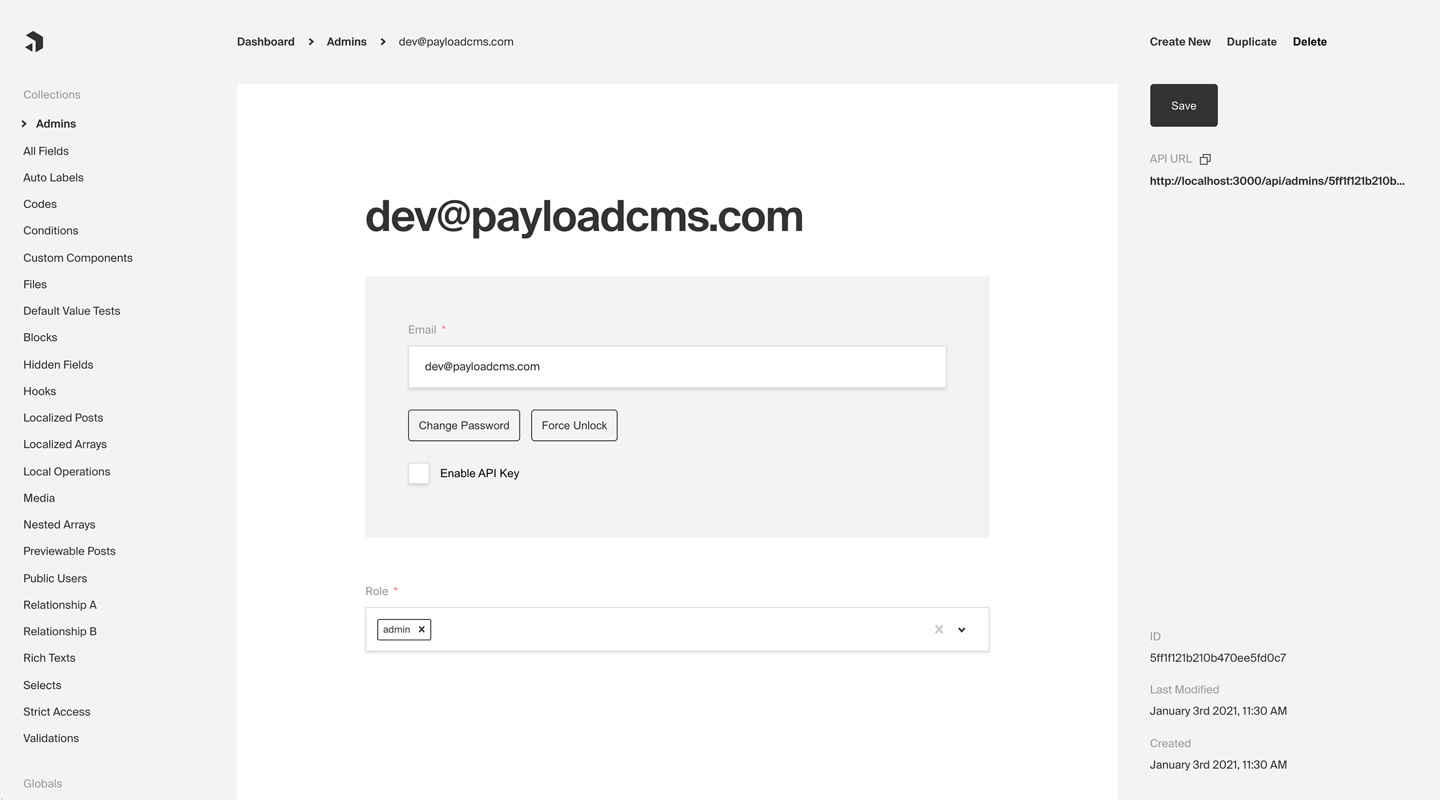
|
||||
_Admin Panel screenshot depicting an Admins Collection with Auth enabled_
|
||||
|
||||
## Config Options
|
||||
|
||||
Any [Collection](../configuration/collections) can opt-in to supporting Authentication. Once enabled, each Document that is created within the Collection can be thought of as a "user". This enables a complete authentication workflow on your Collection, such as logging in and out, resetting their password, and more.
|
||||
|
||||
<Banner type="warning">
|
||||
<strong>Note:</strong>
|
||||
By default, Payload provides an auth-enabled `User` Collection which is used to access the Admin Panel. [More details](../admin/overview#the-admin-user-collection).
|
||||
<Banner>
|
||||
Payload provides for highly secure and customizable user Authentication out of the box, which
|
||||
allows for users to identify themselves to Payload.
|
||||
</Banner>
|
||||
|
||||
To enable Authentication on a Collection, use the `auth` property in the [Collection Config](../configuration/collections):
|
||||
Authentication is used within the Payload Admin panel itself as well as throughout your app(s) themselves however you determine necessary.
|
||||
|
||||

|
||||
_Admin panel screenshot depicting an Admins Collection with Auth enabled_
|
||||
|
||||
**Here are some common use cases of Authentication outside of Payload's dashboard itself:**
|
||||
|
||||
- Customer accounts for an ecommerce app
|
||||
- Customer accounts for a SaaS product
|
||||
- P2P app or social site where users need to log in and manage their profiles
|
||||
- Online game where players need to track their progress over time
|
||||
|
||||
By default, Payload provides you with a `User` collection that supports Authentication, which is used to access the Admin panel. But, you can add support to one or many Collections of your own. For more information on how to customize, override, or remove the default `User` collection, [click here](/docs/admin/overview#the-admin-user-collection).
|
||||
|
||||
### Enabling Auth on a collection
|
||||
|
||||
Every Payload Collection can opt-in to supporting Authentication by specifying the `auth` property on the Collection's config to either `true` or to an object containing `auth` options.
|
||||
|
||||
**For a full list of all `auth` options, [click here](/docs/authentication/config).**
|
||||
|
||||
Simple example collection:
|
||||
|
||||
```ts
|
||||
import type { CollectionConfig } from 'payload'
|
||||
import { CollectionConfig } from 'payload/types'
|
||||
|
||||
export const Admins: CollectionConfig = {
|
||||
// ...
|
||||
slug: 'admins',
|
||||
// highlight-start
|
||||
auth: {
|
||||
tokenExpiration: 7200, // How many seconds to keep the user logged in
|
||||
@@ -61,137 +52,130 @@ export const Admins: CollectionConfig = {
|
||||
// More options are available
|
||||
},
|
||||
// highlight-end
|
||||
fields: [
|
||||
{
|
||||
name: 'role',
|
||||
type: 'select',
|
||||
required: true,
|
||||
options: [
|
||||
'user',
|
||||
'admin',
|
||||
'editor',
|
||||
'developer',
|
||||
],
|
||||
},
|
||||
],
|
||||
}
|
||||
```
|
||||
|
||||
<Banner type="info">
|
||||
**By enabling Authentication on a config, the following modifications will automatically be made to your Collection:**
|
||||
|
||||
1. `email` as well as password `salt` & `hash` fields will be added to your Collection's schema
|
||||
1. The Admin panel will feature a new set of corresponding UI to allow for changing password and editing email
|
||||
1. [A new set of `operations`](/docs/authentication/operations) will be exposed via Payload's REST, Local, and GraphQL APIs
|
||||
|
||||
Once enabled, each document that is created within the Collection can be thought of as a `user` - who can make use of commonly required authentication functions such as logging in / out, resetting their password, and more.
|
||||
|
||||
### Logging in / out, resetting password, etc.
|
||||
|
||||
[Click here](/docs/authentication/operations) for a list of all automatically-enabled Auth operations, including `login`, `logout`, `refresh`, and others.
|
||||
|
||||
### Token-based auth
|
||||
|
||||
Successfully logging in returns a `JWT` (JSON web token) which is how a user will identify themselves to Payload. By providing this JWT via either an HTTP-only cookie or an `Authorization` header, Payload will automatically identify the user and add its user JWT data to the Express `req`, which is available throughout Payload including within access control, hooks, and more.
|
||||
|
||||
You can specify what data gets encoded to the JWT token by setting `saveToJWT` to true in your auth collection fields. If you wish to use a different key other than the field `name`, you can provide it to `saveToJWT` as a string. It is also possible to use `saveToJWT` on fields that are nested in inside groups and tabs. If a group has a `saveToJWT` set it will include the object with all sub-fields in the token. You can set `saveToJWT: false` for any fields you wish to omit. If a field inside a group has `saveToJWT` set, but the group does not, the field will be included at the top level of the token.
|
||||
|
||||
<Banner type="success">
|
||||
<strong>Tip:</strong>
|
||||
For default auth behavior, set `auth: true`. This is a good starting point for most applications.
|
||||
<br />
|
||||
You can access the logged-in user from access control functions and hooks via the Express{' '}
|
||||
<strong>req</strong>. The logged-in user is automatically added as the <strong>user</strong>{' '}
|
||||
property.
|
||||
</Banner>
|
||||
|
||||
### HTTP-only cookies
|
||||
|
||||
Payload `login`, `logout`, and `refresh` operations make use of HTTP-only cookies for authentication purposes. HTTP-only cookies are a highly secure method of storing identifiable data on a user's device so that Payload can automatically recognize a returning user until their cookie expires. They are totally protected from common XSS attacks and cannot be read at all via JavaScript in the browser.
|
||||
|
||||
##### Automatic browser inclusion
|
||||
|
||||
Modern browsers automatically include `http-only` cookies when making requests directly to URLs—meaning that if you are running your API on http://example.com, and you have logged in and visit http://example.com/test-page, your browser will automatically include the Payload authentication cookie for you.
|
||||
|
||||
##### Using Fetch or other HTTP APIs
|
||||
|
||||
However, if you use `fetch` or similar APIs to retrieve Payload resources from its REST or GraphQL API, you need to specify to include credentials (cookies).
|
||||
|
||||
Fetch example, including credentials:
|
||||
|
||||
```ts
|
||||
const response = await fetch('http://localhost:3000/api/pages', {
|
||||
credentials: 'include',
|
||||
})
|
||||
|
||||
const pages = await response.json()
|
||||
```
|
||||
|
||||
For more about how to automatically include cookies in requests from your app to your Payload API, [click here](https://developer.mozilla.org/en-US/docs/Web/API/Fetch_API/Using_Fetch#Sending_a_request_with_credentials_included).
|
||||
|
||||
<Banner type="success">
|
||||
<strong>Tip:</strong>
|
||||
<br />
|
||||
To make sure you have a Payload cookie set properly in your browser after logging in, you can use
|
||||
Chrome's Developer Tools - Application - Cookies - [your-domain-here]. The Chrome Developer tools
|
||||
will still show HTTP-only cookies, even when JavaScript running on the page can't.
|
||||
</Banner>
|
||||
|
||||
### CSRF Protection
|
||||
|
||||
CSRF (cross-site request forgery) attacks are common and dangerous. By using an HTTP-only cookie, Payload removes many XSS vulnerabilities, however, CSRF attacks can still be possible.
|
||||
|
||||
For example, let's say you have a very popular app running at coolsite.com. This app allows users to manage finances and send / receive money. As Payload is using HTTP-only cookies, that means that browsers automatically will include cookies when sending requests to your domain - no matter what page created the request.
|
||||
|
||||
So, if a user of coolsite.com is logged in and just browsing around on the internet, they might stumble onto a page with bad intentions. That bad page might automatically make requests to all sorts of sites to see if they can find one that they can log into - and coolsite.com might be on their list. If your user was logged in while they visited that evil site, the attacker could do whatever they wanted as if they were your coolsite.com user by just sending requests to the coolsite API (which would automatically include the auth cookie). They could send themselves a bunch of money from your user's account, change the user's password, etc. This is what a CSRF attack is.
|
||||
|
||||
<Banner type="warning">
|
||||
<strong>Note:</strong>
|
||||
Auth-enabled Collections with be automatically injected with the `hash`, `salt`, and `email` fields. [More details](../fields/overview#field-names).
|
||||
<strong>
|
||||
To protect against CSRF attacks, Payload only accepts cookie-based authentication from domains
|
||||
that you explicitly whitelist.
|
||||
</strong>
|
||||
</Banner>
|
||||
|
||||
The following options are available:
|
||||
To define domains that should allow users to identify themselves via the Payload HTTP-only cookie, use the `csrf` option on the base Payload config to whitelist domains that you trust.
|
||||
|
||||
| Option | Description |
|
||||
|----------------------------|-------------------------------------------------------------------------------------------------------------------------------------------------------------------------------------------------------------------------------------|
|
||||
| **`cookies`** | Set cookie options, including `secure`, `sameSite`, and `domain`. For advanced users. |
|
||||
| **`depth`** | How many levels deep a `user` document should be populated when creating the JWT and binding the `user` to the `req`. Defaults to `0` and should only be modified if absolutely necessary, as this will affect performance. |
|
||||
| **`disableLocalStrategy`** | Advanced - disable Payload's built-in local auth strategy. Only use this property if you have replaced Payload's auth mechanisms with your own. |
|
||||
| **`forgotPassword`** | Customize the way that the `forgotPassword` operation functions. [More details](./email#forgot-password). |
|
||||
| **`lockTime`** | Set the time (in milliseconds) that a user should be locked out if they fail authentication more times than `maxLoginAttempts` allows for. |
|
||||
| **`loginWithUsername`** | Ability to allow users to login with username/password. [More](/docs/authentication/overview#login-with-username) |
|
||||
| **`maxLoginAttempts`** | Only allow a user to attempt logging in X amount of times. Automatically locks out a user from authenticating if this limit is passed. Set to `0` to disable. |
|
||||
| **`removeTokenFromResponses`** | Set to true if you want to remove the token from the returned authentication API responses such as login or refresh. |
|
||||
| **`strategies`** | Advanced - an array of custom authentification strategies to extend this collection's authentication with. [More details](./custom-strategies). |
|
||||
| **`tokenExpiration`** | How long (in seconds) to keep the user logged in. JWTs and HTTP-only cookies will both expire at the same time. |
|
||||
| **`useAPIKey`** | Payload Authentication provides for API keys to be set on each user within an Authentication-enabled Collection. [More details](./api-keys). |
|
||||
| **`verify`** | Set to `true` or pass an object with verification options to require users to verify by email before they are allowed to log into your app. [More details](./email#email-verification). |
|
||||
`payload.config.ts`:
|
||||
|
||||
### Login With Username
|
||||
```ts
|
||||
import { buildConfig } from 'payload/config'
|
||||
|
||||
You can allow users to login with their username instead of their email address by setting the `loginWithUsername` property to `true`.
|
||||
const config = buildConfig({
|
||||
collections: [
|
||||
// collections here
|
||||
],
|
||||
// highlight-start
|
||||
csrf: [
|
||||
// whitelist of domains to allow cookie auth from
|
||||
'https://your-frontend-app.com',
|
||||
'https://your-other-frontend-app.com',
|
||||
],
|
||||
// highlight-end
|
||||
})
|
||||
|
||||
export default config
|
||||
```
|
||||
|
||||
### Identifying users via the Authorization Header
|
||||
|
||||
In addition to authenticating via an HTTP-only cookie, you can also identify users via the `Authorization` header on an HTTP request.
|
||||
|
||||
Example:
|
||||
|
||||
```ts
|
||||
{
|
||||
slug: 'customers',
|
||||
auth: {
|
||||
loginWithUsername: true,
|
||||
const request = await fetch('http://localhost:3000', {
|
||||
headers: {
|
||||
Authorization: `JWT ${token}`,
|
||||
},
|
||||
}
|
||||
```
|
||||
|
||||
Or, you can pass an object with additional options:
|
||||
|
||||
```ts
|
||||
{
|
||||
slug: 'customers',
|
||||
auth: {
|
||||
loginWithUsername: {
|
||||
allowEmailLogin: true, // default: false
|
||||
requireEmail: false, // default: false
|
||||
},
|
||||
},
|
||||
}
|
||||
```
|
||||
|
||||
**`allowEmailLogin`**
|
||||
|
||||
If set to `true`, users can log in with either their username or email address. If set to `false`, users can only log in with their username.
|
||||
|
||||
**`requireEmail`**
|
||||
|
||||
If set to `true`, an email address is required when creating a new user. If set to `false`, email is not required upon creation.
|
||||
|
||||
## Auto-Login
|
||||
|
||||
For testing and demo purposes you may want to skip forcing the user to login in order to access your application. Typically, all users should be required to login, however, you can speed up local development time by enabling auto-login.
|
||||
|
||||
To enable auto-login, set the `autoLogin` property in the [Admin Config](../configuration/admin):
|
||||
|
||||
```ts
|
||||
import { buildConfig } from 'payload'
|
||||
|
||||
export default buildConfig({
|
||||
// ...
|
||||
// highlight-start
|
||||
autoLogin:
|
||||
process.env.NEXT_PUBLIC_ENABLE_AUTOLOGIN === 'true'
|
||||
? {
|
||||
email: 'test@example.com',
|
||||
password: 'test',
|
||||
prefillOnly: true,
|
||||
}
|
||||
: false,
|
||||
// highlight-end
|
||||
})
|
||||
```
|
||||
|
||||
<Banner type="warning">
|
||||
<strong>Warning:</strong>
|
||||
The recommended way to use this feature is behind an [Environment Variable](../configuration/environment-vars). This will ensure it is _disabled_ in production.
|
||||
</Banner>
|
||||
|
||||
The following options are available:
|
||||
|
||||
| Option | Description |
|
||||
|-------------------|-----------------------------------------------------------------------------------------------------------------|
|
||||
| **`username`** | The username of the user to login as |
|
||||
| **`email`** | The email address of the user to login as |
|
||||
| **`password`** | The password of the user to login as. This is only needed if `prefillOnly` is set to true |
|
||||
| **`prefillOnly`** | If set to true, the login credentials will be prefilled but the user will still need to click the login button. |
|
||||
|
||||
## Operations
|
||||
|
||||
All auth-related operations are available via Payload's REST, Local, and GraphQL APIs. These operations are automatically added to your Collection when you enable Authentication. [More details](./operations).
|
||||
|
||||
## Strategies
|
||||
|
||||
Out of the box Payload ships with a three powerful Authentication strategies:
|
||||
|
||||
- [HTTP-Only Cookies](./cookies)
|
||||
- [JSON Web Tokens (JWT)](./jwt)
|
||||
- [API-Keys](./api-keys)
|
||||
|
||||
Each of these strategies can work together or independently. You can also create your own custom strategies to fit your specific needs. [More details](./custom-strategies).
|
||||
|
||||
### HTTP-Only Cookies
|
||||
|
||||
[HTTP-only cookies](https://developer.mozilla.org/en-US/docs/Web/HTTP/Cookies) are a highly secure method of storing identifiable data on a user's device so that Payload can automatically recognize a returning user until their cookie expires. They are totally protected from common XSS attacks and <strong>cannot be read by JavaScript in the browser</strong>, unlike JWT's. [More details](./cookies).
|
||||
|
||||
### JSON Web Tokens
|
||||
|
||||
JWT (JSON Web Tokens) can also be utilized to perform authentication. Tokens are generated on `login`, `refresh` and `me` operations and can be attached to future requests to authenticate users. [More details](./jwt).
|
||||
|
||||
### API Keys
|
||||
|
||||
API Keys can be enabled on auth collections. These are particularly useful when you want to authenticate against Payload from a third party service. [More details](./api-keys).
|
||||
|
||||
### Custom Strategies
|
||||
|
||||
There are cases where these may not be enough for your application. Payload is extendable by design so you can wire up your own strategy when you need to. [More details](./custom-strategies).
|
||||
You can retrieve a user's token via the response to `login`, `refresh`, and `me` auth operations.
|
||||
|
||||
@@ -1,107 +0,0 @@
|
||||
---
|
||||
title: Token Data
|
||||
label: Token Data
|
||||
order: 70
|
||||
desc: Storing data for read on the request object.
|
||||
keywords: authentication, config, configuration, documentation, Content Management System, cms, headless, javascript, node, react, nextjs
|
||||
---
|
||||
|
||||
During the lifecycle of a request you will be able to access the data you have configured to be stored in the JWT by accessing `req.user`. The user object is automatically appeneded to the request for you.
|
||||
|
||||
### Definining Token Data
|
||||
|
||||
You can specify what data gets encoded to the Cookie/JWT-Token by setting `saveToJWT` property on fields within your auth collection.
|
||||
|
||||
```ts
|
||||
import type { CollectionConfig } from 'payload'
|
||||
|
||||
export const Users: CollectionConfig = {
|
||||
slug: 'users',
|
||||
auth: true,
|
||||
fields: [
|
||||
{
|
||||
// will be stored in the JWT
|
||||
saveToJWT: true,
|
||||
type: 'select',
|
||||
name: 'role',
|
||||
options: [
|
||||
'super-admin',
|
||||
'user',
|
||||
]
|
||||
},
|
||||
{
|
||||
// the entire object will be stored in the JWT
|
||||
// tab fields can do the same thing!
|
||||
saveToJWT: true,
|
||||
type: 'group',
|
||||
name: 'group1',
|
||||
fields: [
|
||||
{
|
||||
type: 'text',
|
||||
name: 'includeField',
|
||||
},
|
||||
{
|
||||
// will be omitted from the JWT
|
||||
saveToJWT: false,
|
||||
type: 'text',
|
||||
name: 'omitField',
|
||||
},
|
||||
]
|
||||
},
|
||||
{
|
||||
type: 'group',
|
||||
name: 'group2',
|
||||
fields: [
|
||||
{
|
||||
// will be stored in the JWT
|
||||
// but stored at the top level
|
||||
saveToJWT: true,
|
||||
type: 'text',
|
||||
name: 'includeField',
|
||||
},
|
||||
{
|
||||
type: 'text',
|
||||
name: 'omitField',
|
||||
},
|
||||
]
|
||||
},
|
||||
]
|
||||
}
|
||||
```
|
||||
|
||||
<Banner type="success">
|
||||
<strong>Tip:</strong>
|
||||
<br/>
|
||||
If you wish to use a different key other than the field `name`, you can define `saveToJWT` as a string.
|
||||
</Banner>
|
||||
|
||||
|
||||
### Using Token Data
|
||||
|
||||
This is especially helpful when writing [Hooks](../hooks/overview) and [Access Control](../access-control/overview) that depend on user defined fields.
|
||||
|
||||
```ts
|
||||
import type { CollectionConfig } from 'payload'
|
||||
|
||||
export const Invoices: CollectionConfig = {
|
||||
slug: 'invoices',
|
||||
access: {
|
||||
read: ({ req, data }) => {
|
||||
if (!req?.user) return false
|
||||
// highlight-start
|
||||
if ({ req.user?.role === 'super-admin'}) {
|
||||
return true
|
||||
}
|
||||
// highlight-end
|
||||
return data.owner === req.user.id
|
||||
}
|
||||
}
|
||||
fields: [
|
||||
{
|
||||
name: 'owner',
|
||||
relationTo: 'users'
|
||||
},
|
||||
// ... other fields
|
||||
],
|
||||
}
|
||||
```
|
||||
56
docs/authentication/using-middleware.mdx
Normal file
56
docs/authentication/using-middleware.mdx
Normal file
@@ -0,0 +1,56 @@
|
||||
---
|
||||
title: Using the Payload Auth Middleware
|
||||
label: Using the Middleware
|
||||
order: 40
|
||||
desc: Make full use of Payload's built-in authentication with your own custom Express endpoints by adding Payload's authentication middleware.
|
||||
keywords: authentication, middleware, config, configuration, documentation, Content Management System, cms, headless, javascript, node, react, express
|
||||
---
|
||||
|
||||
Because Payload uses your existing Express server, you are free to add whatever logic you need to your app through endpoints of your own. However, Payload does not add its middleware to your Express app itself—instead, it scopes all of its middleware to Payload-specific routers.
|
||||
|
||||
This approach has a ton of benefits - it's great for isolation of concerns and limiting scope, but it also means that your additional routes won't have access to Payload's user authentication.
|
||||
|
||||
<Banner type="success">
|
||||
You can make full use of Payload's built-in authentication within your own custom Express
|
||||
endpoints by adding Payload's authentication middleware.
|
||||
</Banner>
|
||||
|
||||
<Banner type="warning">
|
||||
Payload must be initialized before the `payload.authenticate` middleware can be used. This is done
|
||||
by calling `payload.init()` prior to adding the middleware.
|
||||
</Banner>
|
||||
|
||||
Example in `server.js`:
|
||||
|
||||
```ts
|
||||
import express from 'express'
|
||||
import payload from 'payload'
|
||||
|
||||
const app = express()
|
||||
|
||||
const start = async () => {
|
||||
await payload.init({
|
||||
secret: 'PAYLOAD_SECRET_KEY',
|
||||
express: app,
|
||||
})
|
||||
|
||||
const router = express.Router()
|
||||
|
||||
// Note: Payload must be initialized before the `payload.authenticate` middleware can be used
|
||||
router.use(payload.authenticate) // highlight-line
|
||||
|
||||
router.get('/', (req, res) => {
|
||||
if (req.user) {
|
||||
return res.send(`Authenticated successfully as ${req.user.email}.`)
|
||||
}
|
||||
|
||||
return res.send('Not authenticated')
|
||||
})
|
||||
|
||||
app.use('/some-route-here', router)
|
||||
|
||||
app.listen(3000)
|
||||
}
|
||||
|
||||
start()
|
||||
```
|
||||
@@ -6,7 +6,7 @@ desc: Quickly configure and deploy your Payload Cloud project in a few simple st
|
||||
keywords: configuration, config, settings, project, cloud, payload cloud, deploy, deployment
|
||||
---
|
||||
|
||||
## Select your plan
|
||||
### Select your plan
|
||||
|
||||
Once you have created a project, you will need to select your plan. This will determine the resources that are allocated to your project and the features that are available to you.
|
||||
|
||||
@@ -17,7 +17,7 @@ Once you have created a project, you will need to select your plan. This will de
|
||||
anytime.
|
||||
</Banner>
|
||||
|
||||
## Project Details
|
||||
### Project Details
|
||||
|
||||
| Option | Description |
|
||||
| ---------------- | --------------------------------------------------------------------------------------------------------------------------------------------------------------------------------------------------------------------------------------------- |
|
||||
@@ -26,7 +26,7 @@ Once you have created a project, you will need to select your plan. This will de
|
||||
| **Project Slug** | Choose a unique slug to identify your project. This needs to be unique for your team and you can change it any time. |
|
||||
| **Team** | Select the team you want to create the project under. If this is your first project, a personal team will be created for you automatically. You can modify your team settings and invite new members at any time from the Team Settings page. |
|
||||
|
||||
## Build Settings
|
||||
### Build Settings
|
||||
|
||||
If you are deploying a new project from a template, the following settings will be automatically configured for you. If you are using your own repository, you need to make sure your build settings are accurate for your project to deploy correctly.
|
||||
|
||||
@@ -39,17 +39,17 @@ If you are deploying a new project from a template, the following settings will
|
||||
| **Branch to Deploy** | Select the branch of your repository that you want to deploy from. This is the branch that will be used to build your project when you commit new changes. |
|
||||
| **Default Domain** | Set a default domain for your project. This must be unique and you will not able to change it. You can always add a custom domain later in your project settings. |
|
||||
|
||||
## Environment Variables
|
||||
### Environment Variables
|
||||
|
||||
Any of the features in Payload Cloud that require environment variables will automatically be provided to your application. If your app requires any custom environment variables, you can set them here.
|
||||
|
||||
<Banner type="warning">
|
||||
Note: For security reasons, any variables you wish to provide to the [Admin Panel](../admin/overview) must be prefixed
|
||||
with `NEXT_PUBLIC_`. Learn more
|
||||
[here](../configuration/environment-vars).
|
||||
Note: For security reasons, any variables you wish to provide to the Admin panel must be prefixed
|
||||
with `PAYLOAD_PUBLIC_`. Learn more
|
||||
[here](https://payloadcms.com/docs/admin/webpack#admin-environment-vars).
|
||||
</Banner>
|
||||
|
||||
## Payment
|
||||
### Payment
|
||||
|
||||
Payment methods can be set per project and can be updated any time. You can use team’s default payment method, or add a new one. Modify your payment methods in your Project settings / Team settings.
|
||||
|
||||
|
||||
@@ -6,7 +6,7 @@ desc: Manage your Payload Cloud projects.
|
||||
keywords: cloud, payload cloud, projects, project, overview, database, file storage, build settings, environment variables, custom domains, email, developing locally
|
||||
---
|
||||
|
||||
## Overview
|
||||
### Overview
|
||||
|
||||
<Banner>
|
||||
The overview tab shows your most recent deployment, along with build and deployment logs. From
|
||||
@@ -18,51 +18,33 @@ keywords: cloud, payload cloud, projects, project, overview, database, file stor
|
||||
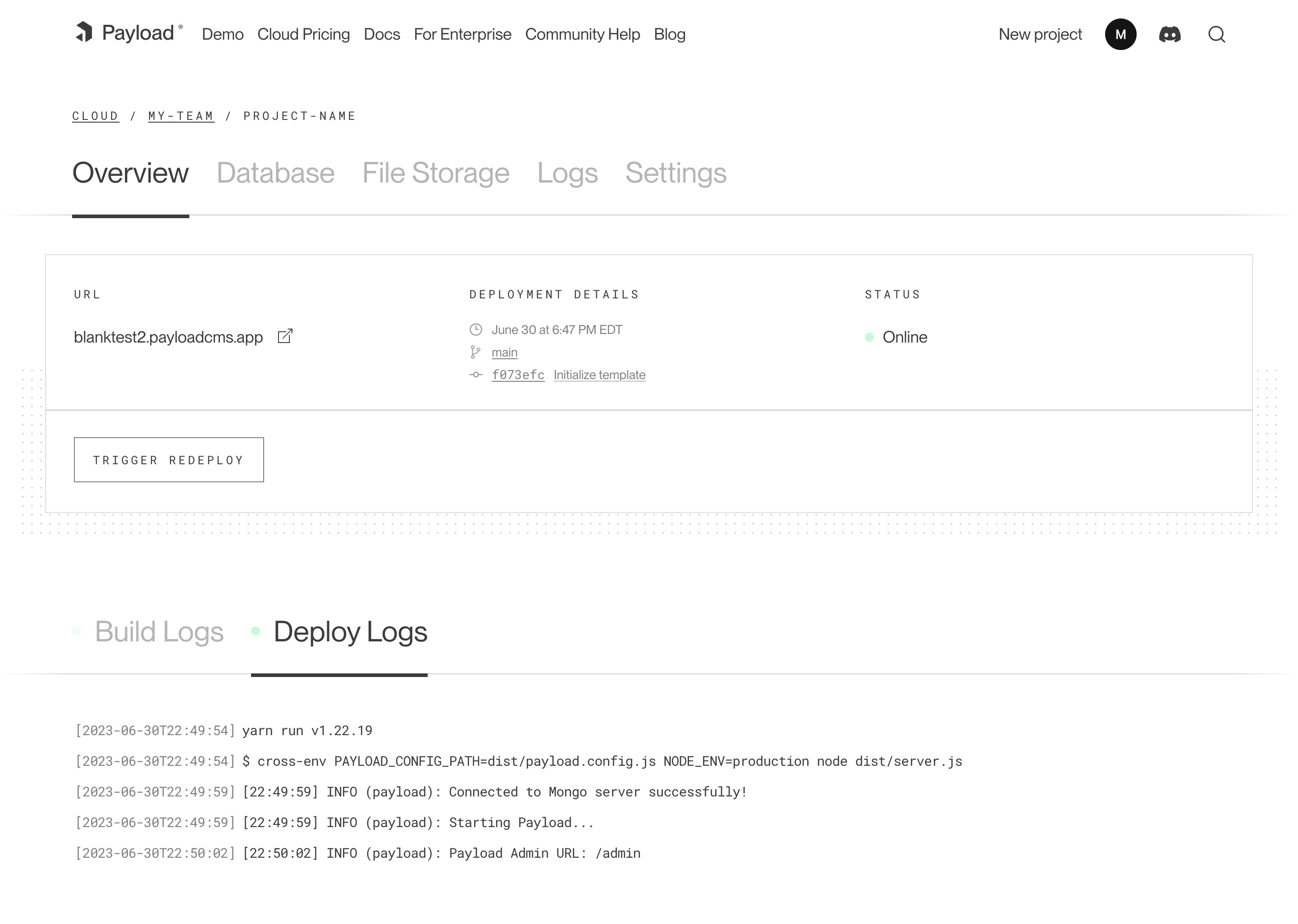
|
||||
_A screenshot of the Overview page for a Cloud project._
|
||||
|
||||
## Database
|
||||
### Database
|
||||
|
||||
Your Payload Cloud project comes with a MongoDB serverless Atlas DB instance or a Dedicated Atlas cluster, depending on your plan. To interact with your cloud database, you will be provided with a MongoDB connection string. This can be found under the **Database** tab of your project.
|
||||
|
||||
`mongodb+srv://your_connection_string`
|
||||
|
||||
## File Storage
|
||||
### File Storage
|
||||
|
||||
Payload Cloud gives you S3 file storage backed by Cloudflare as a CDN, and this plugin extends Payload so that all of your media will be stored in S3 rather than locally.
|
||||
|
||||
AWS Cognito is used for authentication to your S3 bucket. The [Payload Cloud Plugin](https://github.com/payloadcms/plugin-cloud) will automatically pick up these values. These values are only if you'd like to access your files directly, outside of Payload Cloud.
|
||||
|
||||
### Accessing Files Outside of Payload Cloud
|
||||
|
||||
If you'd like to access your files outside of Payload Cloud, you'll need to retrieve some values from your project's settings and put them into your environment variables. In Payload Cloud, navigate to the File Storage tab and copy the values using the copy button. Put these values in your .env file. Also copy the Cognito Password value separately and put into your .env file as well.
|
||||
|
||||
When you are done, you should have the following values in your .env file:
|
||||
|
||||
```env
|
||||
PAYLOAD_CLOUD=true
|
||||
PAYLOAD_CLOUD_ENVIRONMENT=prod
|
||||
PAYLOAD_CLOUD_COGNITO_USER_POOL_CLIENT_ID=
|
||||
PAYLOAD_CLOUD_COGNITO_USER_POOL_ID=
|
||||
PAYLOAD_CLOUD_COGNITO_IDENTITY_POOL_ID=
|
||||
PAYLOAD_CLOUD_PROJECT_ID=
|
||||
PAYLOAD_CLOUD_BUCKET=
|
||||
PAYLOAD_CLOUD_BUCKET_REGION=
|
||||
PAYLOAD_CLOUD_COGNITO_PASSWORD=
|
||||
```
|
||||
|
||||
The plugin will pick up these values and use them to access your files.
|
||||
|
||||
## Build Settings
|
||||
### Build Settings
|
||||
|
||||
You can update settings from your Project’s Settings tab. Changes to your build settings will trigger a redeployment of your project.
|
||||
|
||||
## Environment Variables
|
||||
### Environment Variables
|
||||
|
||||
From the Environment Variables page of the Settings tab, you can add, update and delete variables for use in your project. Like build settings, these changes will trigger a redeployment of your project.
|
||||
|
||||
<Banner>
|
||||
Note: For security reasons, any variables you wish to provide to the [Admin Panel](../admin/overview) must be prefixed with `NEXT_PUBLIC_`. [More details](../configuration/environment-vars).
|
||||
Note: For security reasons, any variables you wish to provide to the Admin panel must be prefixed
|
||||
with `PAYLOAD_PUBLIC_`. Learn more
|
||||
[here](https://payloadcms.com/docs/admin/webpack#admin-environment-vars).
|
||||
</Banner>
|
||||
|
||||
## Custom Domains
|
||||
### Custom Domains
|
||||
|
||||
With Payload Cloud, you can add custom domain names to your project. To do so, first go to the Domains page of the Settings tab of your project. Here you can see your default domain. To add a new domain, type in the domain name you wish to use.
|
||||
|
||||
@@ -82,27 +64,27 @@ export default buildConfig({
|
||||
})
|
||||
```
|
||||
|
||||
## Email
|
||||
### Email
|
||||
|
||||
Powered by [Resend](https://resend.com), Payload Cloud comes with integrated email support out of the box. No configuration is needed, and you can use `payload.sendEmail()` to send email right from your Payload app. To learn more about sending email with Payload, checkout the [Email Configuration](../email/overview) overview.
|
||||
Powered by [Resend](https://resend.com), Payload Cloud comes with integrated email support out of the box. No configuration is needed, and you can use `payload.sendEmail()` to send email right from your Payload app. To learn more about sending email with Payload, checkout the [Email Configuration](https://payloadcms.com/docs/email/overview) overview.
|
||||
|
||||
If you are on the Pro or Enterprise plan, you can add your own custom Email domain name. From the Email page of your project’s Settings, add the domain you wish to use for email delivery. This will generate a set of DNS records. Add these records to your DNS provider and click verify to check that your records are resolving properly. Once verified, your emails will now be sent from your custom domain name.
|
||||
|
||||
## Developing Locally
|
||||
### Developing Locally
|
||||
|
||||
To make changes to your project, you will need to clone the repository defined in your project settings to your local machine. In order to run your project locally, you will need configure your local environment first. Refer to your repository’s `README.md` file to see the steps needed for your specific template.
|
||||
|
||||
From there, you are ready to make updates to your project. When you are ready to make your changes live, commit your changes to the branch you specified in your Project settings, and your application will automatically trigger a redeploy and build from your latest commit.
|
||||
|
||||
## Cloud Plugin
|
||||
### Cloud Plugin
|
||||
|
||||
Projects generated from a template will come pre-configured with the official Cloud Plugin, but if you are using your own repository you will need to add this into your project. To do so, add the plugin to your Payload Config:
|
||||
Projects generated from a template will come pre-configured with the official Cloud Plugin, but if you are using your own repository you will need to add this into your project. To do so, add the plugin to your Payload config:
|
||||
|
||||
`yarn add @payloadcms/plugin-cloud`
|
||||
|
||||
```js
|
||||
import { payloadCloud } from '@payloadcms/plugin-cloud'
|
||||
import { buildConfig } from 'payload'
|
||||
import { buildConfig } from 'payload/config'
|
||||
|
||||
export default buildConfig({
|
||||
plugins: [payloadCloud()],
|
||||
@@ -111,11 +93,11 @@ export default buildConfig({
|
||||
```
|
||||
|
||||
<Banner type="warning">
|
||||
**Note:** If your Payload Config already has an email with transport, this will take precedence
|
||||
**Note:** If your Payload config already has an email with transport, this will take precedence
|
||||
over Payload Cloud's email service.
|
||||
</Banner>
|
||||
|
||||
#### **Optional configuration**
|
||||
##### **Optional configuration**
|
||||
|
||||
If you wish to opt-out of any Payload cloud features, the plugin also accepts options to do so.
|
||||
|
||||
|
||||
@@ -14,22 +14,22 @@ keywords: team, teams, billing, subscription, payment, plan, plans, cloud, paylo
|
||||
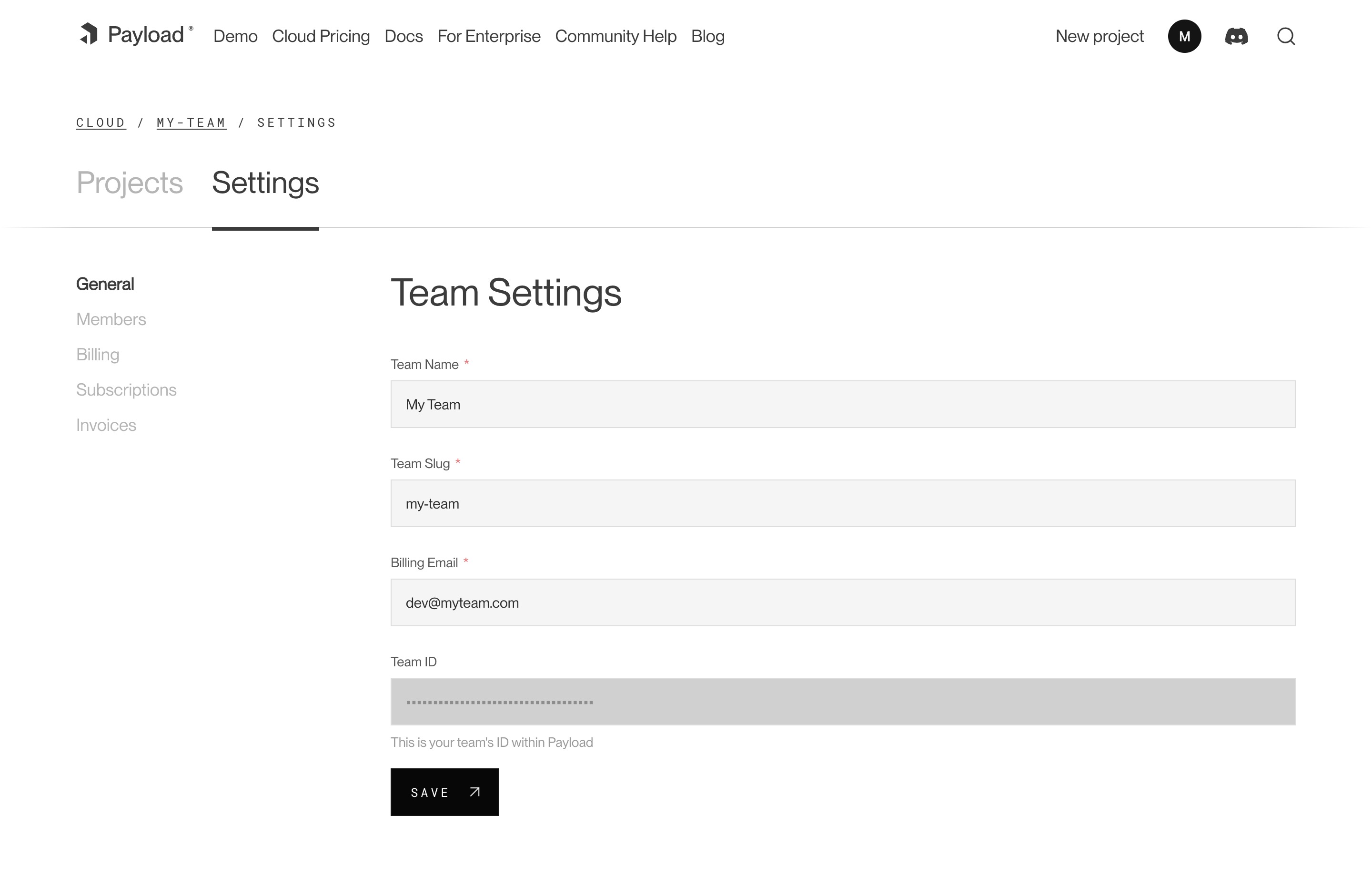
|
||||
_A screenshot of the Team Settings page._
|
||||
|
||||
## Members
|
||||
### Members
|
||||
|
||||
Each team has members that can interact with your projects. You can invite multiple people to your team and each individual can belong to more than one team. You can assign them either `owner` or `user` permissions. Owners are able to make admin-only changes, such as deleting projects, and editing billing information.
|
||||
|
||||
## Adding Members
|
||||
### Adding Members
|
||||
|
||||
To add a new member to your team, visit your Team’s Settings page, and click “Invite Teammate”. You can then add their email address, and assign their role. Press “Save” to send the invitations, which will send an email to the invited team member where they can create a new account.
|
||||
|
||||
## Billing
|
||||
### Billing
|
||||
|
||||
Users can update billing settings and subscriptions for any teams where they are designated as an `owner`. To make updates to the team’s payment methods, visit the Billing page under the Team Settings tab. You can add new cards, delete cards, and set a payment method as a default. The default payment method will be used in the event that another payment method fails.
|
||||
|
||||
## Subscriptions
|
||||
### Subscriptions
|
||||
|
||||
From the Subscriptions page, a team owner can see all current plans for their team. From here, you can see the price of each plan, if there is an active trial, and when you will be billed next.
|
||||
|
||||
## Invoices
|
||||
### Invoices
|
||||
|
||||
The Invoices page will you show you the invoices for your account, as well as the status on their payment.
|
||||
|
||||
@@ -3,105 +3,231 @@ title: Collection Configs
|
||||
label: Collections
|
||||
order: 20
|
||||
desc: Structure your Collections for your needs by defining fields, adding slugs and labels, establishing access control, tying in hooks, setting timestamps and more.
|
||||
keywords: collections, config, configuration, documentation, Content Management System, cms, headless, javascript, node, react, nextjs
|
||||
keywords: collections, config, configuration, documentation, Content Management System, cms, headless, javascript, node, react, express
|
||||
---
|
||||
|
||||
A Collection is a group of records, called Documents, that all share a common schema. You can define as many Collections as your application needs. Each Document in a Collection is stored in the [Database](../database/overview) based on the [Fields](../fields/overview) that you define, and automatically generates a [Local API](../local-api/overview), [REST API](../rest-api/overview), and [GraphQL API](../graphql/overview) used to manage your Documents.
|
||||
Payload Collections are defined through configs of their own, and you can define as many as your application needs. Each
|
||||
Collection will scaffold a new collection automatically in your database of choice, based on fields that you define.
|
||||
|
||||
Collections are also used to achieve [Authentication](../authentication/overview) in Payload. By defining a Collection with `auth` options, that Collection receives additional operations to support user authentication.
|
||||
It's often best practice to write your Collections in separate files and then import them into the main Payload config.
|
||||
|
||||
Collections are the primary way to structure recurring data in your application, such as users, products, pages, posts, and other types of content that you might want to manage. Each Collection can have its own unique [Access Control](../access-control/overview), [Hooks](../hooks/overview), [Admin Options](#admin-options), and more.
|
||||
## Options
|
||||
|
||||
To define a Collection Config, use the `collection` property in your [Payload Config](./overview):
|
||||
| Option | Description |
|
||||
|-------------------|--------------------------------------------------------------------------------------------------------------------------------------------------------------------------------------------------------------------------|
|
||||
| **`slug`** \* | Unique, URL-friendly string that will act as an identifier for this Collection. |
|
||||
| **`fields`** \* | Array of field types that will determine the structure and functionality of the data stored within this Collection. [Click here](/docs/fields/overview) for a full list of field types as well as how to configure them. |
|
||||
| **`labels`** | Singular and plural labels for use in identifying this Collection throughout Payload. Auto-generated from slug if not defined. |
|
||||
| **`admin`** | Admin-specific configuration. See below for [more detail](#admin-options). |
|
||||
| **`hooks`** | Entry points to "tie in" to Collection actions at specific points. [More](/docs/hooks/overview#collection-hooks) |
|
||||
| **`access`** | Provide access control functions to define exactly who should be able to do what with Documents in this Collection. [More](/docs/access-control/overview/#collections) |
|
||||
| **`auth`** | Specify options if you would like this Collection to feature authentication. For more, consult the [Authentication](/docs/authentication/config) documentation. |
|
||||
| **`upload`** | Specify options if you would like this Collection to support file uploads. For more, consult the [Uploads](/docs/upload/overview) documentation. |
|
||||
| **`timestamps`** | Set to false to disable documents' automatically generated `createdAt` and `updatedAt` timestamps. |
|
||||
| **`versions`** | Set to true to enable default options, or configure with object properties. [More](/docs/versions/overview#collection-config) |
|
||||
| **`endpoints`** | Add custom routes to the REST API. Set to `false` to disable routes. [More](/docs/rest-api/overview#custom-endpoints) |
|
||||
| **`graphQL`** | An object with `singularName` and `pluralName` strings used in schema generation. Auto-generated from slug if not defined. Set to `false` to disable GraphQL. |
|
||||
| **`typescript`** | An object with property `interface` as the text used in schema generation. Auto-generated from slug if not defined. |
|
||||
| **`defaultSort`** | Pass a top-level field to sort by default in the collection List view. Prefix the name of the field with a minus symbol ("-") to sort in descending order. |
|
||||
| **`custom`** | Extension point for adding custom data (e.g. for plugins) |
|
||||
|
||||
_\* An asterisk denotes that a property is required._
|
||||
|
||||
#### Simple collection example
|
||||
|
||||
```ts
|
||||
import { buildConfig } from 'payload'
|
||||
import { CollectionConfig } from 'payload/types'
|
||||
|
||||
export default buildConfig({
|
||||
// ...
|
||||
collections: [ // highlight-line
|
||||
// Your Collections go here
|
||||
export const Orders: CollectionConfig = {
|
||||
slug: 'orders',
|
||||
fields: [
|
||||
{
|
||||
name: 'total',
|
||||
type: 'number',
|
||||
required: true,
|
||||
},
|
||||
{
|
||||
name: 'placedBy',
|
||||
type: 'relationship',
|
||||
relationTo: 'customers',
|
||||
required: true,
|
||||
},
|
||||
],
|
||||
})
|
||||
}
|
||||
```
|
||||
|
||||
<Banner type="success">
|
||||
<strong>Tip:</strong>
|
||||
If your Collection is only ever meant to contain a single Document, consider using a [Global](./globals) instead.
|
||||
</Banner>
|
||||
#### More collection config examples
|
||||
|
||||
## Config Options
|
||||
You can find an assortment
|
||||
of [example collection configs](https://github.com/payloadcms/public-demo/tree/master/src/collections) in the Public
|
||||
Demo source code on GitHub.
|
||||
|
||||
It's often best practice to write your Collections in separate files and then import them into the main [Payload Config](../overview).
|
||||
### Admin options
|
||||
|
||||
Here is what a simple Collection Config might look like:
|
||||
You can customize the way that the Admin panel behaves on a collection-by-collection basis by defining the `admin`
|
||||
property on a collection's config.
|
||||
|
||||
| Option | Description |
|
||||
|------------------------------|-------------------------------------------------------------------------------------------------------------------------------------------------------------------------------------------------------|
|
||||
| `group` | Text used as a label for grouping collection and global links together in the navigation. |
|
||||
| `hidden` | Set to true or a function, called with the current user, returning true to exclude this collection from navigation and admin routing. |
|
||||
| `hooks` | Admin-specific hooks for this collection. [More](#admin-hooks) |
|
||||
| `useAsTitle` | Specify a top-level field to use for a document title throughout the Admin panel. If no field is defined, the ID of the document is used as the title. |
|
||||
| `description` | Text or React component to display below the Collection label in the List view to give editors more information. |
|
||||
| `defaultColumns` | Array of field names that correspond to which columns to show by default in this collection's List view. |
|
||||
| `disableDuplicate ` | Disables the "Duplicate" button while editing documents within this collection. |
|
||||
| `hideAPIURL` | Hides the "API URL" meta field while editing documents within this collection. |
|
||||
| `enableRichTextLink` | The [Rich Text](/docs/fields/rich-text) field features a `Link` element which allows for users to automatically reference related documents within their rich text. Set to `true` by default. |
|
||||
| `enableRichTextRelationship` | The [Rich Text](/docs/fields/rich-text) field features a `Relationship` element which allows for users to automatically reference related documents within their rich text. Set to `true` by default. |
|
||||
| `preview` | Function to generate preview URLS within the Admin panel that can point to your app. [More](#preview). |
|
||||
| `livePreview` | Enable real-time editing for instant visual feedback of your front-end application. [More](/docs/live-preview/overview). |
|
||||
| `components` | Swap in your own React components to be used within this collection. [More](/docs/admin/components#collections) |
|
||||
| `listSearchableFields` | Specify which fields should be searched in the List search view. [More](#list-searchable-fields) |
|
||||
| **`pagination`** | Set pagination-specific options for this collection. [More](#pagination) |
|
||||
|
||||
### Preview
|
||||
|
||||
Collection `admin` options can accept a `preview` function that will be used to generate a link pointing to the frontend
|
||||
of your app to preview data.
|
||||
|
||||
If the function is specified, a Preview button will automatically appear in the corresponding collection's Edit view.
|
||||
Clicking the Preview button will link to the URL that is generated by the function.
|
||||
|
||||
**The preview function accepts two arguments:**
|
||||
|
||||
1. The document being edited
|
||||
1. An `options` object, containing `locale` and `token` properties. The `token` is the currently logged-in user's JWT.
|
||||
|
||||
**Example collection with preview function:**
|
||||
|
||||
```ts
|
||||
import type { CollectionConfig } from 'payload'
|
||||
import { CollectionConfig } from 'payload/types'
|
||||
|
||||
export const Posts: CollectionConfig = {
|
||||
slug: 'posts',
|
||||
fields: [
|
||||
{
|
||||
name: 'title',
|
||||
name: 'slug',
|
||||
type: 'text',
|
||||
}
|
||||
]
|
||||
required: true,
|
||||
},
|
||||
],
|
||||
admin: {
|
||||
preview: (doc, { locale }) => {
|
||||
if (doc?.slug) {
|
||||
return `https://bigbird.com/preview/posts/${doc.slug}?locale=${locale}`
|
||||
}
|
||||
|
||||
return null
|
||||
},
|
||||
},
|
||||
}
|
||||
```
|
||||
|
||||
<Banner type="success">
|
||||
<strong>Reminder:</strong>
|
||||
For a more complex example, see the [Public Demo](https://github.com/payloadcms/public-demo) source code on GitHub, or the [Templates](https://github.com/payloadcms/payload/tree/main/templates) and [Examples](https://github.com/payloadcms/payload/tree/main/examples) directories in the Payload repository.
|
||||
</Banner>
|
||||
### Pagination
|
||||
|
||||
The following options are available:
|
||||
Here are a few options that you can specify options for pagination on a collection-by-collection basis:
|
||||
|
||||
| Option | Description |
|
||||
|------------------------|----------------------------------------------------------------------------------------------------------------------------------------------------------------------------------------------- |
|
||||
| **`admin`** | The configuration options for the Admin Panel. [More details](../admin/collections). |
|
||||
| **`access`** | Provide Access Control functions to define exactly who should be able to do what with Documents in this Collection. [More details](../access-control/collections). |
|
||||
| **`auth`** | Specify options if you would like this Collection to feature authentication. [More details](../authentication/overview). |
|
||||
| **`custom`** | Extension point for adding custom data (e.g. for plugins) |
|
||||
| **`disableDuplicate`** | When true, do not show the "Duplicate" button while editing documents within this Collection and prevent `duplicate` from all APIs. |
|
||||
| **`defaultSort`** | Pass a top-level field to sort by default in the Collection List View. Prefix the name of the field with a minus symbol ("-") to sort in descending order. |
|
||||
| **`dbName`** | Custom table or Collection name depending on the Database Adapter. Auto-generated from slug if not defined. |
|
||||
| **`endpoints`** | Add custom routes to the REST API. Set to `false` to disable routes. [More details](../rest-api/overview#custom-endpoints). |
|
||||
| **`fields`** \* | Array of field types that will determine the structure and functionality of the data stored within this Collection. [More details](../fields/overview). |
|
||||
| **`graphQL`** | An object with `singularName` and `pluralName` strings used in schema generation. Auto-generated from slug if not defined. Set to `false` to disable GraphQL. |
|
||||
| **`hooks`** | Entry point for Hooks. [More details](../hooks/overview#collection-hooks). |
|
||||
| **`labels`** | Singular and plural labels for use in identifying this Collection throughout Payload. Auto-generated from slug if not defined. |
|
||||
| **`lockDocuments`** | Enables or disables document locking. By default, document locking is enabled. Set to an object to configure, or set to `false` to disable locking. [More details](../admin/locked-documents). |
|
||||
| **`slug`** \* | Unique, URL-friendly string that will act as an identifier for this Collection. |
|
||||
| **`timestamps`** | Set to false to disable documents' automatically generated `createdAt` and `updatedAt` timestamps. |
|
||||
| **`typescript`** | An object with property `interface` as the text used in schema generation. Auto-generated from slug if not defined. |
|
||||
| **`upload`** | Specify options if you would like this Collection to support file uploads. For more, consult the [Uploads](../upload/overview) documentation. |
|
||||
| **`versions`** | Set to true to enable default options, or configure with object properties. [More details](../versions/overview#collection-config). |
|
||||
| Option | Description |
|
||||
|----------------|-----------------------------------------------------------------------------------------------------|
|
||||
| `defaultLimit` | Integer that specifies the default per-page limit that should be used. Defaults to 10. |
|
||||
| `limits` | Provide an array of integers to use as per-page options for admins to choose from in the List view. |
|
||||
|
||||
_\* An asterisk denotes that a property is required._
|
||||
### Access control
|
||||
|
||||
### Fields
|
||||
|
||||
Fields define the schema of the Documents within a Collection. To learn more, go to the [Fields](../fields/overview) documentation.
|
||||
|
||||
### Access Control
|
||||
|
||||
[Collection Access Control](../access-control/overview) determines what a user can and cannot do with any given Document within a Collection. To learn more, go to the [Access Control](../access-control/overview) documentation.
|
||||
You can specify extremely granular access control (what users can do with documents in a collection) on a collection by
|
||||
collection basis. To learn more, go to the [Access Control](/docs/access-control/overview) docs.
|
||||
|
||||
### Hooks
|
||||
|
||||
[Collection Hooks](../hooks/collections) allow you to tie into the lifecycle of your Documents so you can execute your own logic during specific events. To learn more, go to the [Hooks](../hooks/overview) documentation.
|
||||
Hooks are a powerful way to extend collection functionality and execute your own logic, and can be defined on a
|
||||
collection by collection basis. To learn more, go to the [Hooks](/docs/hooks/overview) documentation.
|
||||
|
||||
### Admin Options
|
||||
### Field types
|
||||
|
||||
You can customize the way that the [Admin Panel](../admin/overview) behaves on a Collection-by-Collection basis. To learn more, go to the [Collection Admin Options](../admin/collections) documentation.
|
||||
Collections support all field types that Payload has to offer—including simple fields like text and checkboxes all the
|
||||
way to more complicated layout-building field groups like Blocks. [Click here](/docs/fields/overview) to learn more
|
||||
about field types.
|
||||
|
||||
## TypeScript
|
||||
### List Searchable Fields
|
||||
|
||||
You can import types from Payload to help make writing your Collection configs easier and type-safe. There are two main types that represent the Collection Config, `CollectionConfig` and `SanitizeCollectionConfig`.
|
||||
In the List view, there is a "search" box that allows you to quickly find a document with a search. By default, it
|
||||
searches on the ID field. If you have `admin.useAsTitle` defined, the list search will use that field. However, you can
|
||||
define more than one field to search to make it easier on your admin editors to find the data they need.
|
||||
|
||||
The `CollectionConfig` type represents a raw Collection Config in its full form, where only the bare minimum properties are marked as required. The `SanitizedCollectionConfig` type represents a Collection Config after it has been fully sanitized. Generally, this is only used internally by Payload.
|
||||
For example, let's say you have a Posts collection with `title`, `metaDescription`, and `tags` fields - and you want all
|
||||
three of those fields to be searchable in the List view. You can simply
|
||||
add `admin.listSearchableFields: ['title', 'metaDescription', 'tags']` - and the admin UI will automatically search on
|
||||
those three fields plus the ID field.
|
||||
|
||||
<Banner type="warning">
|
||||
<strong>Note:</strong>
|
||||
<br />
|
||||
If you are adding <strong>listSearchableFields</strong>, make sure you index each of these fields
|
||||
so your admin queries can remain performant.
|
||||
</Banner>
|
||||
|
||||
### Admin Hooks
|
||||
|
||||
In addition to collection hooks themselves, Payload provides for admin UI-specific hooks that you can leverage.
|
||||
|
||||
**`beforeDuplicate`**
|
||||
|
||||
The `beforeDuplicate` hook is an async function that accepts an object containing the data to duplicate, as well as the
|
||||
locale of the doc to duplicate. Within this hook, you can modify the data to be duplicated, which is useful in cases
|
||||
where you have unique fields that need to be incremented or similar, as well as if you want to automatically modify a
|
||||
document's `title`.
|
||||
|
||||
Example:
|
||||
|
||||
```ts
|
||||
import type { CollectionConfig, SanitizedCollectionConfig } from 'payload'
|
||||
import { BeforeDuplicate, CollectionConfig } from 'payload/types'
|
||||
// Your auto-generated Page type
|
||||
import { Page } from '../payload-types.ts'
|
||||
|
||||
const beforeDuplicate: BeforeDuplicate<Page> = ({ data }) => {
|
||||
return {
|
||||
...data,
|
||||
title: `${data.title} Copy`,
|
||||
uniqueField: data.uniqueField ? `${data.uniqueField}-copy` : '',
|
||||
}
|
||||
}
|
||||
|
||||
export const Page: CollectionConfig = {
|
||||
slug: 'pages',
|
||||
admin: {
|
||||
hooks: {
|
||||
beforeDuplicate,
|
||||
},
|
||||
},
|
||||
fields: [
|
||||
{
|
||||
name: 'title',
|
||||
type: 'text',
|
||||
},
|
||||
{
|
||||
name: 'uniqueField',
|
||||
type: 'text',
|
||||
unique: true,
|
||||
},
|
||||
],
|
||||
}
|
||||
```
|
||||
|
||||
### TypeScript
|
||||
|
||||
You can import collection types as follows:
|
||||
|
||||
```ts
|
||||
import { CollectionConfig } from 'payload/types'
|
||||
|
||||
// This is the type used for incoming collection configs.
|
||||
// Only the bare minimum properties are marked as required.
|
||||
```
|
||||
|
||||
```ts
|
||||
import { SanitizedCollectionConfig } from 'payload/types'
|
||||
|
||||
// This is the type used after an incoming collection config is fully sanitized.
|
||||
// Generally, this is only used internally by Payload.
|
||||
```
|
||||
|
||||
@@ -1,101 +0,0 @@
|
||||
---
|
||||
title: Environment Variables
|
||||
label: Environment Variables
|
||||
order: 100
|
||||
desc: Learn how to use Environment Variables in your Payload project
|
||||
---
|
||||
|
||||
Environment Variables are a way to store sensitive information that your application needs to function. This could be anything from API keys to [Database](../database/overview) credentials. Payload allows you to easily use Environment Variables within your config and throughout your application.
|
||||
|
||||
## Next.js Applications
|
||||
|
||||
If you are using Next.js, no additional setup is required other than creating your `.env` file.
|
||||
|
||||
To use Environment Variables, add a `.env` file to the root of your project:
|
||||
|
||||
```plaintext
|
||||
project-name/
|
||||
├─ .env
|
||||
├─ package.json
|
||||
├─ payload.config.ts
|
||||
```
|
||||
|
||||
Here is an example of what an `.env` file might look like:
|
||||
|
||||
```plaintext
|
||||
SERVER_URL=localhost:3000
|
||||
DATABASE_URI=mongodb://localhost:27017/my-database
|
||||
```
|
||||
|
||||
To use Environment Variables in your Payload Config, you can access them directly from `process.env`:
|
||||
|
||||
```ts
|
||||
import { buildConfig } from 'payload'
|
||||
|
||||
export default buildConfig({
|
||||
serverURL: process.env.SERVER_URL, // highlight-line
|
||||
// ...
|
||||
})
|
||||
```
|
||||
|
||||
## Client-side Environments
|
||||
|
||||
For security and safety reasons, the [Admin Panel](../admin/overview) does **not** include Environment Variables in its _client-side_ bundle by default. But, Next.js provides a mechanism to expose Environment Variables to the client-side bundle when needed.
|
||||
|
||||
If you are building a [Custom Component](../admin/components) and need to access Environment Variables from the client-side, you can do so by prefixing them with `NEXT_PUBLIC_`.
|
||||
|
||||
<Banner type="warning">
|
||||
<strong>Important:</strong>
|
||||
Be careful about what variables you provide to your client-side code. Analyze every single one to make sure that you're not accidentally leaking sensitive information. Only ever include keys that are safe for the public to read in plain text.
|
||||
</Banner>
|
||||
|
||||
For example, if you've got the following Environment Variable:
|
||||
|
||||
```bash
|
||||
NEXT_PUBLIC_STRIPE_PUBLISHABLE_KEY=pk_test_XXXXXXXXXXXXXXXXXX
|
||||
```
|
||||
|
||||
This key will automatically be made available to the client-side Payload bundle and can be referenced in your Custom Component as follows:
|
||||
|
||||
```tsx
|
||||
'use client'
|
||||
import React from 'react'
|
||||
|
||||
const stripeKey = process.env.NEXT_PUBLIC_STRIPE_PUBLISHABLE_KEY // highlight-line
|
||||
|
||||
const MyClientComponent = () => {
|
||||
// do something with the key
|
||||
|
||||
return (
|
||||
<div>
|
||||
My Client Component
|
||||
</div>
|
||||
)
|
||||
}
|
||||
```
|
||||
|
||||
For more information, check out the [Next.js Documentation](https://nextjs.org/docs/app/building-your-application/configuring/environment-variables).
|
||||
|
||||
## Outside of Next.js
|
||||
|
||||
If you are using Payload outside of Next.js, we suggest using the [`dotenv`](https://www.npmjs.com/package/dotenv) package to handle Environment Variables from `.env` files. This will automatically load your Environment Variables into `process.env`.
|
||||
|
||||
To do this, import the package as high up in your application as possible:
|
||||
|
||||
```ts
|
||||
import dotenv from 'dotenv'
|
||||
dotenv.config() // highlight-line
|
||||
|
||||
import { buildConfig } from 'payload'
|
||||
|
||||
export default buildConfig({
|
||||
serverURL: process.env.SERVER_URL,
|
||||
// ...
|
||||
})
|
||||
```
|
||||
|
||||
<Banner type="warning">
|
||||
<strong>Tip:</strong>
|
||||
Be sure that `dotenv` can find your `.env` file. By default, it will look for a file named `.env` in the root of your project. If you need to specify a different file, pass the path into the config options.
|
||||
</Banner>
|
||||
|
||||
81
docs/configuration/express.mdx
Normal file
81
docs/configuration/express.mdx
Normal file
@@ -0,0 +1,81 @@
|
||||
---
|
||||
title: Express
|
||||
label: Express
|
||||
order: 60
|
||||
desc: Payload utilizes Express middleware packages, you can customize how they work by passing in configuration options.
|
||||
keywords: config, configuration, documentation, Content Management System, cms, headless, javascript, node, react, express
|
||||
---
|
||||
|
||||
Payload utilizes a few Express-specific middleware packages within its own routers. You can customize how they work by passing in configuration options to the main Payload config's `express` property.
|
||||
|
||||
### Custom Middleware
|
||||
|
||||
Payload allows you to pass in custom Express middleware to be used on all of the routes it opens. This is useful for adding logging or any other custom functionality to your endpoints.
|
||||
|
||||
There are 2 exposed properties. Each property is an array of middleware functions.
|
||||
|
||||
- `preMiddleware` - runs before any of the Payload middleware
|
||||
- `postMiddleware` - runs after all of the Payload middleware
|
||||
|
||||
```ts
|
||||
{
|
||||
express: {
|
||||
preMiddleware: [
|
||||
(req, res, next) => {
|
||||
// do something
|
||||
next()
|
||||
}
|
||||
],
|
||||
postMiddleware: [
|
||||
(req, res, next) => {
|
||||
// do something
|
||||
next()
|
||||
}
|
||||
]
|
||||
}
|
||||
}
|
||||
|
||||
// Example logging middleware function
|
||||
const requestLoggerMiddleware = (req, res, next) => {
|
||||
req.payload.logger.info(`request: ${req.method} ${req.url}`)
|
||||
next()
|
||||
}
|
||||
```
|
||||
|
||||
### JSON
|
||||
|
||||
`express.json()` is used to parse JSON body content into JavaScript objects accessible on the Express `req`. Payload allows you to customize all of the `json` method's options. Common examples of customization use-cases are increasing the max allowed JSON body size which defaults to `2MB`.
|
||||
|
||||
**Example payload.config.js for how to increase the max JSON size allowed to be sent to Payload endpoints:**
|
||||
|
||||
```js
|
||||
{
|
||||
express: {
|
||||
json: {
|
||||
limit: '4mb',
|
||||
}
|
||||
}
|
||||
}
|
||||
```
|
||||
|
||||
You can find a list of all available options that are able to be passed to `express.json()` [here](https://expressjs.com/en/api.html).
|
||||
|
||||
### Compression
|
||||
|
||||
Payload uses the `compression` package to optimize transfer size for all of the routes it opens, and you can pass customization options through the Payload config.
|
||||
|
||||
To customize compression options, pass an object to the Payload config's `express` property.
|
||||
|
||||
**Example payload.config.js:**
|
||||
|
||||
```js
|
||||
{
|
||||
express: {
|
||||
compression: {
|
||||
// settings go here
|
||||
}
|
||||
}
|
||||
}
|
||||
```
|
||||
|
||||
Typically, the default options for this package are suitable. However, for a list of all available customization options, [click here](http://expressjs.com/en/resources/middleware/compression.html).
|
||||
@@ -3,41 +3,38 @@ title: Global Configs
|
||||
label: Globals
|
||||
order: 30
|
||||
desc: Set up your Global config for your needs by defining fields, adding slugs and labels, establishing access control, tying in hooks and more.
|
||||
keywords: globals, config, configuration, documentation, Content Management System, cms, headless, javascript, node, react, nextjs
|
||||
keywords: globals, config, configuration, documentation, Content Management System, cms, headless, javascript, node, react, express
|
||||
---
|
||||
|
||||
Globals are in many ways similar to [Collections](../configuration/collections), except they correspond to only a single Document. You can define as many Globals as your application needs. Each Global Document is stored in the [Database](../database/overview) based on the [Fields](../fields/overview) that you define, and automatically generates a [Local API](../local-api/overview), [REST API](../rest-api/overview), and [GraphQL API](../graphql/overview) used to manage your Documents.
|
||||
Global configs are in many ways similar to [Collections](/docs/configuration/collections). The big difference is that Collections will potentially contain _many_ documents, while a Global is a "one-off". Globals are perfect for things like header nav, site-wide banner alerts, app-wide localized strings, and other "global" data that your site or app might rely on.
|
||||
|
||||
Globals are the primary way to structure singletons in Payload, such as a header navigation, site-wide banner alerts, or app-wide localized strings. Each Global can have its own unique [Access Control](../access-control/overview), [Hooks](../hooks/overview), [Admin Options](#admin-options), and more.
|
||||
As with Collection configs, it's often best practice to write your Globals in separate files and then import them into the main Payload config.
|
||||
|
||||
To define a Global Config, use the `globals` property in your [Payload Config](./overview):
|
||||
## Options
|
||||
|
||||
| Option | Description |
|
||||
| ------------------ | -------------------------------------------------------------------------------------------------------------------------------------------------------------------------------------------------------------------- |
|
||||
| **`slug`** \* | Unique, URL-friendly string that will act as an identifier for this Global. |
|
||||
| **`fields`** \* | Array of field types that will determine the structure and functionality of the data stored within this Global. [Click here](/docs/fields/overview) for a full list of field types as well as how to configure them. |
|
||||
| **`label`** | Text for the name in the Admin panel or an object with keys for each language. Auto-generated from slug if not defined. |
|
||||
| **`description`** | Text or React component to display below the Global header to give editors more information. |
|
||||
| **`admin`** | Admin-specific configuration. See below for [more detail](/docs/configuration/globals#admin-options). |
|
||||
| **`hooks`** | Entry points to "tie in" to collection actions at specific points. [More](/docs/hooks/overview#global-hooks) |
|
||||
| **`access`** | Provide access control functions to define exactly who should be able to do what with this Global. [More](/docs/access-control/overview/#globals) |
|
||||
| **`versions`** | Set to true to enable default options, or configure with object properties. [More](/docs/versions/overview#globals-config) |
|
||||
| **`endpoints`** | Add custom routes to the REST API. [More](/docs/rest-api/overview#custom-endpoints) |
|
||||
| **`graphQL.name`** | Text used in schema generation. Auto-generated from slug if not defined. |
|
||||
| **`typescript`** | An object with property `interface` as the text used in schema generation. Auto-generated from slug if not defined. |
|
||||
| **`custom`** | Extension point for adding custom data (e.g. for plugins) |
|
||||
|
||||
_\* An asterisk denotes that a property is required._
|
||||
|
||||
#### Simple Global example
|
||||
|
||||
```ts
|
||||
import { buildConfig } from 'payload'
|
||||
import { GlobalConfig } from 'payload/types'
|
||||
|
||||
export default buildConfig({
|
||||
// ...
|
||||
globals: [ // highlight-line
|
||||
// Your Globals go here
|
||||
],
|
||||
})
|
||||
```
|
||||
|
||||
<Banner type="success">
|
||||
<strong>Tip:</strong>
|
||||
If you have more than one Global that share the same structure, consider using a [Collection](../configuration/collections) instead.
|
||||
</Banner>
|
||||
|
||||
## Config Options
|
||||
|
||||
It's often best practice to write your Globals in separate files and then import them into the main [Payload Config](./overview).
|
||||
|
||||
Here is what a simple Global Config might look like:
|
||||
|
||||
```ts
|
||||
import { GlobalConfig } from 'payload'
|
||||
|
||||
export const Nav: GlobalConfig = {
|
||||
const Nav: GlobalConfig = {
|
||||
slug: 'nav',
|
||||
fields: [
|
||||
{
|
||||
@@ -56,56 +53,90 @@ export const Nav: GlobalConfig = {
|
||||
},
|
||||
],
|
||||
}
|
||||
|
||||
export default Nav
|
||||
```
|
||||
|
||||
<Banner type="success">
|
||||
<strong>Reminder:</strong>
|
||||
For a more complex example, see the [Public Demo](https://github.com/payloadcms/public-demo) source code on GitHub, or the [Templates](https://github.com/payloadcms/payload/tree/main/templates) and [Examples](https://github.com/payloadcms/payload/tree/main/examples) directories in the Payload repository.
|
||||
</Banner>
|
||||
#### Global config example
|
||||
|
||||
The following options are available:
|
||||
You can find an [example Global config](https://github.com/payloadcms/public-demo/blob/master/src/globals/MainMenu.ts) in the Public Demo source code on GitHub.
|
||||
|
||||
| Option | Description |
|
||||
| ------------------- | ---------------------------------------------------------------------------------------------------------------------------------------------------------------------------------------------- |
|
||||
| **`access`** | Provide Access Control functions to define exactly who should be able to do what with this Global. [More details](../access-control/globals). |
|
||||
| **`admin`** | The configuration options for the Admin Panel. [More details](../admin/globals). |
|
||||
| **`custom`** | Extension point for adding custom data (e.g. for plugins) |
|
||||
| **`dbName`** | Custom table or collection name for this Global depending on the Database Adapter. Auto-generated from slug if not defined. |
|
||||
| **`description`** | Text or React component to display below the Global header to give editors more information. |
|
||||
| **`endpoints`** | Add custom routes to the REST API. [More details](../rest-api/overview#custom-endpoints). |
|
||||
| **`fields`** \* | Array of field types that will determine the structure and functionality of the data stored within this Global. [More details](../fields/overview). |
|
||||
| **`graphQL.name`** | Text used in schema generation. Auto-generated from slug if not defined. |
|
||||
| **`hooks`** | Entry point for Hooks. [More details](../hooks/overview#global-hooks). |
|
||||
| **`label`** | Text for the name in the Admin Panel or an object with keys for each language. Auto-generated from slug if not defined. |
|
||||
| **`lockDocuments`** | Enables or disables document locking. By default, document locking is enabled. Set to an object to configure, or set to `false` to disable locking. [More details](../admin/locked-documents). |
|
||||
| **`slug`** \* | Unique, URL-friendly string that will act as an identifier for this Global. |
|
||||
| **`typescript`** | An object with property `interface` as the text used in schema generation. Auto-generated from slug if not defined. |
|
||||
| **`versions`** | Set to true to enable default options, or configure with object properties. [More details](../versions/overview#globals-config). |
|
||||
### Admin options
|
||||
|
||||
_\* An asterisk denotes that a property is required._
|
||||
You can customize the way that the Admin panel behaves on a Global-by-Global basis by defining the `admin` property on a Global's config.
|
||||
|
||||
### Fields
|
||||
| Option | Description |
|
||||
| ------------ | ----------------------------------------------------------------------------------------------------------------------------------------- |
|
||||
| `group` | Text used as a label for grouping collection and global links together in the navigation. |
|
||||
| `hidden` | Set to true or a function, called with the current user, returning true to exclude this global from navigation and admin routing. |
|
||||
| `components` | Swap in your own React components to be used within this Global. [More](/docs/admin/components#globals) |
|
||||
| `preview` | Function to generate a preview URL within the Admin panel for this global that can point to your app. [More](#preview). |
|
||||
| `livePreview`| Enable real-time editing for instant visual feedback of your front-end application. [More](/docs/live-preview/overview). |
|
||||
| `hideAPIURL` | Hides the "API URL" meta field while editing documents within this collection. |
|
||||
|
||||
Fields define the schema of the Global. To learn more, go to the [Fields](../fields/overview) documentation.
|
||||
### Preview
|
||||
|
||||
### Access Control
|
||||
Global `admin` options can accept a `preview` function that will be used to generate a link pointing to the frontend of your app to preview data.
|
||||
|
||||
[Global Access Control](../access-control/globals) determines what a user can and cannot do with any given Global Document. To learn more, go to the [Access Control](../access-control/overview) documentation.
|
||||
If the function is specified, a Preview button will automatically appear in the corresponding global's Edit view. Clicking the Preview button will link to the URL that is generated by the function.
|
||||
|
||||
**The preview function accepts two arguments:**
|
||||
|
||||
1. The document being edited
|
||||
1. An `options` object, containing `locale` and `token` properties. The `token` is the currently logged-in user's JWT.
|
||||
|
||||
**Example global with preview function:**
|
||||
|
||||
```ts
|
||||
import { GlobalConfig } from 'payload/types'
|
||||
|
||||
export const MyGlobal: GlobalConfig = {
|
||||
slug: 'my-global',
|
||||
fields: [
|
||||
{
|
||||
name: 'slug',
|
||||
type: 'text',
|
||||
required: true,
|
||||
},
|
||||
],
|
||||
admin: {
|
||||
preview: (doc, { locale }) => {
|
||||
if (doc?.slug) {
|
||||
return `https://bigbird.com/preview/${doc.slug}?locale=${locale}`
|
||||
}
|
||||
|
||||
return null
|
||||
},
|
||||
},
|
||||
}
|
||||
```
|
||||
|
||||
### Access control
|
||||
|
||||
As with Collections, you can specify extremely granular access control (what users can do with this Global) on a Global-by-Global basis. However, Globals only have `update` and `read` access control due to their nature of only having one document. To learn more, go to the [Access Control](/docs/access-control/overview) docs.
|
||||
|
||||
### Hooks
|
||||
|
||||
[Global Hooks](../hooks/globals) allow you to tie into the lifecycle of your Documents so you can execute your own logic during specific events. To learn more, go to the [Hooks](../hooks/overview) documentation.
|
||||
Globals also fully support a smaller subset of Hooks. To learn more, go to the [Hooks](/docs/hooks/overview) documentation.
|
||||
|
||||
### Admin Options
|
||||
### Field types
|
||||
|
||||
You can customize the way that the [Admin Panel](../admin/overview) behaves on a Global-by-Global basis. To learn more, go to the [Global Admin Options](../admin/globals) documentation.
|
||||
Globals support all field types that Payload has to offer—including simple fields like text and checkboxes all the way to more complicated layout-building field groups like Blocks. [Click here](/docs/fields/overview) to learn more about field types.
|
||||
|
||||
## TypeScript
|
||||
### TypeScript
|
||||
|
||||
You can import types from Payload to help make writing your Global configs easier and type-safe. There are two main types that represent the Global Config, `GlobalConfig` and `SanitizeGlobalConfig`.
|
||||
|
||||
The `GlobalConfig` type represents a raw Global Config in its full form, where only the bare minimum properties are marked as required. The `SanitizedGlobalConfig` type represents a Global Config after it has been fully sanitized. Generally, this is only used internally by Payload.
|
||||
You can import global types as follows:
|
||||
|
||||
```ts
|
||||
import type { GlobalConfig, SanitizedGlobalConfig } from 'payload'
|
||||
import { GlobalConfig } from 'payload/types'
|
||||
|
||||
// This is the type used for incoming global configs.
|
||||
// Only the bare minimum properties are marked as required.
|
||||
```
|
||||
|
||||
```ts
|
||||
import { SanitizedGlobalConfig } from 'payload/types'
|
||||
|
||||
// This is the type used after an incoming global config is fully sanitized.
|
||||
// Generally, this is only used internally by Payload.
|
||||
```
|
||||
|
||||
@@ -3,96 +3,94 @@ title: I18n
|
||||
label: I18n
|
||||
order: 40
|
||||
desc: Manage and customize internationalization support in your CMS editor experience
|
||||
keywords: internationalization, i18n, config, configuration, documentation, Content Management System, cms, headless, javascript, node, react, nextjs
|
||||
keywords: internationalization, i18n, config, configuration, documentation, Content Management System, cms, headless, javascript, node, react, express
|
||||
---
|
||||
|
||||
The [Admin Panel](../admin/overview) is translated in over [30 languages and counting](https://github.com/payloadcms/payload/tree/beta/packages/translations). With I18n, editors can navigate the interface and read API error messages in their preferred language. This is similar to [Localization](./localization), but instead of managing translations for the data itself, you are managing translations for your application's interface.
|
||||
Not only does Payload support managing localized content, it also has internationalization support so that admin users can work in their preferred language. Payload's i18n support is built on top of [i18next](https://www.i18next.com). It comes included by default and can be extended in your config.
|
||||
|
||||
By default, Payload comes with preinstalled with English, but you can easily load other languages into your own application. Languages are automatically detected based on the request. If no language was detected, or if the user's language is not yet supported by your application, English will be chosen.
|
||||
While Payload's built-in features come translated, you may want to also translate parts of your project's configuration too. This is possible in places like collections and globals labels and groups, field labels, descriptions and input placeholder text. The admin UI will display all the correct translations you provide based on the user's language.
|
||||
|
||||
To configure I18n, use the `i18n` key in your [Payload Config](./overview):
|
||||
Here is an example of a simple collection supporting both English and Spanish editors:
|
||||
|
||||
```ts
|
||||
import { buildConfig } from 'payload'
|
||||
import { CollectionConfig } from 'payload/types'
|
||||
|
||||
export default buildConfig({
|
||||
// ...
|
||||
i18n: { // highlight-line
|
||||
// ...
|
||||
export const Articles: CollectionConfig = {
|
||||
slug: 'articles',
|
||||
labels: {
|
||||
singular: {
|
||||
en: 'Article',
|
||||
es: 'Artículo',
|
||||
},
|
||||
plural: {
|
||||
en: 'Articles',
|
||||
es: 'Artículos',
|
||||
},
|
||||
},
|
||||
})
|
||||
admin: {
|
||||
group: { en: 'Content', es: 'Contenido' },
|
||||
},
|
||||
fields: [
|
||||
{
|
||||
name: 'title',
|
||||
type: 'text',
|
||||
label: {
|
||||
en: 'Title',
|
||||
es: 'Título',
|
||||
},
|
||||
admin: {
|
||||
placeholder: { en: 'Enter title', es: 'Introduce el título' },
|
||||
},
|
||||
},
|
||||
{
|
||||
name: 'type',
|
||||
type: 'radio',
|
||||
options: [
|
||||
{
|
||||
value: 'news',
|
||||
label: { en: 'News', es: 'Noticias' },
|
||||
}, // etc...
|
||||
],
|
||||
},
|
||||
],
|
||||
}
|
||||
```
|
||||
|
||||
<Banner type="success">
|
||||
### Admin UI
|
||||
|
||||
The Payload admin panel reads the language settings of a user's browser and display all text in that language, or will fall back to English if the user's language is not yet supported.
|
||||
After a user logs in, they can change their language selection in the `/account` view.
|
||||
|
||||
<Banner>
|
||||
<strong>Note:</strong>
|
||||
If there is a language that Payload does not yet support, we accept [code contributions](https://github.com/payloadcms/payload/blob/main/CONTRIBUTING.md).
|
||||
<br />
|
||||
If there is a language that Payload does not yet support, we accept code
|
||||
[contributions](https://github.com/payloadcms/payload/blob/main/contributing.md).
|
||||
</Banner>
|
||||
|
||||
## Config Options
|
||||
### Node Express
|
||||
|
||||
You can easily customize and override any of the i18n settings that Payload provides by default. Payload will use your custom options and merge them in with its own.
|
||||
Payload's backend uses express middleware to set the language on incoming requests before they are handled. This allows backend validation to return error messages in the user's own language or system generated emails to be sent using the correct translation. You can make HTTP requests with the `accept-language` header and Payload will use that language.
|
||||
|
||||
Anywhere in your Payload app that you have access to the `req` object, you can access i18next's extensive internationalization features assigned to `req.i18n`. To access text translations you can use `req.t('namespace:key')`.
|
||||
|
||||
Read the i18next [API documentation](https://www.i18next.com/overview/api) to learn more.
|
||||
|
||||
### Configuration Options
|
||||
|
||||
In your Payload config, you can add translations and customize the settings in `i18n`. Payload will use your custom options and merge it with the default, allowing you to override the settings Payload provides.
|
||||
|
||||
**Example Payload config extending i18n:**
|
||||
|
||||
```ts
|
||||
import { buildConfig } from 'payload'
|
||||
|
||||
export default buildConfig({
|
||||
// ...
|
||||
// highlight-start
|
||||
i18n: {
|
||||
fallbackLanguage: 'en', // default
|
||||
}
|
||||
// highlight-end
|
||||
})
|
||||
```
|
||||
|
||||
The following options are available:
|
||||
|
||||
| Option | Description |
|
||||
| --------------------- | --------------------------------|
|
||||
| **`fallbackLanguage`** | The language to fall back to if the user's preferred language is not supported. Default is `'en'`. |
|
||||
| **`translations`** | An object containing the translations. The keys are the language codes and the values are the translations. |
|
||||
| **`supportedLanguages`** | An object containing the supported languages. The keys are the language codes and the values are the translations. |
|
||||
|
||||
## Adding Languages
|
||||
|
||||
You can easily add new languages to your Payload app by providing the translations for the new language. Payload maintains a number of built-in translations that can be imported from `@payloadcms/translations`, but you can also provide your own [Custom Translations](#custom-translations) to support any language.
|
||||
|
||||
To add a new language, use the `i18n.supportedLanguages` key in your [Payload Config](./overview):
|
||||
|
||||
```ts
|
||||
import { buildConfig } from 'payload'
|
||||
import { en } from '@payloadcms/translations/languages/en'
|
||||
import { de } from '@payloadcms/translations/languages/de'
|
||||
|
||||
export default buildConfig({
|
||||
// ...
|
||||
// highlight-start
|
||||
i18n: {
|
||||
supportedLanguages: { en, de },
|
||||
},
|
||||
// highlight-end
|
||||
})
|
||||
```
|
||||
|
||||
<Banner type="warning">
|
||||
<strong>Tip:</strong>
|
||||
It's best to only support the languages that you need so that the bundled JavaScript is kept to a minimum for your project.
|
||||
</Banner>
|
||||
|
||||
### Custom Translations
|
||||
|
||||
You can customize Payload's built-in translations either by extending existing languages or by adding new languages entirely. This can be done by injecting new translation strings into existing languages, or by providing an entirely new language keys altogether.
|
||||
|
||||
To add Custom Translations, use the `i18n.translations` key in your [Payload Config](./overview):
|
||||
|
||||
```ts
|
||||
import { buildConfig } from 'payload'
|
||||
import { buildConfig } from 'payload/config'
|
||||
|
||||
export default buildConfig({
|
||||
//...
|
||||
i18n: {
|
||||
// highlight-start
|
||||
translations: {
|
||||
fallbackLng: 'en', // default
|
||||
debug: false, // default
|
||||
resources: {
|
||||
en: {
|
||||
custom: {
|
||||
// namespace can be anything you want
|
||||
@@ -104,153 +102,9 @@ export default buildConfig({
|
||||
},
|
||||
},
|
||||
},
|
||||
// highlight-end
|
||||
},
|
||||
//...
|
||||
})
|
||||
```
|
||||
|
||||
### Project Translations
|
||||
|
||||
While Payload's built-in features come fully translated, you may also want to translate parts of your own project. This is possible in places like [Collections](./collections) and [Globals](./globals), such as on their labels and groups, field labels, descriptions or input placeholder text.
|
||||
|
||||
To do this, provide the translations wherever applicable, keyed to the language code:
|
||||
|
||||
```ts
|
||||
import type { CollectionConfig } from 'payload'
|
||||
|
||||
export const Articles: CollectionConfig = {
|
||||
slug: 'articles',
|
||||
labels: {
|
||||
singular: {
|
||||
// highlight-start
|
||||
en: 'Article',
|
||||
es: 'Artículo',
|
||||
// highlight-end
|
||||
},
|
||||
plural: {
|
||||
// highlight-start
|
||||
en: 'Articles',
|
||||
es: 'Artículos',
|
||||
// highlight-end
|
||||
},
|
||||
},
|
||||
admin: {
|
||||
group: {
|
||||
// highlight-start
|
||||
en: 'Content',
|
||||
es: 'Contenido',
|
||||
// highlight-end
|
||||
},
|
||||
},
|
||||
fields: [
|
||||
{
|
||||
name: 'title',
|
||||
type: 'text',
|
||||
label: {
|
||||
// highlight-start
|
||||
en: 'Title',
|
||||
es: 'Título',
|
||||
// highlight-end
|
||||
},
|
||||
admin: {
|
||||
placeholder: {
|
||||
// highlight-start
|
||||
en: 'Enter title',
|
||||
es: 'Introduce el título'
|
||||
// highlight-end
|
||||
},
|
||||
},
|
||||
},
|
||||
],
|
||||
}
|
||||
```
|
||||
|
||||
## Node
|
||||
|
||||
Payload's backend sets the language on incoming requests before they are handled. This allows backend validation to return error messages in the user's own language or system generated emails to be sent using the correct translation. You can make HTTP requests with the `accept-language` header and Payload will use that language.
|
||||
|
||||
Anywhere in your Payload app that you have access to the `req` object, you can access Payload's extensive internationalization features assigned to `req.i18n`. To access text translations you can use `req.t('namespace:key')`.
|
||||
|
||||
## TypeScript
|
||||
|
||||
In order to use custom translations in your project, you need to provide the types for the translations.
|
||||
|
||||
Here we create a shareable translations object. We will import this in both our custom components and in our Payload config.
|
||||
|
||||
```ts
|
||||
// <rootDir>/custom-translations.ts
|
||||
|
||||
import type { Config } from 'payload'
|
||||
import type { NestedKeysStripped } from '@payloadcms/translations'
|
||||
|
||||
export const customTranslations: Config['i18n']['translations'] = {
|
||||
en: {
|
||||
general: {
|
||||
myCustomKey: 'My custom english translation',
|
||||
},
|
||||
fields: {
|
||||
addLabel: 'Add!',
|
||||
}
|
||||
},
|
||||
}
|
||||
|
||||
export type CustomTranslationsObject = typeof customTranslations.en
|
||||
export type CustomTranslationsKeys = NestedKeysStripped<CustomTranslationsObject>
|
||||
```
|
||||
|
||||
Import the shared translations object into our Payload config so they are available for use:
|
||||
|
||||
```ts
|
||||
// <rootDir>/payload.config.ts
|
||||
|
||||
import { buildConfig } from 'payload'
|
||||
|
||||
import { customTranslations } from './custom-translations'
|
||||
|
||||
export default buildConfig({
|
||||
//...
|
||||
i18n: {
|
||||
translations: customTranslations,
|
||||
},
|
||||
//...
|
||||
})
|
||||
```
|
||||
|
||||
Import the shared translation types to use in your [Custom Component](../admin/components):
|
||||
|
||||
```ts
|
||||
// <rootDir>/components/MyComponent.tsx
|
||||
|
||||
'use client'
|
||||
import type React from 'react'
|
||||
import { useTranslation } from '@payloadcms/ui'
|
||||
|
||||
import type { CustomTranslationsObject, CustomTranslationsKeys } from '../custom-translations'
|
||||
|
||||
export const MyComponent: React.FC = () => {
|
||||
const { i18n, t } = useTranslation<CustomTranslationsObject, CustomTranslationsKeys>() // These generics merge your custom translations with the default client translations
|
||||
|
||||
return t('general:myCustomKey')
|
||||
}
|
||||
```
|
||||
|
||||
Additionally, Payload exposes the `t` function in various places, for example in labels. Here is how you would type those:
|
||||
|
||||
```ts
|
||||
// <rootDir>/fields/myField.ts
|
||||
|
||||
import type { DefaultTranslationKeys, TFunction } from '@payloadcms/translations'
|
||||
import type { Field } from 'payload'
|
||||
|
||||
import { CustomTranslationsKeys } from '../custom-translations'
|
||||
|
||||
const field: Field = {
|
||||
name: 'myField',
|
||||
type: 'text',
|
||||
label: (
|
||||
{ t }: { t: TFunction<CustomTranslationsKeys | DefaultTranslationKeys> }, // The generic passed to TFunction does not automatically merge the custom translations with the default translations. We need to merge them ourselves here
|
||||
) => t('fields:addLabel'),
|
||||
}
|
||||
```
|
||||
|
||||
See the i18next [configuration options](https://www.i18next.com/overview/configuration-options) to learn more.
|
||||
|
||||
@@ -2,49 +2,37 @@
|
||||
title: Localization
|
||||
label: Localization
|
||||
order: 50
|
||||
desc: Add and maintain as many locales as you need by adding Localization to your Payload Config, set options for default locale, fallbacks, fields and more.
|
||||
keywords: localization, internationalization, i18n, config, configuration, documentation, Content Management System, cms, headless, javascript, node, react, nextjs
|
||||
desc: Add and maintain as many locales as you need by adding Localization to your Payload config, set options for default locale, fallbacks, fields and more.
|
||||
keywords: localization, internationalization, i18n, config, configuration, documentation, Content Management System, cms, headless, javascript, node, react, express
|
||||
---
|
||||
|
||||
Localization is one of the most important features of a modern CMS. It allows you to manage content in multiple languages, then serve it to your users based on their requested language. This is similar to [I18n](./i18n), but instead of managing translations for your application's interface, you are managing translations for the data itself.
|
||||
Payload features deep field-based localization support. Maintaining as many locales as you need is easy. All localization support is opt-in by default. To do so, follow the two steps below.
|
||||
|
||||
With Localization, you can begin to serve personalized content to your users based on their specific language preferences, such as a multilingual website or multi-site application. There are no limits to the number of locales you can add to your Payload project.
|
||||
### Enabling in the Payload config
|
||||
|
||||
To configure Localization, use the `localization` key in your [Payload Config](./overview):
|
||||
Add the `localization` property to your Payload config to enable localization project-wide. You'll need to provide a list of all locales that you'd like to support as well as set a few other options.
|
||||
|
||||
**Example Payload config set up for localization:**
|
||||
|
||||
```ts
|
||||
import { buildConfig } from 'payload'
|
||||
import { buildConfig } from 'payload/config'
|
||||
|
||||
export default buildConfig({
|
||||
// ...
|
||||
localization: { // highlight-line
|
||||
// ...
|
||||
},
|
||||
})
|
||||
```
|
||||
|
||||
## Config Options
|
||||
|
||||
Add the `localization` property to your Payload Config to enable Localization project-wide. You'll need to provide a list of all locales that you'd like to support as well as set a few other options.
|
||||
|
||||
To configure locales, use the `localization.locales` property in your [Payload Config](./overview):
|
||||
|
||||
```ts
|
||||
import { buildConfig } from 'payload'
|
||||
|
||||
export default buildConfig({
|
||||
// ...
|
||||
collections: [
|
||||
// collections go here
|
||||
],
|
||||
localization: {
|
||||
locales: ['en', 'es', 'de'] // required
|
||||
defaultLocale: 'en', // required
|
||||
locales: ['en', 'es', 'de'],
|
||||
defaultLocale: 'en',
|
||||
fallback: true,
|
||||
},
|
||||
})
|
||||
```
|
||||
|
||||
You can also define locales using [full configuration objects](#locale-object):
|
||||
**Example Payload config set up for localization with full locales objects:**
|
||||
|
||||
```ts
|
||||
import { buildConfig } from 'payload'
|
||||
import { buildConfig } from 'payload/config'
|
||||
|
||||
export default buildConfig({
|
||||
collections: [
|
||||
@@ -59,52 +47,35 @@ export default buildConfig({
|
||||
{
|
||||
label: 'Arabic',
|
||||
code: 'ar',
|
||||
// opt-in to setting default text-alignment on Input fields to rtl (right-to-left)
|
||||
// when current locale is rtl
|
||||
// opt-in to setting default text-alignment on Input fields to rtl (right-to-left) when current locale is rtl
|
||||
rtl: true,
|
||||
},
|
||||
],
|
||||
defaultLocale: 'en', // required
|
||||
defaultLocale: 'en',
|
||||
fallback: true,
|
||||
},
|
||||
})
|
||||
```
|
||||
|
||||
<Banner type="success">
|
||||
<strong>Tip:</strong>
|
||||
Localization works very well alongside [I18n](/docs/configuration/i18n).
|
||||
</Banner>
|
||||
**Here is a brief explanation of each of the options available within the `localization` property:**
|
||||
|
||||
The following options are available:
|
||||
**`locales`**
|
||||
|
||||
| Option | Description |
|
||||
| -------------- | ------------------------------------------------------------------------------------------------------------------------------ |
|
||||
| **`locales`** | Array of all the languages that you would like to support. [More details](#locales) |
|
||||
| **`defaultLocale`** | Required string that matches one of the locale codes from the array provided. By default, if no locale is specified, documents will be returned in this locale. |
|
||||
| **`fallback`** | Boolean enabling "fallback" locale functionality. If a document is requested in a locale, but a field does not have a localized value corresponding to the requested locale, then if this property is enabled, the document will automatically fall back to the fallback locale value. If this property is not enabled, the value will not be populated. |
|
||||
Array-based list of all locales that you would like to support. These can be strings of locale codes or objects with a `label`, a locale `code`, and the `rtl` (right-to-left) property. The locale codes do not need to be in any specific format. It's up to you to define how to represent your locales. Common patterns are to use two-letter ISO 639 language codes or four-letter language and country codes (ISO 3166‑1) such as `en-US`, `en-UK`, `es-MX`, etc.
|
||||
|
||||
### Locales
|
||||
**`defaultLocale`**
|
||||
|
||||
The locales array is a list of all the languages that you would like to support. This can be strings for each language code, or [full configuration objects](#locale-object) for more advanced options.
|
||||
Required string that matches one of the locale codes from the array provided. By default, if no locale is specified, documents will be returned in this locale.
|
||||
|
||||
The locale codes do not need to be in any specific format. It's up to you to define how to represent your locales. Common patterns are to use two-letter ISO 639 language codes or four-letter language and country codes (ISO 3166‑1) such as `en-US`, `en-UK`, `es-MX`, etc.
|
||||
**`fallback`**
|
||||
|
||||
#### Locale Object
|
||||
Boolean enabling "fallback" locale functionality. If a document is requested in a locale, but a field does not have a localized value corresponding to the requested locale, then if this property is enabled, the document will automatically fall back to the fallback locale value. If this property is not enabled, the value will not be populated.
|
||||
|
||||
| Option | Description |
|
||||
| -------------------- | ------------------------------------------------------------------------------------------------------------------------------ |
|
||||
| **`code`** \* | Unique code to identify the language throughout the APIs for `locale` and `fallbackLocale` |
|
||||
| **`label`** | A string to use for the selector when choosing a language, or an object keyed on the i18n keys for different languages in use. |
|
||||
| **`rtl`** | A boolean that when true will make the admin UI display in Right-To-Left. |
|
||||
| **`fallbackLocale`** | The code for this language to fallback to when properties of a document are not present. |
|
||||
### Field by field localization
|
||||
|
||||
_\* An asterisk denotes that a property is required._
|
||||
Payload localization works on a **field** level—not a document level. In addition to configuring the base Payload config to support localization, you need to specify each field that you would like to localize.
|
||||
|
||||
## Field Localization
|
||||
|
||||
Payload Localization works on a **field** level—not a document level. In addition to configuring the base Payload Config to support Localization, you need to specify each field that you would like to localize.
|
||||
|
||||
**Here is an example of how to enable Localization for a field:**
|
||||
**Here is an example of how to enable localization for a field:**
|
||||
|
||||
```js
|
||||
{
|
||||
@@ -120,28 +91,29 @@ With the above configuration, the `title` field will now be saved in the databas
|
||||
|
||||
All field types with a `name` property support the `localized` property—even the more complex field types like `array`s and `block`s.
|
||||
|
||||
<Banner type="info">
|
||||
<Banner>
|
||||
<strong>Note:</strong>
|
||||
Enabling Localization for field types that support nested fields will automatically create
|
||||
<br />
|
||||
Enabling localization for field types that support nested fields will automatically create
|
||||
localized "sets" of all fields contained within the field. For example, if you have a page layout
|
||||
using a blocks field type, you have the choice of either localizing the full layout, by enabling
|
||||
Localization on the top-level blocks field, or only certain fields within the layout.
|
||||
localization on the top-level blocks field, or only certain fields within the layout.
|
||||
</Banner>
|
||||
|
||||
<Banner type="warning">
|
||||
<strong>Important:</strong>
|
||||
<br />
|
||||
When converting an existing field to or from `localized: true` the data structure in the document
|
||||
will change for this field and so existing data for this field will be lost. Before changing the
|
||||
Localization setting on fields with existing data, you may need to consider a field migration
|
||||
localization setting on fields with existing data, you may need to consider a field migration
|
||||
strategy.
|
||||
</Banner>
|
||||
|
||||
## Retrieving Localized Docs
|
||||
### Retrieving localized docs
|
||||
|
||||
When retrieving documents, you can specify which locale you'd like to receive as well as which fallback locale should be
|
||||
used.
|
||||
When retrieving documents, you can specify which locale you'd like to receive as well as which fallback locale should be used.
|
||||
|
||||
#### REST API
|
||||
##### REST API
|
||||
|
||||
REST API locale functionality relies on URL query parameters.
|
||||
|
||||
@@ -151,8 +123,7 @@ Specify your desired locale by providing the `locale` query parameter directly i
|
||||
|
||||
**`?fallback-locale=`**
|
||||
|
||||
Specify fallback locale to be used by providing the `fallback-locale` query parameter. This can be provided as either a
|
||||
valid locale as provided to your base Payload Config, or `'null'`, `'false'`, or `'none'` to disable falling back.
|
||||
Specify fallback locale to be used by providing the `fallback-locale` query parameter. This can be provided as either a valid locale as provided to your base Payload config, or `'null'`, `'false'`, or `'none'` to disable falling back.
|
||||
|
||||
**Example:**
|
||||
|
||||
@@ -160,13 +131,11 @@ valid locale as provided to your base Payload Config, or `'null'`, `'false'`, or
|
||||
fetch('https://localhost:3000/api/pages?locale=es&fallback-locale=none');
|
||||
```
|
||||
|
||||
#### GraphQL API
|
||||
##### GraphQL API
|
||||
|
||||
In the GraphQL API, you can specify `locale` and `fallbackLocale` args to all relevant queries and mutations.
|
||||
|
||||
The `locale` arg will only accept valid locales, but locales will be formatted automatically as valid GraphQL enum
|
||||
values (dashes or special characters will be converted to underscores, spaces will be removed, etc.). If you are curious
|
||||
to see how locales are auto-formatted, you can use the [GraphQL playground](/docs/graphql/overview#graphql-playground).
|
||||
The `locale` arg will only accept valid locales, but locales will be formatted automatically as valid GraphQL enum values (dashes or special characters will be converted to underscores, spaces will be removed, etc.). If you are curious to see how locales are auto-formatted, you can use the [GraphQL playground](/docs/graphql/overview#graphql-playground).
|
||||
|
||||
The `fallbackLocale` arg will accept valid locales as well as `none` to disable falling back.
|
||||
|
||||
@@ -188,11 +157,9 @@ query {
|
||||
arguments in nested related document queries.
|
||||
</Banner>
|
||||
|
||||
#### Local API
|
||||
##### Local API
|
||||
|
||||
You can specify `locale` as well as `fallbackLocale` within the Local API as well as properties on the `options`
|
||||
argument. The `locale` property will accept any valid locale, and the `fallbackLocale` property will accept any valid
|
||||
locale as well as `'null'`, `'false'`, `false`, and `'none'`.
|
||||
You can specify `locale` as well as `fallbackLocale` within the Local API as well as properties on the `options` argument. The `locale` property will accept any valid locale, and the `fallbackLocale` property will accept any valid locale as well as `'null'`, `'false'`, `false`, and `'none'`.
|
||||
|
||||
**Example:**
|
||||
|
||||
@@ -204,9 +171,10 @@ const posts = await payload.find({
|
||||
})
|
||||
```
|
||||
|
||||
<Banner type="success">
|
||||
<Banner type="alert">
|
||||
<strong>Tip:</strong>
|
||||
The REST and Local APIs can return all Localization data in one request by passing 'all' or '*' as
|
||||
<br />
|
||||
The REST and Local APIs can return all localization data in one request by passing 'all' or '*' as
|
||||
the <strong>locale</strong> parameter. The response will be structured so that field values come
|
||||
back as the full objects keyed for each locale instead of the single, translated value.
|
||||
</Banner>
|
||||
|
||||
@@ -2,266 +2,191 @@
|
||||
title: The Payload Config
|
||||
label: Overview
|
||||
order: 10
|
||||
desc: The Payload Config is central to everything that Payload does, from adding custom React components, to modifying collections, controlling localization and much more.
|
||||
keywords: overview, config, configuration, documentation, Content Management System, cms, headless, javascript, node, react, nextjs
|
||||
desc: The Payload config is central to everything that Payload does, from adding custom React components, to modifying collections, controlling localization and much more.
|
||||
keywords: overview, config, configuration, documentation, Content Management System, cms, headless, javascript, node, react, express
|
||||
---
|
||||
|
||||
Payload is a _config-based_, code-first CMS and application framework. The Payload Config is central to everything that Payload does, allowing for deep configuration of your application through a simple and intuitive API. The Payload Config is a fully-typed JavaScript object that can be infinitely extended upon.
|
||||
Payload is a _config-based_, code-first CMS and application framework. The Payload config is central to everything that Payload does. It scaffolds the data that Payload stores as well as maintains custom React components, hook logic, custom validations, and much more.
|
||||
|
||||
Everything from your [Database](../database/overview) choice, to the appearance of the [Admin Panel](../admin/overview), is fully controlled through the Payload Config. From here you can define [Fields](../fields/overview), add [Localization](./localization), enable [Authentication](../authentication/overview), configure [Access Control](../access-control/overview), and so much more.
|
||||
**Also, because the Payload source code is fully written in TypeScript, its configs are strongly typed—meaning that even if you aren't using TypeScript, your IDE (such as VSCode) may still provide helpful information like type-ahead suggestions while you write your config.**
|
||||
|
||||
The Payload Config is a `payload.config.ts` file typically located in the root of your project:
|
||||
|
||||
```ts
|
||||
import { buildConfig } from 'payload'
|
||||
|
||||
export default buildConfig({
|
||||
// Your config goes here
|
||||
})
|
||||
```
|
||||
|
||||
The Payload Config is strongly typed and ties directly into Payload's TypeScript codebase. This means your IDE (such as VSCode) will provide helpful information like type-ahead suggestions while you write your config.
|
||||
|
||||
<Banner type="success">
|
||||
<strong>Tip:</strong>
|
||||
The location of your Payload Config can be customized. [More details](#customizing--automating-config-location-detection).
|
||||
<Banner type="warning">
|
||||
<strong>Important:</strong>
|
||||
<br />
|
||||
This file is included in the Payload admin bundle, so make sure you do not embed any sensitive
|
||||
information.
|
||||
</Banner>
|
||||
|
||||
## Config Options
|
||||
## Options
|
||||
|
||||
To author your Payload Config, first determine which [Database](../database/overview) you'd like to use, then use [Collections](./collections) or [Globals](./globals) to define the schema of your data.
|
||||
| Option | Description |
|
||||
| --------------------- | ----------------------------------------------------------------------------------------------------------------------------------------------------------------------------- |
|
||||
| `serverURL` | A string used to define the absolute URL of your app including the protocol, for example `https://example.com`. No paths allowed, only protocol, domain and (optionally) port |
|
||||
| `collections` | An array of all Collections that Payload will manage. To read more about how to define your collection configs, [click here](/docs/configuration/collections). |
|
||||
| `cors` | Either a whitelist array of URLS to allow CORS requests from, or a wildcard string (`'*'`) to accept incoming requests from any domain. |
|
||||
| `globals` | An array of all Globals that Payload will manage. For more on Globals and their configs, [click here](/docs/configuration/globals). |
|
||||
| `admin` | Base Payload admin configuration. Specify custom components, control metadata, set the Admin user collection, and [more](/docs/admin/overview#admin-options). |
|
||||
| `editor` | Default richText editor which will be used by richText fields. |
|
||||
| `localization` | Opt-in and control how Payload handles the translation of your content into multiple locales. [More](/docs/configuration/localization) |
|
||||
| `graphQL` | Manage GraphQL-specific functionality here. Define your own queries and mutations, manage query complexity limits, and [more](/docs/graphql/overview#graphql-options). |
|
||||
| `cookiePrefix` | A string that will be prefixed to all cookies that Payload sets. |
|
||||
| `csrf` | A whitelist array of URLs to allow Payload cookies to be accepted from as a form of CSRF protection. [More](/docs/authentication/overview#csrf-protection) |
|
||||
| `defaultDepth` | If a user does not specify `depth` while requesting a resource, this depth will be used. [More](/docs/getting-started/concepts#depth) |
|
||||
| `maxDepth` | The maximum allowed depth to be permitted application-wide. This setting helps prevent against malicious queries. Defaults to `10`. |
|
||||
| `indexSortableFields` | Automatically index all sortable top-level fields in the database to improve sort performance and add database compatibility for Azure Cosmos and similar. |
|
||||
| `upload` | Base Payload upload configuration. [More](/docs/upload/overview#payload-wide-upload-options). |
|
||||
| `routes` | Control the routing structure that Payload binds itself to. Specify `admin`, `api`, `graphQL`, and `graphQLPlayground`. |
|
||||
| `email` | Base email settings to allow Payload to generate email such as Forgot Password requests and other requirements. [More](/docs/email/overview#configuration) |
|
||||
| `express` | Express-specific middleware options such as compression and JSON parsing. [More](/docs/configuration/express) |
|
||||
| `debug` | Enable to expose more detailed error information. |
|
||||
| `telemetry` | Disable Payload telemetry by passing `false`. [More](/docs/configuration/overview#telemetry) |
|
||||
| `rateLimit` | Control IP-based rate limiting for all Payload resources. Used to prevent DDoS attacks and [more](/docs/production/preventing-abuse#rate-limiting-requests). |
|
||||
| `hooks` | Tap into Payload-wide hooks. [More](/docs/hooks/overview) |
|
||||
| `plugins` | An array of Payload plugins. [More](/docs/plugins/overview) |
|
||||
| `endpoints` | An array of custom API endpoints added to the Payload router. [More](/docs/rest-api/overview#custom-endpoints) |
|
||||
| `custom` | Extension point for adding custom data (e.g. for plugins) |
|
||||
|
||||
Here is one of the simplest possible Payload configs:
|
||||
#### Simple example
|
||||
|
||||
```ts
|
||||
import { buildConfig } from 'payload'
|
||||
import { buildConfig } from 'payload/config'
|
||||
import { mongooseAdapter } from '@payloadcms/db-mongodb'
|
||||
import { postgresAdapter } from '@payloadcms/db-postgres'
|
||||
|
||||
import { viteBundler } from '@payloadcms/bundler-vite'
|
||||
import { webpackBundler } from '@payloadcms/bundler-webpack'
|
||||
|
||||
import { lexicalEditor } from '@payloadcms/richtext-lexical'
|
||||
import { slateEditor } from '@payloadcms/richtext-slate'
|
||||
|
||||
export default buildConfig({
|
||||
secret: process.env.PAYLOAD_SECRET,
|
||||
db: mongooseAdapter({
|
||||
url: process.env.DATABASE_URI,
|
||||
}),
|
||||
bundler: webpackBundler() // or viteBundler(),
|
||||
db: mongooseAdapter({}) // or postgresAdapter({}),
|
||||
editor: lexicalEditor({}) // or slateEditor({})
|
||||
collections: [
|
||||
{
|
||||
slug: 'pages',
|
||||
fields: [
|
||||
{
|
||||
name: 'title',
|
||||
type: 'text'
|
||||
}
|
||||
]
|
||||
}
|
||||
type: 'text',
|
||||
required: true,
|
||||
},
|
||||
{
|
||||
name: 'content',
|
||||
type: 'richText',
|
||||
required: true,
|
||||
},
|
||||
],
|
||||
},
|
||||
],
|
||||
globals: [
|
||||
{
|
||||
slug: 'header',
|
||||
fields: [
|
||||
{
|
||||
name: 'nav',
|
||||
type: 'array',
|
||||
fields: [
|
||||
{
|
||||
name: 'page',
|
||||
type: 'relationship',
|
||||
relationTo: 'pages',
|
||||
},
|
||||
],
|
||||
},
|
||||
],
|
||||
},
|
||||
],
|
||||
})
|
||||
```
|
||||
|
||||
<Banner type="success">
|
||||
<strong>Note:</strong>
|
||||
For a more complex example, see the [Public Demo](https://github.com/payloadcms/public-demo) source code on GitHub, or the [Templates](https://github.com/payloadcms/payload/tree/main/templates) and [Examples](https://github.com/payloadcms/payload/tree/main/examples) directories in the Payload repository.
|
||||
</Banner>
|
||||
#### Full example config
|
||||
|
||||
The following options are available:
|
||||
You can see a full [example config](https://github.com/payloadcms/public-demo/blob/master/src/payload.config.ts) in the Public Demo source code on GitHub.
|
||||
|
||||
| Option | Description |
|
||||
|----------------------------|------------------------------------------------------------------------------------------------------------------------------------------------------------------------------------------------|
|
||||
| **`admin`** | The configuration options for the Admin Panel, including Custom Components, Live Preview, etc. [More details](../admin/overview#admin-options). |
|
||||
| **`bin`** | Register custom bin scripts for Payload to execute. |
|
||||
| **`editor`** | The Rich Text Editor which will be used by `richText` fields. [More details](../rich-text/overview). |
|
||||
| **`db`** \* | The Database Adapter which will be used by Payload. [More details](../database/overview). |
|
||||
| **`serverURL`** | A string used to define the absolute URL of your app. This includes the protocol, for example `https://example.com`. No paths allowed, only protocol, domain and (optionally) port. |
|
||||
| **`collections`** | An array of Collections for Payload to manage. [More details](./collections). |
|
||||
| **`compatibility`** | Compatibility flags for earlier versions of Payload. [More details](#compatibility-flags). |
|
||||
| **`globals`** | An array of Globals for Payload to manage. [More details](./globals). |
|
||||
| **`cors`** | Cross-origin resource sharing (CORS) is a mechanism that accept incoming requests from given domains. You can also customize the `Access-Control-Allow-Headers` header. [More details](#cors). |
|
||||
| **`localization`** | Opt-in to translate your content into multiple locales. [More details](./localization). |
|
||||
| **`logger`** | Logger options, logger options with a destination stream, or an instantiated logger instance. [More details](https://getpino.io/#/docs/api?id=options). |
|
||||
| **`graphQL`** | Manage GraphQL-specific functionality, including custom queries and mutations, query complexity limits, etc. [More details](../graphql/overview#graphql-options). |
|
||||
| **`cookiePrefix`** | A string that will be prefixed to all cookies that Payload sets. |
|
||||
| **`csrf`** | A whitelist array of URLs to allow Payload to accept cookies from. [More details](../authentication/overview#csrf-protection). |
|
||||
| **`defaultDepth`** | If a user does not specify `depth` while requesting a resource, this depth will be used. [More details](../queries/depth). |
|
||||
| **`defaultMaxTextLength`** | The maximum allowed string length to be permitted application-wide. Helps to prevent malicious public document creation. |
|
||||
| **`maxDepth`** | The maximum allowed depth to be permitted application-wide. This setting helps prevent against malicious queries. Defaults to `10`. [More details](../queries/depth). |
|
||||
| **`indexSortableFields`** | Automatically index all sortable top-level fields in the database to improve sort performance and add database compatibility for Azure Cosmos and similar. |
|
||||
| **`upload`** | Base Payload upload configuration. [More details](../upload/overview#payload-wide-upload-options). |
|
||||
| **`routes`** | Control the routing structure that Payload binds itself to. [More details](../admin/overview#root-level-routes). |
|
||||
| **`email`** | Configure the Email Adapter for Payload to use. [More details](../email/overview). |
|
||||
| **`debug`** | Enable to expose more detailed error information. |
|
||||
| **`telemetry`** | Disable Payload telemetry by passing `false`. [More details](#telemetry). |
|
||||
| **`rateLimit`** | Control IP-based rate limiting for all Payload resources. Used to prevent DDoS attacks, etc. [More details](../production/preventing-abuse#rate-limiting-requests). |
|
||||
| **`hooks`** | An array of Root Hooks. [More details](../hooks/overview). |
|
||||
| **`plugins`** | An array of Plugins. [More details](../plugins/overview). |
|
||||
| **`endpoints`** | An array of Custom Endpoints added to the Payload router. [More details](../rest-api/overview#custom-endpoints). |
|
||||
| **`custom`** | Extension point for adding custom data (e.g. for plugins). |
|
||||
| **`i18n`** | Internationalization configuration. Pass all i18n languages you'd like the admin UI to support. Defaults to English-only. [More details](./i18n). |
|
||||
| **`secret`** \* | A secure, unguessable string that Payload will use for any encryption workflows - for example, password salt / hashing. |
|
||||
| **`sharp`** | If you would like Payload to offer cropping, focal point selection, and automatic media resizing, install and pass the Sharp module to the config here. |
|
||||
| **`typescript`** | Configure TypeScript settings here. [More details](#typescript). |
|
||||
### Using environment variables in your config
|
||||
|
||||
_\* An asterisk denotes that a property is required._
|
||||
We suggest using the `dotenv` package to handle environment variables alongside of Payload. All that's necessary to do is to require the package as high up in your application as possible (for example, at the top of your `server.js` file), and ensure that it can find an `.env` file that you create.
|
||||
|
||||
<Banner type="warning">
|
||||
<strong>Note:</strong>
|
||||
Some properties are removed from the client-side bundle. [More details](../admin/components#accessing-the-payload-config).
|
||||
</Banner>
|
||||
**Add this line to the top of your server:**
|
||||
|
||||
|
||||
### Typescript Config
|
||||
|
||||
Payload exposes a variety of TypeScript settings that you can leverage. These settings are used to auto-generate TypeScript interfaces for your [Collections](../configuration/collections) and [Globals](../configuration/globals), and to ensure that Payload uses your [Generated Types](../typescript/overview) for all [Local API](../local-api/overview) methods.
|
||||
|
||||
To customize the TypeScript settings, use the `typescript` property in your Payload Config:
|
||||
|
||||
```ts
|
||||
import { buildConfig } from 'payload'
|
||||
|
||||
export default buildConfig({
|
||||
// ...
|
||||
typescript: { // highlight-line
|
||||
// ...
|
||||
}
|
||||
})
|
||||
```
|
||||
require('dotenv').config()
|
||||
// ...
|
||||
// the rest of your `server.js` file goes here
|
||||
```
|
||||
|
||||
The following options are available:
|
||||
Note that if you rely on any environment variables in your config itself, you should also call `dotenv()` at the top of your config itself as well. There's no harm in calling it in both your server and your config itself!
|
||||
|
||||
| Option | Description |
|
||||
| --------------- | --------------------- |
|
||||
| **`autoGenerate`** | By default, Payload will auto-generate TypeScript interfaces for all collections and globals that your config defines. Opt out by setting `typescript.autoGenerate: false`. [More details](../typescript/overview). |
|
||||
| **`declare`** | By default, Payload adds a `declare` block to your generated types, which makes sure that Payload uses your generated types for all Local API methods. Opt out by setting `typescript.declare: false`. |
|
||||
| **`outputFile`** | Control the output path and filename of Payload's auto-generated types by defining the `typescript.outputFile` property to a full, absolute path. |
|
||||
**Here is an example project structure w/ `dotenv` and an `.env` file:**
|
||||
|
||||
## Config Location
|
||||
|
||||
For Payload command-line scripts, we need to be able to locate your Payload Config. We'll check a variety of locations for the presence of `payload.config.ts` by default, including:
|
||||
|
||||
1. The root current working directory
|
||||
1. The `compilerOptions` in your `tsconfig`*
|
||||
1. The `dist` directory*
|
||||
|
||||
_\* Config location detection is different between development and production environments. See below for more details._
|
||||
```
|
||||
project-name
|
||||
---- .env
|
||||
---- package.json
|
||||
---- payload.config.js
|
||||
---- server.js
|
||||
```
|
||||
|
||||
<Banner type="warning">
|
||||
<strong>Important:</strong>
|
||||
Ensure your `tsconfig.json` is properly configured for Payload to auto-detect your config location. If if does not exist, or does not specify the proper `compilerOptions`, Payload will default to the current working directory.
|
||||
<br />
|
||||
If you use an environment variable to configure any properties that are required for the Admin
|
||||
panel to function (ex. serverURL or any routes), you need to make sure that your Admin panel code
|
||||
can access it. [Click here](/docs/admin/webpack#admin-environment-vars) for more info.
|
||||
</Banner>
|
||||
|
||||
**Development Mode**
|
||||
### Customizing & Automating Config Location Detection
|
||||
|
||||
In development mode, if the configuration file is not found at the root, Payload will attempt to read your `tsconfig.json`, and attempt to find the config file specified in the `rootDir`:
|
||||
Payload is designed to automatically locate your configuration file. By default, it will first look in the root of your current working directory for a file named `payload.config.js` or `payload.config.ts` if you're using TypeScript.
|
||||
|
||||
```json
|
||||
{
|
||||
// ...
|
||||
// highlight-start
|
||||
"compilerOptions": {
|
||||
"rootDir": "src"
|
||||
}
|
||||
// highlight-end
|
||||
}
|
||||
```
|
||||
In development mode, if the configuration file is not found at the root, Payload will attempt to read your `tsconfig.json`, and search in the directory specified in `compilerOptions.rootDir` (typically "src").
|
||||
|
||||
**Production Mode**
|
||||
In production mode, Payload will first attempt to find the config file in the output directory specified in `compilerOptions.outDir` of your `tsconfig.json`, then fallback to the source directory (`compilerOptions.rootDir`), and finally will check the 'dist' directory.
|
||||
|
||||
In production mode, Payload will first attempt to find the config file in the `outDir` of your `tsconfig.json`, and if not found, will fallback to the `rootDor` directory:
|
||||
Please ensure your `tsconfig.json` is properly configured if you want Payload to accurately auto-detect your configuration file location. If `tsconfig.json` does not exist or doesn't specify `rootDir` or `outDir`, Payload will default to the current working directory.
|
||||
|
||||
```json
|
||||
{
|
||||
// ...
|
||||
// highlight-start
|
||||
"compilerOptions": {
|
||||
"outDir": "dist",
|
||||
"rootDir": "src"
|
||||
}
|
||||
// highlight-end
|
||||
}
|
||||
```
|
||||
#### Overriding the Config Location
|
||||
|
||||
If none was in either location, Payload will finally check the `dist` directory.
|
||||
In addition to the above automated detection, you can specify your own location for the Payload config file. This is done by using the environment variable `PAYLOAD_CONFIG_PATH`. The path you provide via this environment variable can either be absolute or relative to your current working directory. This can be useful in situations where your Payload config is not in a standard location, or you wish to switch between multiple configurations.
|
||||
|
||||
### Customizing the Config Location
|
||||
|
||||
In addition to the above automated detection, you can specify your own location for the Payload Config. This can be useful in situations where your config is not in a standard location, or you wish to switch between multiple configurations. To do this, Payload exposes an [Environment Variable](..environment-variables) to bypass all automatic config detection.
|
||||
|
||||
To use a custom config location, set the `PAYLOAD_CONFIG_PATH` environment variable:
|
||||
**Example in package.json:**
|
||||
|
||||
```json
|
||||
{
|
||||
"scripts": {
|
||||
"payload": "PAYLOAD_CONFIG_PATH=/path/to/custom-config.ts payload"
|
||||
"dev": "PAYLOAD_CONFIG_PATH=path/to/custom-config.js node server.js"
|
||||
}
|
||||
}
|
||||
```
|
||||
|
||||
<Banner type="info">
|
||||
<strong>Tip:</strong>
|
||||
`PAYLOAD_CONFIG_PATH` can be either an absolute path, or path relative to your current working directory.
|
||||
</Banner>
|
||||
When `PAYLOAD_CONFIG_PATH` is set, Payload will use this path to load the configuration, bypassing all automated detection.
|
||||
|
||||
## Telemetry
|
||||
### Developing within the Config
|
||||
|
||||
Payload collects **completely anonymous** telemetry data about general usage. This data is super important to us and helps us accurately understand how we're growing and what we can do to build the software into everything that it can possibly be. The telemetry that we collect also help us demonstrate our growth in an accurate manner, which helps us as we seek investment to build and scale our team. If we can accurately demonstrate our growth, we can more effectively continue to support Payload as free and open-source software. To opt out of telemetry, you can pass `telemetry: false` within your Payload Config.
|
||||
Payload comes with `isomorphic-fetch` installed which means that even in Node, you can use the `fetch` API just as you would within the browser. No need to import `axios` or similar, unless you want to!
|
||||
|
||||
### TypeScript
|
||||
|
||||
You can import config types as follows:
|
||||
|
||||
```ts
|
||||
import { Config } from 'payload/config'
|
||||
|
||||
// This is the type used for an incoming Payload config.
|
||||
// Only the bare minimum properties are marked as required.
|
||||
```
|
||||
|
||||
```ts
|
||||
import { SanitizedConfig } from 'payload/config'
|
||||
|
||||
// This is the type used after an incoming Payload config is fully sanitized.
|
||||
// Generally, this is only used internally by Payload.
|
||||
```
|
||||
|
||||
### Telemetry
|
||||
|
||||
Payload collects **completely anonymous** telemetry data about general usage. This data is super important to us and helps us accurately understand how we're growing and what we can do to build the software into everything that it can possibly be. The telemetry that we collect also help us demonstrate our growth in an accurate manner, which helps us as we seek investment to build and scale our team. If we can accurately demonstrate our growth, we can more effectively continue to support Payload as free and open-source software. To opt out of telemetry, you can pass `telemetry: false` within your Payload config.
|
||||
|
||||
For more information about what we track, take a look at our [privacy policy](/privacy).
|
||||
|
||||
## Cross-origin resource sharing (CORS)
|
||||
|
||||
Cross-origin resource sharing (CORS) can be configured with either a whitelist array of URLS to allow CORS requests from, a wildcard string (`*`) to accept incoming requests from any domain, or a object with the following properties:
|
||||
|
||||
| Option | Description |
|
||||
| --------- | --------------------------------------------------------------------------------------------------------------------------------------- |
|
||||
| **`origins`** | Either a whitelist array of URLS to allow CORS requests from, or a wildcard string (`'*'`) to accept incoming requests from any domain. |
|
||||
| **`headers`** | A list of allowed headers that will be appended in `Access-Control-Allow-Headers`. |
|
||||
|
||||
Here's an example showing how to allow incoming requests from any domain:
|
||||
|
||||
```ts
|
||||
import { buildConfig } from 'payload'
|
||||
|
||||
export default buildConfig({
|
||||
// ...
|
||||
cors: '*' // highlight-line
|
||||
})
|
||||
```
|
||||
|
||||
Here's an example showing how to append a new header (`x-custom-header`) in `Access-Control-Allow-Headers`:
|
||||
|
||||
```ts
|
||||
import { buildConfig } from 'payload'
|
||||
|
||||
export default buildConfig({
|
||||
// ...
|
||||
// highlight-start
|
||||
cors: {
|
||||
origins: ['http://localhost:3000']
|
||||
headers: ['x-custom-header']
|
||||
}
|
||||
// highlight-end
|
||||
})
|
||||
```
|
||||
|
||||
## TypeScript
|
||||
|
||||
You can import types from Payload to help make writing your config easier and type-safe. There are two main types that represent the Payload Config, `Config` and `SanitizedConfig`.
|
||||
|
||||
The `Config` type represents a raw Payload Config in its full form. Only the bare minimum properties are marked as required. The `SanitizedConfig` type represents a Payload Config after it has been fully sanitized. Generally, this is only used internally by Payload.
|
||||
|
||||
```ts
|
||||
import type { Config, SanitizedConfig } from 'payload'
|
||||
```
|
||||
|
||||
## Server vs. Client
|
||||
|
||||
The Payload Config only lives on the server and is not allowed to contain any client-side code. That way, you can load up the Payload Config in any server environment or standalone script, without having to use Bundlers or Node.js loaders to handle importing client-only modules (e.g. scss files or React Components) without any errors.
|
||||
|
||||
Behind the curtains, the Next.js-based Admin Panel generates a ClientConfig, which strips away any server-only code and enriches the config with React Components.
|
||||
|
||||
## Compatibility flags
|
||||
|
||||
The Payload Config can accept compatibility flags for running the newest versions but with older databases. You should only use these flags if you need to, and should confirm that you need to prior to enabling these flags.
|
||||
|
||||
`allowLocalizedWithinLocalized`
|
||||
|
||||
Payload localization works on a field-by-field basis. As you can nest fields within other fields, you could potentially nest a localized field within a localized field—but this would be redundant and unnecessary. There would be no reason to define a localized field within a localized parent field, given that the entire data structure from the parent field onward would be localized.
|
||||
|
||||
By default, Payload will remove the `localized: true` property from sub-fields if a parent field is localized. Set this compatibility flag to `true` only if you have an existing Payload MongoDB database from pre-3.0, and you have nested localized fields that you would like to maintain without migrating.
|
||||
|
||||
@@ -2,12 +2,11 @@
|
||||
title: Migrations
|
||||
label: Migrations
|
||||
order: 20
|
||||
keywords: database, migrations, ddl, sql, mongodb, postgres, documentation, Content Management System, cms, headless, typescript, node, react, nextjs
|
||||
keywords: database, migrations, ddl, sql, mongodb, postgres, documentation, Content Management System, cms, headless, typescript, node, react, express
|
||||
desc: Payload features first-party database migrations all done in TypeScript.
|
||||
---
|
||||
|
||||
Payload exposes a full suite of migration controls available for your use. Migration commands are accessible via
|
||||
the `npm run payload` command in your project directory.
|
||||
Payload exposes a full suite of migration controls available for your use. Migration commands are accessible via the `npm run payload` command in your project directory.
|
||||
|
||||
Ensure you have an npm script called "payload" in your `package.json` file.
|
||||
|
||||
@@ -20,55 +19,34 @@ Ensure you have an npm script called "payload" in your `package.json` file.
|
||||
```
|
||||
|
||||
<Banner>
|
||||
Note that you need to run Payload migrations through the package manager that you are using,
|
||||
because Payload should not be globally installed on your system.
|
||||
Note that you need to run Payload migrations through the package manager that you are using, because Payload should not be globally installed on your system.
|
||||
</Banner>
|
||||
|
||||
## Migration file contents
|
||||
### Migration file contents
|
||||
|
||||
Payload stores all created migrations in a folder that you can specify. By default, migrations are stored
|
||||
in `./src/migrations`.
|
||||
Payload stores all created migrations in a folder that you can specify. By default, migrations are stored in `./src/migrations`.
|
||||
|
||||
A migration file has two exports - an `up` function, which is called when a migration is executed, and a `down` function
|
||||
that will be called if for some reason the migration fails to complete successfully. The `up` function should contain
|
||||
all changes that you attempt to make within the migration, and the `down` should ideally revert any changes you make.
|
||||
A migration file has two exports - an `up` function, which is called when a migration is executed, and a `down` function that will be called if for some reason the migration fails to complete successfully. The `up` function should contain all changes that you attempt to make within the migration, and the `down` should ideally revert any changes you make.
|
||||
|
||||
For an added level of safety, migrations should leverage Payload [transactions](/docs/database/transactions).
|
||||
|
||||
Here is an example migration file:
|
||||
|
||||
```ts
|
||||
import { MigrateUpArgs, MigrateDownArgs } from '@payloadcms/your-db-adapter'
|
||||
|
||||
export async function up({ payload, req }: MigrateUpArgs): Promise<void> {
|
||||
export async function up({ payload }: MigrateUpArgs): Promise<void> {
|
||||
// Perform changes to your database here.
|
||||
// You have access to `payload` as an argument, and
|
||||
// everything is done in TypeScript.
|
||||
}
|
||||
};
|
||||
|
||||
export async function down({ payload, req }: MigrateDownArgs): Promise<void> {
|
||||
export async function down({ payload }: MigrateDownArgs): Promise<void> {
|
||||
// Do whatever you need to revert changes if the `up` function fails
|
||||
}
|
||||
};
|
||||
```
|
||||
|
||||
## Using Transactions
|
||||
|
||||
When migrations are run, each migration is performed in a new [transactions](/docs/database/transactions) for you. All
|
||||
you need to do is pass the `req` object to any [local API](/docs/local-api/overview) or direct database calls, such as
|
||||
`payload.db.updateMany()`, to make database changes inside the transaction. Assuming no errors were thrown, the
|
||||
transaction is committed
|
||||
after your `up` or `down` function runs. If the migration errors at any point or fails to commit, it is caught and the
|
||||
transaction gets aborted. This way no change is made to the database if the migration fails.
|
||||
|
||||
## Migrations Directory
|
||||
|
||||
Each DB adapter has an optional property `migrationDir` where you can override where you want your migrations to be
|
||||
stored/read. If this is not specified, Payload will check the default and possibly make a best effort to find your
|
||||
migrations directory by searching in common locations ie. `./src/migrations`, `./dist/migrations`, `./migrations`, etc.
|
||||
|
||||
All database adapters should implement similar migration patterns, but there will be small differences based on the
|
||||
adapter and its specific needs. Below is a list of all migration commands that should be supported by your database
|
||||
adapter.
|
||||
|
||||
## Commands
|
||||
All database adapters should implement similar migration patterns, but there will be small differences based on the adapter and its specific needs. Below is a list of all migration commands that should be supported by your database adapter.
|
||||
|
||||
### Migrate
|
||||
|
||||
@@ -80,8 +58,7 @@ npm run payload migrate
|
||||
|
||||
### Create
|
||||
|
||||
Create a new migration file in the migrations directory. You can optionally name the migration that will be created. By
|
||||
default, migrations will be named using a timestamp.
|
||||
Create a new migration file in the migrations directory. You can optionally name the migration that will be created. By default, migrations will be named using a timestamp.
|
||||
|
||||
```text
|
||||
npm run payload migrate:create optional-name-here
|
||||
@@ -89,8 +66,7 @@ npm run payload migrate:create optional-name-here
|
||||
|
||||
### Status
|
||||
|
||||
The `migrate:status` command will check the status of migrations and output a table of which migrations have been run,
|
||||
and which migrations have not yet run.
|
||||
The `migrate:status` command will check the status of migrations and output a table of which migrations have been run, and which migrations have not yet run.
|
||||
|
||||
`payload migrate:status`
|
||||
|
||||
@@ -129,223 +105,3 @@ Drops all entities from the database and re-runs all migrations from scratch.
|
||||
```text
|
||||
npm run payload migrate:fresh
|
||||
```
|
||||
|
||||
## When to run migrations
|
||||
|
||||
Depending on which Database Adapter you use, your migration workflow might differ subtly.
|
||||
|
||||
In relational databases, migrations will be **required** for non-development database environments. But with MongoDB,
|
||||
you might only need to run migrations once in a while (or never even need them).
|
||||
|
||||
#### MongoDB
|
||||
|
||||
In MongoDB, you'll only ever really need to run migrations for times where you change your database shape, and you have
|
||||
lots of existing data that you'd like to transform from Shape A to Shape B.
|
||||
|
||||
In this case, you can create a migration by running `pnpm payload migrate:create`, and then write the logic that you
|
||||
need to perform to migrate your documents to their new shape. You can then either run your migrations in CI before you
|
||||
build / deploy, or you can run them locally, against your production database, by using your production database
|
||||
connection string on your local computer and running the `pnpm payload migrate` command.
|
||||
|
||||
#### Postgres
|
||||
|
||||
In relational databases like Postgres, migrations are a bit more important, because each time you add a new field or a
|
||||
new collection, you'll need to update the shape of your database to match your Payload Config (otherwise you'll see
|
||||
errors upon trying to read / write your data).
|
||||
|
||||
That means that Postgres users of Payload should become familiar with the entire migration workflow from top to bottom.
|
||||
|
||||
Here is an overview of a common workflow for working locally against a development database, creating migrations, and
|
||||
then running migrations against your production database before deploying.
|
||||
|
||||
**1 - work locally using push mode**
|
||||
|
||||
Payload uses Drizzle ORM's powerful `push` mode to automatically sync data changes to your database for you while in
|
||||
development mode. By default, this is enabled and is the suggested workflow to using Postgres and Payload while doing
|
||||
local development.
|
||||
|
||||
You can disable this setting and solely use migrations to manage your local development database (pass `push: false` to
|
||||
your Postgres adapter), but if you do disable it, you may see frequent errors while running development mode. This is
|
||||
because Payload will have updated to your new data shape, but your local database will not have updated.
|
||||
|
||||
For this reason, we suggest that you leave `push` as its default setting and treat your local dev database as a sandbox.
|
||||
|
||||
For more information about push mode and prototyping in development, [click here](./postgres#prototyping-in-dev-mode).
|
||||
|
||||
The typical workflow in Payload is to build out your Payload configs, install plugins, and make progress in development
|
||||
mode - allowing Drizzle to push your changes to your local database for you. Once you're finished, you can create a
|
||||
migration.
|
||||
|
||||
But importantly, you do not need to run migrations against your development database, because Drizzle will have already
|
||||
pushed your changes to your database for you.
|
||||
|
||||
<Banner type="warning">
|
||||
Warning: do not mix "push" and migrations with your local development database. If you use "push"
|
||||
locally, and then try to migrate, Payload will throw a warning, telling you that these two methods
|
||||
are not meant to be used interchangeably.
|
||||
</Banner>
|
||||
|
||||
**2 - create a migration**
|
||||
|
||||
Once you're done with working in your Payload Config, you can create a migration. It's best practice to try and complete
|
||||
a specific task or fully build out a feature before you create a migration.
|
||||
|
||||
But once you're ready, you can run `pnpm payload migrate:create`, which will perform the following steps for you:
|
||||
|
||||
- We will look for any existing migrations, and automatically generate SQL changes necessary to convert your schema from
|
||||
its prior state to the new state of your Payload Config
|
||||
- We will then create a new migration file in your `/migrations` folder that contains all the SQL necessary to be run
|
||||
|
||||
We won't immediately run this migration for you, however.
|
||||
|
||||
<Banner type="success">
|
||||
Tip: migrations created by Payload are relatively programmatic in nature, so there should not be any surprises, but before you check in the created migration it's a good idea to always double-check the contents of the migration files.
|
||||
</Banner>
|
||||
|
||||
**3 - set up your build process to run migrations**
|
||||
|
||||
Generally, you want to run migrations before you build Payload for production. This typically happens in your CI
|
||||
pipeline and can usually be configured on platforms like Payload Cloud, Vercel, or Netlify by specifying your build
|
||||
script.
|
||||
|
||||
A common set of scripts in a `package.json`, set up to run migrations in CI, might look like this:
|
||||
|
||||
```js
|
||||
"scripts"
|
||||
:
|
||||
{
|
||||
// For running in dev mode
|
||||
"dev"
|
||||
:
|
||||
"next dev --turbo",
|
||||
|
||||
// To build your Next + Payload app for production
|
||||
"build"
|
||||
:
|
||||
"next build",
|
||||
|
||||
// A "tie-in" to Payload's CLI for convenience
|
||||
// this helps you run `pnpm payload migrate:create` and similar
|
||||
"payload"
|
||||
:
|
||||
"cross-env NODE_OPTIONS=--no-deprecation payload",
|
||||
|
||||
// This command is what you'd set your `build script` to.
|
||||
// Notice how it runs `payload migrate` and then `pnpm build`?
|
||||
// This will run all migrations for you before building, in your CI,
|
||||
// against your production database
|
||||
"ci"
|
||||
:
|
||||
"payload migrate && pnpm build",
|
||||
}
|
||||
,
|
||||
```
|
||||
|
||||
In the example above, we've specified a `ci` script which we can use as our "build script" in the platform that we are
|
||||
deploying to production with.
|
||||
|
||||
This will require that your build pipeline can connect to your database, and it will simply run the `payload migrate`
|
||||
command prior to starting the build process. By calling `payload migrate`, Payload will automatically execute any
|
||||
migrations in your `/migrations` folder that have not yet been executed against your production database, in the order
|
||||
that they were created.
|
||||
|
||||
If it fails, the deployment will be rejected. But now, with your build script set up to run your migrations, you will be
|
||||
all set! Next time you deploy, your CI will execute the required migrations for you, and your database will be caught up
|
||||
with the shape that your Payload Config requires.
|
||||
|
||||
## Running migrations in production
|
||||
|
||||
In certain cases, you might want to run migrations at runtime when the server starts. Running them during build time may
|
||||
be impossible due to not having access to your database connection while building or similar reasoning.
|
||||
|
||||
If you're using a long-running server or container where your Node server starts up one time and then stays initialized,
|
||||
you might prefer to run migrations on server startup instead of within your CI.
|
||||
|
||||
In order to run migrations at runtime, on initialization, you can pass your migrations to your database adapter under
|
||||
the `prodMigrations` key as follows:
|
||||
|
||||
```ts
|
||||
// Import your migrations from the `index.ts` file
|
||||
// that Payload generates for you
|
||||
import { migrations } from './migrations'
|
||||
import { buildConfig } from 'payload'
|
||||
|
||||
export default buildConfig({
|
||||
// your config here
|
||||
db: postgresAdapter({
|
||||
// your adapter config here
|
||||
prodMigrations: migrations
|
||||
})
|
||||
})
|
||||
```
|
||||
|
||||
Passing your migrations as shown above will tell Payload, in production only, to execute any migrations that need to be
|
||||
run prior to completing the initialization of Payload. This is ideal for long-running services where Payload will only
|
||||
be initialized at startup.
|
||||
|
||||
<Banner type="warning">
|
||||
Warning - if Payload is instructed to run migrations in production, this may slow down serverless cold starts on platforms such as Vercel. Generally, this option should only be used for long-running servers / containers.
|
||||
</Banner>
|
||||
|
||||
## Change Management
|
||||
|
||||
Making changes to your Payload configuration impact how the database interprets and builds the structure of your
|
||||
data. Depending on the change, after you have data, Payload may no longer be able to access data that has been saved. If
|
||||
you're using MongoDB the data will still be in your database, though it might not be under the same collection or
|
||||
properties as it was originally saved as. By contrast, Postgres or SQLite has to adjust structures as you make your
|
||||
changes. Because the SQL based database adapters use Drizzle, is called on and will ask prompting questions for you to
|
||||
help with both DDL (Data Definition Language) controlling the structure and data migration. That said it cannot account
|
||||
for all changes that may occur and may warn you of data loss.
|
||||
|
||||
No matter what data you have and what changes you make to your configuration there are ways to work around changes to
|
||||
not suffer data loss.
|
||||
|
||||
The simplest way to avoid breaking changes to your configuration is to plan ahead for them. For example, if you think
|
||||
you might want to support multiple locales in the future, you can
|
||||
enable [localization](/docs/configuration/localizatoin) before editors begin saving content and set fields
|
||||
to `localization: true` so that data can be keyed under one language so that when enabled later the structure of data
|
||||
doesn't need to change. Enabling [versions](/docs/versions/overview) is another feature that is better to enable up
|
||||
front if you intend to use it later.
|
||||
|
||||
Below is a list of properties that change the structure of your data and brief description on how they impact the
|
||||
underlying data and will require a migration to prevent data loss.
|
||||
|
||||
#### Collection Slugs
|
||||
|
||||
The MongoDB collection or SQL table(s) holding these documents will need to be renamed. Drizzle will ask to rename
|
||||
tables. In MongoDB, you can use `payload.db.collection('old-slug').rename('new-slug')`. To keep version history for
|
||||
version enabled collections, you will rename the `_versions_old-slug` DB collection to `_versions_new-slug`.
|
||||
|
||||
#### Globals Slugs
|
||||
|
||||
Renaming global slugs cause table name changes for SQL adapters, which drizzle can handle. In MongoDB all globals saved
|
||||
in the `globals` collection. To migrate you need to update any existing globals documents by updating the `globalType`
|
||||
properties to equal the new slug. For example:
|
||||
|
||||
```ts
|
||||
const options = { session: db.sessions[req.transactionID] }
|
||||
await payload.db.collection('globals')
|
||||
.findOneAndUpdate({ globalType: 'old-slug' }, { globalType: 'new-slug' }, options)
|
||||
```
|
||||
|
||||
In MongoDB, to keep history for a versions enabled globals, you will rename the `_versions_old-slug` DB collection
|
||||
to `_versions_new-slug`.
|
||||
|
||||
#### Block Slugs
|
||||
|
||||
#### Localization
|
||||
|
||||
Adding `localization: true` to a field impact MongoDB and SQL adapters differently. In SQL the a collection with
|
||||
localized fields will have a new table added or a column is added to one that already exists. For example a `posts`
|
||||
collection will have a `posts_locales` table and all localized fields will be moved to the locales table.
|
||||
|
||||
#### `hasMany`
|
||||
|
||||
Fields that support the `hasMany` property will also force SQL adapters to create an additional table in which to store
|
||||
ordered items in aside from relationships that need to be in a collection's `_rels` table such as those that are
|
||||
polymorphic where the `relationTo` also needs to be stored in a separate column. In MongoDB, the difference is to move
|
||||
the value of the field into an array.
|
||||
|
||||
#### Field Names
|
||||
|
||||
TODO: WIP
|
||||
|
||||
@@ -3,13 +3,12 @@ title: MongoDB
|
||||
label: MongoDB
|
||||
order: 40
|
||||
desc: Payload has supported MongoDB natively since we started. The flexible nature of MongoDB lends itself well to Payload's powerful fields.
|
||||
keywords: MongoDB, documentation, typescript, Content Management System, cms, headless, javascript, node, react, nextjs
|
||||
keywords: MongoDB, documentation, typescript, Content Management System, cms, headless, javascript, node, react, express
|
||||
---
|
||||
|
||||
To use Payload with MongoDB, install the package `@payloadcms/db-mongodb`. It will come with everything you need to
|
||||
store your Payload data in MongoDB.
|
||||
To use Payload with MongoDB, install the package `@payloadcms/db-mongodb`. It will come with everything you need to store your Payload data in MongoDB.
|
||||
|
||||
Then from there, pass it to your Payload Config as follows:
|
||||
Then from there, pass it to your Payload config as follows:
|
||||
|
||||
```ts
|
||||
import { mongooseAdapter } from '@payloadcms/db-mongodb'
|
||||
@@ -28,24 +27,20 @@ export default buildConfig({
|
||||
})
|
||||
```
|
||||
|
||||
## Options
|
||||
### Options
|
||||
|
||||
| Option | Description |
|
||||
| -------------------- | ----------- |
|
||||
| `autoPluralization` | Tell Mongoose to auto-pluralize any collection names if it encounters any singular words used as collection `slug`s. |
|
||||
| `connectOptions` | Customize MongoDB connection options. Payload will connect to your MongoDB database using default options which you can override and extend to include all the [options](https://mongoosejs.com/docs/connections.html#options) available to mongoose. |
|
||||
| `disableIndexHints` | Set to true to disable hinting to MongoDB to use 'id' as index. This is currently done when counting documents for pagination, as it increases the speed of the count function used in that query. Disabling this optimization might fix some problems with AWS DocumentDB. Defaults to false |
|
||||
| `migrationDir` | Customize the directory that migrations are stored. |
|
||||
| `transactionOptions` | An object with configuration properties used in [transactions](https://www.mongodb.com/docs/manual/core/transactions/) or `false` which will disable the use of transactions. |
|
||||
| `collation` | Enable language-specific string comparison with customizable options. Available on MongoDB 3.4+. Defaults locale to "en". Example: `{ strength: 3 }`. For a full list of collation options and their definitions, see the [MongoDB documentation](https://www.mongodb.com/docs/manual/reference/collation/). |
|
||||
| Option | Description |
|
||||
| --------------------- | ------------------------------------------------------------------------------------------------------------------------------------------------------------------------------------------------------------------------------------------------------------ |
|
||||
| `autoPluralization` | Tell Mongoose to auto-pluralize any collection names if it encounters any singular words used as collection `slug`s. |
|
||||
| `connectOptions` | Customize MongoDB connection options. Payload will connect to your MongoDB database using default options which you can override and extend to include all the [options](https://mongoosejs.com/docs/connections.html#options) available to mongoose. |
|
||||
| `migrationDir` | Customize the directory that migrations are stored. |
|
||||
|
||||
## Access to Mongoose models
|
||||
### Access to Mongoose models
|
||||
|
||||
After Payload is initialized, this adapter exposes all of your Mongoose models and they are available for you to work
|
||||
with directly.
|
||||
After Payload is initialized, this adapter exposes all of your Mongoose models and they are available for you to work with directly.
|
||||
|
||||
You can access Mongoose models as follows:
|
||||
|
||||
- Collection models - `payload.db.collections[myCollectionSlug]`
|
||||
- Globals model - `payload.db.globals`
|
||||
- Versions model (both collections and globals) - `payload.db.versions[myEntitySlug]`
|
||||
- Versions model (both collections and globals) - `payload.db.versions[myEntitySlug]`
|
||||
Some files were not shown because too many files have changed in this diff Show More
Reference in New Issue
Block a user