fd0ff51296
If you had a lot of fields and collections, createClientConfig would be extremely slow, as it was copying a lot of memory. In my test config with a lot of fields and collections, it took 4 seconds(!!). And not only that, it also ran between every single page navigation. This PR significantly speeds up the createClientConfig function. In my test config, its execution speed went from 4 seconds to 50 ms. Additionally, createClientConfig is now properly cached in both dev & prod. It no longer runs between every single page navigation. Even if you trigger a full page reload, createClientConfig will be cached and not run again. Despite that, HMR remains fully-functional. This will make payload feel noticeably faster for large configs - especially if it contains a lot of richtext fields, as it was previously deep-copying the relatively large richText editor configs over and over again. ## Before - 40 sec navigation speed https://github.com/user-attachments/assets/fe6b707a-459b-44c6-982a-b277f6cbb73f ## After - 1 sec navigation speed https://github.com/user-attachments/assets/384fba63-dc32-4396-b3c2-0353fcac6639 ## Todo - [x] Implement ClientSchemaMap and cache it, to remove createClientField call in our form state endpoint - [x] Enable schemaMap caching for dev - [x] Cache lexical clientField generation, or add it to the parent clientConfig ## Lexical changes Red: old / removed Green: new  ### Speed up version queries This PR comes with performance optimizations for fetching versions before a document is loaded. Not only does it use the new select API to limit the fields it queries, it also completely skips a database query if the current document is published. ### Speed up lexical init Removes a bunch of unnecessary deep copying of lexical objects which caused higher memory usage and slower load times. Additionally, the lexical default config sanitization now happens less often.





Explore the Docs · Community Help · Roadmap · View G2 Reviews
Important
🎉 We've released 3.0! Star this repo or keep an eye on it to follow along.
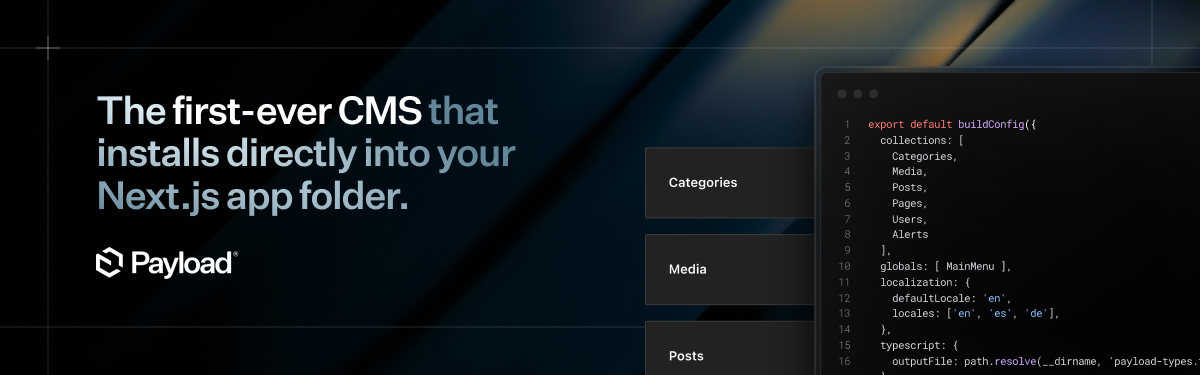
Payload is the first-ever Next.js native CMS that can install directly in your existing /app folder. It's the start of a new era for headless CMS.
Benefits over a regular CMS
- Deploy anywhere, including serverless on Vercel for free
- Combine your front+backend in the same
/appfolder if you want - Don't sign up for yet another SaaS - Payload is open source
- Query your database in React Server Components
- Both admin and backend are 100% extensible
- No vendor lock-in
- Never touch ancient WP code again
- Build faster, never hit a roadblock
Quickstart
Before beginning to work with Payload, make sure you have all of the required software.
pnpx create-payload-app@latest
If you're new to Payload, you should start with the website template (pnpx create-payload-app@latest -t website). It shows how to do everything - including custom Rich Text blocks, on-demand revalidation, live preview, and more. It comes with a frontend built with Tailwind all in one /app folder.
One-click templates
Jumpstart your next project by starting with a pre-made template. These are production-ready, end-to-end solutions designed to get you to market as fast as possible.
🌐 Website
Build any kind of website, blog, or portfolio from small to enterprise. Comes with a fully functional front-end built with RSCs and Tailwind.
We're constantly adding more templates to our Templates Directory. If you maintain your own template, consider adding the payload-template topic to your GitHub repository for others to find.
✨ Features
- Completely free and open-source
- Next.js native, built to run inside your
/appfolder - Use server components to extend Payload UI
- Query your database directly in server components, no need for REST / GraphQL
- Fully TypeScript with automatic types for your data
- Auth out of the box
- Versions and drafts
- Localization
- Block-based layout builder
- Customizable React admin
- Lexical rich text editor
- Conditional field logic
- Extremely granular Access Control
- Document and field-level hooks for every action Payload provides
- Intensely fast API
- Highly secure thanks to HTTP-only cookies, CSRF protection, and more
🗒️ Documentation
Check out the Payload website to find in-depth documentation for everything that Payload offers.
Migrating from v2 to v3? Check out the 3.0 Migration Guide on how to do it.
🙋 Contributing
If you want to add contributions to this repository, please follow the instructions in contributing.md.
📚 Examples
The Examples Directory is a great resource for learning how to setup Payload in a variety of different ways, but you can also find great examples in our blog and throughout our social media.
If you'd like to run the examples, you can either copy them to a folder outside this repo or run them directly by (1) navigating to the example's subfolder (cd examples/your-example-folder) and (2) using the --ignore-workspace flag to bypass workspace restrictions (e.g., pnpm --ignore-workspace install or pnpm --ignore-workspace dev).
You can see more examples at:
🔌 Plugins
Payload is highly extensible and allows you to install or distribute plugins that add or remove functionality. There are both officially-supported and community-supported plugins available. If you maintain your own plugin, consider adding the payload-plugin topic to your GitHub repository for others to find.
🚨 Need help?
There are lots of good conversations and resources in our Github Discussions board and our Discord Server. If you're struggling with something, chances are, someone's already solved what you're up against. 👇
⭐ Like what we're doing? Give us a star